
How to Care for Hoya Parasitica Variegata in Hong Kong | Plantjai

Plantjai 植仔 · Care Encyclopedia
Hoya Parasitica Variegata
Hoya parasitica variegata 寄生內錦毬蘭
Hong Kong care guide — useful before you buy and after it arrives.
Shop this plantCentrally-variegated leaves as mottled as a painting, weaving green and white together, with flowers in a striking bright red — every leaf is a one-of-a-kind work of art, and when it flowers, it steals the show.
Origin & characteristics
- Native range: Southeast Asian tropical rainforest (Thailand, Malaysia, and Indonesia)
- Growth habit: a vigorous, fast-growing climbing vine, with vines exceeding 2 metres
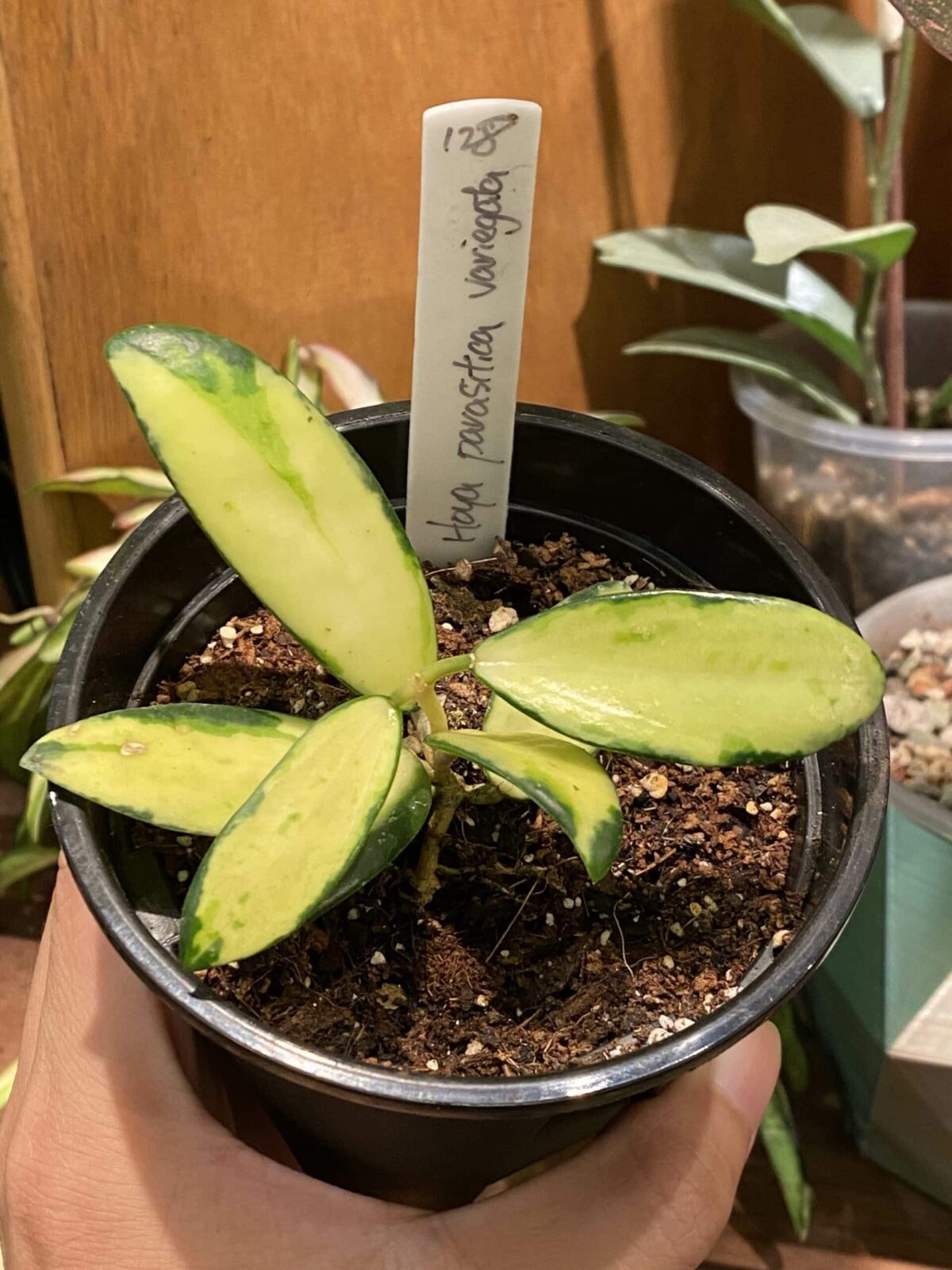
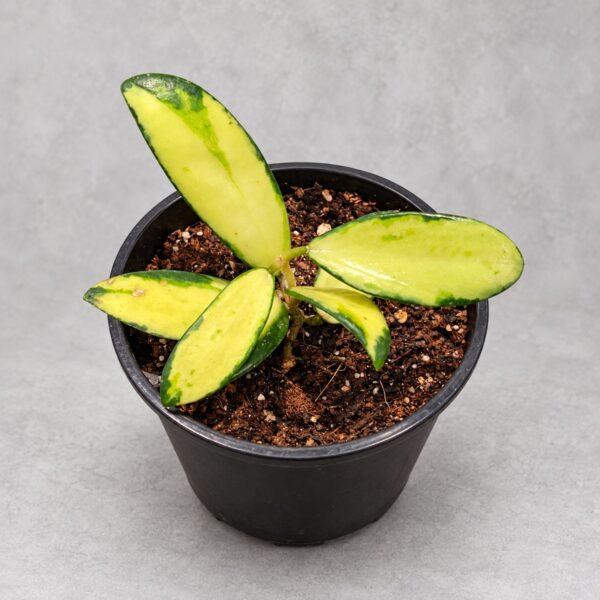
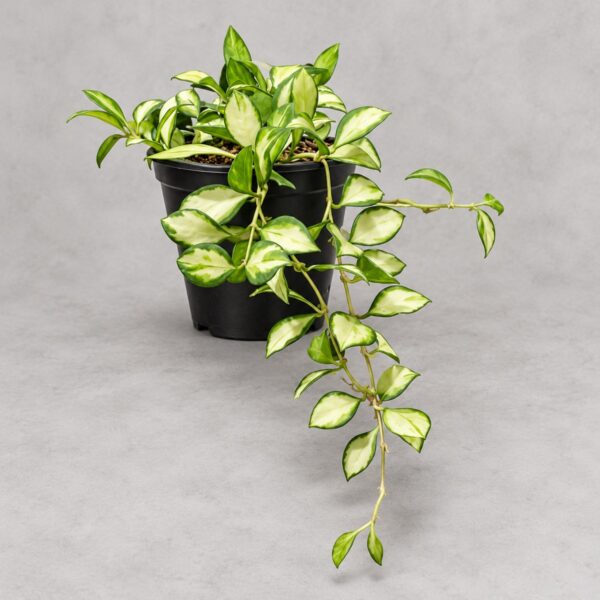
- Leaf characteristics: oval, thick, succulent leaves; the central variegation appears as a green base with creamy-white to golden-yellow patches, with each leaf's variegation pattern being completely unique; new leaves often carry a pink hue
- Flowers: large, eye-catching globe-shaped flower clusters with bright red to deep pink star-shaped blooms and a dark-coloured corolla tube at the centre; the flowering period is long and reblooms repeatedly
- Growth rate: fast
- Toxicity: non-toxic to pets — the Hoya genus is listed by the ASPCA as safe for cats and dogs
Plantjai tip: the variegated parasitica is a vigorous, easy-to-flower variegated cultivar, making it an excellent first variegated Hoya for beginners. Its bright red flowers are absolutely eye-catching!
Light
| Item | Recommendation |
|---|---|
| Ideal light | Bright indirect light, filtered light from east-, west-, or south-facing windows |
| Acceptable range | Most indoor spots with a window |
| Light intensity | 1,500–3,000 lux |
| Avoid | Prolonged harsh sun exposure, especially summer midday sun |
- Ample light helps maintain vivid variegation and prevents it from reverting to solid green
- Needs at least 5–6 hours of bright indirect light daily
- The variegated portions are more delicate — avoid moving suddenly from shade into strong light, acclimate gradually
- More direct light is acceptable in winter
Watering
- Frequency: water once the top 3–4 cm of soil dries out, roughly every 7–10 days during the growing season
- Method:
- Test soil moisture with a finger or bamboo skewer
- Water slowly around the rim until it drains from the base
- Let it drain for 10–15 minutes, then discard any runoff from the saucer
- Water quality: room-temperature tap water left to sit, filtered water, or rainwater
- Winter adjustment: reduce to every 10–14 days
- Key principle: fast growth means higher water needs, but still follow the rule of letting it dry before watering
💡 Watering tip: the variegated parasitica grows vigorously and may need more frequent watering in summer; "lifting the pot to feel its weight" is the most accurate gauge — noticeably lighter means it's time to water.
Soil & pot
Soil recipe
As a fast-growing plant, the variegated parasitica needs a breathable mix with adequate nutrients:
| Material | Ratio | Function |
|---|---|---|
| Pine bark (medium grade) | 35% | Aeration and drainage |
| Perlite | 20% | Improves drainage |
| Coco coir | 20% | Retains moisture and nutrients |
| Succulent soil | 20% | Basic structure and nutrients |
| Bamboo charcoal chips | 5% | Inhibits bacteria and pests |
- A dedicated Plantjai Hoya mix can also be used directly
- Given its faster growth, apply slow-release fertiliser each spring or half-strength liquid fertiliser monthly
Pot choice
- Material: plastic (moisture-retentive, suited to dry environments) or terracotta (breathable, suited to humid environments)
- Size: can be slightly larger than for other Hoya species, given its faster growth rate
- Drainage: drainage holes at the base are essential
- When to repot: roughly once a year, or once roots fill the base of the pot
Climbing support
- A vigorous climber — provide a moss pole, trellis, or hanging basket
- Also looks stunning as a hanging plant, with vines trailing naturally and elegantly
Temperature & humidity
| Item | Ideal range | Acceptable range |
|---|---|---|
| Temperature | 18–29°C | 15–32°C |
| Winter minimum | — | 12°C (never prolonged below 10°C) |
| Humidity | 50–70% | 40–70% |
- Highly adaptable, generally settling into Hong Kong indoor conditions with ease
- Higher humidity helps the variegated leaves stay vivid and supports smoother new growth
- Keep away from direct AC airflow and cold window drafts in winter
- Use a humidifier or pebble tray to help if the air is dry
Common problems
1. Variegation fading, reverting to solid green
- Cause: insufficient light, causing the plant to reduce variegation to boost chlorophyll
- Fix: gradually move to a brighter spot — variegation may reappear
2. Small new leaves, elongated internodes
- Cause: severe light deficiency
- Fix: increase light immediately, and prune overly long stems to reshape the plant
3. Variegated portions turning brown and scorched
- Cause: sunburn on the variegated areas from excessive light, or humidity too low
- Fix: move to a gentler light position, raise ambient humidity
4. Won't flower
- Cause: insufficient light, immature plant, or lack of temperature differential stimulation
- Fix: ensure adequate light, create a 5–10°C day-night temperature differential in autumn/winter
5. Leggy, sprawling growth
- Cause: fast growth without pruning
- Fix: prune overly long stems in spring — cuttings can be propagated for more plants
6. Scale insects or whitefly
- Cause: poor ventilation, or introduced with a new plant
- Fix: wipe with a 70% alcohol-soaked cotton swab, regularly check leaf undersides and stem joints
How to explain to customers
"The variegated parasitica Hoya is a real eye-catcher — every leaf has a different green-and-white pattern, as beautiful as a painting. It grows fast and strong, perfect for a Hoya beginner wanting to try a variegated variety. The best surprise is when it flowers — bright red star-shaped blooms in clusters, so striking! It's easy to care for: keep it in bright indirect light, water thoroughly once dry, and give it a bit of liquid fertiliser during its fast summer growth. Just remember not to expose the variegated parts to harsh sun — let it acclimate gradually to stronger light. If you want it to climb, give it a support; if you want it to trail, place it somewhere high and let it cascade down — both look lovely."
Quick reference for customer questions
| Customer asks | How to answer |
|---|---|
| "Why is it called 'parasitica'? Is it actually parasitic?" | "It grows epiphytically on large trees in the wild, which looks a bit like parasitism, but it's actually an epiphyte and doesn't harm the host tree." |
| "Will the variegation disappear?" | "If there isn't enough light, it might revert to green — just move it somewhere brighter and it'll come back." |
| "How long until it flowers?" | "It flowers fairly easily once mature — the red flower clusters are eye-catching, and it reblooms from the same peduncle." |
| "Does it grow fast?" | "Yes, fairly fast — it can grow several dozen centimetres a year, so leave room for it or prune regularly." |
| "Is it safe for pets?" | "Yes, safe — the entire Hoya genus is ASPCA-certified non-toxic for cats and dogs." |
| "Why do some parts of the leaf look brownish?" | "The variegated parts are more delicate — it might be too much light or humidity too low. Try adjusting the position and humidity." |
Fun facts
- Decoding the name: "parasitica" comes from its epiphytic growth habit on trees — early botanists mistook it for a parasitic plant, hence the name
- Central vs. marginal variegation: "central variegation" refers to patterning distributed in the middle of the leaf, while "marginal variegation" appears at the edges; the variegated parasitica's mottled distribution makes every leaf unique
- A red flower surprise: most Hoyas bloom in white or pale pink, making the variegated parasitica's bright red flowers remarkably rare and eye-catching
- Impressive vigour: it's one of the fastest-growing Hoya species, capable of growing over 50 cm a year with proper care
- Passing on the mother plant: thanks to its fast growth and ease of propagation, many Hoya enthusiasts propagate multiple offspring from a single mother plant to share with friends
Keywords
Hoya parasitica variegata, variegated parasitica Hoya, central variegation Hoya, variegated Hoya, red-flowered Hoya, epiphyte, climbing plant, fast-growing Hoya, foliage plant, flowering plant, indoor plant, pet-safe plant, non-toxic plant, native to Southeast Asia, Plantjai, dedicated Hoya soil, bright indirect light, water thoroughly when dry, variegation care, preventing reversion, hanging plant, climbing vine, bright red flowers, beginner-friendly Hoya
參考資料(想知來源可展開)
References
- Royal Botanic Gardens, Kew — Plants of the World Online: Hoya parasitica, https://powo.science.kew.org/
- ASPCA — Toxic and Non-Toxic Plant List, https://www.aspca.org/pet-care/animal-poison-control/toxic-and-non-toxic-plants
⚠️ Non-toxic to cats and dogs; sap may cause mild skin irritation in sensitive individuals.
Plantjai · Causeway Bay collector indoor plants · WhatsApp +852 66807550
Plantjai shop · In stock online
Hoya parasitica variegata
HK$128.00
Hong Kong delivery · Causeway Bay pickup
For Hong Kong homes and offices. Stock and pricing follow the product page.
IN STORE NOW
Plants for this guide
Related plants in stock now — live prices, delivery or Causeway Bay pickup.
FREE PLANT ADVICE
Send us a photo before you change anything
WhatsApp a photo of the plant and your window light. Our Causeway Bay team will suggest care steps or plants that suit your space.
STORE · CAUSEWAY BAY
4/F, 39 Yiu Wa Street, Causeway Bay
Daily 12:30–8:00pm · ~3 min walk from Times Square
Map & directionsPlant Care