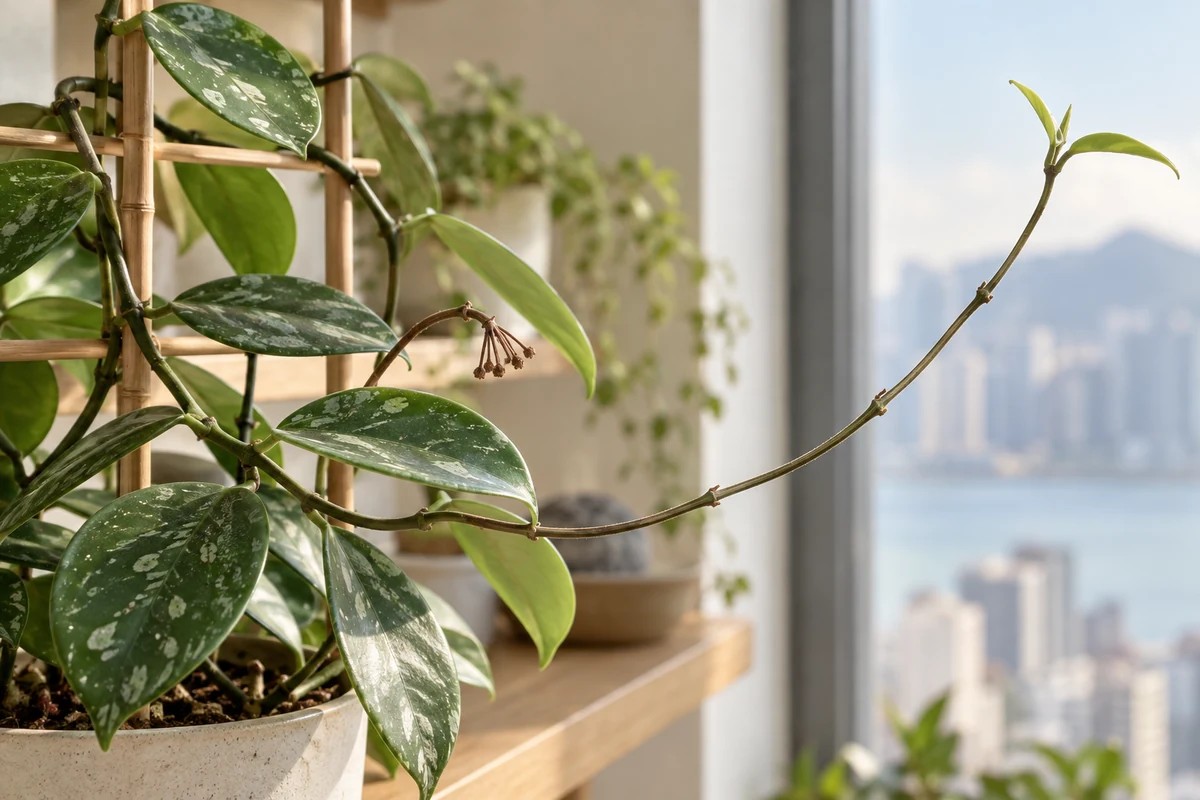
A long bare hoya vine: new growth, dead stem or old flower spur?

In this guide (9)
- 01Trace nodes and the growing end
- 02Choose retention, training or removal
- 03Train without forcing tight bends
- 04For flowering, review conditions before adding feed
- 05When one pot has two kinds of leafless structure
- 06Photograph the spurs instead of pruning by calendar
- 07Sources and scope
- 08Further reading
- 09Related Plantjai plants
Updated: 2026-09-08
Do not cut a long, sparsely leafed hoya vine simply because it looks untidy. Living extension growth, a fully dead section and a short previously flowering spur need different decisions. Many hoyas can flower again from retained spurs. Let stem condition and available space guide pruning rather than leaflessness alone.
Trace nodes and the growing end
Follow the stem from a leafy section to its tip, checking firmness, continuity of colour and small buds or leaf traces at nodes. Some hoyas extend initially sparsely leafed stems before leaves develop, as described for Hoya waymaniae in a cultivation journal; this does not establish a common leafing rate for every species, but length and leaflessness alone do not prove normal growth. A section that progressively shrivels, becomes brittle, or turns black and soft needs a different investigation.
An old flower spur is usually a short structure that previously carried the flower cluster and may retain marks from repeated flowering. Not every small projection is a spur. Photographs taken during flowering are the best reference for recognising it afterwards. If you cannot identify the structure on an unfamiliar hoya, postpone cutting.
Reference: Mark Randal — Hoya waymaniae, Stemma 1(1), 2007, p.4 · Colorado State Extension — Tri-color Wax Plant, Hoya carnosa
Choose retention, training or removal
| Stem condition | Possible action | Avoid |
|---|---|---|
| Firm stem with an extending tip | Retain and provide an accessible support | Removing it only because it lacks leaves for now |
| A known previously flowering spur | Keep it and record its position | Removing the whole spur as spent flowers |
| A confirmed dry, brittle, dead end | Trim conservatively after locating healthy tissue | Continuing into a large length of healthy vine |
| Expanding black, wet or soft tissue | Separate and assess rot or other injury | Hiding a soft stem against a support |
Hoyas differ in growth rhythm, and no individual spur is guaranteed to bloom again. Retaining it preserves an opportunity, not a flowering date.
Train without forcing tight bends
Choose a loop or trellis that supports the vine while leaving inspection access. Guide it gently along its existing direction with loose soft ties. Do not force a mature, stiff vine into a tight bend for a perfect circle. Avoid clipping the tender tip or trapping a flower spur between stem and support.
A high hanging position is not automatically practical. Test whether you can see the medium, drain the pot after watering and inspect undersides. Curled hoya leaves hide their axils particularly well; an overly dense support makes later pest checks harder.
Reference: RHS — How to grow hoya
For flowering, review conditions before adding feed
Long vines without flowers do not establish a deficiency in a particular bloom nutrient. Maturity, light, species and condition all influence flowering. Review a persistently dark position, repeated environmental changes, an overly wet root zone and removal of old spurs before assuming more nutrients are needed.
When buds are present, avoid unnecessary relocation or twisting of vines, and do not impose extreme drought to force flowers. Hoyas have different moisture needs, and thick leaves do not guarantee tolerance of prolonged neglect. Flowering is a possible result of sustainable care, not a promise obtained by suddenly increasing fertiliser.
When one pot has two kinds of leafless structure
Suppose a plant has a long outward-growing vine and a short thick projection near an old leaf axil. The vine tip is still changing, while a previous flowering photograph shows that the short projection carried flowers. Train the long vine and retain the short spur; there is no need to cut both for tidiness.
If the vine exceeds the available space, a planned light trim is still an option. Choose a healthy, clearly identified node area, retain adequate healthy foliage, use clean tools and avoid contact with sap. The point is not that no vine may ever be cut, but that each cut should have an understood consequence.
Photograph the spurs instead of pruning by calendar
For each flowering event, take one photograph of the whole branch and one close-up of the spur, with date and position. After flowers fade, you have a reference instead of guessing whether a brown projection is a dead twig or flower spur. Mark the photograph rather than tying a tight label around a tender stem.
Later, watch shoot extension, leaf development and any renewed spur activity. If nothing changes, assess the whole plant rather than squeezing or peeling the structure daily. Avoiding a mistaken cut can be more useful than another supposed flowering treatment.
Sources and scope
- RHS — How to grow hoya — Hoya supports, light pruning and flowering structures. Species differ; no flowering date is promised.
- Colorado State Extension — Tri-color Wax Plant, Hoya carnosa — Retained Hoya carnosa spurs can flower again. No transfer of hardiness numbers, feeding intervals or guaranteed repeat flowering.
- Mark Randal — Hoya waymaniae, Stemma 1(1), 2007, p.4 — The author describes initially leafless extension growth in Hoya waymaniae. A specialist cultivation account of one species, not a growth-rate or leafing guarantee for all hoyas.
Further reading
Related Plantjai plants
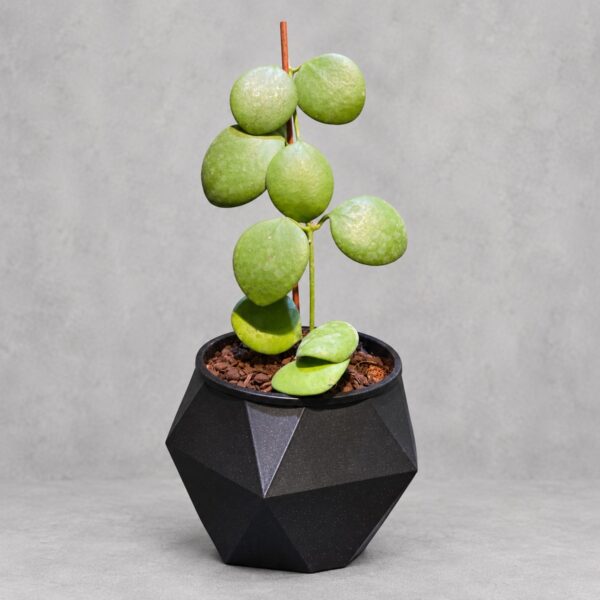
- Hoya obovata albomarginata
Its thick rounded leaves and vines suit careful training observations. Give bright indirect light and drainage rather than drought or extra fertiliser to force flowers.
- Hoya compacta
Curled foliage can conceal nodes and axils, so inspect carefully before cutting. Do not force the curls open, and check their folds for pests.
IN STORE NOW
Plants for this guide
Related plants in stock now — live prices, delivery or Causeway Bay pickup.
FREE PLANT ADVICE
Send us a photo before you change anything
WhatsApp a photo of the plant and your window light. Our Causeway Bay team will suggest care steps or plants that suit your space.
STORE · CAUSEWAY BAY
4/F, 39 Yiu Wa Street, Causeway Bay
Daily 12:30–8:00pm · ~3 min walk from Times Square
Map & directionsPlant Care