At the top of the moss pole: extend, replace or prune?

In this guide (9)
- 01Map the stem, petioles and attached roots
- 02Match the option to the constraint
- 03Protect the existing attachment during extension
- 04Assess pole moisture separately from pot moisture
- 05Example: an extension you cannot maintain
- 06Judge stability and subsequent growth
- 07Sources and scope
- 08Further reading
- 09Related Plantjai plants
Updated: 2026-09-08
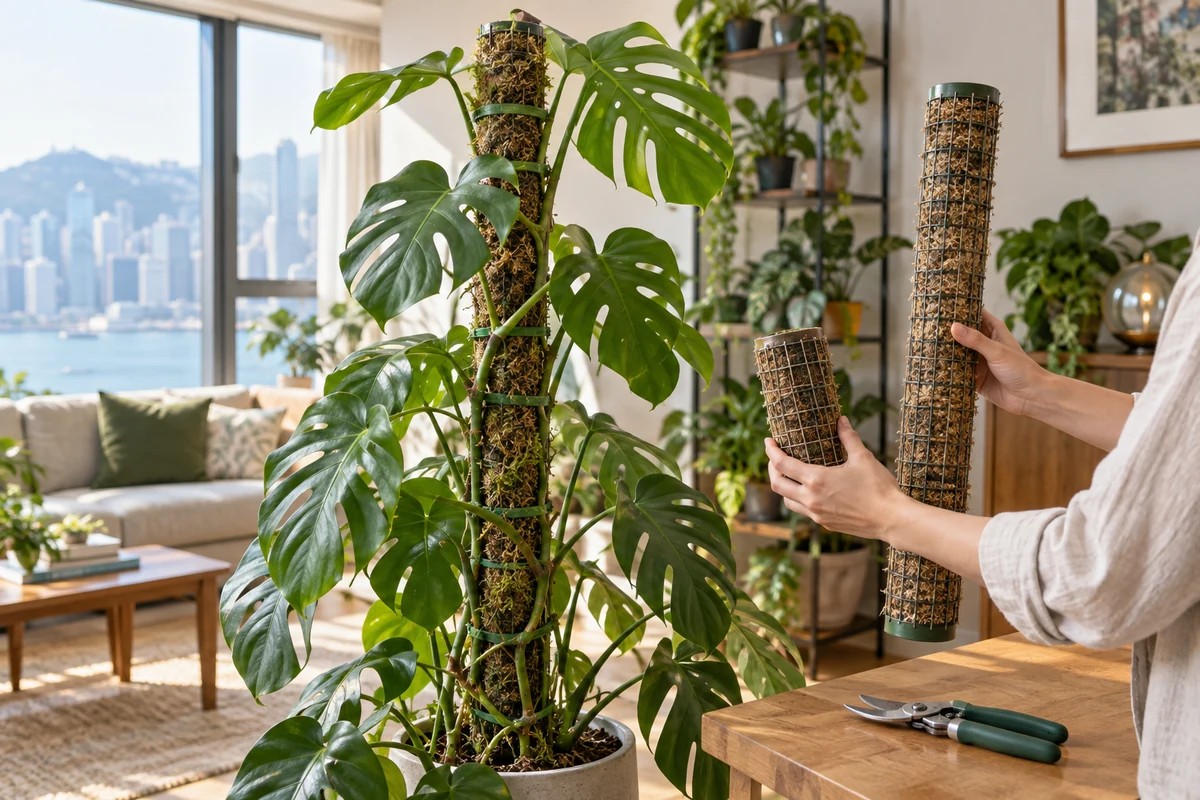
When a plant reaches the top of its pole, check the base, the pole’s extension design and where roots are attached. Extend only if the base is stable and the system supports it. An independent support or suitable pruning may be better when the base is loose or space is exhausted. Do not tear out established roots merely to fit a new pole.
Map the stem, petioles and attached roots
Trace a leaf back to its petiole, then locate the continuous stem with nodes, leaves and roots. Support the stem rather than cinching several petioles tightly against the pole. Leave room for emerging foliage and keep ties clear of the growing point.
Photograph the front, back and pot surface and note where roots are visibly attached. You do not need to dismantle the moss to inspect every root; identify the places that could tear if pulled apart. Once plant and pole are joined, support them as a single unit while working.
Reference: RHS — How to grow Swiss cheese plants
Match the option to the constraint
| Situation | First option | Check first |
|---|---|---|
| Stable pole, designed connector and headroom | Extend as intended | Wet weight and connection stability |
| Usable old pole that should not carry more load | Add an appropriate independent support | No pulling on attached roots or increased tipping risk |
| The plant has outgrown the usable space | Plan pruning or relocation | Nodes, health and the resulting plant form |
More height is not automatically better. A pole near a ceiling, lamp or air outlet may fit another section while leaving no usable space for the next leaf.
Protect the existing attachment during extension
Clear nearby plants, stabilise the existing pole and then work on its connector. If a second person is needed, do not balance the plant in one hand while forcing the connection with the other. Follow the support’s design rather than compensating for a loose joint with thin wire around tender stems.
Prepare the new moss section so it is appropriately moist and can drain excess water. Use a soft tie with room for growth to guide the stem towards it, keeping pressure off root tips. Where old roots pass through mesh, do not pull them free just to straighten the display. Some asymmetry is usually easier to manage than extensive root damage.
Assess pole moisture separately from pot moisture
The pole top may dry while the bottom of the pot is still wet. Before watering the extension, decide where runoff will go. Rewetting one new section should not automatically soak the entire pot again. Small sectional applications with runoff collection may help, depending on the support’s design and your access.
A dry outer surface does not necessarily mean the core is dry. Moss density, diameter and airflow change water retention. Make modest adjustments and record the new section’s moisture alongside pot weight rather than imposing three sprays a day. A tall support without safe access for collecting runoff becomes increasingly difficult to maintain.
Example: an extension you cannot maintain
Suppose the old pole top was at chest level but the extension can only be watered while standing on a chair. The display may look impressive, yet the change adds fall and spill risks. Use an empty section or a paper measure to test the height and watering-can access first. If access fails, choose a lower support or another position.
In a different case, the pole is stable but an emerging leaf will touch a curtain. Moving the pot away from the curtain may solve the problem without cutting the top. Target the actual constraint to preserve established roots and leaves.
Judge stability and subsequent growth
Check immediately for wobble, leaning and pressure marks from ties. Later, monitor unfolding leaves and new root contact, loosening ties as stems expand. A moss pole provides attachment and support, while leaf maturity also depends on age, light and overall growing conditions.
If pruning is the chosen route, plan which stem and nodes to retain separately; a failed extension attempt is not a reason for improvised cutting. Existing leaf size does not guarantee equally large regrowth after pruning. Prioritise a plant form that can be maintained.
Reference: RHS — How to grow philodendrons
Sources and scope
- RHS — How to grow Swiss cheese plants — Climbing growth, support and maintenance. Extension and load decisions depend on the support; larger leaves are not guaranteed.
- RHS — How to grow philodendrons — Support, pruning and propagation of climbing forms. Not all philodendrons climb; regrowth form is not guaranteed.
Further reading
Related Plantjai plants
- Monstera deliciosa
A climbing monstera can be supported along its stem. Allow for its mature form; a moss pole does not replace sufficient light.
- Philodendron melanochrysum
Its climbing stem suits a maintained support. Protect velvet foliage, tender growth and attached roots during any extension.
- Epipremnum pinnatum 'Cebu Blue'
Useful for comparing a climbing display with a trailing one. A pole needs stability and access for watering; larger leaves are not an immediate guarantee.
IN STORE NOW
Plants for this guide
Related plants in stock now — live prices, delivery or Causeway Bay pickup.
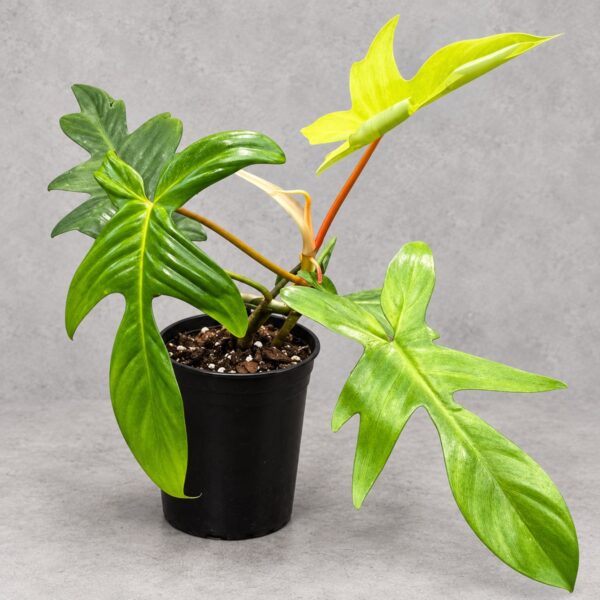
Philodendron 'Florida Ghost'
Philodendron 'Florida Ghost'
from HK$118.00
In stock · store pickup
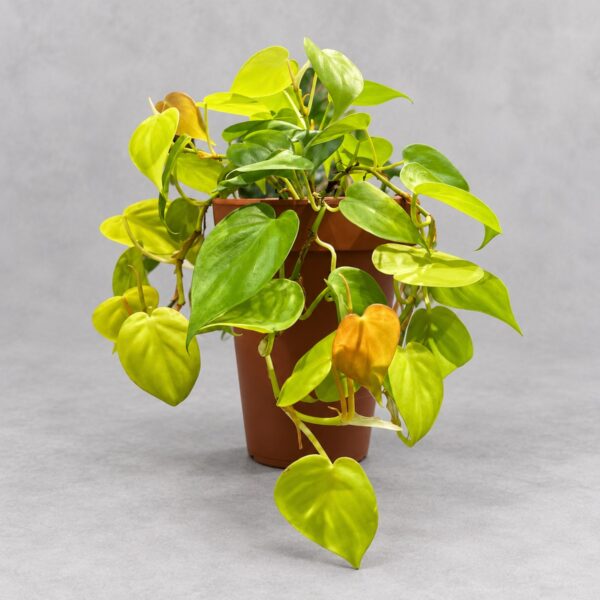
View plantPhilodendron hederaceum 'Lemon Lime'
Philodendron hederaceum 'Lemon Lime'
HK$198.00
In stock · store pickup
View plant
FREE PLANT ADVICE
Send us a photo before you change anything
WhatsApp a photo of the plant and your window light. Our Causeway Bay team will suggest care steps or plants that suit your space.
STORE · CAUSEWAY BAY
4/F, 39 Yiu Wa Street, Causeway Bay
Daily 12:30–8:00pm · ~3 min walk from Times Square
Map & directionsPlant Care