
Is the new leaf really larger? Taking comparable plant-growth photos

In this guide (9)
- 01Choose the question before taking the picture
- 02Build a baseline without specialist equipment
- 03Let new leaves finish developing
- 04A compact record you can use
- 05Growth does not identify its cause
- 06Use the record to make the next small decision
- 07Sources and scope
- 08Further reading
- 09Related Plantjai plants
Updated: 2026-09-08
Compare the same plant at similar leaf maturity, using a consistent angle and scale reference. An unfolding leaf is not directly comparable with a mature one, and close-up perspective, wide-angle lenses and lighting can alter apparent size or colour. Photographs document trends; one before-and-after pair cannot establish that a fertiliser, lamp or medium caused them.
Choose the question before taking the picture
“Is the plant improving?” is too broad. Ask whether the next mature leaf is longer, whether a particular lesion is expanding, or whether internodes keep lengthening after relocation. Choose one or two observations so the photographs stay consistent rather than combining leaf count, colour, pattern and height into a score.
Different questions need different views. Overall posture requires a whole-plant image; leaf dimensions need a face-on view and scale; a lesion needs a close-up plus its location. A beautiful isolated leaf portrait may omit the pot, stem base and light source, leaving little context for later interpretation.
Build a baseline without specialist equipment
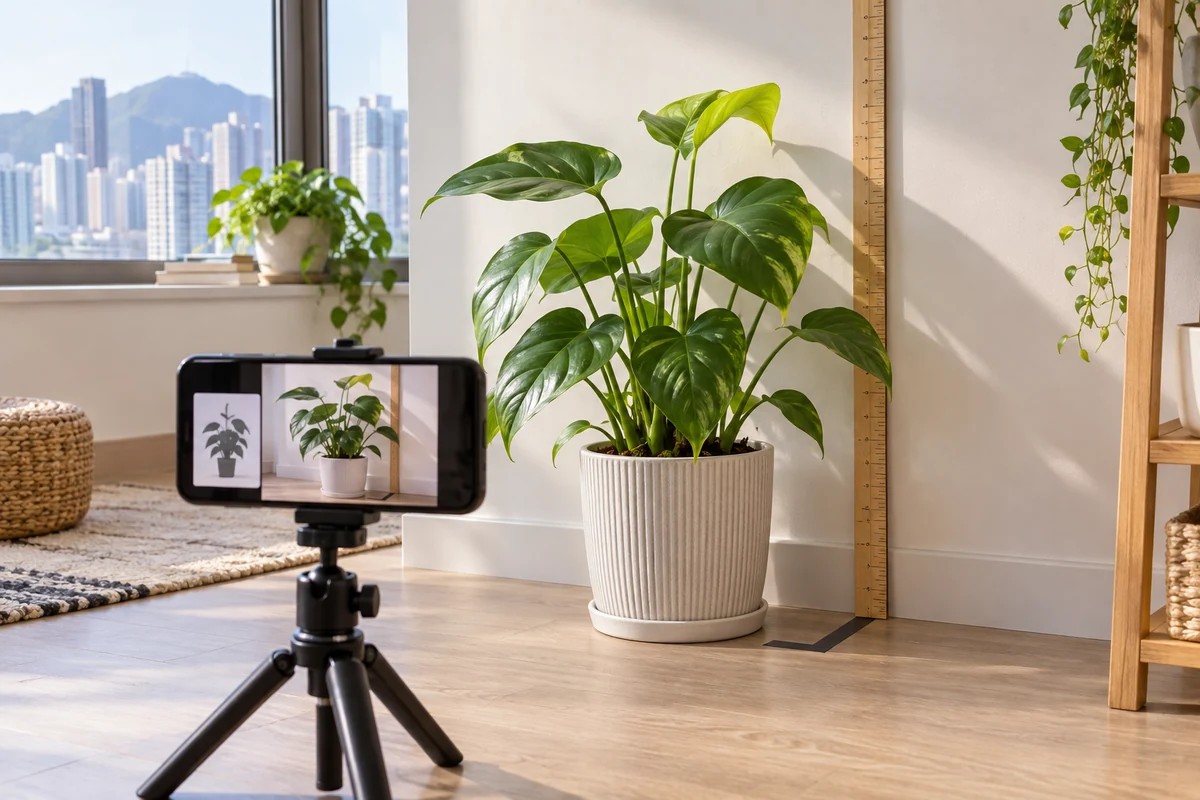
Choose a safe repeatable position and mark the pot location on the table or floor. Use the same phone lens at roughly the same distance. Do not compare the fraction of a frame filled by a leaf photographed close with an ultra-wide lens and later from far away with zoom. A plain, non-reflective background is sufficient.
Place the ruler beside the leaf in approximately the same plane, not behind it while the leaf projects forwards. For a naturally curved leaf, record whether the measurement is straight-line distance or follows the curve, then use the same method later. Flattening a tender leaf for a neat measurement defeats the purpose.
Reference: Iowa State Plant and Insect Diagnostic Clinic — Photography · Alabama Cooperative Extension — Photo Submission Guide
Let new leaves finish developing
Size, colour and texture continue changing after a new leaf first appears. Record stages such as emergence, unfolding and relative stability without imposing one maturity interval on every species. Use the plant’s own sequence to judge when obvious expansion and colour change have slowed before comparing equivalent leaves.
A three-day-old leaf compared with a completed older leaf may appear to have shrunk in size between generations. Bringing a new leaf closer to the lens can create the opposite impression. Align maturity and camera position before interpreting numbers. Mark missing measurements as unmeasured rather than estimating decimal precision from perspective photographs.
A compact record you can use
| Field | What to write | Purpose |
|---|---|---|
| Plant and leaf ID | A01 / fourth new leaf | Avoid mixing plants or leaves |
| Date and stage | First emergence, unfolded, stable | Account for leaf age |
| Measurement method | Straight-line length, maximum width | Keep comparisons consistent |
| Environmental changes | Dates of relocation, lighting or repotting | Preserve the sequence |
| Images | Whole plant, face-on leaf, necessary details | Retain context |
A simple spreadsheet or album caption is enough. Date and plant ID make a useful filename; there is no need to recopy the complete care history each time.
Growth does not identify its cause
Suppose the leaf following a lamp change is larger, while the weather also warms and the plant develops more roots. You can accurately record “greater leaf length observed after the lamp change,” but cannot exclude temperature, roots or natural maturation. To compare care approaches, avoid changing many conditions together and do not present one plant as a universal result.
Colour needs additional caution. Automatic white balance and exposure can deepen green or intensify pink. Keep original images without beautifying filters. Even a consistent lamp does not make a phone photograph a precise colour measurement, and natural changes in pattern percentage are not proof of successful feeding.
Use the record to make the next small decision
Repeated images showing smaller new leaves and longer internodes can prompt a review of light and root conditions. A single apparently smaller leaf calls first for a maturity check. An expanding lesion deserves attention immediately rather than waiting for a scheduled photography day.
The record reduces reliance on memory and preserves comparable information. It need not become a growth competition. Detecting problems earlier and avoiding unnecessary moves or feeding are practical benefits in their own right.
Sources and scope
- Iowa State Plant and Insect Diagnostic Clinic — Photography — Whole-plant views, details, clarity and scale. Leaf IDs and comparison tables are original recordkeeping suggestions, not controlled experiments.
- Alabama Cooperative Extension — Photo Submission Guide — Diagnostic photographs preserving the affected area and its context. Phone images are not precise colour or causal measurements.
Further reading
- From Plant Parent to Collector: Building a Meaningful Foliage Plant Collection
- Plant classification and selection
Related Plantjai plants
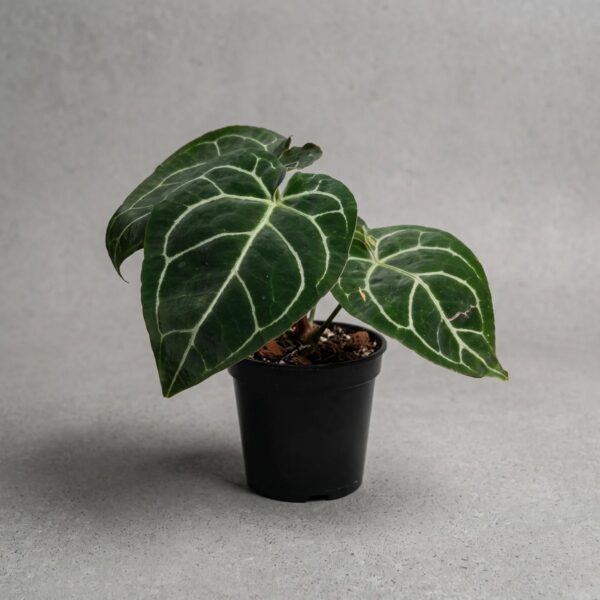
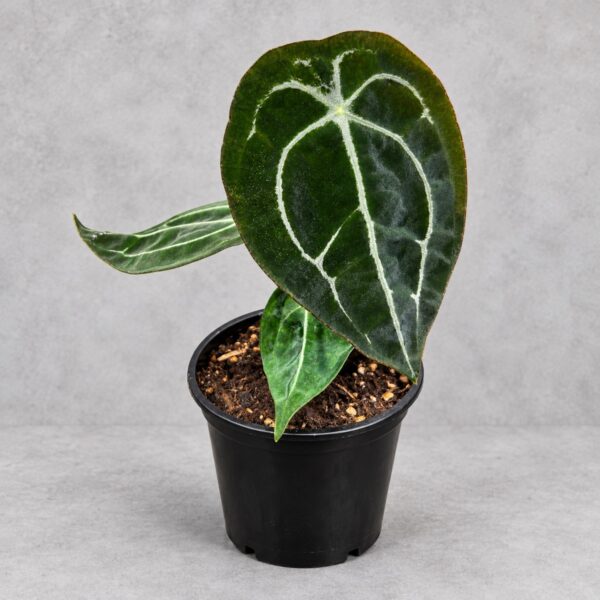
- Anthurium crystallinum
Distinct veins make mature leaf shape easy to compare. Velvet reflections change with angle, so avoid flash and filters that create a false contrast.
- Philodendron 'Pink Princess'
Record leaf size separately from pink patterning instead of combining them into one score. Natural variation remains, and photographs cannot predict future colour.
IN STORE NOW
Plants for this guide
Related plants in stock now — live prices, delivery or Causeway Bay pickup.
Anthurium crystallinum
Anthurium crystallinum
Original price was: HK$780.00.HK$380.00Current price is: HK$380.00.
In stock · store pickup
View plantAnthurium morona
Anthurium morona
Original price was: HK$4,680.00.HK$1,980.00Current price is: HK$1,980.00.
In stock · store pickup
View plant
FREE PLANT ADVICE
Send us a photo before you change anything
WhatsApp a photo of the plant and your window light. Our Causeway Bay team will suggest care steps or plants that suit your space.
STORE · CAUSEWAY BAY
4/F, 39 Yiu Wa Street, Causeway Bay
Daily 12:30–8:00pm · ~3 min walk from Times Square
Map & directionsPlant Care