
How to Care for Kalanchoe Beharensis in Hong Kong | Plantjai

Hong Kong care guide for Kalanchoe Beharensis.
Giant silvery-green fuzzy leaves with an otherworldly quality — a single specimen can carry an entire room as a statement piece.
Origin & characteristics
Kalanchoe beharensis (also known as Felt Bush or Elephant Ear Kalanchoe) is native to arid regions of southern Madagascar and belongs to a perennial succulent shrub in the family Crassulaceae, genus Kalanchoe. It can grow to 3-5 metres in the wild, though indoor potted specimens are usually kept at 30-120 cm. Its most distinctive feature is its enormous silvery-green triangular leaves, covered in a thick layer of brown fuzz, with serrated or wavy edges and a darker underside — giving it an elegant, distinctive form reminiscent of a dancing fairy's flowing gown, hence its name. The stem becomes woody and thickens at the base over time, developing a tree-like form. It can produce small pale yellow or green flowers in autumn and winter, though it flowers less often indoors.
Toxicity note: Kalanchoe beharensis contains cardiac glycosides and is fairly toxic — ingestion can cause vomiting, diarrhoea, and abnormal heart rhythm, and can be fatal in severe cases. Contact with the sap may also cause skin sensitivity. It must be kept completely out of reach of pets and children; wear gloves when handling and wash your hands thoroughly afterward.
Light
Kalanchoe beharensis loves abundant sunlight and is a full-sun plant. Indoors, it's best placed near a south-facing window, receiving at least 6 hours of direct or strong indirect light daily. With ample light, the leaf fuzz becomes thicker, the silvery-green colour more vivid, and the plant's overall form more compact and elegant.
Note: prolonged placement in a dim spot causes leaves to thin, elongate, and lose their fuzzy sheen, with internodes stretching out and the overall form becoming loose and unattractive. When moving it from indoors to outdoors in summer, acclimate it gradually to avoid sudden sunburn.
Watering
As a succulent, Kalanchoe beharensis is extremely drought-tolerant and fears standing water and root rot above all else. Follow the "better dry than wet" principle — during the spring/summer growing season, water thoroughly once the soil is completely dry, roughly every 7-10 days; during autumn/winter dormancy, water significantly less, once every 10-14 days or even longer.
Tip: slightly wrinkled, softening leaves signal thirst. When watering, pour directly onto the soil, avoiding pooling at the leaf centre or on the fuzz, since residual moisture there easily causes rot. In winter, try to water around midday, with water temperature close to room temperature.
Soil & pot
Must use an extremely fast-draining, dedicated succulent soil with a high proportion of coarse particles. Recommended recipe: Akadama soil + Kanuma soil + perlite + a little peat (roughly 3:3:3:1), or use commercial succulent soil mixed with an additional half-portion of coarse particles. Choose a terracotta or cement pot with drainage holes — drainage performance is the top priority.
Note: don't use a pot without drainage holes just for aesthetics — standing water will definitely cause root rot. When repotting, check root health and trim any dried-out roots; repotting once every 1-2 years is typical. Since it can grow fairly large, leave enough growing space and use a sturdy, large pot.
Temperature & humidity
The ideal growing temperature is 18-30°C. It has strong heat tolerance, withstanding summer temperatures above 35°C, though ventilation should be watched. Its cold tolerance is weaker, with a minimum tolerable temperature of about 10°C — prolonged exposure below 12°C easily causes cold damage, with leaves developing water-soaked spots before turning mushy. If Hong Kong winter temperatures stay below 12°C for extended periods, move the plant indoors for warmth.
There's no special humidity requirement — 30-50% is sufficient, and typical Hong Kong indoor conditions pose no issue at all. Being native to arid regions, excessively high humidity can actually trigger fungal problems, so ensure good ventilation.
Common problems
| Issue | Likely cause | What to do |
|---|---|---|
| Lower leaves yellowing, drying out, and dropping | Natural ageing or overwatering | Normal if it's just lower, older leaves; check roots for rot if drop is extensive |
| Thinner leaves, losing fuzzy sheen | Severe light deficiency | Gradually move closer to a window, increase light exposure time |
| Elongated internodes, loose plant form | Legginess (insufficient light) | Increase light, or prune the tip and take a cutting |
| Water-soaked black spots on leaves, then turning mushy | Cold damage or overwatering | Move to a warm spot, reduce watering; propagate from a healthy cutting if severe |
| White powdery substance on leaves | Mealybugs or scale insects | Wipe each leaf with alcohol-soaked cotton, or spray a dedicated insecticide |
| Whole plant softening and collapsing | Severe root rot | Check roots, trim rot and repot, or take healthy cuttings to propagate |
| Small, deformed new leaf development | Nutrient deficiency or root-bound | Apply diluted liquid fertiliser during the growing season, or consider a larger pot |
How to explain to customers
"This Dancing Fairy Kalanchoe instantly upgrades the whole room the moment you place it down! The leaves are big and fuzzy, with a really rich texture in that silvery-green colour. But remember, it's a succulent, and its biggest fear is you being too generous with water — better to let the leaves wrinkle slightly from dryness before watering than to overdo it. Definitely place it by the brightest window — the more sun it gets, the more beautiful it becomes. Important reminder — this plant is toxic, and not mildly so. If you have cats or dogs, or children at home, keep it completely out of their reach — safety first!"
Fun facts
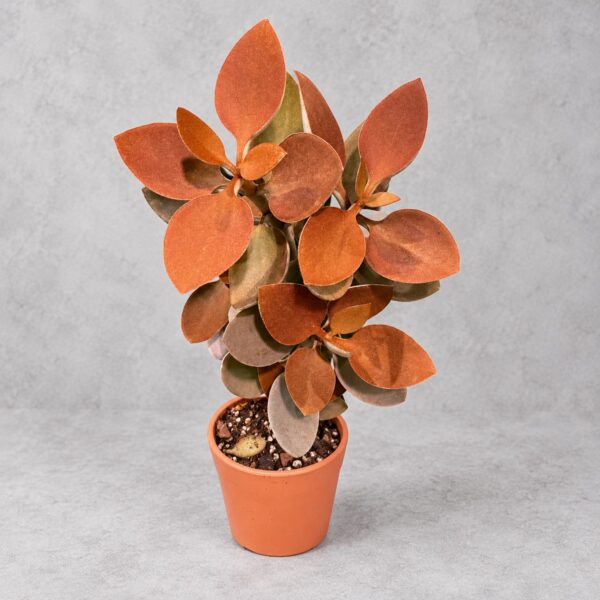
Kalanchoe beharensis's species name "beharensis" refers to the Behara region of Madagascar, where it was first discovered. It's often confused with another common species, Kalanchoe orgyalis (Copper Spoons), but Kalanchoe beharensis has larger, more triangular leaves, with fuzz in a silvery-green rather than copper-red colour.
Additionally, plants in the genus Kalanchoe have a delightful reproductive method called "plantlets" — tiny plantlets grow along the leaf margins, and once mature, they naturally drop off and root themselves, earning many of them the nickname "Mother of Thousands." However, Kalanchoe beharensis primarily propagates through stem or leaf cuttings. Traditionally, people in Madagascar used the sap from its leaves to treat skin ailments, though this is no longer recommended today due to the high toxicity risk.
Keywords
Kalanchoe beharensis, Felt Bush, Elephant Ear Kalanchoe, Crassulaceae, succulent, Madagascar, silvery-green leaves, fuzzy leaves, full sun, drought-tolerant, better dry than wet, toxic plant, pet danger, keep away from children, large succulent, statement piece, indoor decor
參考資料(想知來源可展開)
References
- Missouri Botanical Garden — Plant Finder: Kalanchoe beharensis, https://www.missouribotanicalgarden.org/PlantFinder/PlantFinderDetails.aspx?kempercode=e871
- ASPCA — Toxic and Non-Toxic Plant List, https://www.aspca.org/pet-care/animal-poison-control/toxic-and-non-toxic-plants
⚠️ Contains cardiac glycosides; toxic to pets and humans if ingested, and severe cases can be fatal. Keep completely out of reach of children and pets.
Plantjai · Causeway Bay collector indoor plants · WhatsApp +852 66807550
For Hong Kong homes and offices. Stock and pricing follow the product page.
IN STORE NOW
Plants for this guide
Related plants in stock now — live prices, delivery or Causeway Bay pickup.
FREE PLANT ADVICE
Send us a photo before you change anything
WhatsApp a photo of the plant and your window light. Our Causeway Bay team will suggest care steps or plants that suit your space.
STORE · CAUSEWAY BAY
4/F, 39 Yiu Wa Street, Causeway Bay
Daily 12:30–8:00pm · ~3 min walk from Times Square
Map & directionsPlant Care