
How to Care for Calathea Musaica in Hong Kong | Plantjai


Plantjai 植仔 · Care Encyclopedia
Calathea Musaica
Hong Kong care guide — useful before you buy and after it arrives.
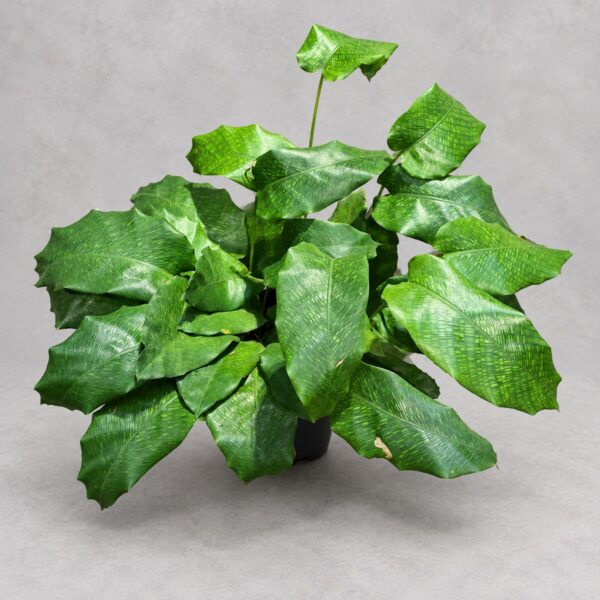
Shop this plantLeaves covered in an exquisite grid pattern — as if hand-crafted from mosaic tile.
Origin & characteristics
Mosaic Calathea is native to the tropical rainforest understory of Central and South America. Recent botanical reclassification places it under the genus Goeppertia (as Goeppertia kegeljanii), though the market still commonly uses Calathea musaica. Its leaf surface is covered in an extraordinarily fine, light-green grid pattern — from a distance it resembles mosaic tiling, while up close the interwoven venation reveals a striking geometric beauty. The leaves have a thin, soft texture, and it's classed as a small-to-medium Calathea.
Light
It enjoys bright, diffused light and tolerates partial shade. Avoid harsh midday direct sun, which fades the leaf pattern. East- or north-facing windows are ideal. Too little light causes new leaves to develop a blurred, indistinct pattern.
Watering
Keep the soil evenly slightly moist, watering once the top 2–3 cm dries out — roughly every 5–7 days, adjusted by season. Like other Calatheas, it's sensitive to water quality; use filtered water, rainwater, or tap water left standing for 24+ hours. Reduce watering slightly in winter.
Soil & pot
Needs organically rich, well-draining, slightly acidic soil. Suggested recipe: quality potting soil mixed with perlite and coco coir (roughly 4:3:3), keeping it loose and airy. Choose a pot with drainage holes to avoid waterlogged, rotting roots.
Temperature & humidity
Optimal temperature is 18–27°C, never below 15°C. It has fairly high humidity requirements, ideally 50–70% or above. Hong Kong summers generally pose no issue, but in the dry autumn/winter season, use a humidifier or humidity tray. Keep away from AC vents when in an air-conditioned room.
Common problems
- Yellowing, dry leaf tips: the most common issue, usually caused by hard water or overly dry air — switch to filtered water and increase humidity
- Drooping leaves: a sign of thirst — water promptly and check root health
- Fading pattern: caused by insufficient light — move to a brighter spot
- Small new leaves: possibly nutrient deficiency or a root-bound pot — consider repotting or supplementing liquid fertiliser
How to explain to customers
"The leaf pattern on this Mosaic Calathea is really something special — the grid-like design is incredibly fine up close, and it gives your home a real sense of taste." "It's easier to grow than White Fusion — just remember to avoid direct sun and keep the humidity up, and you'll have no problems."
Fun facts
The grid pattern on Mosaic Calathea's leaf surface is actually formed by extremely fine interwoven veins — held up to strong light, the pattern becomes translucent, creating a genuinely dreamlike effect!
Keywords
Mosaic Calathea, Calathea musaica, Goeppertia kegeljanii, Calathea, grid pattern, foliage plant, prayer plant, indoor potted plant, tropical plant
In-depth care guide
One-line pitch
Leaves covered in a deep green mosaic pattern as intricate as a digital network — up close, you'd think it was a handcrafted piece of art. One of the most understated yet enduring members of the Calathea family.
Origin & characteristics
Mosaic Calathea's botanical name has undergone one of the most significant taxonomic shifts in recent years. Traditionally classified as Calathea musaica (the species name musaica meaning "mosaic-like," describing its grid-patterned leaf surface), a 2012 molecular phylogenetic study by Borchsenius et al. re-established the genus Goeppertia as distinct, transferring several subgenera previously grouped under Calathea into Goeppertia. As a result, according to the latest botanical classification, Mosaic Calathea's correct name should be Goeppertia kegeljanii (with Calathea musaica now treated as a synonym). The species name kegeljanii honours Ferdinand Kegeljan (c. 1822–1910), president of the Royal Horticultural Society of Namur in Belgium, a distinguished philanthropist and champion of horticulture.
Mosaic Calathea is native to the Brazilian Amazon rainforest understory, growing beneath the forest canopy in warm, humid, low-light conditions. It's a rhizomatous perennial evergreen herb, reaching a mature height and width of roughly 30–60 cm, growing in a clumping habit. Leaves emerge from the tip of the rhizome on long, upright petioles, with a heart-shaped to ovate leaf blade — thick, waxy in texture, with a faint velvety feel to the surface. Its most distinctive feature is of course the leaf pattern — a light green base overlaid with a fine grid of dark green venation, resembling mosaic tile or a digital network, hence its other common name, "Network Prayer Plant."
Like other members of Marantaceae, Mosaic Calathea exhibits nyctinasty: leaves spread horizontally during the day and gradually rise upright after dark, controlled by the pulvinus (a swollen joint) at the base of the petiole. This movement is triggered by a combination of light intensity and temperature change, believed to help reduce nighttime water loss and lower the risk of pathogen exposure. While it can flower, the blooms are small and inconspicuous, greenish-white, with far less ornamental value than the foliage.
It's worth noting that Mosaic Calathea is considered non-toxic to pets, making it one of the few foliage species that can be safely kept in homes with cats and dogs. That said, the plant's sap may cause mild skin irritation on contact, so wearing gloves when pruning or dividing is recommended.
Light / Watering / Soil & pot / Temperature & humidity
Light
Mosaic Calathea needs bright, diffused light, but must never be exposed to direct sunlight — even brief morning direct sun can scorch the leaves. An ideal position is 1–2 metres from an east- or north-facing window, or near a south-/west-facing window with sheer curtains filtering the light.
Too little light (below 1,200 lux for extended periods) causes small new leaves, faded patterning, and elongated petioles; too much light causes fading patterns, bleached patches, and even scorched edges. Aim to maintain 1,500–3,000 lux. You can measure this with a phone light meter app, or simply observe new leaf performance — in a healthy environment, new leaves should fully unfurl within 48 hours, with clear patterning visible within 72 hours.
Watering
Mosaic Calathea needs a consistently moist but never waterlogged soil environment. To judge watering timing: insert a finger or bamboo skewer about 3–4 cm into the soil, and water once it starts to feel dry. In summer this is roughly every 5–7 days, in winter every 7–10 days, depending on ambient humidity and how quickly the soil dries.
On water quality, Mosaic Calathea is fairly sensitive to fluoride, chlorine, and mineral salts in tap water, and long-term use will cause browning leaf tips. Recommendations:
- Use rainwater (ideal)
- Use filtered or distilled water
- If using tap water, let it stand for 24+ hours to allow chlorine to dissipate (note: this doesn't remove minerals — in hard water areas, filtered water is recommended)
Watering technique:
- Pour slowly around the pot's edge until water flows from the base
- Empty the saucer after half an hour
- Keep water temperature around 20–22°C, as overly cold water can shock the roots
Soil & pot
Mosaic Calathea's roots need access to both water and oxygen simultaneously, so soil structure is crucial. Recommended recipe (by volume):
- 40% peat moss or coco coir (retains moisture and maintains slight acidity)
- 30% perlite or vermiculite (increases drainage and aeration)
- 20% orchid bark (provides structure and microbial habitat)
- 10% worm castings (slow-release nutrients)
Alternatively, a simplified version: use a commercial African violet mix, adding roughly 20% perlite to improve drainage.
For pot selection, the only hard requirement is drainage holes. Plastic pots retain more moisture, while terracotta offers better airflow but dries faster. Since Mosaic Calathea's rhizome spreads horizontally, a wide, shallow pot suits it better than a deep, narrow one. Repot once every 2–3 years, ideally in spring, sizing up by only one increment each time.
Temperature & humidity
Mosaic Calathea's optimal growing temperature is 18–24°C, never below 15°C. It's extremely sensitive to sudden temperature swings and cold drafts — AC vents, gaps around doors and windows, and elevator lobbies are all unsuitable spots. When running AC or heating in winter, never place it near the outlet.
Humidity is the key factor in successfully growing Mosaic Calathea. It needs above 60% relative humidity, ideally 60–80%. Hong Kong's natural summer humidity is usually sufficient, but winter AC or dehumidifier use can drop indoor humidity below 30%, requiring active humidification:
- Most effective: use an evaporative (cool-mist) humidifier, placed about 1 metre from the plant
- Second choice: a moist pebble tray — a waterproof tray filled with wet pebbles, with the pot elevated above the water level, never touching it directly
- Supplementary: grouping multiple plants together to mutually raise surrounding humidity
Direct misting of the leaves is not recommended: while it briefly raises surface humidity, it does little for overall conditions and can leave water droplets on the leaves that invite fungal infection. If dust accumulates, wipe gently with a slightly damp soft cloth instead.
Common problems
| Issue | Symptoms | Cause | Solution |
|---|---|---|---|
| Browning leaf tips or edges | Dry, browning tissue spreading inward from the tip | Low humidity, hard water, or fertiliser applied too concentrated | Switch to rainwater/filtered water; increase humidification; flush the soil thoroughly with distilled water once a month |
| Curling leaves | Leaves curl inward and won't flatten | Underwatering, low humidity, or temperature below 15°C | Check soil moisture and water thoroughly if dry; raise surrounding humidity; move away from cold drafts |
| Fading pattern | Mosaic pattern becomes blurry, colours lighten | Light too strong or too weak | Adjust to bright, diffused light position (1,500–3,000 lux); avoid direct sun |
| New leaves struggling to unfurl | New leaves stay curled for a long time | Insufficient humidity or light | Increase humidity above 70%; check light levels |
| Spider mites | Fine yellow specks on leaf surface, possible webbing on undersides | Hot, dry conditions (spider mites favour dryness) | Increase humidity; wipe leaf undersides with a damp cloth; apply neem oil or insecticidal soap |
| Yellowing leaves | Entire leaf uniformly yellows | Natural ageing (lower older leaves), or overwatering | If only one or two older bottom leaves yellow, this is normal and can be trimmed; if multiple new leaves yellow simultaneously, check for waterlogged roots |
How to explain to customers
"Mosaic Calathea is one of the relatively easier Calatheas to care for, perfect for anyone wanting to try a Calathea without too much worry. Its standout feature is the grid pattern on the leaves — held up against light, it's genuinely striking. The most important things to remember: diffused light, no direct sun; water once the topsoil dries slightly, ideally with rainwater; and keep humidity high — a humidifier is a great idea for winter AC use. At night the leaves rise up like praying hands, which is quite charming. It's much more adaptable than White Fusion, so beginners can give it a try."
Fun facts
- A recent taxonomic shift: Mosaic Calathea was recently reclassified from Calathea musaica to Goeppertia kegeljanii, based on a 2012 molecular phylogenetic study. In simple terms, scientists analysed DNA and found that species previously grouped under Calathea were actually more closely related to Goeppertia. Although this change is now widely accepted in academic circles, the horticultural trade still commonly uses the older name Calathea musaica.
- The leaf pattern is a "living map": the intricate grid on Mosaic Calathea's leaf surface is essentially a visual representation of its vein system. The dark green lines are the veins, while the lighter green grid is the leaf mesophyll tissue. This pattern is known botanically as "reticulate venation," common in dicotyledonous plants, but Mosaic Calathea has evolved it into an unusually fine geometric design — a genuinely rare trait.
- Extremely sensitive to environmental change: Mosaic Calathea has earned the nickname "living sensor" in horticultural circles because it responds clearly to environmental changes within 48 hours — low humidity causes leaf curling, too much light causes fading, and overwatering causes yellowing. While this "sensitivity" can make it seem tricky, it's also an excellent teaching tool for learning to observe plant needs.
- Rhizome division is the only propagation method: Mosaic Calathea cannot be propagated by leaf or stem cuttings — the only viable method is rhizome division. The best time is late spring to early summer (May–June), when temperatures are stable above 20°C and new shoots have grown 5–8 cm. Remove the plant from its pot, gently separate the rhizome, ensuring each division has 2–3 healthy growth points, use a sterilised sharp knife to cut, dust the wound with cinnamon or sulphur powder as an antifungal measure, and plant separately. Success rates exceed 90%.
- Named in honour of a Belgian horticulturist: the species name kegeljanii commemorates Ferdinand Kegeljan, who served as president of the Royal Horticultural Society of Namur in 19th-century Belgium, championing botanical research and horticultural education. Naming a beautiful tropical plant in his honour feels genuinely fitting.
Keywords
Goeppertia kegeljanii, Calathea musaica, Mosaic Calathea, Network prayer plant, Marantaceae, nyctinasty, rhizome propagation, Brazilian Amazon, foliage plant, pet-safe plant, high humidity plant, indoor potted plant, Plantjai
參考資料(想知來源可展開)
References
- Borchsenius, F., S. Suárez, & L.P. Kvist. (2012). "Molecular phylogeny and biogeography of the neotropical genus Goeppertia (Marantaceae)." Taxon, 61(6), 1220–1230.
- North Carolina Extension Gardener Plant Toolbox. "Goeppertia kegeljanii (Mosaic Calathea, Network Prayer Plant)." https://plants.ces.ncsu.edu/plants/goeppertia-kegeljanii/
- Gardenia.net. "Calathea musaica (Mosaic Calathea): Care and Growing Guide." https://www.gardenia.net/plant/calathea-musaica-mosaic-calathea
- Urbaneeight. "Calathea 'Network' Care Guide for Goeppertia kegeljanii." https://urbaneeight.com/blogs/news/calathea-network-care
- ASPCA. "Calathea / Goeppertia (non-toxic to cats and dogs)." https://www.aspca.org/pet-care/animal-poison-control/toxic-and-non-toxic-plants
⚠️ Toxicity/pet note: Mosaic Calathea is listed by the ASPCA as non-toxic to cats and dogs, making it one of the foliage plants that can be safely kept in pet-owning households. That said, the sap may cause mild skin irritation on contact — wearing gloves when pruning or dividing is recommended. While non-toxic, ingesting large amounts of plant fibre may still cause mild gastrointestinal upset, so it's still best kept out of pets' easy reach.
Plantjai shop · In stock online
Calathea musaica
Calathea musaica
HK$138.00
Hong Kong delivery · Causeway Bay pickup
For Hong Kong homes and offices. Stock and pricing follow the product page.
IN STORE NOW
Plants for this guide
Related plants in stock now — live prices, delivery or Causeway Bay pickup.
FREE PLANT ADVICE
Send us a photo before you change anything
WhatsApp a photo of the plant and your window light. Our Causeway Bay team will suggest care steps or plants that suit your space.
STORE · CAUSEWAY BAY
4/F, 39 Yiu Wa Street, Causeway Bay
Daily 12:30–8:00pm · ~3 min walk from Times Square
Map & directionsPlant Care