
How to Care for Aglaomorpha Coronas in Hong Kong | Plantjai

Plantjai 植仔 · Care Encyclopedia
Aglaomorpha Coronas
Hong Kong care guide — useful before you buy and after it arrives.
Shop this plantA giant, glossy-leaved rainforest fern that shrugs off Hong Kong's air-conditioned dryness — proof that not all ferns are fussy.
Origin & characteristics
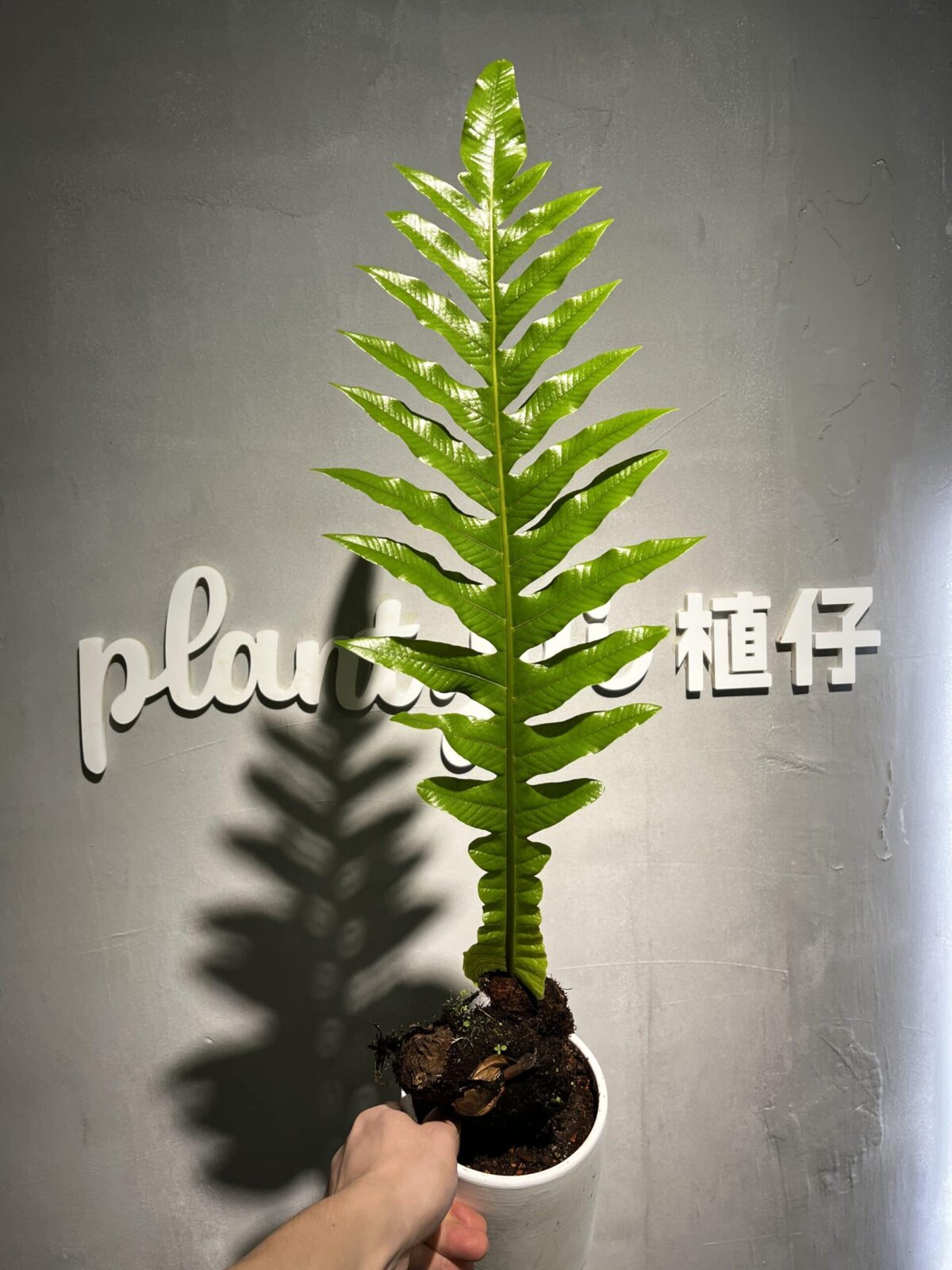
Native to the rainforests of Indonesia and Southeast Asia, Aglaomorpha coronans is an epiphytic fern in the Polypodiaceae family. Its deeply lobed, leathery fronds are glossy and vivid green, and mature plants develop rounded "shield fronds" that wrap the base of the plant to protect the roots and trap falling organic matter — hence the nicknames "crown fern" and "basket fern." A thick, water-storing rhizome makes it noticeably more drought-tolerant than most ferns, and it copes with lower humidity than the maidenhairs and Boston ferns you may already know. It's one of the few large ferns genuinely suited to beginners.
Light
- Very adaptable — tolerates anything from low light to bright, filtered sun.
- Best placed near an east- or north-facing window with soft morning light.
- Brighter light produces paler, sometimes red-veined foliage and faster growth; lower light gives darker green leaves and a slower pace.
- Keep it out of direct midday summer sun — leaf edges scorch quickly.
Watering
- Likes the mix to stay lightly, evenly moist — never soggy.
- Small, frequent waterings suit it better than one big soak followed by a long dry spell.
- Water once the top 1–2 cm of soil has dried; the thick rhizome buffers short dry spells.
- Cut back in autumn/winter when growth slows.
- Yellowing, mushy fronds near the base almost always mean overwatering or poor drainage.
Soil & pot
- Needs a chunky, fast-draining mix — avoid dense garden soil or straight peat.
- A fern mix, or a succulent mix loosened with a little coco coir, both work well.
- Drainage holes are essential; a layer of leca at the base helps.
- The rhizome grows slowly, so repot only every 2–3 years.
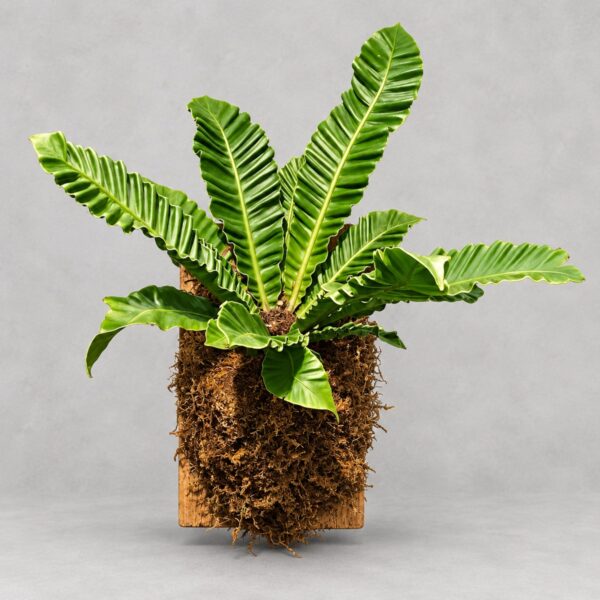
- Mature specimens look spectacular mounted on bark or grown in a hanging basket, mimicking their epiphytic habit.
Temperature & humidity
- Comfortable across a wide range: 15–35°C.
- Can survive brief dips to around 10°C, but sustained cold below 15°C slows growth noticeably.
- More tolerant of low humidity than most ferns — typical Hong Kong air-conditioned rooms are usually fine.
- If humidity drops below 40% for long stretches, mist occasionally or use a pebble tray.
- Keep away from direct AC or heater airflow.
Common problems
| Issue | Likely cause | What to do |
|---|---|---|
| Lower fronds turn yellow and mushy | Overwatering or poor drainage | Switch to a chunkier mix and water less often |
| Shield fronds turn brown | Natural ageing — not a problem | Leave them; they protect the roots and feed the plant |
| Slow growth, small new fronds | Too little light or too cold | Move to a brighter, warmer spot |
| New fronds stay curled ("fiddleheads") | Humidity or water too low | Increase misting frequency |
| Brown dots on frond undersides | Normal spore clusters (sori), not pests | No action needed |
How to explain to customers
"This crown fern is far more forgiving than it looks — those big glossy fronds handle typical Hong Kong air conditioning just fine. Just don't let it sit in water, and it'll settle in happily even if you're not the most attentive waterer."
Fun facts
In the wild, Aglaomorpha coronans grows shield-shaped fronds that form a natural "basket" around its base, collecting fallen leaves and rainwater to make its own compost — which is exactly why it's also called the basket fern. It's one of the few houseplant ferns that can be mounted on a board and grown vertically like an orchid.
Keywords
crown fern, Aglaomorpha coronans, basket fern, snake leaf fern, Drynaria coronans, epiphytic fern, large fern, low-light fern, beginner-friendly, low-humidity tolerant, Hong Kong indoor plant
參考資料(想知來源可展開)
References
- RHS — Aglaomorpha coronans. https://www.rhs.org.uk/plants/701/aglaomorpha-coronans/details
- Our House Plants — Aglaomorpha coronans (Snake Leaf Fern) Growing Guide. https://www.ourhouseplants.com/plants/aglaomorpha-coronans-snake-leaf-fern
- Gabriella Plants — Fern Aglaomorpha coronans 'Crown Fern'. https://www.gabriellaplants.com/products/fern-aglaomorpha-coronans-crown-fern
⚠️ Pet / toxicity note: Non-toxic to cats and dogs — a safe choice for pet-friendly homes.
In-depth care guide
Introduction
The crown fern (Aglaomorpha coronans) goes by several English common names — Crown Fern, Basket Fern, or Snake Leaf Fern — and belongs to the Polypodiaceae, a family of ferns known for their leathery, often epiphytic habit. Its genus name comes from the Greek aglaios ("splendid") and morphe ("form") — "splendid form" — while coronans is Latin for "crowning," a nod to the ring of shield-shaped fronds that circles the rhizome on a mature plant like a crown. It's a fitting name for a fern with real presence.
In the wild, the species ranges from Nepal and northeast India through Myanmar, Thailand, the Malay Peninsula, Indonesia and the Philippines, growing as a true epiphyte on tree trunks and branches in humid tropical forest. Its creeping rhizome hugs the bark, while the shield fronds form a natural basket that traps falling leaf litter and organic debris, slowly breaking it down into nutrients — the origin of its "basket fern" nickname, and a neat example of a plant fertilising itself.
Native habitat & growth habit
The crown fern produces two very different types of fronds. The foliage fronds are long and arching, typically 60–120 cm, deeply divided into pinnate segments with a smooth, almost snakeskin-like texture (hence "snake leaf fern"). In bright light these fronds take on a paler green with occasional red veining; in lower light they turn a deeper, more uniform green. The shield fronds are shorter, rounder, and papery, growing flat against the growing medium or mount. Their job is purely structural and nutritional — anchoring the plant and collecting organic matter — and they naturally brown and die back over time. Resist the urge to trim them off; they're doing important work.
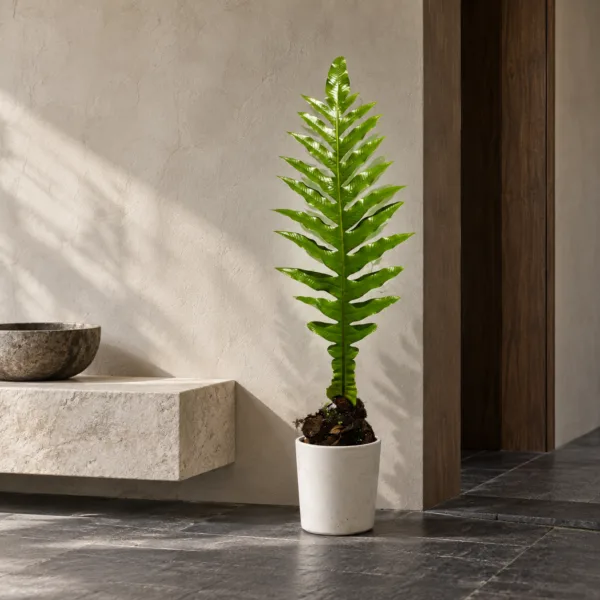
The rhizome itself is thick, covered in golden-brown fuzz, and stores water — the anatomical reason this fern tolerates short dry spells so much better than delicate ferns like maidenhair. Indoors, expect a mature plant to reach 60–80 cm tall and spread over a metre wide, so give it room to arch outward. Older literature sometimes files this species under Drynaria coronans, but Aglaomorpha coronans is now the accepted name.
Light requirements
Crown ferns handle a genuinely wide range of light — from fairly dim corners to bright filtered sun — which is part of what makes them so forgiving. That said, bright indirect light gives the best growth and leaf colour, closely mimicking the dappled canopy light of its native rainforest floor.
In practice, an east- or north-facing windowsill is ideal, or a spot 1.2–1.8 m back from a south- or west-facing window. It can even take a couple of hours of gentle morning sun, but watch closely for scorching — yellow-brown patches on the tips or blade mean it's time to pull the plant back into shade.
Light intensity visibly changes the plant's appearance: strong light produces paler, sometimes red-veined, faster-growing fronds; medium light gives the most balanced, deep-green form; low light slows growth and shrinks new fronds. If you tuck the plant into a tight corner or crowd it against furniture, the fronds — which naturally radiate outward — will bend and distort trying to find space, so give it room to fan out, or better yet, hang it.
Watering method
The watering mantra for this fern is "little and often, evenly moist." Despite being tougher than most ferns, it isn't a plant you can neglect indefinitely — the goal is a growing medium that's consistently just barely damp, never fully wet and never bone dry.
Check by pushing a finger 2–3 cm into the mix; water once it starts to feel dry. In the warmth of spring and summer this typically means every 5–7 days; in cooler, slower autumn and winter months you can stretch that to 7–10 days. Always adjust for your specific room temperature, humidity and light.
A few practical notes: frequent light watering generally suits the shallow-ish root system better than one heavy soak followed by a long gap, though if you're using a very free-draining mix, watering thoroughly is fine too — the key is that the medium never stays waterlogged. The thick rhizome and leathery fronds mean the plant can ride out a few days of neglect (handy if you travel), but don't make a habit of testing that patience, since prolonged drought will eventually yellow and wilt the fronds. If possible, use rainwater, filtered water, or tap water left to stand overnight, since ferns can be sensitive to mineral buildup. Water in the morning rather than the evening, so the surface has time to dry down before nightfall and fungal risk drops.
Soil, pot & repotting
Because it evolved growing on bark, the crown fern needs an extremely airy, fast-draining medium — heavy peat or garden soil will suffocate the roots and invite rot. A reliable homemade mix:
- 40% orchid bark (medium grade)
- 30% perlite or pumice
- 20% coco coir or sphagnum moss (for a little water retention)
- 10% horticultural charcoal (to keep the mix "sweet")
If you'd rather buy a ready-made blend, a fern mix or succulent/cactus mix both work — if the succulent mix drains too fast, loosen it up with a bit of extra coir or worm castings.
Because the rhizome creeps along the surface rather than digging deep, a shallow, wide pot suits it better than a tall, narrow one. Terracotta is a great material choice for its breathability, though plastic or glazed ceramic are fine as long as there's a drainage hole. Repotting is only needed every 2–3 years, or once the rhizome has filled the pot's surface. When you do repot, leave part of the rhizome exposed above the soil line rather than burying it — that's how it naturally grows as an epiphyte.
Beyond conventional pots, this species is a rewarding candidate for mounting on a slab of bark or wood, which really shows off the golden, fuzzy, creeping rhizome. Mounted plants need more frequent watering since there's no soil reservoir to buffer dry spells.
Temperature, humidity & feeding
Humidity: The crown fern tolerates indoor humidity as low as 40% — genuinely unusual for a fern, and the reason it's often recommended as a "gateway fern" for people who've killed maidenhairs before. That said, it thrives even more at 60–80%, with glossier leaves and more frequent new growth. Below 50% for extended periods, tips will start to brown. Boost humidity with regular misting (2–3 times a week, ideally in the morning), a small humidifier during dry spells, a pebble tray, or by placing it in a naturally humid bathroom with a window.
Temperature: This is one of the most temperature-tolerant houseplant ferns, coping with anything from roughly 5°C to 40°C, though it will only actively grow within 18–27°C, which lines up neatly with a typical Hong Kong living room. In summer, keep it out of scorching direct sun and water adequately. In winter it can survive brief dips to around 10°C, though growth stalls completely; avoid placing it near window drafts. Steer clear of direct AC or heater airflow, and doorways with fluctuating temperatures — a warm, slightly humid kitchen is often an underrated spot for this plant.
Feeding: This is not a heavy feeder. During the growing season (April–September), apply a standard balanced houseplant liquid fertiliser at half strength every 4–6 weeks. Stop feeding entirely from October to March. Because it evolved on nutrient-poor bark, over-fertilising is a bigger risk than under-fertilising — expect burnt frond tips and rhizome damage if you overdo it. An organic option is a thin layer of worm castings or well-rotted compost worked lightly into the surface every 3–4 months. Mounted specimens can be fed via a diluted foliar spray or by soaking the whole mount every 4–6 weeks.
Propagation
Division is the simplest and most reliable method. At spring repotting, gently separate sections of rhizome by hand — each division should have some roots and at least one frond attached. Pot into fresh, free-draining mix, keep warm and evenly moist, and expect new growth within 2–4 weeks.
Rhizome cuttings let you propagate without disturbing the whole plant: cut a 2.5–5 cm section of actively growing rhizome, ideally with a frond attached, and press it lightly into (or lay it on top of) a free-draining mix. Keep humid and warm; new roots and fronds typically appear in 4–8 weeks.
Spore propagation is possible but slow and technical — mature fronds produce rows of brown sori (spore clusters) on their undersides that are often mistaken for pests. Collecting and sowing spores onto sterile medium at 21°C+ and high humidity can take weeks to months to germinate, and success rates are modest, but it's a satisfying challenge for experienced growers.
Common problems (detailed)
Brown, crispy frond tips are almost always caused by low humidity, underwatering, or both. Increase humidity (misting, humidifier, pebble tray) and water a little more often; damaged tips won't turn green again, but trimming them off tidies the plant up considerably.
Yellow, mushy fronds, especially near the base, point to overwatering or poor drainage. Check for a drainage hole and reassess your mix — switch to something chunkier if needed, and cut back on frequency immediately. If the rhizome itself has gone soft or black, cut away the rotten section; healthy tissue can be replanted.
Distorted, curled fronds usually mean the plant is too cramped and can't spread its fronds naturally. Move it somewhere more open, or switch to a hanging basket so fronds can arch down freely.
Browning shield fronds are a normal part of the plant's life cycle — leave them be unless they're fully dry and loose, at which point you can gently remove them.
Brown dots on frond undersides are spore clusters (sori), not scale insects — a completely natural reproductive structure. If you're sensitive to spores, you can temporarily move the plant further away; the spore-producing period rarely lasts more than a month.
Toxicity
Aglaomorpha coronans is considered non-toxic to cats and dogs, making it one of the safer large statement plants for pet-owning households. As always, discourage pets from chewing any houseplant, since even non-toxic species can cause mild digestive upset if eaten in quantity.
References
- RHS — Aglaomorpha coronans. https://www.rhs.org.uk/plants/701/aglaomorpha-coronans/details
- Our House Plants — Aglaomorpha coronans (Snake Leaf Fern) Growing Guide. https://www.ourhouseplants.com/plants/aglaomorpha-coronans-snake-leaf-fern
- Gabriella Plants — Fern Aglaomorpha coronans 'Crown Fern'. https://www.gabriellaplants.com/products/fern-aglaomorpha-coronans-crown-fern
- San Marcos Growers — Drynaria (Aglaomorpha) coronans, Basket Fern. https://www.smgrowers.com/products/plants/plantdisplay.asp?region_id=15&plant_id=641
- Grow Tropicals — Aglaomorpha coronans 'Snake Leaf Fern'. https://growtropicals.com/products/aglaomorpha-coronans-snake-leaf-fern
- Verdeia — Aglaomorpha Coronans, Epiphytic Fern. https://verdeia.eu/en/products/aglaomorpha-coronans
Plantjai shop · In stock online
Aglaomorpha coronas
Aglaomorpha coronas
from HK$128.00
Hong Kong delivery · Causeway Bay pickup
For Hong Kong homes and offices. Stock and pricing follow the product page.
IN STORE NOW
Plants for this guide
Related plants in stock now — live prices, delivery or Causeway Bay pickup.
Asplenium nidus var plicatum
Original price was: HK$428.00.HK$180.00Current price is: HK$180.00.
In stock · store pickup
View plant
FREE PLANT ADVICE
Send us a photo before you change anything
WhatsApp a photo of the plant and your window light. Our Causeway Bay team will suggest care steps or plants that suit your space.
STORE · CAUSEWAY BAY
4/F, 39 Yiu Wa Street, Causeway Bay
Daily 12:30–8:00pm · ~3 min walk from Times Square
Map & directionsPlant Care