
How to Care for Polyscias Fruticosa in Hong Kong | Plantjai


Plantjai 植仔 · Care Encyclopedia
Polyscias Fruticosa
Polyscias fruticosa 裂葉福祿桐 / 森樹
Hong Kong care guide — useful before you buy and after it arrives.
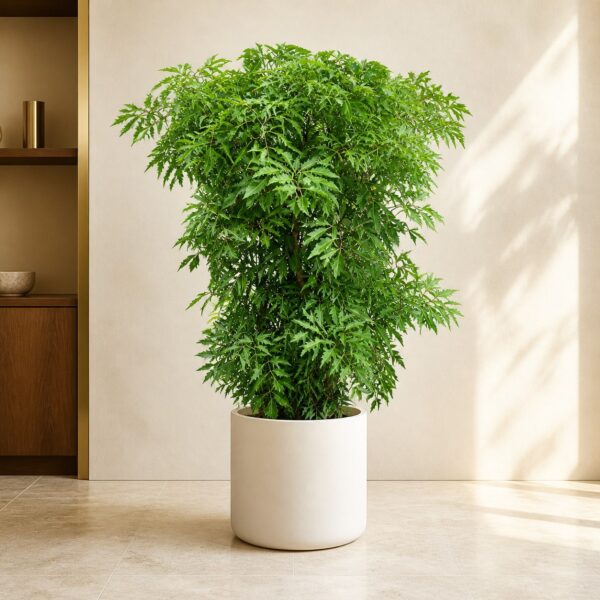
Shop this plantLayer upon layer of feathery, ferny foliage with delicately ruffled, lace-like edges — a single plant brings the atmosphere of a miniature indoor forest.
Origin & characteristics
Ming Aralia is native to the Pacific Islands and Southeast Asia, an evergreen shrub in the Araliaceae family. Thanks to its variable, densely growing foliage, it's often nicknamed "the forest tree" in horticultural circles, symbolising vitality. The finely divided (parsley-leaf) cultivar has deep green, neatly arranged pinnately compound leaves with distinctly ruffled or wavy edges, giving it a texture reminiscent of embroidered lace. It can be pruned into either a single-trunk small tree form or a clustered shrub form, reaching 1-2 metres tall, making it ideal as an indoor living screen or a statement focal plant.
Light
- Bright indirect light to partial sun: an east- or north-facing window is ideal
- Tolerates partial shade: can survive in lower light, though leaf colour will be paler
- Avoid harsh midday sun: intense summer direct sun causes yellowing or scorch spots
- Indoors, keep it within 2 metres of a window to ensure adequate indirect light
Watering
- Err on the dry side: let the top 3-4 cm of soil dry out before watering
- Spring/summer: roughly every 7-10 days, keeping the soil lightly moist
- Autumn/winter: roughly every 10-14 days, allowing the soil to stay slightly drier
- Drainage is key: standing water at the base of the pot is its biggest enemy — make sure drainage is unobstructed
- Avoid letting water pool in the crown of the plant, which can cause rot
Soil & pot
- Soil: a loose, breathable garden mix; recommended ratio is peat soil : perlite : coco coir = 4:3:3
- pH: slightly acidic to neutral (pH 6.0-7.0)
- Pot: a breathable terracotta or plastic pot both work, as long as it has drainage holes
- Repotting: every 2 years in spring, which is also a good opportunity for light pruning and shaping
Temperature & humidity
- Ideal temperature: 20-28°C, growing best in warm conditions
- Minimum temperature: no lower than 12°C — sensitive to cold
- Humidity: 50-70% suits it well, in line with typical Hong Kong indoor humidity
- Winter care: keep away from heater vents when running the heating; a pebble tray can boost local humidity
- Regular misting helps keep the foliage green and glossy
Common problems
| Issue | Cause | What to do |
|---|---|---|
| Lower leaves yellowing and dropping | Natural aging or overwatering | Mild leaf drop is normal; check the roots if drop is significant |
| Leaves thinning, colour fading | Insufficient light | Move to a brighter position |
| Leggy, sparse branches | Insufficient light or overwatering | Increase light, reduce watering, prune to encourage branching |
| Brown spots on leaf surface | Fungal infection or sunburn | Improve airflow, avoid water pooling on foliage |
| New leaves curling and deforming | Possible aphid or thrips damage | Check leaf undersides, spray with soapy water if needed |
How to explain to customers
"Ming Aralia is also called 'the forest tree' because, true to its name, it grows really densely, almost like a miniature forest. It works beautifully in a living room corner or a study — a single plant already makes a real statement. Care is simple: just remember the golden rule 'better dry than wet' — water once the soil has dried out, and it's genuinely hard to kill. For the best look, rotate it occasionally and give it a light misting now and then, and the leaves will stay glossy and vibrant green."
Fun facts
In feng shui, Ming Aralia is considered a wealth-attracting plant — its Chinese name literally reads "fortune-and-prosperity paulownia," symbolising good luck and financial fortune, and it's a common sight in offices and shops across Hong Kong and Taiwan. The genus name Polyscias comes from the Greek "poly" (many) and "skias" (shade), describing how densely it grows and the shade it can provide. The finely divided cultivar is actually the result of long-term horticultural selection — the wild species has much less ruffled, less refined foliage than what's commonly sold today.
Keywords
Ming Aralia, Polyscias fruticosa, forest tree, Araliaceae, Aralia, indoor shrub, foliage plant, pinnately compound leaf, wealth plant, feng shui plant, indirect light, dry-favouring, green screen plant, Plantjai
參考資料(想知來源可展開)
References
- The Spruce. "How to Grow and Care for Ming Aralia." https://www.thespruce.com/grow-polyscias-fruticosa-1902765
- Missouri Botanical Garden — Plant Finder: Polyscias fruticosa, https://www.missouribotanicalgarden.org/PlantFinder/PlantFinderDetails.aspx
- Guide to Houseplants. "Ming Aralia Plant Care – How to Grow Polyscias Fruticosa Indoors." https://www.guide-to-houseplants.com/ming-aralia.html
⚠️ Mildly toxic to humans and pets if ingested; may cause stomach upset. Keep out of reach of children and pets.
Plantjai · Causeway Bay collector indoor plants · WhatsApp +852 66807550
In-depth care guide
Introduction
Ming Aralia (Polyscias fruticosa), also known as Threadleaf Aralia or Fern-leaf Aralia, is an evergreen shrub in the Araliaceae family, native to Pacific Island nations and Southeast Asia including India, Vietnam, Thailand, and Polynesia. It's prized for its elegant, finely divided pinnately compound foliage — leaves cut so finely they resemble feathers — which give it a strong tropical and East Asian aesthetic that has kept it popular among houseplant collectors for decades.
Across Asian culture, Ming Aralia is considered an auspicious plant: its Chinese name puns on "fortune and prosperity arriving together," making it a favourite fixture in homes and offices as a symbol of good luck and wealth. It's slow-growing but long-lived, with an upright growth habit that can be pruned into either a shrub or a small-tree form, and can even be trained as bonsai material — height is highly adjustable, from as compact as 30 cm to well over 2 metres, giving it real flexibility for different spaces.
Popular cultivars include 'Variegata' and 'Snowflake,' which have white-edged leaves, and 'Elegans' (Parsley Aralia), with tightly curled, parsley-like foliage. Regardless of cultivar, this is fundamentally a foliage plant — it rarely flowers indoors, and when it does, the flowers are small, unremarkable green umbels.
Growth form
Ming Aralia is a woody shrub whose stem becomes rougher and more textured with age, developing an aged, characterful trunk over time. Leaves are bi- or tri-pinnately compound, with serrated leaflet edges and a thin, glossy texture. As the plant ages, lower leaves naturally drop, revealing an increasingly attractive woody stem and giving the plant more of a "little tree" silhouette over time.
In its native range it can grow beyond 3 metres, but indoors it typically stays between 1.2 and 2.4 metres. Regular pruning makes it easy to keep at a more compact height suited to almost any space.
Light requirements
Ming Aralia is quite adaptable, tolerating anything from full light to partial shade. That said, bright indirect light is ideal — a north- or east-facing window usually works best. It can adapt to lower light, but growth slows and the foliage becomes less dense. Avoid harsh midday direct sun, which will scorch the delicate young leaves. If you want it to stay lush and full, giving it as much bright indirect light as possible is the key.
If natural light is insufficient, a full-spectrum LED grow light, run for 10-12 hours daily, works as an effective supplement.
Temperature requirements
Ming Aralia enjoys warmth, with an ideal range of 18-24°C and tolerance up to around 29°C. Most importantly, it cannot tolerate cold — it has essentially no cold hardiness, and temperatures below 15°C trigger stress responses, while below 10°C can be fatal. Hong Kong winters generally aren't a major concern, but keep it well away from AC vents or drafty doors and windows.
Temperature stability matters more than the absolute reading. Sudden fluctuations — such as the temperature swing from an air-conditioned room — can trigger leaf drop.
Humidity
Native to tropical rainforest, Ming Aralia naturally prefers higher humidity (50-60% or above). In typical household environments — especially in winter with heating, or in air-conditioned rooms — humidity can drop to 30-40%, leading to dry, crisp leaf tips.
Ways to raise humidity include: a humidifier (the most effective method — choose a model with a built-in hygrometer), a pebble tray filled with water beneath the pot (without the pot touching the water), grouping several plants together to take advantage of collective transpiration, and periodic misting, which offers a short-lived boost and should be followed by good airflow to prevent fungal issues.
Watering
Ming Aralia's watering motto is "better dry than wet." Its fine root system rots very easily if kept waterlogged. Water once the top 1-2 inches (roughly 2.5-5 cm) of soil has dried out, watering thoroughly until it runs from the drainage holes. In winter, when growth slows, you can stretch watering to about once every two weeks.
Avoid overly cold water — room temperature is best. If your tap water is high in chlorine or fluoride, this can cause browning leaf tips; filtered water or rainwater is a worthwhile switch if you notice this issue.
Soil
Ming Aralia needs a well-draining, organically rich potting mix. A recommended recipe:
- 2 parts peat-free potting soil
- 1 part perlite
- 1 part orchid bark
Alternatively, a good-quality indoor potting mix generously amended with perlite works well too. Terracotta pots help wick away excess moisture and are a solid choice. Whatever pot you choose, drainage holes are essential.
Feeding
During the growing season (spring through autumn), feed monthly with a balanced liquid fertiliser (such as 10-10-10) diluted to half strength. If new leaves come in pale yellow-green, this may indicate a nutrient deficiency, and feeding frequency can be increased slightly. Stop feeding entirely in autumn and winter. Avoid over-fertilising — salt buildup can damage the plant's delicate roots.
Pruning and shaping
Ming Aralia responds very well to pruning. Left alone, it naturally grows upright and somewhat sparse; if you want a fuller, bushier shape, prune in early spring before new growth emerges:
- Pinching: pinch off the tips of young shoots by hand to encourage side branching and a denser habit
- Thinning: remove overly crowded, crossing, or weak branches to improve airflow and light penetration
- Shaping: prune into a rounded, tiered, or naturalistic form according to preference. Avoid removing more than 25% of total foliage in a single session
If you want to train it in a bonsai style, retain a main trunk, prune the top regularly, and let the lower stem gradually become woodier, achieving an "old tree" appearance over time.
Propagation
Ming Aralia is propagated primarily via stem cuttings:
- In late spring/early summer, select a semi-hardwood stem 10-15 cm long with 2-3 mature leaves
- Remove the lower leaves, and dip the cut end in rooting hormone (IBA, roughly 0.1% concentration)
- Insert into pre-moistened propagation medium (50% perlite + 50% coco coir)
- Cover with a clear plastic bag or dome to maintain high humidity
- Place in bright indirect light, keeping temperatures around 21°C
- Roots typically form within 4-6 weeks; transplant once roots exceed 2.5 cm
Note: leaf cuttings alone will not work — Ming Aralia's petioles lack the regenerative bud tissue needed for a leaf cutting to root successfully.
Repotting
Repot every 2-3 years, ideally in early spring (March-April). Signs it's time include roots circling the base of the pot, water running straight through without being absorbed, or noticeably slowed growth. Choose a new pot no more than 2 inches larger in diameter than the old one — an oversized pot leads to persistently overly wet soil.
Repotting steps: water the plant 24 hours beforehand to soften the root ball; gently invert the pot and tap the edges to release the plant; inspect the roots and trim away any black, rotten, or dried-out sections; add about 2.5 cm of fresh soil to the base of the new pot; position the plant so the original soil line sits level with the new pot's rim; backfill around the sides, firm gently, and water thoroughly; keep the plant in a slightly shadier spot for 7-10 days afterward to reduce transplant shock.
Common problems in more detail
Yellowing, dropping leaves are most commonly caused by overwatering, sudden temperature changes, or a change in environment — check that the soil isn't waterlogged, and avoid moving the plant around or placing it near AC vents. Some lower leaf drop from natural aging is normal and not a cause for concern.
Dry, browning leaf tips point to low humidity or water quality issues (excess chlorine/fluoride) — raise humidity and switch to filtered water or rainwater. Leggy growth with sparse foliage indicates insufficient light — move to a brighter spot or add supplemental lighting. Pale new leaves may signal nitrogen deficiency or soil pH that's too high — test the soil pH (ideal range 5.8-6.5) and fertilise appropriately. A blackened, softened stem suggests a fungal infection (such as Phytophthora or Rhizoctonia) — immediately cut away affected sections, repot into sterile fresh soil, and apply a copper-based fungicide if necessary.
Pests are relatively uncommon on this species, but aphids, scale, whitefly, or spider mites can occasionally appear — treat with insecticidal soap or neem oil (roughly 2 tablespoons per gallon of water). If fertiliser is overused or soft water is used consistently, mineral salts can build up in the soil and cause leaf-tip scorch — flush the soil thoroughly with clean water every few months, or refresh the top layer of soil annually.
Placement suggestions
Ming Aralia's elegant silhouette makes it an excellent "focal plant" for interiors. It suits living room corners, entryways, office lobbies, or hotel lobby-style spaces. Because it grows slowly and upright, it doesn't take up much lateral space, making it well suited to narrow corners. When potted, a heavier terracotta or cement pot is recommended to prevent a tall plant from tipping over.
Toxicity note
Ming Aralia is classified as mildly toxic to both humans and pets. Ingesting leaf or stem material may cause gastrointestinal discomfort. While not considered a serious toxin, it's still sensible to place it out of reach of curious pets and small children.
References
- The Spruce. "How to Grow and Care for Ming Aralia." https://www.thespruce.com/grow-polyscias-fruticosa-1902765
- Guide to Houseplants. "Ming Aralia Plant Care – How to Grow Polyscias Fruticosa Indoors." https://www.guide-to-houseplants.com/ming-aralia.html
- Missouri Botanical Garden — Plant Finder: Polyscias fruticosa, https://www.missouribotanicalgarden.org/PlantFinder/PlantFinderDetails.aspx
- Royal Botanic Gardens, Kew — Plants of the World Online: genus Polyscias, https://powo.science.kew.org/
Plantjai · Causeway Bay collector indoor plants · WhatsApp +852 66807550
Plantjai shop · In stock online
Polyscias fruticosa
Polyscias fruticosa
HK$1,080.00
Hong Kong delivery · Causeway Bay pickup
For Hong Kong homes and offices. Stock and pricing follow the product page.
IN STORE NOW
Plants for this guide
Related plants in stock now — live prices, delivery or Causeway Bay pickup.
Cocos nucifera
Cocos nucifera
Original price was: HK$398.00.HK$298.00Current price is: HK$298.00.
In stock · store pickup
View plant
FREE PLANT ADVICE
Send us a photo before you change anything
WhatsApp a photo of the plant and your window light. Our Causeway Bay team will suggest care steps or plants that suit your space.
STORE · CAUSEWAY BAY
4/F, 39 Yiu Wa Street, Causeway Bay
Daily 12:30–8:00pm · ~3 min walk from Times Square
Map & directionsPlant Care