

How to Care for Philodendron Plowmanii Blackface in Hong Kong | Plantjai

Plantjai 植仔 · Care Encyclopedia
Philodendron Plowmanii Blackface
Philodendron plowmanii 'Blackface' 黑面普洛蔓綠絨
Hong Kong care guide — useful before you buy and after it arrives.
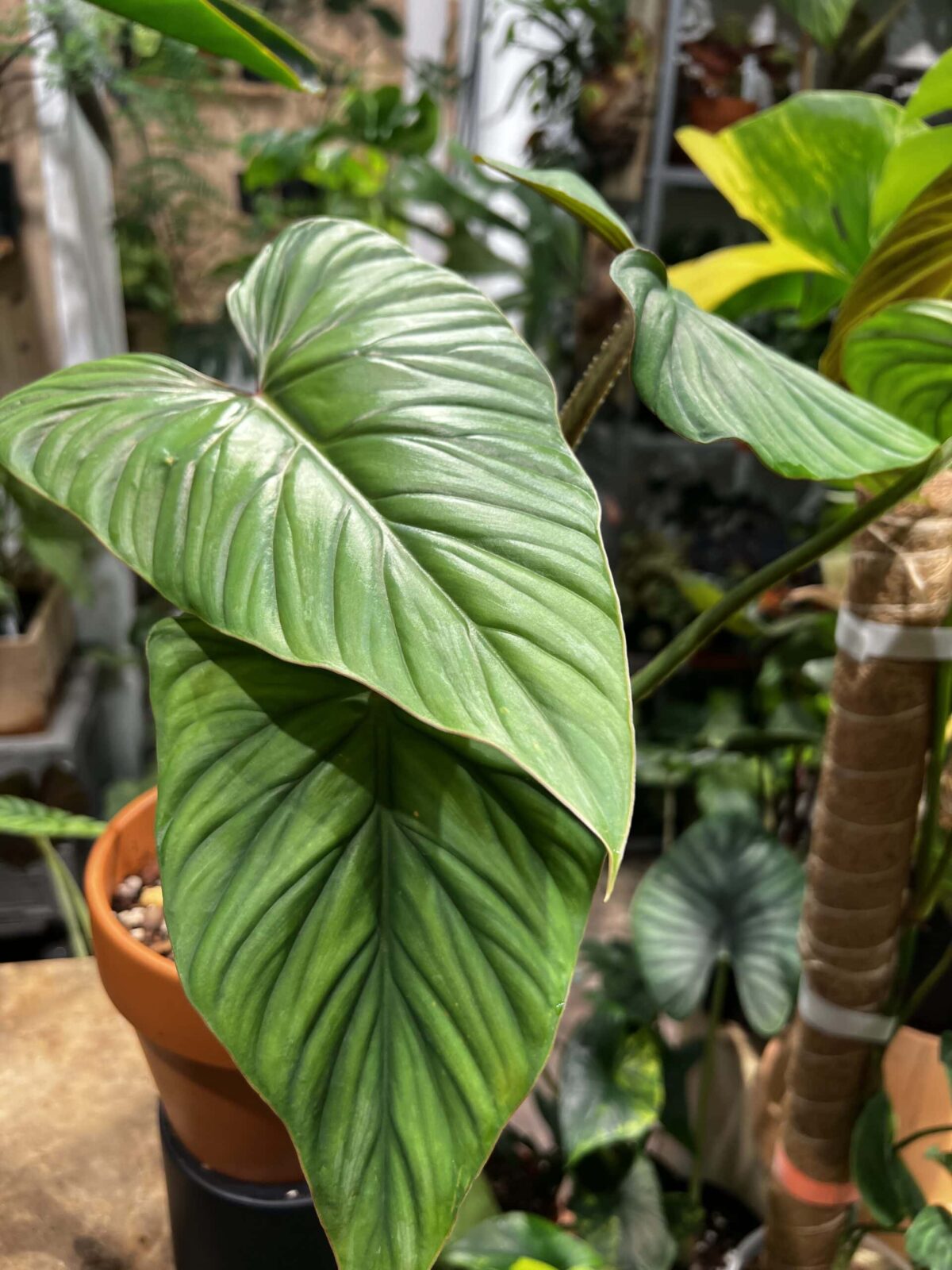
Shop this plantVelvety leaves in a near-black inky green, with a wavy, ruffled texture — an understated, luxurious advanced collector's cultivar.
⚠️ Toxicity warning: all Philodendron species contain calcium oxalate crystals; ingestion may cause mouth pain and swelling. Never let pets or children ingest it. Wash your hands after handling.
Origin & characteristics
Philodendron plowmanii is native to the tropical rainforest of Ecuador to Peru in South America. 'Blackface' is a dark-leaved selection bred from regular plowmanii in horticultural circles, not a separate species.
Its most distinguishing feature is its extremely dark leaf colour — mature leaves are inky green to near-black, with a fine velvety texture on the surface, soft to the touch. Leaves are large, heart-shaped or long-oval, with pronounced wavy ripples along the edges, and veins sunken deep into the leaf. New leaves emerge reddish-brown or purplish-black, gradually deepening to inky green as they unfurl; mature plants have leaves reaching 40-60 cm — genuinely impressive.
Its growth habit is terrestrial or creeping-climbing, with a thick stem and well-developed aerial roots. Compared to regular plowmanii, 'Blackface' grows more slowly but has higher ornamental value.
Light
- Ideal light: medium to bright indirect light (1,000-2,000 lux); an east-facing window or 1-2 metres from a south-facing window is best
- Acceptable range: can grow in semi-shade, though leaf colour will become paler
- Avoid: direct sun damages the velvety leaf surface and fades the colour; prolonged darkness causes legginess
- Tip: appropriate light helps maintain the deep inky-black colour; too dark causes leaves to become paler green
Watering
- Frequency: water once the top 2-3 cm of soil dries out, typically every 5-7 days in summer, every 10-14 days in winter
- Method: water slowly and thoroughly around the rim until a little water appears at the base, empty tray runoff after half an hour
- Water quality: room-temperature tap water is fine; occasionally use room-temperature distilled water in dry seasons
- Note: 'Blackface' has a robust root system but fears waterlogging — better to underwater than let it sit in standing water; soil dries slowly in winter, so extend the watering interval
- How to check: insert a finger to the second knuckle in the soil and feel for dryness before watering
Soil & pot
Soil recipe:
- A dedicated Araceae potting mix with good drainage is recommended
- Custom ratio: 35% peat soil + 30% perlite + 25% pine bark/bark + 10% activated charcoal
- pH: slightly acidic (5.5-6.5)
Pot choice:
- Terracotta or cement pots suit it best, both breathable and complementary to its dark leaf texture
- Drainage holes at the base are essential
- Don't rush to upsize the pot — 'Blackface' grows more vigorously once roots have filled the current pot
Support:
- A sphagnum or coco coir pole can be added — leaf shape becomes more three-dimensional once climbing
- Can also be grown as a ground-cover plant, with its own charm when creeping
Temperature & humidity
- Ideal temperature: 20-28°C
- Tolerable range: 16-30°C
- Danger zone: below 12°C easily causes frost damage; above 35°C stalls growth
- Humidity: 60-80% is most ideal — the wavy leaf edges look more upright and beautiful at higher humidity
- Humidity suggestions: Hong Kong's autumn/winter is drier — place on a humidity tray, use a humidifier, or group with other plants to raise localised humidity
Common problems
Q: Leaf colour is too pale, not black enough?
Usually caused by light that's too strong or too weak — adjust to a bright indirect light position. Also, new leaves are naturally paler and darken naturally with maturity.
Q: The wavy ruffled leaf edges disappearing?
Insufficient humidity is the main cause — raise environmental humidity above 60% and the wavy edges will gradually return.
Q: Growth is very slow, no new leaves for a whole month?
Normal — 'Blackface' naturally grows slowly, even slower during the autumn/winter dormant period. If aerial roots are drying out, mist the moss pole to keep it moist and stimulate growth.
Q: Water spots appearing on the leaf surface?
Caused by water splashing onto the leaf and being left in sunlight — water around the rim instead, avoiding standing water on the leaf surface.
Q: Can it be propagated?
Yes, via single-node cuttings — choose a stem node with an aerial root, cut it, root in water, then transfer to soil. Spring has the highest success rate.
How to explain to customers
"This is Philodendron plowmanii 'Blackface' — the leaf surface has a velvety texture, coloured so dark it's nearly black, with wavy ruffled edges — having it at home really elevates the room's style. It grows a bit slowly but is very easy to care for — water thoroughly once dry, and remember, higher humidity makes the leaves look better. Once it climbs a pole, the leaves get much bigger, as large as your whole palm. But remember, Philodendron is toxic, so don't let pets chew on it."
Fun facts
'Blackface' is actually a horticultural trade name, not a formal botanical cultivar name. Its dark colour comes from extremely concentrated chlorophyll, combined with the visual effect of the leaf surface's fine hairs refracting light. Some botanists believe such extremely dark leaves may be a protective adaptation evolved in high-elevation, high-UV native environments — more chlorophyll absorbs more light energy, while the dark colour reduces UV damage.
Keywords
Philodendron, plowmanii, Blackface, dark-leaved plant, velvety leaf, wavy-edged leaf, Araceae, foliage plant, indoor plant, tropical plant, climbing plant, aerial root plant, advanced plant collector, rare cultivar, Plantjai, air purification, medium-to-large indoor plant, textured plant
參考資料(想知來源可展開)
References
- Royal Botanic Gardens, Kew — Plants of the World Online: genus Philodendron, https://powo.science.kew.org/
- ASPCA — Toxic and Non-Toxic Plant List, https://www.aspca.org/pet-care/animal-poison-control/toxic-and-non-toxic-plants
⚠️ Contains calcium oxalate crystals; toxic to humans and pets if ingested. Keep out of reach of children and pets.
Plantjai · Causeway Bay collector indoor plants · WhatsApp +852 66807550

Plantjai shop · In stock online
Philodendron plowmanii 'Blackface'
Philodendron plowmanii 'Blackface'
Original price was: HK$980.00.HK$380.00Current price is: HK$380.00.
Hong Kong delivery · Causeway Bay pickup
For Hong Kong homes and offices. Stock and pricing follow the product page.
IN STORE NOW
Plants for this guide
Related plants in stock now — live prices, delivery or Causeway Bay pickup.
Philodendron 'Florida Ghost'
Philodendron 'Florida Ghost'
from HK$118.00
In stock · store pickup
View plantPhilodendron hederaceum 'Lemon Lime'
Philodendron hederaceum 'Lemon Lime'
HK$198.00
In stock · store pickup
View plant


FREE PLANT ADVICE
Send us a photo before you change anything
WhatsApp a photo of the plant and your window light. Our Causeway Bay team will suggest care steps or plants that suit your space.
STORE · CAUSEWAY BAY
4/F, 39 Yiu Wa Street, Causeway Bay
Daily 12:30–8:00pm · ~3 min walk from Times Square
Map & directionsPlant Care


