
How to Care for Hoya Bella Variegata in Hong Kong | Plantjai

Plantjai 植仔 · Care Encyclopedia
Hoya Bella Variegata
Hong Kong care guide — useful before you buy and after it arrives.
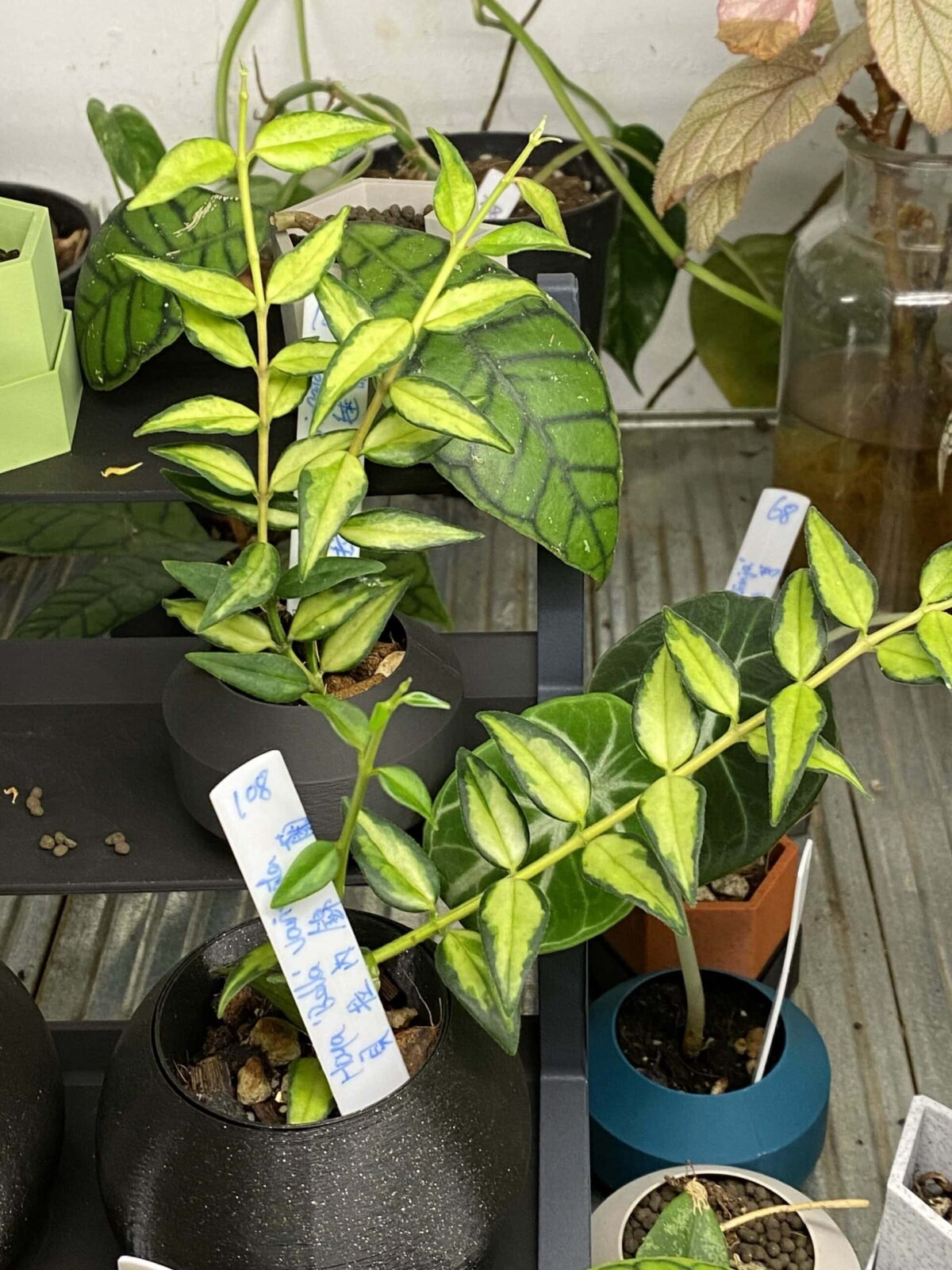
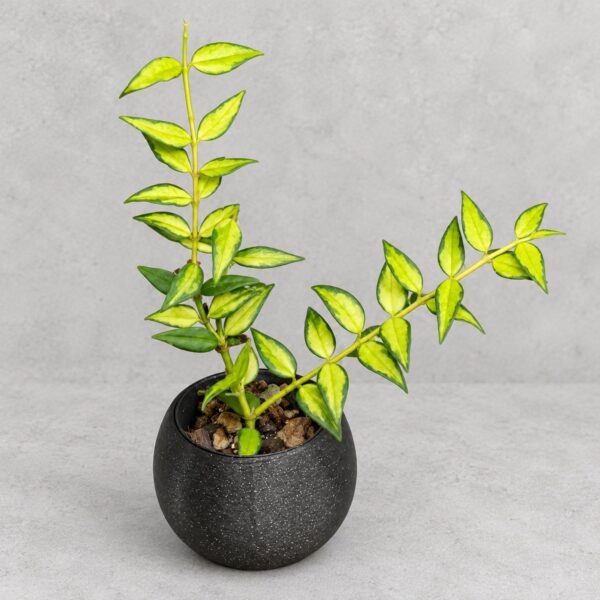
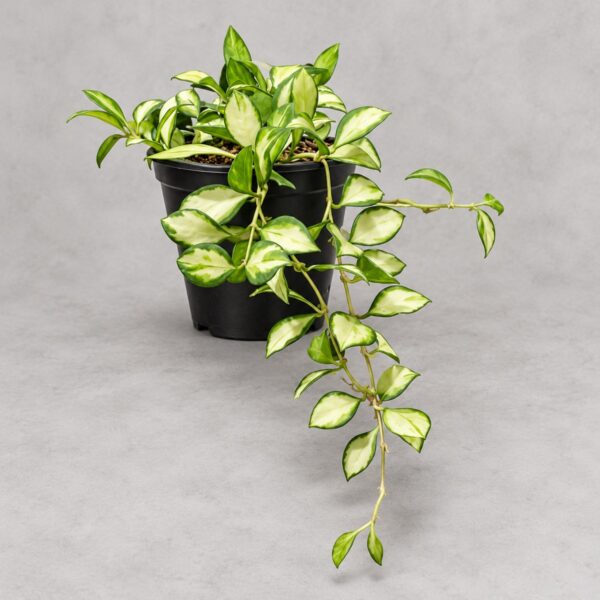
Shop this plantTiny, elegant leaves splashed with golden central variegation, cascading like a miniature waterfall — its white star flowers with pink centres are dainty yet enchanting, making it the centrepiece of any tabletop.
Brand: Plantjai
Botanical status: confirmed — Hoya bella is a subspecies of Hoya lanceolata, and 'Variegata' is its centrally-variegated cultivar
Classification: Apocynaceae, genus Hoya
Origin & characteristics
Hoya bella is native to northeastern India, Myanmar, Thailand, Indonesia, and Malaysia, growing beneath rainforest canopies as an epiphytic vine. 'Variegata' is its centrally-variegated form, with yellow to creamy variegation running through the middle of the leaf, elegantly contrasted by green edges.
Key characteristics:
- Leaves: small, pointed and almost triangular, with a distinct central vein groove; centre variegated yellow/cream ("centre variegation," where the pattern sits in the middle and the edges remain green)
- Vines: slower-growing, with an arching, pendulous habit — mature growth reaches about 30–60 cm, ideal for small spaces or tabletops
- Flowers: white star-shaped blooms with a pale pink or purple centre, resembling little gumdrops, with a light sweet fragrance, typically blooming from late spring through autumn
- Growth rate: slow to moderate
- Toxicity: non-toxic to cats and dogs (ASPCA verified), safe for pet households
Light
- Ideal: bright indirect light, an east-facing window is best, tolerating gentle morning sun
- Acceptable range: about 1 metre from a south-facing window, or a west-facing window with a sheer curtain
- Notes:
- The variegated (yellow) portions have less chlorophyll and need ample but gentle light to stay vibrant
- Absolutely avoid direct scorching sun — the thinner leaves burn easily, with variegated areas scorching first
- Insufficient light causes variegation to revert to green, sparser growth, and difficulty flowering
- Try the "hand shadow test": at midday, hold your hand in front of the leaves — a soft-edged shadow means light is right; a sharp shadow means too strong; no shadow at all means too weak
Watering
- Principle: "water when just dry" — this thinner-leaved cultivar needs water more than thick-leaved Hoyas, but is equally prone to root rot from standing water
- Growing season (spring–autumn): water once the top 2 cm of soil dries out, roughly every 5–9 days depending on conditions
- Dormant season (winter): water less, letting the soil dry about halfway through, roughly every 10–14 days
- Tips:
- Insert a finger about 2 cm into the soil to check dryness
- The "lift test" also works — noticeably lighter means it needs water
- Water thoroughly until excess drains from the base, emptying the saucer after 30 minutes
- Never let the pot sit in water long-term — thin-leaved cultivars are hard to save once root rot sets in
- Soil dries faster with AC in summer or heating in winter — check more frequently then
Soil & pot
Soil recipe:
This cultivar has shallow, fine roots, needing an extremely airy, lightweight mix that still retains a little moisture. Suggested recipe:
- 1 part quality potting soil (or peat)
- 1 part orchid bark (aeration and epiphytic feel)
- 1 part perlite or coco coir (drainage)
- A little horticultural charcoal helps aeration and disease prevention
Pot choice:
- Drainage holes are non-negotiable
- A shallow or wide pot suits its horizontal root growth — depth isn't needed
- Terracotta pots are ideal, wicking away excess moisture and preventing rot
- Plastic pots can work, but require stricter watering control
- Hoya bella likes being "snug" — a pot-bound root system actually favours flowering, so repotting every 2 years is typical
- Size up the new pot by just 2–3 cm in diameter
Temperature & humidity
| Item | Ideal range | Notes |
|---|---|---|
| Temperature | 18–28°C | growth stalls below 15°C, cold damage risk below 10°C |
| Humidity | 50–70% | leaf tips scorch below 45% |
- Its thinner leaves make it far more sensitive to dry air than thick-leaved Hoyas
- Hong Kong's spring and summer humidity is generally sufficient, but watch out in AC-heavy rooms
- Ways to raise humidity:
- Set on a pebble tray (keep the pot base above the waterline)
- Group with other plants to form a mini humid microclimate
- Occasional misting of the surrounding air (not directly on leaves, to avoid fungal issues)
- Use a small humidifier (keeping humidity above 50% is ideal)
- Avoid direct AC airflow in summer and cold drafts or heaters in winter
- Maintain good air circulation to prevent fungal infection
Common problems
| Issue | Likely cause | What to do |
|---|---|---|
| Brown, crispy leaf tips | Dry air (most common), or overly hard water | Raise humidity above 50%; use distilled water or tap water left to sit overnight |
| Variegation fading / all-white stems dying back | Insufficient light causing reversion; all-white stems lack chlorophyll and naturally die off | Move to brighter light; prune all-white stems, keeping the ones with green for healthy variegation |
| Wrinkled, soft leaves | Severe underwatering | Water thoroughly right away, then maintain a more consistent schedule without letting the soil fully dry out |
| Yellowing, dropping leaves | Overwatering, root rot | Check root health, trim rot, repot with a more breathable mix and pot with drainage |
| Sparse growth, stalled development | Insufficient light, too cold, or needs feeding | Check conditions; feed dilute fertiliser every 3–4 weeks during the growing season |
| Won't flower | Immature plant, weak light, or low humidity | Ensure ample bright indirect light and 50%+ humidity; a bloom-boosting high phosphorus/potassium fertiliser can help. Never cut the flower stalk after blooming! |
| Whitefly / mealybugs | Poor ventilation or plant stress | Wipe pests off with an alcohol-dipped cotton swab; use insecticidal soap or neem oil for serious infestations |
How to explain to customers
"This variegated Hoya bella is a really refined little plant — small leaves with a yellow centre that looks so elegant. It grows slowly, so it won't outgrow its pot quickly, making it perfect for a desk or shelf. Note that its leaves are thinner than most Hoyas, so it needs more frequent checking — water once the surface feels dry. It prefers a more humid spot, like near a bathroom window or kitchen; if it's in an air-conditioned room, mist it occasionally, or the leaf tips can crisp up. When it flowers, you get little white blooms with pink centres and a faint scent — really lovely! It's completely non-toxic to cats and dogs, so you can grow it worry-free."
Fun facts
- A dual identity: Hoya bella is technically a subspecies of Hoya lanceolata — its full name is Hoya lanceolata subsp. bella — but the horticultural trade commonly shortens it to Hoya bella. "Bella" means "beautiful" in Italian, and it lives up to the name.
- Flowers like candy: the white, semi-translucent flowers with pink or purple centres have a texture reminiscent of jelly sweets, earning it the nickname "Jelly Bean Flowers" among overseas growers.
- Central vs. marginal variegation: "central variegation" describes patterning that appears in the middle of the leaf while the edges stay green — this is a classic example. Centrally variegated cultivars generally need more careful attention, since while the green edges retain enough chlorophyll, the variegated centre can still discolor or scorch under stress.
- Nighttime perfumer: like other Hoyas, its fragrance is strongest at night since it evolved to be pollinated by night-flying moths — keep it near your bedroom for gentle natural fragrance while you sleep.
- Trailing elegance: its stems naturally arch downward rather than climb like many other Hoyas. A hanging pot lets the stems cascade freely, showing off its graceful form best.
Keywords
Hoya bella, Variegata, Hoya lanceolata ssp. bella, central variegation, variegated Hoya, golden variegation, thin-leaved Hoya, small Hoya, epiphyte, high humidity, bright indirect light, well-draining soil, non-toxic pet-safe, Hong Kong indoor plant, trailing plant, tabletop plant, white and pink flowers, ethereal, flowering plant, intermediate care, Plantjai
參考資料(想知來源可展開)
References
- Royal Botanic Gardens, Kew — Plants of the World Online: Hoya lanceolata, https://powo.science.kew.org/
- ASPCA — Toxic and Non-Toxic Plant List, https://www.aspca.org/pet-care/animal-poison-control/toxic-and-non-toxic-plants
⚠️ Non-toxic to cats and dogs; sap may mildly irritate skin.
Plantjai · Causeway Bay collector indoor plants · WhatsApp +852 66807550
Plantjai shop · In stock online
Hoya bella variegata
HK$168.00
Hong Kong delivery · Causeway Bay pickup
For Hong Kong homes and offices. Stock and pricing follow the product page.
IN STORE NOW
Plants for this guide
Related plants in stock now — live prices, delivery or Causeway Bay pickup.
FREE PLANT ADVICE
Send us a photo before you change anything
WhatsApp a photo of the plant and your window light. Our Causeway Bay team will suggest care steps or plants that suit your space.
STORE · CAUSEWAY BAY
4/F, 39 Yiu Wa Street, Causeway Bay
Daily 12:30–8:00pm · ~3 min walk from Times Square
Map & directionsPlant Care