
Fungus Gnats or Fruit Flies? Identification and Control


In this guide (7)
- 01Three small flies, three starting points
- 02Why adults can return after you catch them
- 03First actions: remove sources without desiccating the collection
- 04Track improvement with a consistent method
- 05If further treatment is needed, match the target and label
- 06Change direction when the source is not the pot
- 07Further reading and next steps
A small fly near a plant is not automatically a fungus gnat, and a yellow sticky card does not treat larvae in the pot. Look at the insect and where it appears, then trace its breeding source. With confirmed fungus gnats, address persistently moist breeding conditions, consider larval control where needed, and use adult catches to track the trend.
“Little black flies” is a description, not an identification. Common fruit flies may be associated with food waste; moth flies may be associated with drains. Repeatedly replacing potting mix will not solve a source you have misidentified.
The lead image shows growing medium, not an insect identification photograph. Compare the insect and its location using the table below.
Three small flies, three starting points
| Group | Common appearance and location | Investigate first |
|---|---|---|
| Fungus gnats | Dark, slender and long-legged, rather like tiny mosquitoes; often active near mix | Persistently moist potting media and other damp organic material |
| Common household fruit flies | More compact, often tan; many have red eyes | Overripe fruit, food waste, fermenting liquids and residue in containers |
| Moth or drain flies | Hairy, broader-winged and moth-like | Bathrooms, kitchens and drains |
These are starting clues, not a definitive identification from a blurred photograph. Compare the University of Minnesota’s guides to fungus gnats, fruit flies and moth flies. If uncertain, obtain a clear image or specimen before selecting a treatment.
Why adults can return after you catch them
Fungus gnats pass through egg, larval, pupal and adult stages. The insects you see flying are adults, while immature stages may remain in organic growing media. Sticky cards catch adults and help monitoring; they do not automatically eliminate those other stages.
University of California IPM guidance explains that larvae mainly consume fungi and organic material but can damage roots, particularly at high populations and on young plants. Many adults do not, by themselves, prove root rot. Nor does the presence of gnats explain every yellow leaf.
Separate two questions: “Is the breeding source being reduced?” and “Is the plant itself healthy?” The first concerns catches and moisture sources. The second still requires attention to drainage, roots and growth.
First actions: remove sources without desiccating the collection
- Mark suspect locations: avoid moving infested plants around the home. Record the pots, windows or drains where flies recur.
- Remove standing water and decaying material: empty ordinary cover pots and saucers, clear fallen decaying leaves, and deal with food waste and liquid residues.
- Adjust watering to the plant: allow surface drying where appropriate, but do not force moisture-loving plants or seedlings to become completely dry.
- Store unused mix sensibly: keep it clean and closed rather than exposed in a persistently damp area.
- Place monitoring cards: position them near suspect pots without contacting foliage, and beyond the reach of children and pets.
Do not dismantle an established reservoir system as a universal remedy before locating the breeding source. Extensive mix replacement should have a clear reason: disturbing healthy roots has a cost too.
Track improvement with a consistent method
| Item | How to record it |
|---|---|
| Location | A numbered pot, kitchen location or drain—not just “everywhere” |
| Card setup | Consistent card size, position and observation interval; replacement dates |
| Catch | New catches over equivalent periods, not a one-day card against a week-old card |
| Root zone | Moisture, standing water and any continuing plant damage |
| Actions | Dates and details of cleaning, watering changes or product use |
An empty card is not proof of eradication, and moving it changes the comparison. Look across repeated observations and revisit unresolved sources. Seeing one fly today is not a reason to double every intervention.
If further treatment is needed, match the target and label
Horticultural guidance describes biological options against fungus-gnat larvae, including Bti (Bacillus thuringiensis subsp. israelensis) and Steinernema feltiae. Evidence for an organism does not mean every product containing it is suitable, or that overseas doses, uses and availability transfer directly to Hong Kong.
Check the target pest, setting, formulation and label. Ask a qualified supplier or professional when these are unclear. Hong Kong AFCD guidance on pesticide use emphasises following labels and notes that pesticides are not the only solution.
This guide does not prescribe homemade peroxide, bleach, detergent or mixed-pesticide root drenches. Such experiments can add risks for plants and people. “Natural” does not mean unrestricted use around pets, aquariums or children.
Change direction when the source is not the pot
If activity centres on fruit, food waste or drink containers, address those sources. If it centres on drains, investigate cleaning and drainage issues and obtain appropriate help when needed. Continued flies after plants have been moved are a reason to reassess—not automatically to blame the last trace of potting mix.
The useful sequence is identification, source tracing, environmental correction and monitoring. A sticky card is a monitoring tool, not a guarantee against recurrence. Record plant health separately from fly numbers.
Further reading and next steps
IN STORE NOW
Plants for this guide
Related plants in stock now — live prices, delivery or Causeway Bay pickup.
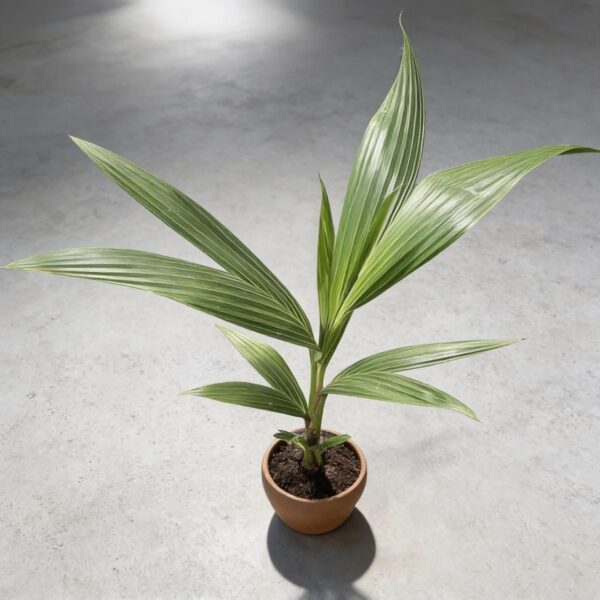
Cocos nucifera
Cocos nucifera
Original price was: HK$398.00.HK$298.00Current price is: HK$298.00.
In stock · store pickup
View plant
FREE PLANT ADVICE
Send us a photo before you change anything
WhatsApp a photo of the plant and your window light. Our Causeway Bay team will suggest care steps or plants that suit your space.
STORE · CAUSEWAY BAY
4/F, 39 Yiu Wa Street, Causeway Bay
Daily 12:30–8:00pm · ~3 min walk from Times Square
Map & directionsPlant Care