
How to Care for Calathea White Fusion in Hong Kong | Plantjai


Plantjai 植仔 · Care Encyclopedia
Calathea White Fusion
Hong Kong care guide — useful before you buy and after it arrives.
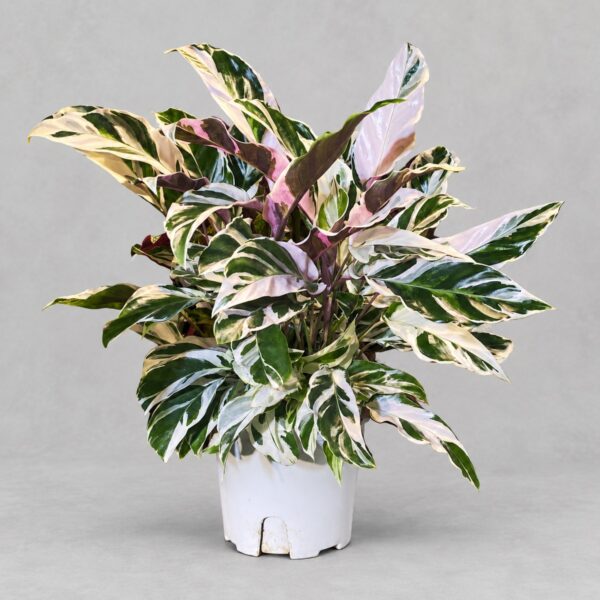
Shop this plantWhite-and-green marbled leaves with a painterly quality — the pinnacle of looks in the Calathea world.
Origin & characteristics
Calathea 'White Fusion' is an extremely popular cultivar within the genus Calathea, bred from hybridising several Calathea species. Its standout feature is a leaf surface covered in interwoven white and light green patterning with deep green edges, giving an overall effect like a delicate oil painting. The underside is magenta, and it's a classic prayer plant, with leaves rising up at night.
Light
It needs bright, diffused light, and cannot tolerate direct sun, which easily scorches the white-patterned sections and turns them yellow. It suits an east- or north-facing window, or light filtered through sheer curtains. Too little light causes the pattern to fade and become dull.
Watering
Keep the soil slightly moist but never waterlogged, watering once the top 2 cm dries out — roughly every 5–7 days, adjusted to ambient humidity. Room-temperature, standing water must be used; chlorine and fluoride in tap water cause browning leaf tips. Consider filtered water or rainwater.
Soil & pot
Needs a loose, breathable, water-retentive but well-draining acidic soil. Suggested recipe: peat moss mixed with perlite and a little bark (roughly 5:3:2). Choose a pot with drainage holes; either plastic or ceramic works.
Temperature & humidity
Optimal temperature is 18–25°C, never below 15°C; growth slows above 30°C. It has very high humidity requirements, needing above 60%. Place near a humidifier, on a humidity tray, or group with other plants to boost local humidity. Dry conditions cause curling, browning leaf edges.
Common problems
- Browning leaf edges: the most common issue, usually caused by dry air or poor water quality — increase humidity and switch to filtered water
- Curling leaves: underwatering or low humidity — check soil moisture immediately and mist to raise humidity
- Fading pattern: caused by insufficient light — move to a brighter spot, but avoid direct sun
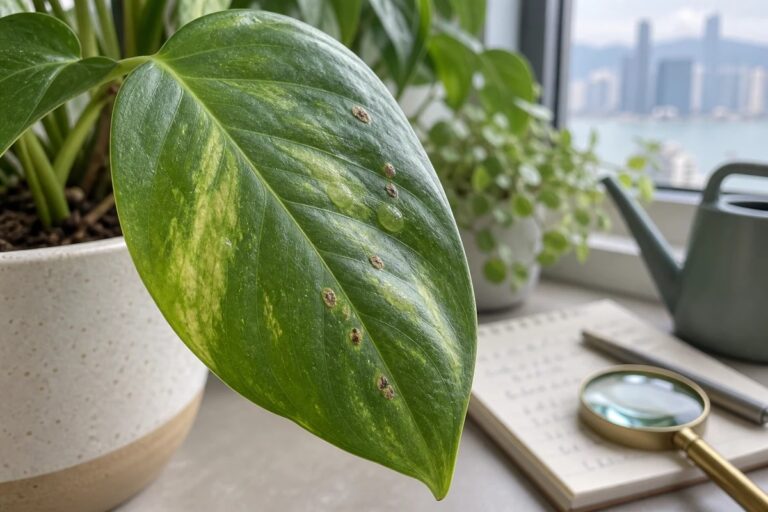
- Brown spots on leaves: possibly sunburn or fungal infection — move away from strong light and improve ventilation
How to explain to customers
"White Fusion is one of the most beautiful Calatheas around — its white and green patterning really does look like an oil painting, though it's a bit demanding. Remember to keep humidity high and use filtered water for watering!" "Place it somewhere with a window in the bathroom or kitchen — with enough humidity, it will really thrive."
Fun facts
White Fusion's white patterning is a natural "variegation" phenomenon caused by uneven chlorophyll distribution — the white sections have almost no chlorophyll, giving them weaker photosynthetic capacity, which is one reason this plant grows relatively slowly.
Keywords
Calathea White Fusion, Calathea, prayer plant, foliage plant, variegated plant, high humidity plant, indoor potted plant
In-depth care guide
One-line pitch
White-and-green marbled leaves with a dreamy magenta underside — like bringing an abstract oil painting into your home, one of the most artistic-looking members of the Calathea family.
Origin & characteristics
Calathea 'White Fusion's current botanical name is more accurately written as Goeppertia lietzei 'Fusion White' (commonly called 'White Fusion' in horticulture), belonging to the family Marantaceae. It's worth noting that a 2012 molecular phylogenetic study (Borchsenius et al., 2012) transferred several species previously classified under Calathea into the genus Goeppertia, meaning White Fusion's correct name should be Goeppertia lietzei 'Fusion White', though the market still widely uses the older Calathea designation.
This cultivar isn't a wild species but a horticulturally bred variety. According to a US Plant Patent granted in 2015, 'Fusion White' was discovered in May 2007 at a commercial nursery in Malaysia by inventor Taiyan Yam, who noticed an individual plant showing an all-over white-green mottled mutation within a batch of ordinary Calathea lietzei. After years of testing, evaluation, and asexual propagation, this stable, richly variegated cultivar was ultimately developed. The original parent species, G. lietzei, is native to the Atlantic coastal forests of eastern Brazil, growing in the damp, shady understory beneath the forest canopy.
White Fusion is a rhizomatous perennial herb with a compact growth habit, reaching a mature height of roughly 30–50 cm. The leaves are narrowly elliptical, reaching up to 40 cm in length, with an irregular white, light green, and deep green marbled pattern on the surface — every leaf's pattern is unique — and the underside is pink to deep purple. Like other Calatheas, it exhibits nyctinasty: leaves lie flat during the day to capture light, rising upright after dark to reveal the purple underside as if praying, which is why the Marantaceae family is nicknamed "Prayer Plants." This movement is controlled by the pulvinus (a swollen structure) at the base of the petiole, where cells change water pressure to move the leaf.
It's worth noting that White Fusion is listed by the ASPCA (American Society for the Prevention of Cruelty to Animals) as non-toxic to cats and dogs, making it one of the few foliage species that can be safely displayed in pet-owning households.
Light / Watering / Soil & pot / Temperature & humidity
Light
White Fusion needs bright, diffused light, and absolutely cannot be exposed to direct sunlight — even a few minutes of morning direct sun can scorch the white-patterned sections (the white tissue, lacking chlorophyll, is the most light-sensitive part of the leaf). An east- or north-facing window is ideal, with light filtered through a sheer curtain being most suitable. If placed near a south- or west-facing window, keep at least 1.5 metres back and install sheer curtains.
If light is too weak (below 1,200 lux for more than 4 consecutive days), new leaves become small and dull-coloured with fading patterns, and petioles elongate (etiolation), making the plant loose and leggy overall. Use a phone light meter app (such as Light Meter Pro) to confirm peak periods stay within 1,500–3,000 lux.
Watering
White Fusion is extremely sensitive to watering, making it its most challenging care aspect. The principle is to keep the soil consistently slightly moist, but absolutely never waterlogged.
- Insert a finger about 2 cm into the soil surface, and water once it starts to feel dry
- In winter or high-humidity conditions, this might mean watering every 7–10 days; in dry summer conditions, every 4–5 days
- Water thoroughly each time until it flows from the pot's base, and empty the saucer within half an hour
Water quality is critical: White Fusion is very sensitive to fluoride, chlorine, and mineral salts in tap water, and long-term use causes browning leaf tips. Use one of the following:
- Tap water left standing for 24+ hours (to let chlorine dissipate, though this doesn't remove minerals)
- Filtered water
- Rainwater (ideal)
- Distilled water
Keep the water temperature around 20–22°C — overly cold water shocks the roots. Never use ice-cold water directly.
Soil & pot
White Fusion needs a soil that's somewhat "contradictory" in nature — both moisture-retentive and breathable. Recommended recipe (by volume):
- 40% coco coir (low-salt type, first rinsed with clean water to a pH of 5.8–6.2)
- 30% medium-grade orchid bark (must be fir bark — pine bark decomposes too quickly and acidifies the soil)
- 20% perlite (increases drainage and oxygen diffusion)
- 10% worm castings (provides slow-release nutrients and beneficial microbes)
Avoid using pure peat, since while it retains moisture strongly, it becomes extremely difficult to re-wet once dried out, easily creating an extreme "dry-wet" cycle. Also avoid substituting vermiculite for perlite, as vermiculite holds too much water.
For pots, either a perforated ceramic or plastic pot works, but ceramic evaporates moisture faster and needs closer monitoring. Don't oversize the pot — each repotting should only increase by one size (e.g. from a 4-inch to a 5-inch pot); an oversized pot keeps the root zone waterlogged for too long, easily causing root rot. Repot once every 1.5–2 years, ideally in spring.
Temperature & humidity
The ideal temperature range is 18–26°C, never below 15°C. White Fusion is extremely sensitive to sudden temperature changes — AC vents, gaps around doors and windows, and drafts all cause it to "sulk" — curling leaves, browning edges. When running AC or heating in winter, never place it near the outlet.
Humidity is the key to successfully growing White Fusion. It needs consistent 60–85% relative humidity — occasional misting won't solve the problem. Hong Kong summers usually provide sufficient natural humidity, but winter AC or dehumidifier use can drop indoor humidity below 30%, at which point active humidification is essential:
- Most effective: use an evaporative (cool-mist) humidifier, placed about 1 metre from the plant, avoiding direct airflow onto the leaves
- Second choice: a moist pebble tray — a waterproof tray with 2 cm of pumice or LECA clay pebbles, water added below the pebble surface, with the pot elevated above the stones (never let the pot base touch the water, or it effectively waterlogs the roots)
- Supplementary: grouping multiple plants together to create a microclimate humidity zone (though this alone only raises humidity by about 3–5%, insufficient on its own)
Direct misting of the leaves is not recommended: while it briefly raises surface humidity, it evaporates within 15 minutes, doing little for overall humidity; water droplets left on the white leaf patches can also leave watermarks, or even trigger fungal infection in poorly ventilated conditions.
Common problems
| Issue | Symptoms | Cause | Solution |
|---|---|---|---|
| Browning tips or edges | Brown, dry tissue extending inward from the tip | Low humidity, mineral buildup from tap water, or fertiliser too concentrated | Switch to rainwater or filtered water; flush soil thoroughly with distilled water once a month; increase humidification |
| Curling leaves | New or all leaves curl inward and won't flatten | Underwatering, sudden humidity drop, or temperature below 15°C | Check soil moisture, water thoroughly if dry; check surrounding temperature and humidity |
| White patterning turning brown | Paper-like brown patches on the white marbled areas | Sunscald from direct sun or heat reflected through glass | Move to a diffused-light position, or filter with sheer curtains; scorched areas won't recover but can be trimmed |
| Small new leaves | New leaves noticeably smaller than older ones | Insufficient light, root system stressed, or still adjusting after a recent purchase | Move closer to a window while avoiding direct sun; check whether repotting is needed; allow time to acclimate |
| Spider mites | Fine yellow specks on leaf surface, near-invisible webbing on undersides | Hot, dry conditions triggering infestation | Isolate the affected plant; wipe leaf undersides with a damp cloth; apply neem oil or insecticidal soap |
| Rotting stem base | New shoots turning soft and discoloured, foul-smelling roots | Prolonged waterlogged soil, root rot (Pythium or Phytophthora infection) | Remove the plant, trim away rotten roots and discoloured rhizome, treat the wound with fungicidal powder, replant in fresh soil |
How to explain to customers
"White Fusion is genuinely stunning, but it is a fairly demanding cultivar. Remember three key things: first, never expose it to direct sun — diffused light only; second, the soil needs to stay slightly moist but the roots must never sit in water — rainwater or filtered water is best for watering; third, humidity needs to be high — ideally with a humidifier, or place it near a bathroom window. If you're running AC in winter, keep it away from the outlet or the leaf edges will scorch. It can be a bit tricky, but when you see it raise its leaves at night to reveal that purple underside, all the extra effort feels worth it."
Fun facts
- Patented until 2033: White Fusion 'Fusion White' was granted a US Plant Patent in 2015, valid until 14 December 2033. Under patent law, no one may asexually propagate, sell, or commercially use this cultivar without authorisation from the patent holder. In simple terms, propagating it for resale without permission is illegal (though dividing it for your own personal collection is fine).
- The parent species comes from Brazil's Atlantic Forest: the original species Goeppertia lietzei is native to Brazil's Atlantic Forest, home to 80% of the world's known primates, 54% of its tree species, and 40% of its animal species, but facing serious deforestation threats — it's considered one of the world's biodiversity hotspots.
- White comes from a genetic mutation: White Fusion's white patterning isn't caused by virus or disease, but a stable genetic mutation (chimeric mutation) causing some mesophyll cells to lack chlorophyll. Precisely because the white tissue has no chlorophyll, it's especially sensitive to changes in light, water, and nutrients — the white tissue is the most vulnerable part of the entire leaf, and environmental stress shows up there first.
- Nyctinasty serves a function: the Marantaceae family's day-open, night-closed "prayer" leaf movement isn't just decorative — it has real ecological function. Spreading the leaves flat during the day maximises light absorption, while rising up at night helps reduce water loss and lowers the risk of fungal or bacterial growth on the leaf surface.
- A confusing name: while the patent document uses the name "Fusion White," the market commonly calls it "White Fusion," reportedly because it rolls off the tongue more easily. The botanically correct form should be Goeppertia lietzei 'Fusion White', with the cultivar name in single quotes and the genus/species names in italics.
Keywords
Calathea White Fusion, Goeppertia lietzei, Marantaceae, prayer plant, nyctinasty, marbled leaf, foliage plant, pet-safe plant, high humidity plant, indoor potted plant, rhizome propagation, Plantjai
參考資料(想知來源可展開)
References
- Borchsenius, F., S. Suárez, & L.P. Kvist. (2012). "Molecular phylogeny and biogeography of the neotropical genus Goeppertia (Marantaceae)." Taxon, 61(6), 1220–1230.
- Yam, T. (2015). "Calathea plant named 'Fusion White'." US Plant Patent PP25,801.
- Gardenia.net. "Calathea lietzei 'White Fusion': Care and Growing Guide." https://www.gardenia.net/plant/calathea-lietzei-white-fusion
- Pistils & Pollen. "How to Grow and Care for Calathea 'White Fusion'." https://www.pistilsandpollen.com/blog/calathea-white-fusion-a-guide-to-growing-and-caring-for-calathea-white-fusion
- The Spruce. "How to Grow and Care for Calathea 'White Fusion'." https://www.thespruce.com/growing-calathea-white-fusion-plants-5088748
- Foliage Factory. "Goeppertia (Calathea) lietzei 'White fusion'." https://foliage-factory.com/products/goeppertia-calathea-white-fusion
- ASPCA. "Calathea (non-toxic to cats and dogs)." https://www.aspca.org/pet-care/animal-poison-control/toxic-and-non-toxic-plants
⚠️ Toxicity/pet note: White Fusion is listed by the ASPCA as non-toxic to cats and dogs, one of the few foliage species that can be safely displayed in pet-owning households. However, the leaves are relatively thin and easily damaged by pets chewing on them, so it's best kept out of pets' reach to prevent damage to the plant. While non-toxic, ingesting large amounts of plant fibre may still cause mild gastrointestinal upset.
Plantjai shop · In stock online
Calathea 'White Fusion'
Calathea 'White Fusion'
HK$380.00
Hong Kong delivery · Causeway Bay pickup
For Hong Kong homes and offices. Stock and pricing follow the product page.
IN STORE NOW
Plants for this guide
Related plants in stock now — live prices, delivery or Causeway Bay pickup.
FREE PLANT ADVICE
Send us a photo before you change anything
WhatsApp a photo of the plant and your window light. Our Causeway Bay team will suggest care steps or plants that suit your space.
STORE · CAUSEWAY BAY
4/F, 39 Yiu Wa Street, Causeway Bay
Daily 12:30–8:00pm · ~3 min walk from Times Square
Map & directionsPlant Care