
How to Care for Calathea Triostar in Hong Kong | Plantjai

Plantjai 植仔 · Care Encyclopedia
Calathea Triostar
Hong Kong care guide — useful before you buy and after it arrives.
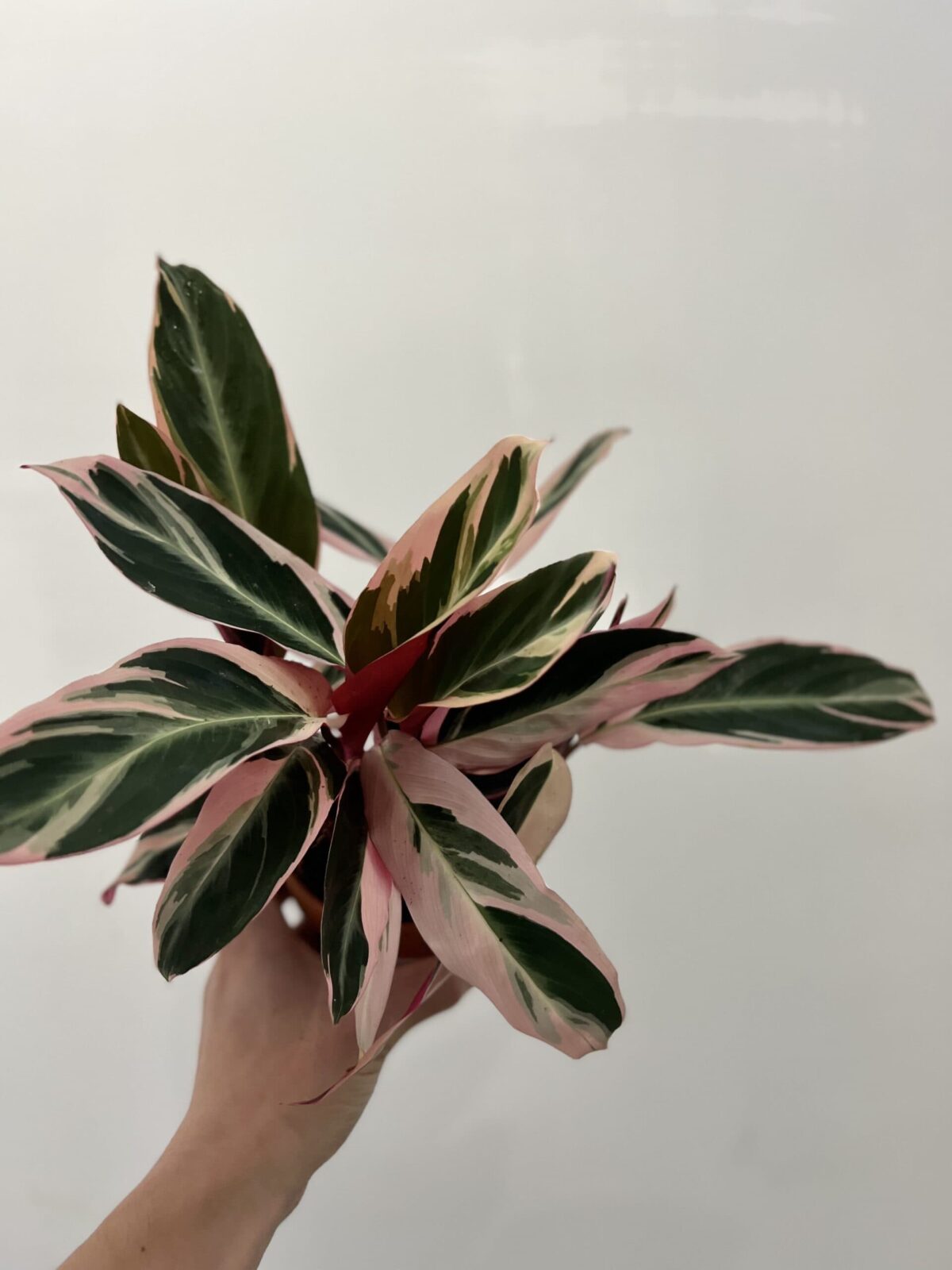
Shop this plantPink, cream, and green gradient leaves — as dreamy and vibrant as a rainbow.
Origin & characteristics
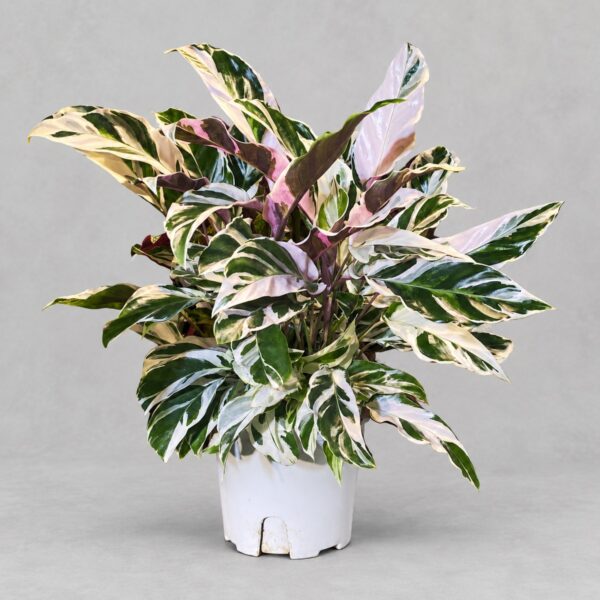
Often marketed as a "Calathea," Stromanthe 'Triostar' actually belongs to the genus Stromanthe (a close relative of Calathea within the same family), with the botanical name Stromanthe sanguinea 'Triostar'. It's native to the rainforests of Brazil. What makes it so captivating is its leaves, which simultaneously display pink, cream, and deep green in an interwoven pattern — every leaf is a unique combination of colours. The underside is a deep magenta, and the whole plant is remarkably colourful. It's a prayer plant, with leaves that open by day and close at night.
Light
It needs bright, diffused light — plenty of light makes the pink colouring more vivid. Avoid direct sun, which fades the leaves or causes sunburn spots. An east-facing window is ideal, and north-facing windows also work well.
Watering
Keep the soil evenly moist, watering once the top 2 cm dries out — every 5–7 days in summer, every 7–10 days in winter. It's sensitive to water quality; use filtered water, rainwater, or tap water left standing. Never let it sit in water, and also avoid letting the soil dry out completely.
Soil & pot
Needs a loose, breathable, organically rich, slightly acidic soil. Suggested recipe: peat moss mixed with perlite and coco coir (roughly 5:2:3). Choose a pot with drainage holes — plastic is lightweight and easy to move, ceramic offers more stability.
Temperature & humidity
Optimal temperature is 18–26°C, never below 15°C. It has high humidity requirements, ideally above 60%. In Hong Kong's dry autumn/winter season, pay particular attention — a humidifier or humidity tray is recommended. It grows better in naturally humid spots like a bathroom.
Common problems
- Leaves fading to green: caused by insufficient light — the pink will gradually fade, so move to a brighter spot
- Dry, curling leaf edges: air too dry or poor water quality — increase humidity and switch to filtered water
- Slow growth: possibly caused by low temperature, insufficient humidity, or nutrient deficiency — apply diluted liquid fertiliser during the growing season
- Brown spots on leaves: possibly sunburn or water pooling on the leaf surface during watering — avoid midday watering and direct strong light
How to explain to customers
"Stromanthe 'Triostar's colours are absolutely stunning — pink, white, and green all together, and it makes a real statement at home!" "It looks fancy, but it's not actually too hard to grow — remember diffused light, high humidity, and filtered water, and you'll be fine on all three counts."
Fun facts
Stromanthe 'Triostar's pink colouring is actually a natural "variegation" mutation — the pink sections lack chlorophyll, so the more light it gets, the more vivid the pink becomes. But because the pink sections can't photosynthesise, the plant's overall growth rate is somewhat slower than a fully green plant.
Keywords
Stromanthe Triostar, Calathea triostar, Stromanthe sanguinea Triostar, Marantaceae, prayer plant, pink foliage plant, variegated plant, indoor potted plant, tropical plant, high humidity plant
In-depth care guide
One-line pitch
Pink, cream, and emerald green woven together in dreamlike foliage that folds up to "pray" each night — one of the rare houseplants that manages to be both romantic and full of energy at once, and it's safe for cats and dogs too.
Origin & characteristics
Stromanthe 'Triostar' is native to the Atlantic coastal rainforests of eastern Brazil, growing in the leaf-litter layer beneath a dense canopy, in conditions warm, humid, high in humidity, and diffused in light year-round. It belongs to the genus Stromanthe within the family Marantaceae, and 'Triostar' is a cultivar bred in Florida, USA in the late 1980s, prized for its stable three-colour variegation.
Botanically speaking, 'Triostar's tricolour display stems from a stable chimeral mutation affecting chloroplast distribution in the epidermal layer, meaning the variegation won't "revert to green" even under insufficient light. The upper leaf surface shows pink, cream, and deep green stripes interwoven, while the underside is a deep wine-red, giving off a captivating red glow when light passes through. Mature plants reach 45–60 cm tall, spreading via underground rhizomes to form a dense clumping habit.
Like other Marantaceae, Stromanthe 'Triostar' exhibits nyctinasty — leaves rise and fall with the day/night cycle: spread out during the day to capture light, folding upward in the evening to reveal the deep wine-red underside, resembling a pair of praying hands. The exact function of this phenomenon remains uncertain, though the leading hypothesis is that the deep red underside may deter nocturnal herbivores, or reduce nighttime water loss.
Light
Stromanthe 'Triostar' needs bright, diffused light, and most dislikes direct sunlight. In a Hong Kong home, east- or north-facing windows are ideal; if placed near south- or west-facing windows, sheer curtains must be drawn or the plant kept 1–1.5 metres back. Too much light causes brown spotting, faded variegation, and even scorched edges; conversely, too little light causes pale new growth and stalled growth, with the plant becoming loose and leggy. Rotate the pot 180 degrees each month to ensure even growth on all sides.
A professional understanding of its light needs: 'Triostar's chloroplast distribution has already been reduced by the variegation, decreasing its total photosynthetic surface area, so it relies more heavily than fully green cultivars on stable, moderate light. You can roughly measure this with a phone light meter app — aim to maintain 800–1,500 lux (roughly 10–20% of overcast outdoor light).
Watering
Stromanthe 'Triostar' is extremely sensitive to water, needing to maintain a state of "consistently slightly moist but never waterlogged." Watering frequency depends on season:
- Spring/summer (peak growing season): roughly every 5–7 days, depending on how quickly the soil dries. Insert a finger about 2–3 cm into the soil, and water once it feels slightly dry.
- Autumn/winter (slower growth): roughly every 7–10 days, letting the topsoil dry slightly longer before watering.
Water quality is critical. Stromanthe 'Triostar' is extremely sensitive to fluoride, chlorine, and mineral salts in tap water, and long-term use causes browning tips and scorched edges. Recommended:
- Filtered / reverse-osmosis water
- Tap water left standing for 24+ hours (to let chlorine dissipate)
- Rainwater (most economical, especially useful during Hong Kong's rainy season)
Watering technique: use room-temperature water (not cold, which shocks the roots), pouring slowly around the pot's edge until it flows from the base, emptying the saucer after 30 minutes. Never let the plant sit in standing water, or root rot easily follows.
Soil & pot
Stromanthe 'Triostar' needs soil that drains well while also retaining moisture. Recommended homemade mix:
- 2 parts coco coir or peat moss
- 1 part perlite or pumice
- 1 part vermiculite
- A small amount of compost or worm castings as base fertility
This recipe mimics the texture of the leaf-litter layer in its native habitat — loose, organically rich, breathable, and moisture-retentive. A slightly acidic pH (5.5–6.5) is ideal.
For pots, a terracotta pot with drainage holes is recommended, since terracotta's breathability aids water evaporation and reduces root rot risk. Plastic pots also work, but require closer attention to watering frequency to avoid waterlogging. When repotting, choose a new pot only 1–2 inches (2.5–5 cm) larger than the current one — an oversized pot causes soil to stay wet for too long.
Young plants should be repotted once a year in spring; mature plants every 2–3 years, or when roots emerge from the drainage holes.
Temperature & humidity
Stromanthe 'Triostar' is a tropical plant with an optimal growing temperature of 18–27°C. Hong Kong's year-round indoor temperature generally falls within this range, but note the following:
- Air-conditioned rooms: survivable, but avoid direct AC airflow, as dry cold air scorches leaf edges
- Winter: growth stalls below 13°C; below 7°C may cause cellular damage, appearing as water-soaked, translucent patches on the leaves
- Summer high heat: above 30°C requires high humidity, or heat exhaustion may occur — curling, drooping leaves
Humidity is key to success. Stromanthe 'Triostar' needs 50–70% relative humidity. Hong Kong summers usually provide sufficient natural humidity, but autumn/winter or long-term AC/heater use can dry the air out. Methods for raising humidity (ranked by effectiveness):
- Humidifier: most directly effective, maintaining 50–60% humidity.
- Pebble tray: a large tray filled with pebbles, water added to half-full, with the pot placed on top (not touching the water) — evaporation raises local humidity.
- Grouping plants: placing multiple high-humidity plants together to mutually raise surrounding humidity.
- Regular misting: mist the leaf surface and surrounding air in the morning (avoid misting in the evening, which may cause overnight humidity buildup and fungal issues). Note that misting alone isn't enough to maintain long-term high humidity — it's best as a supplementary measure only.
Common problems
| Symptom | Likely cause | Solution |
|---|---|---|
| Browning tips, scorched edges | Low humidity / poor water quality / fertiliser too concentrated | Check a hygrometer, use a humidifier if needed; switch to filtered water or rainwater; halve fertiliser concentration |
| Whole leaves yellowing and dropping | Overwatering causing root rot | Stop watering immediately, remove from pot to check roots, trim away rotten roots (brown, mushy, foul-smelling), replant in fresh soil |
| Curling, drooping leaves | Underwatering / low humidity / excessive heat | Check soil moisture, water thoroughly if dry; move to a cooler spot; increase humidity to 70% |
| Fading colour, disappearing variegation | Insufficient light | Move to a brighter position, but avoid direct sun |
| Brown spots on leaves | Sunburn from strong light | Move to a diffused-light position — damaged leaves won't recover, but can be trimmed |
| No new leaves for over 8 weeks | Insufficient light / depleted soil nutrients / root-bound | Check light levels; start diluted liquid fertiliser in spring; consider repotting |
How to explain to customers
"The most important thing with Stromanthe 'Triostar' is humidity — if you run AC a lot at home, remember to get a humidifier nearby, or place a pebble tray underneath. Its leaves fold up at night like they're praying, which is really charming. And it's safe for cats and dogs, though it's still best not to let them chew on it."
Fun facts
Stromanthe 'Triostar's nyctinastic movement is actually driven by a mechanism called "turgor movement" — specialised cells at the petiole base (the pulvinus) absorb or release water in response to daily ionic concentration shifts, causing the leaf to swing up and down like a hinge. The 18th-century Swedish botanist Linnaeus once mistakenly believed prayer plants did this to "sleep," and scientists still haven't fully unravelled the mystery today. 'Triostar's variegation stems from a stable chimeral mutation, unlike many other variegated plants that easily "revert to green," allowing it to maintain its vibrant tricolour display over the long term.
Keywords
Stromanthe Triostar, Stromanthe sanguinea Triostar, nyctinasty, prayer plant, pet-safe plant, high humidity plant, diffused light, tricolour variegation, rhizome propagation
參考資料(想知來源可展開)
References
- Healthy Houseplants. (2024). Stromanthe Triostar Care Guide. https://www.healthyhouseplants.com/wp-content/uploads/2024/12/healthyhouseplants_com_indoor_houseplants_stromanthe_triostar_care_guide.pdf
- Borchsenius, F., Suárez, L. S., & Prince, L. M. (2012). Molecular Phylogeny and Redefined Generic Limits of Calathea (Marantaceae). Systematic Botany, 37(3), 620–635. https://doi.org/10.1600/036364412X648571
- ASPCA. (n.d.). Toxic and Non-Toxic Plants: Prayer Plant. https://www.aspca.org/pet-care/aspca-poison-control/toxic-and-non-toxic-plants/prayer-plant
- Jacobs, M., Lopez-Garcia, M., Phrathep, O. P., Lawson, T., Oulton, R., & Whitney, H. M. (2016). Photonic multilayer structure of Begonia chloroplasts enhances photosynthetic efficiency. Nature Plants, 2, 16162. https://doi.org/10.1038/nplants.2016.162
- Plants of the World Online (POWO). Stromanthe sanguinea. Royal Botanic Gardens, Kew. https://powo.science.kew.org/
⚠️ Pet note: according to the ASPCA (American Society for the Prevention of Cruelty to Animals), Stromanthe sanguinea is non-toxic to cats and dogs. That said, eating any plant in large amounts may cause mild gastrointestinal upset, so it's still best kept out of pets' easy reach.
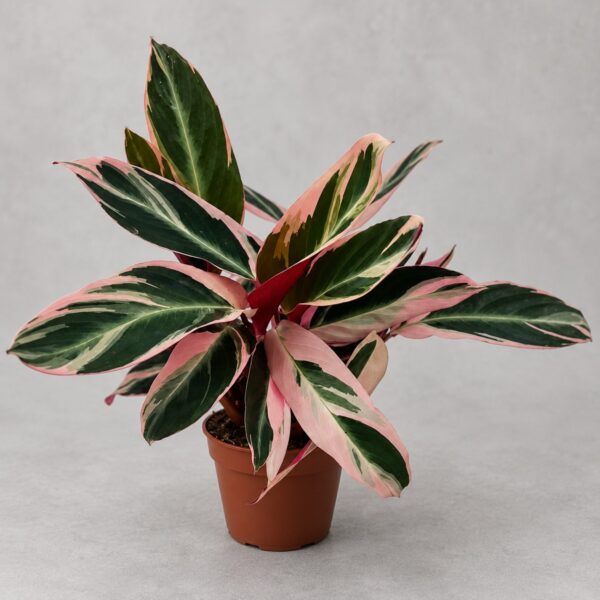
Plantjai shop · In stock online
Calathea triostar
Calathea triostar
HK$188.00
Hong Kong delivery · Causeway Bay pickup
For Hong Kong homes and offices. Stock and pricing follow the product page.
IN STORE NOW
Plants for this guide
Related plants in stock now — live prices, delivery or Causeway Bay pickup.
FREE PLANT ADVICE
Send us a photo before you change anything
WhatsApp a photo of the plant and your window light. Our Causeway Bay team will suggest care steps or plants that suit your space.
STORE · CAUSEWAY BAY
4/F, 39 Yiu Wa Street, Causeway Bay
Daily 12:30–8:00pm · ~3 min walk from Times Square
Map & directionsPlant Care