
How to Care for Calathea Orbifolia in Hong Kong | Plantjai

Plantjai 植仔 · Care Encyclopedia
Calathea Orbifolia
Hong Kong care guide — useful before you buy and after it arrives.
Shop this plantEnormous silver-green striped leaves — the Calathea with the biggest presence in any indoor plant collection.
Origin & characteristics
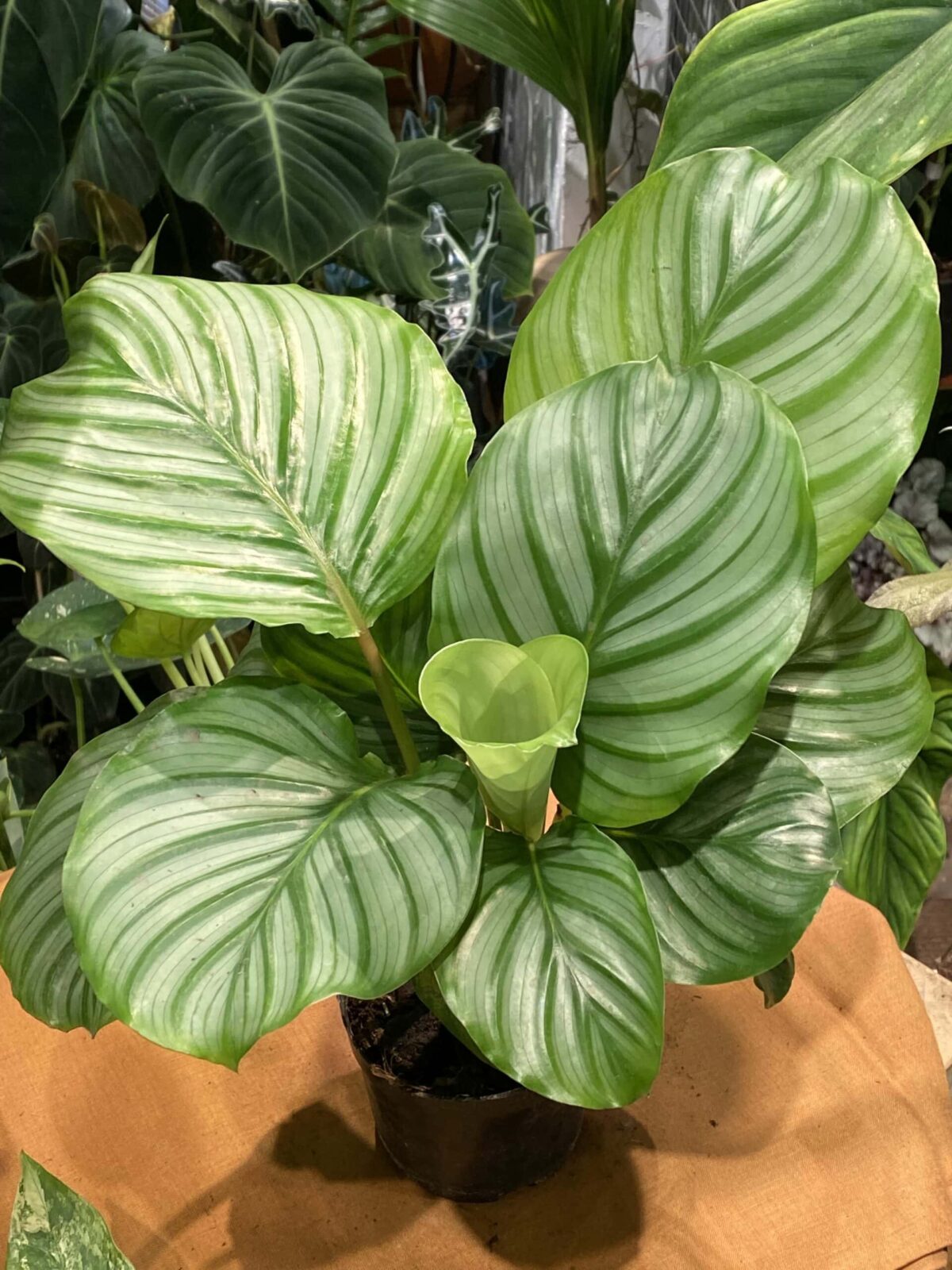
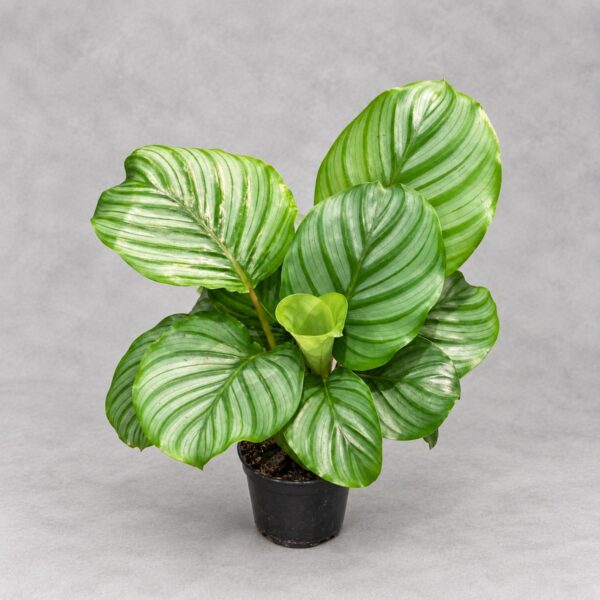
Calathea orbifolia (also known as Round-leaf Calathea) is native to the rainforests of Bolivia, and has recently been reclassified as Goeppertia orbifolia, though the market still commonly uses Calathea orbifolia. It's known for its huge, rounded leaves — mature leaves can exceed 30 cm — with elegant silvery-white and deep green striping that makes a strong visual statement. The leaf underside is a pale purple-red, and the leaves rise upward at night, a classic prayer plant behaviour.
Light
It needs bright, diffused light, and cannot tolerate direct sun, which fades the silver striping or causes scorching. Place it 1–2 metres from a south-facing window, or filter light with a sheer curtain. Too little light causes new leaves to be smaller with reduced striping.
Watering
Keep the soil consistently slightly moist, watering once the top 2 cm dries out — every 5–7 days in summer, every 7–10 days in winter. It's extremely sensitive to water quality, requiring filtered water, rainwater, or water that's been left standing. Minerals in tap water accumulate and cause browning leaf tips. Avoid letting the soil dry out completely.
Soil & pot
Needs a loose, breathable, organically rich, slightly acidic soil that both retains and drains water. Suggested recipe: peat moss mixed with perlite, coco coir, and a little bark (roughly 4:2:2:2). Since the large leaves can make the plant top-heavy, use a heavier ceramic or cement pot for stability.
Temperature & humidity
Optimal temperature is 18–24°C; below 15°C or above 30°C both affect growth. It has very high humidity requirements, ideally 60–80%. In Hong Kong's dry autumn/winter season, a humidifier is essential, or place on a moist pebble tray. Dry conditions are the main cause of browning leaf edges.
Common problems
- Large-scale yellowing along leaf edges: almost always caused by insufficient humidity or poor water quality — immediately increase humidity and switch to filtered water
- Small or deformed new leaves: possibly nutrient deficiency, insufficient light, or low humidity
- Holes or tears in leaves: physical damage or pest activity (check for spider mites) — Calathea orbifolia's thin leaves are prone to tearing
- Growth stalling: normal during winter dormancy; if not winter, roots may be pot-bound and need repotting into a larger pot
How to explain to customers
"Calathea orbifolia's leaves are so big and beautiful — put one in your living room and the whole space instantly feels more alive!" "It's a bit of a diva among plants, needing high humidity — ideally paired with a humidifier — and remember to water with filtered water."
Fun facts
Calathea orbifolia's leaves adjust their angle according to light direction, lying flat during the day to capture light and rising vertically at night — a movement believed to help reduce water loss and protect the leaf surface.
Keywords
Calathea orbifolia, Goeppertia orbifolia, round-leaf Calathea, Calathea, large foliage plant, prayer plant, silver-green striping, indoor potted plant, high humidity plant
In-depth care guide
One-line pitch
Massive, rounded leaves up to 30 cm across, with silver-green stripes radiating outward in near-perfect symmetry — a sculptural masterpiece within the Calathea family, instantly elevating the feel of any living room.
Origin & characteristics
Calathea orbifolia is native to the tropical rainforests of eastern Bolivia in South America, growing in the leaf-litter layer of the forest floor beneath a dense canopy, in conditions that are warm, humid, and dim year-round. It belongs to the family Marantaceae, and is one of the representative species transferred from Calathea to Goeppertia in a recent taxonomic revision. In 2012, Danish botanist Borchsenius and colleagues, through molecular phylogenetic research, confirmed that the traditionally broad genus Calathea was polyphyletic, leading to the reinstatement of the genus Goeppertia and the transfer of roughly 250 species — including Calathea orbifolia — into it. While the horticultural trade still commonly uses the older name Calathea orbifolia, it's listed as Goeppertia orbifolia in academic literature and authoritative databases such as Plants of the World Online (POWO).
Calathea orbifolia's defining feature is its huge, round leaves, reaching 25–30 cm in diameter at maturity, with a deep green base overlaid with broad, radiating silvery-green or blue-green stripes, giving a thick, glossy texture that feels like high-quality waxed paper. Mature plants reach 60–90 cm tall, forming a dense clumping habit. Like other Marantaceae, it exhibits classic nyctinasty (rhythmic leaf movement), rising and falling with the day/night cycle. In the wild, it may produce small white flowers under favourable conditions, though indoor-grown specimens rarely flower.
Light
Calathea orbifolia needs bright but soft, diffused light, and absolutely cannot tolerate direct sunlight. In a Hong Kong home, the best position is within about 1 metre of an east- or north-facing window; if only a south-facing window is available, sheer curtains must be drawn or the plant kept 2 metres or further from the window. Too much light causes brown spotting, faded striping, and even scorched edges; too little light causes smaller new leaves, faded stripes, and slow growth. Rotate the pot once a month to ensure even growth on all sides.
A practical test: at the plant's location, you should be able to comfortably read a book or newspaper during the day without turning on a light — that's about the right brightness for Calathea orbifolia.
Watering
Calathea orbifolia has strict water requirements, needing consistently slightly moist soil — neither fully dried out nor waterlogged. Its roots are fine and delicate, and even a day or two of complete dryness can cause scorched leaf edges.
Recommended watering frequency:
- Spring/summer: every 5–7 days, checking by inserting a finger 2–3 cm into the soil and watering once it feels slightly dry
- Autumn/winter: every 7–10 days, letting the topsoil dry slightly longer before watering
On water quality, Calathea orbifolia is sensitive to fluoride, chlorine, and mineral salts in tap water, and long-term use causes browning leaf tips. Filtered water, reverse-osmosis water, or tap water left standing for 24+ hours is recommended. While some gardening experts (such as Craig Miller-Randle of Australia's Gardening Australia) believe tap water mineral content doesn't necessarily directly harm plants, for sensitive species like Calathea orbifolia, using filtered water or rainwater remains the safest approach.
Watering technique: pour room-temperature water slowly around the pot's edge until it flows from the base, emptying the saucer after 30 minutes. If you're worried about not watering thoroughly enough, try the "bottom-up soak method" — set the pot in a basin of water for 15–20 minutes to let the soil absorb moisture naturally, then remove and drain.
Soil & pot
Calathea orbifolia needs a lightweight soil that both drains well and retains moisture. Recommended recipe:
- 2 parts coco coir or peat moss (moisture retention)
- 1 part perlite (drainage and aeration)
- 1 part vermiculite (moisture retention and slow-release minerals)
- A small amount of compost or worm castings (base fertility)
Maintain a slightly acidic pH (5.5–6.5). A commercial African violet mix, thanks to its fine, light texture, actually suits Calathea orbifolia quite well too.
For pot choice, terracotta is preferred for its breathability, which supports a healthy wet-dry cycle in the soil; plastic pots require stricter watering control. Ensure the pot has drainage holes. When repotting, choose a new pot only 1–2 inches larger than the current one, generally repotting once every 2 years, or when roots emerge from the drainage holes or the soil dries unusually quickly after watering (indicating the roots have filled the pot).
Temperature & humidity
Calathea orbifolia's optimal growing temperature is 18–24°C, never below 15°C. Hong Kong's year-round indoor conditions generally meet this, but pay attention to the following situations:
- Air-conditioned rooms: survivable, but avoid direct AC airflow, as dry cold air will scorch leaf edges
- Winter heating: heating dries the air significantly, requiring humidification measures
- Summer: above 30°C requires enhanced ventilation and humidity management
Humidity is the key to successfully growing Calathea orbifolia. It needs above 60% relative humidity, with leaf-edge scorching starting to appear below 50%. Recommended methods:
- Humidifier: the most reliable method, especially useful during autumn/winter heating season
- Pebble tray: a large tray filled with pebbles and water, with the pot placed on top
- Bathroom placement: if the bathroom has a window providing natural light, the humid bathroom environment is actually ideal
- Grouping: placing it with other high-humidity plants (such as ferns and other Calatheas) to create a shared microclimate
Common problems
| Symptom | Likely cause | Solution |
|---|---|---|
| Browning, scorched leaf edges | Low humidity / poor water quality / roots too dry | Immediately raise humidity above 60%; switch to filtered water or rainwater; check watering frequency |
| Small, faded new leaves | Insufficient light | Move to a brighter diffused-light position |
| Yellow spots turning brown | Sunburn from strong light | Move to a shadier spot — damaged leaves won't recover |
| Drooping, soft leaves | Underwatering / root rot | Check soil moisture, water thoroughly if dry; if soil is waterlogged, check for root rot |
| Yellowing, dropping lower leaves | Natural ageing / overwatering | If only 1–2 older leaves yellow, this is normal; if extensive, check root health |
| Growth stalling for over 2 months | Light too weak / needs repotting / nutrient deficiency | Adjust lighting; repot in spring; start a diluted liquid fertiliser routine |
How to explain to customers
"Calathea orbifolia is genuinely gorgeous, but it's a bit of a 'diva' among plants — humidity and water quality are everything. If your home runs AC a lot, get a humidifier, or even place it in the bathroom — as long as there's a window for light. Water with filtered water or water that's been left standing overnight to prevent browning leaf edges. And its leaves rise and fall with day and night, giving it real character."
Fun facts
Calathea orbifolia was "reassigned" in a 2012 molecular phylogenetic study — moved from the genus Calathea to Goeppertia. This taxonomic shift matters because it revealed that the traditional Calathea genus wasn't a "natural group" (i.e., not descended from a single common ancestor), but rather a mix of superficially similar species that were actually quite distantly related. The genus name Goeppertia was actually first published in 1831 by German botanist Nees von Esenbeck, but lay dormant for nearly two centuries before being revived. The horticultural trade still commonly calls it "Calathea orbifolia," so it's worth searching both names.
It's also worth noting that Calathea orbifolia grows at relatively higher elevations in its native Bolivia, in montane cloud forest. Compared with other lowland Calatheas, it has somewhat better tolerance for cool conditions, though its humidity requirements remain strict.
Keywords
Calathea orbifolia, Goeppertia orbifolia, Marantaceae, taxonomic revision, high humidity plant, diffused light, indoor foliage, nyctinasty, pet-safe
參考資料(想知來源可展開)
References
- Borchsenius, F., Suárez, L. S., & Prince, L. M. (2012). Molecular Phylogeny and Redefined Generic Limits of Calathea (Marantaceae). Systematic Botany, 37(3), 620–635. https://doi.org/10.1600/036364412X648571
- ABC News Australia. (2021). How to care for the Calathea orbifolia. https://www.abc.net.au/news/2021-10-08/how-to-care-for-the-calathea-orbifolia/100515918
- Gardenia.net. (2024). Calathea orbifolia: Care and Growing Guide. https://www.gardenia.net/plant/calathea-orbifolia-care-growing-guide
- The Spruce. (2022). How to Grow and Care for Calathea Orbifolia. https://www.thespruce.com/calathea-orbifolia-growing-guide-5270824
- Plants of the World Online (POWO). Goeppertia orbifolia. Royal Botanic Gardens, Kew. https://powo.science.kew.org/
⚠️ Pet note: Calathea orbifolia (Goeppertia orbifolia) is non-toxic to cats and dogs, and the ASPCA lists Marantaceae plants as safe. However, eating large amounts may still cause mild gastrointestinal upset, so keep the plant out of pets' easy reach. Those with sensitive skin may experience mild irritation from contact with the sap — wash hands after handling.
Plantjai shop · In stock online
Calathea orbifolia
Calathea orbifolia
from HK$118.00
Hong Kong delivery · Causeway Bay pickup
For Hong Kong homes and offices. Stock and pricing follow the product page.
IN STORE NOW
Plants for this guide
Related plants in stock now — live prices, delivery or Causeway Bay pickup.
FREE PLANT ADVICE
Send us a photo before you change anything
WhatsApp a photo of the plant and your window light. Our Causeway Bay team will suggest care steps or plants that suit your space.
STORE · CAUSEWAY BAY
4/F, 39 Yiu Wa Street, Causeway Bay
Daily 12:30–8:00pm · ~3 min walk from Times Square
Map & directionsPlant Care