

How to Care for Begonia Lubbergai in Hong Kong | Plantjai


Plantjai 植仔 · Care Encyclopedia
Begonia Lubbergai
Hong Kong care guide — useful before you buy and after it arrives.
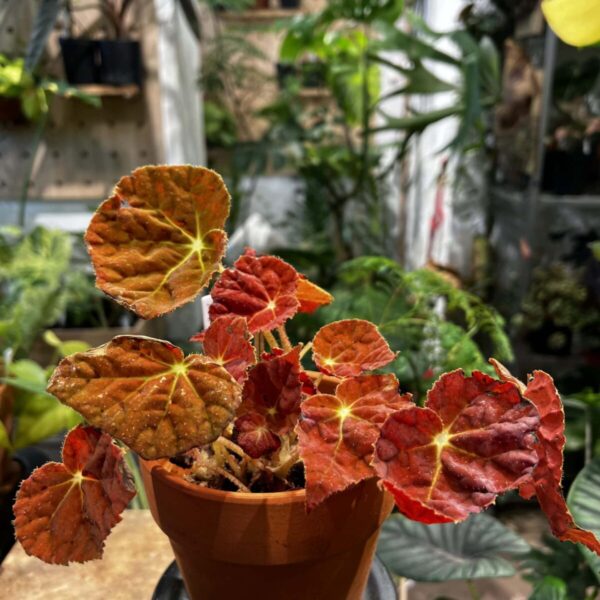
Shop this plantNew growth glows with a fluorescent green tint, in an unusual wing-like leaf shape full of otherworldly charm.
⚠️ Toxicity warning: Begonias contain calcium oxalate crystals throughout the plant, which can cause oral irritation, drooling, and vomiting if ingested. Keep out of reach of children and pets.
Origin & characteristics
Lubbergai Begonia is a hybrid between Begonia baccata and Begonia capensis. Its most eye-catching feature is the unique leaf shape and luminous colouring — new leaves emerge a fresh, faintly fluorescent green, with an elegantly elongated form and slightly wavy edges. The plant grows in a fairly upright habit and is a small-to-medium sized begonia, showing its brightest colours under ample light.
Light
- Prefers bright, diffused light; more light produces more vivid leaf colour
- Can tolerate 1–2 hours of gentle morning direct sun
- Avoid direct midday sun, which easily scorches the leaves
- Indoors, place about 1–2 metres from an east- or south-facing window
- Insufficient light causes the fluorescent leaf colour to fade, losing its distinctive charm
Watering
- Water once the topsoil is dry about 2–3 cm down
- Keep the soil lightly moist; never let it become waterlogged
- Water slightly more often during summer's active growth
- Reduce watering in winter, letting the soil run drier
- Water along the pot's edge, avoiding wetting the leaves
- Room-temperature filtered water or rainwater is recommended
Soil & pot
- Needs a loose, well-draining, slightly acidic soil
- Recommended recipe: 4 parts peat + 3 parts perlite + 2 parts coco coir + 1 part bark chips
- Pot must have drainage holes; terracotta or cement pots both work
- Roots aren't especially deep, so a medium-depth pot is sufficient
- Repot every 1–2 years, ideally in spring
Temperature & humidity
- Optimal growing temperature: 20–28°C
- Never below 15°C; growth stalls above 33°C
- Ensure good ventilation during Hong Kong's hot summers
- Humidity of 60–75% is recommended; higher humidity helps leaves keep their sheen
- A humidifier or pebble tray can help boost humidity
- Slightly enclosed growing conditions speed growth, but regular ventilation is still needed
Common problems
| Issue | Likely cause | What to do |
|---|---|---|
| Fluorescent leaf colour fading | Insufficient light | Move to a brighter position |
| Leaves yellowing and dropping | Overwatering, root rot | Reduce watering, check root health |
| Leaf tips browning | Humidity too low or water too alkaline | Increase humidity, switch to filtered water |
| Leggy, stretched growth | Prolonged low light | Gradually increase diffused light |
| Leaves going soft and drooping | Temperature too low or root issues | Check temperature and roots, repot if necessary |
How to explain to customers
"Lubbergai is a hybrid begonia — its new leaves come in a gorgeous fluorescent green, and the leaf shape is really distinctive, so it stands out beautifully at home! It's also fairly easy-going: just give it enough diffused light and don't drown the roots. If your home has higher humidity, it'll grow even faster and more beautifully."
Fun facts
Lubbergai Begonia is named after the Dutch begonia breeder Lubbers, who successfully crossed Begonia baccata with Begonia capensis. Its fluorescent-toned new leaves gradually deepen to a richer green as they age, so a mature plant displays a layered beauty of glowing new growth alongside deep green older leaves.
Keywords
Lubbergai Begonia, Begonia lubbersii, begonia, hybrid begonia, foliage plant, fluorescent green leaves, Begonia capensis descendant, small-to-medium begonia, indoor plant, Plantjai, Hong Kong plant shop, bright diffused light, easy-care plant, upright begonia
參考資料(想知來源可展開)
References
- Begin With Plants. Begonia lubbersii. https://beginwithplants.com/products/begonia-lubbersii
- The Spruce. How to Grow and Care for Begonia Maculata. https://www.thespruce.com/begonia-maculata-care-guide-6743839
- Longfield Gardens. Polka Dot Begonia Propagation in Water. https://www.longfield-gardens.com/blogs/begonia-care/polka-dot-begonia-propagation-in-water-made-easy
In-depth care guide
Introduction
Lubbergai Begonia, botanically Begonia lubbersii, is a distinctive cane-type begonia within the vast Begonia genus. It's native to Brazil's Atlantic Forest and was named by a Belgian botanist after "Lubbers." The species is relatively uncommon in plant collecting circles, but its striking leaf markings and elegantly elongated leaf shape have earned it a devoted following.
The most striking ornamental feature of Lubbergai Begonia is its foliage — slender, pointed leaves scattered with silvery spots. These silver spots are actually specialised epidermal cells that reflect excess light, serving as natural sun protection in the plant's native habitat (Begin With Plants, n.d.). The leaf texture has a slight velvety quality, with the deep green base colour setting off the silvery-white spots beautifully; the effect shimmers as the viewing angle changes, adding real visual depth. Another distinctive feature is that the leaf attaches to the petiole at a point in the middle of the leaf blade (a "peltate" attachment) rather than at the base, as is more typical — this quirk makes it stand out further from other begonias.
Beyond its beautiful foliage, Lubbergai Begonia also produces large, fragrant white flowers intermittently, adding further charm. Plants typically reach around 30–45 cm in height, making them well suited to indoor potted growing (Begin With Plants, n.d.).
Native habitat
Lubbergai Begonia is native to Brazil's Atlantic Forest in the southeast of the country. This forest stretches along the Atlantic coastline, with a warm, humid climate, abundant year-round rainfall, and average humidity consistently above 70%. In its native environment, it grows in semi-shaded positions on the forest floor, receiving diffused light filtered through the canopy above.
The Atlantic Forest hosts extraordinary biodiversity, and begonias have evolved into a remarkably rich array of forms here. Lubbergai Begonia has adapted to the humid, well-ventilated, softly-lit conditions of the forest floor — exactly the conditions we should aim to replicate indoors.
Light requirements
Lubbergai Begonia needs bright, indirect light for roughly six to eight hours daily (Begin With Plants, n.d.). Place it near an east-facing window to enjoy gentle morning sun, or about one body's width from a south-facing window to receive bright but filtered light.
Direct sun, especially at midday, should be avoided entirely, since the plant's relatively thin leaves scorch easily, developing brown patches. If light is too weak, the silvery spots become dull and less visible, and the plant becomes leggy with thin, weak stems. Rotating the pot regularly helps ensure even growth on all sides.
If your home doesn't have enough natural light, consider a full-spectrum grow light, providing around eight to ten hours of illumination daily, positioned roughly 30–45 cm from the leaf surface.
Watering technique
The watering principle for Lubbergai Begonia is "let it dry, then water thoroughly." Wait until the top inch or so of soil (roughly two to three finger-joints deep) has dried out before watering again (Begin With Plants, n.d.). Insert a finger into the soil to test — if it feels dry, it's time to water.
Water slowly along the pot's edge, avoiding direct contact with the leaves, since standing water on begonia foliage easily triggers fungal disease. Water thoroughly until it flows from the drainage holes, and empty the saucer of any collected water within half an hour.
In summer's active growth period, water roughly every five to seven days; in winter, extend this to every seven to ten days. Lubbergai Begonia is quite sensitive to overwatering — yellowing leaves are usually a warning sign of excess moisture, while wilting leaves or brittle leaf edges indicate underwatering. Observing the plant's condition is generally more useful than following a fixed schedule.
As for water quality, filtered water, rainwater, or tap water left to stand overnight is best, reducing the impact of dissolved minerals on the root system.
Humidity requirements
The ideal humidity range for Lubbergai Begonia is 50–70% (Begin With Plants, n.d.). If humidity remains below 40% for extended periods, leaf tips easily dry out and turn brown, affecting overall growth.
Practical ways to raise humidity include: an ultrasonic humidifier, which is the most direct and effective method; grouping plants together to create a shared humid microclimate; and placing a pebble tray filled with water beneath the pot (making sure the pot base doesn't touch the water). Good air circulation matters just as much — while begonias enjoy humidity, stagnant, warm, humid air easily triggers powdery mildew and botrytis (grey mould).
Temperature control
The ideal growing temperature for Lubbergai Begonia is 18–24°C, with slightly cooler nights being acceptable (Begin With Plants, n.d.). It doesn't tolerate temperature extremes well — sustained temperatures below 15°C or above 27°C both stress the plant. In winter, keep it away from cold drafts near windows and heater vents; in summer, avoid direct AC airflow.
Sudden temperature changes, such as the temperature swing from turning on AC or heating, can cause leaf drop or stalled growth in begonias. Try to place the plant somewhere with relatively stable temperatures.
Growing medium
Lubbergai Begonia needs a well-draining, organic-matter-rich, slightly acidic medium, with an ideal pH of around 6.0–6.5 (Begin With Plants, n.d.). A useful DIY recipe: 3 parts general potting soil + 2 parts perlite or vermiculite + 1 part sphagnum moss or coco coir + 1 part compost. This combination provides sufficient drainage and airflow while retaining adequate moisture and nutrients.
Check the soil texture regularly — if the medium becomes compacted or drainage slows, loosen or replace it promptly. Avoid overly heavy garden soil, since the plant's fine roots rot easily in dense, waterlogged conditions.
For pots, choose terracotta or plastic pots with drainage holes. Terracotta offers better airflow, helping reduce the risk of root rot, while plastic retains moisture better. Choose a pot size appropriate to the plant, rather than jumping straight to an oversized pot.
Fertilising
During the growing season (spring through autumn), apply a balanced fertiliser (such as NPK 10-10-10) diluted to half strength every four to six weeks (Begin With Plants, n.d.). Make sure the soil is already moist before fertilising, to avoid root burn from concentrated fertiliser. Pause fertilising entirely in winter as growth slows.
If new leaves appear pale and growth is slow, this may indicate a nutrient deficiency; conversely, if leaf tips turn scorched yellow or white salt deposits appear on the soil surface, this signals overfertilising, and the medium should be flushed thoroughly with clean water.
Repotting
Lubbergai Begonia generally needs repotting about once a year, or whenever the plant has roughly doubled in size (Begin With Plants, n.d.). The best time is just before the spring growing season begins. Choose a new pot about 2–3 cm larger in diameter than the current one, add fresh medium, gently firm it down, and water thoroughly.
After repotting, place the plant somewhere with bright, diffused light to recover for a few days, avoiding fertiliser for the first two weeks. It's normal for begonias to show a brief "adjustment period" after repotting, appearing slightly wilted or pausing growth — as long as you maintain appropriate humidity and avoid strong light, this usually resolves within one to two weeks.
Pruning and maintenance
Lubbergai Begonia benefits from regular pruning to maintain an attractive shape and encourage branching. Promptly removing yellowed, damaged, or overly dense leaves improves airflow and encourages new growth (Begin With Plants, n.d.). Remove spent flowers promptly too, to avoid wasting the plant's energy.
Use clean, sharp scissors when pruning, cutting just above a leaf node or petiole base. Wear gloves, since begonia sap can irritate skin. You can wipe the leaves gently with a soft damp cloth periodically to remove dust and keep the foliage glossy.
Propagation
Lubbergai Begonia is primarily propagated through stem cuttings. Select a healthy stem segment about 10–15 cm long, ensuring it includes two to three nodes, remove the lower leaves, and insert it into clean water or moist sphagnum moss. Place it in bright, diffused light and maintain humidity — roots typically begin forming after two to three weeks. Once roots reach about 2–3 cm long, transplant into soil.
Begonias can also be propagated by leaf cuttings. Select a healthy, mature leaf with its petiole attached, insert the petiole into moist medium, and maintain high humidity — new shoots typically emerge from the base of the petiole after about three to four weeks.
Common problems in detail
Yellowing leaves: Usually caused by overwatering leading to oxygen-starved or rotting roots. Check soil moisture, and if it feels overly wet, pause watering and let the medium dry out fully. Repot to check the roots in severe cases.
Dry, browning leaf edges: Most commonly caused by low humidity or overly dry air. Increase ambient humidity and avoid placing the plant near heater vents.
Powdery mildew: A common fungal disease in begonias, appearing as a white powdery coating on the leaves. Usually linked to high humidity and poor ventilation. Improve air circulation, and use an organic fungicide if necessary.
Thin, stretched growth with elongated internodes: A classic sign of insufficient light. Move the plant closer to a light source or use a grow light.
Pests: Common pests include aphids, spider mites, and whitefly. Check the undersides of leaves regularly, and treat promptly with soapy water or neem oil if pests are found (Begin With Plants, n.d.).
Toxicity information
Lubbergai Begonia contains oxalic acid, posing potential toxicity to pets and children. Ingestion may cause oral irritation, vomiting, and diarrhoea. Keep the plant out of reach, and wash your hands after handling (Begin With Plants, n.d.).
References
- Begin With Plants. Begonia lubbersii. https://beginwithplants.com/products/begonia-lubbersii
- Reddit r/begonias. Got my Begonia Lubbersii yesterday. Any care tip? https://www.reddit.com/r/begonias/comments/ju799q/got_my_begonia_lubbersii_yesterday_any_care_tip/
- The Spruce. How to Grow and Care for Begonia Maculata. https://www.thespruce.com/begonia-maculata-care-guide-6743839
- Longfield Gardens. Polka Dot Begonia Propagation in Water. https://www.longfield-gardens.com/blogs/begonia-care/polka-dot-begonia-propagation-in-water-made-easy

Plantjai shop · In stock online
Begonia Lubbergai
HK$238.00
Hong Kong delivery · Causeway Bay pickup
For Hong Kong homes and offices. Stock and pricing follow the product page.
IN STORE NOW
Plants for this guide
Related plants in stock now — live prices, delivery or Causeway Bay pickup.


FREE PLANT ADVICE
Send us a photo before you change anything
WhatsApp a photo of the plant and your window light. Our Causeway Bay team will suggest care steps or plants that suit your space.
STORE · CAUSEWAY BAY
4/F, 39 Yiu Wa Street, Causeway Bay
Daily 12:30–8:00pm · ~3 min walk from Times Square
Map & directionsPlant Care


