
Plant Care

How to Care for Ardisia Gagantifolia in Hong Kong | Plantjai

Ardisia gigantifolia 走馬胎

Plantjai 植仔 · Care Encyclopedia

Ardisia Gagantifolia

Ardisia gigantifolia 走馬胎

Hong Kong care guide — useful before you buy and after it arrives.

Shop this plant

Giant leaves paired with bright red berries — a lush, tropical rainforest presence with real ornamental fruit appeal.

LightPrefers semi-shade to bright, diffused light. In the wild it grows beneath the forest canopy, accustomed to shaded conditions. In summer, avoid strong direct sunlight to prevent leaf scorching; in winter it can tolera…
WateringLikes moist but well-draining soil. Water once the top 2–3 cm of soil has dried, watering thoroughly each time. Roughly every 5–7 days, increasing frequency during hot summer weather. Reduce watering in winter, to rou…
SoilSuits a fertile, well-draining loam. A recommended recipe: leaf mould, garden soil, and coarse sand at a 2:2:1 ratio, with a small amount of organic base fertiliser added. Choose a pot with drainage holes — ceramic or…
ClimateIdeal temperature is 20–30°C; avoid temperatures below 10°C in winter, or the leaves may suffer cold damage. Relative humidity of 50–70% is ideal. In dry air, the leaves lose their sheen — regular misting or placement…

Origin & characteristics

Giant-Leaf Ardisia is native to southern China, including Guangxi, Yunnan, and Guizhou, growing in the shaded, humid mountain forests below 1,300 metres elevation. It belongs to the Ardisia genus in the Primulaceae family, as a large evergreen shrub. The plant can reach 1–3 metres tall, with wide, thick, glossy deep green leaves that give it a distinctly tropical presence. It flowers from April to June each year, fruiting from November to December, with vivid red berries that are highly ornamental. The whole plant is used in traditional medicine, valued for its wind-dispelling, damp-clearing, and pain-relieving properties.

Light

Prefers semi-shade to bright, diffused light. In the wild it grows beneath the forest canopy, accustomed to shaded conditions. In summer, avoid strong direct sunlight to prevent leaf scorching; in winter it can tolerate more light. Indoors, place it 2–3 metres from a window, or use a curtain to filter light. Prolonged insufficient light reduces flowering and fruiting.

Watering

Likes moist but well-draining soil. Water once the top 2–3 cm of soil has dried, watering thoroughly each time. Roughly every 5–7 days, increasing frequency during hot summer weather. Reduce watering in winter, to roughly every 7–10 days. Avoid waterlogging, which easily leads to root rot. Regular misting on the leaf surface helps keep the leaves glossy.

Soil & pot

Suits a fertile, well-draining loam. A recommended recipe: leaf mould, garden soil, and coarse sand at a 2:2:1 ratio, with a small amount of organic base fertiliser added. Choose a pot with drainage holes — ceramic or plastic both work. Repot once a year in spring, adding fresh potting soil and organic fertiliser at repotting time.

Temperature & humidity

Ideal temperature is 20–30°C; avoid temperatures below 10°C in winter, or the leaves may suffer cold damage. Relative humidity of 50–70% is ideal. In dry air, the leaves lose their sheen — regular misting or placement in a more humid environment is recommended. Ensure good ventilation in high summer heat to avoid stuffy conditions.

Common problems

IssueLikely causeWhat to do
Yellowing, dropping leavesWaterlogging causing root rot, temperature too low, or insufficient lightCheck soil moisture and root health
Fruit droppingExcessive temperature swings or improper water managementKeep the environment stable, avoid alternating between too wet and too dry
Leaves losing their sheenAir too dry or dust accumulationIncrease misting frequency, wipe leaves regularly with a damp cloth
PestsOccasional aphids or spider mitesTreat with soapy water spray or a natural insecticide

How to explain to customers

"Giant-Leaf Ardisia has such large leaves — it gives your home real rainforest vibes, and it even produces red berries in winter! It's fairly easy to grow — just avoid direct sun and keep the soil moist, and you'll be fine."

Fun facts

In traditional Chinese medicine, Giant-Leaf Ardisia is valued as a medicinal plant — the roots and whole plant are used, with properties for dispelling wind, clearing dampness, and promoting blood circulation, commonly used to treat rheumatic bone pain and injuries from falls.

Keywords

Giant-Leaf Ardisia, Ardisia gigantifolia, Primulaceae, ornamental fruit plant, tropical presence, semi-shade, moist, red berries, medicinal plant, evergreen shrub

參考資料(想知來源可展開)

References

  1. Yu, J., Qu, S., Xie, Q., Shama, R., Bao, M., Su, H., Liu, B., & Borjigidai, A. (2023). Ardisia gigantifolia stapf (Primulaceae): A review of ethnobotany, phytochemistry, pharmacology, clinical application, and toxicity. Journal of Ethnopharmacology, 305, 116079. https://doi.org/10.1016/j.jep.2022.116079
  2. Plants of the World Online (POWO). Ardisia gigantifolia Stapf. Royal Botanic Gardens, Kew. https://powo.science.kew.org/
  3. World Flora Online. Ardisia gigantifolia Stapf. https://www.worldfloraonline.org/taxon/wfo-0000544353

⚠️ Pet / toxicity note: As a medicinal plant, Giant-Leaf Ardisia contains various bioactive compounds (including triterpenoid saponins) that may pose potential toxicity risks to cats and dogs — keep it out of reach of pets. While clinical research suggests it's relatively safe for humans at normal dosages, self-harvesting for consumption isn't recommended, and pregnant or breastfeeding women in particular should avoid internal use.


In-depth care guide

One-line pitch

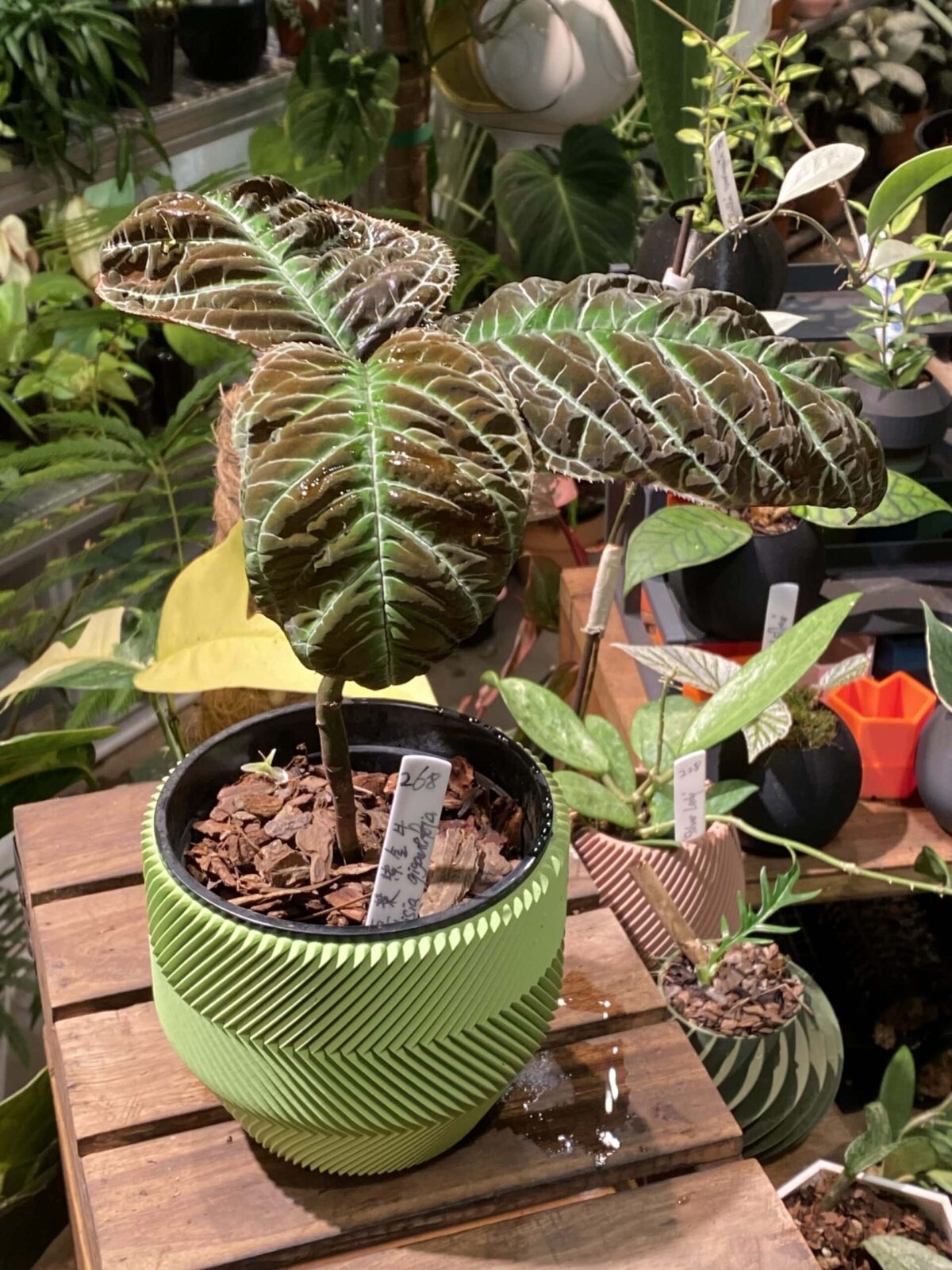
Nearly black leaves with lightning-bolt silver-white veins running through — a medicinal treasure from the depths of Southeast Asian rainforest, and in recent years, an understated luxury darling of the foliage plant world, with genuinely simple care but real presence.

Origin & characteristics

Giant-Leaf Ardisia, scientifically Ardisia gigantifolia Stapf, belongs to the Primulaceae family, genus Ardisia. Ardisia is a large genus within the Primulaceae family, with over 700 accepted species worldwide, distributed mainly across tropical East Asia, Southeast Asia, the Americas, Australia, and Pacific islands, with 65 species found in China, 32 of which are endemic. Giant-Leaf Ardisia is distributed mainly across southern China (Guangxi, Yunnan, Guangdong, Jiangxi, Hainan, Fujian), Thailand, Vietnam, and Laos, growing in evergreen broadleaf forest at roughly 1,250–1,300 metres elevation.

In Chinese folk medicine, Giant-Leaf Ardisia has over 400 years of documented medicinal use, first recorded in 1711 in the Shengcao Yaoxing Beiyao. It has many local names, and there's a well-known folk saying: "for foot ailments, nothing works without走馬胎" — showing its high standing in traditional medicine. Various ethnic minority groups in southern China use it to treat rheumatic joint pain, injuries from falls, fractures, and post-partum blood stasis. The rhizome is the primary medicinal part used, rich in triterpenoid saponins, polyphenols, coumarins, quinones, and flavonoid compounds.

Morphologically, Giant-Leaf Ardisia is an evergreen shrub or subshrub with a creeping rhizome, an erect stem, growing up to 1–1.5 (–3) metres tall. The leaves are large, elliptical to oblanceolate, 25–48 cm long and 5–19 cm wide, leathery, with prominent glandular dots on the surface, and 15–20 pairs of lateral veins per side, giving distinct, raised venation. The leaf colour is deep green to nearly black, with veins in a contrasting silver-white, giving it exceptional ornamental value. The flowers are small, white or pale pink, arranged in a pyramidal panicle. The fruit is globose, roughly 6 mm in diameter, turning red with longitudinal striping when ripe.

In 2023, Yu et al. published a detailed review in the Journal of Ethnopharmacology, summarising the ethnobotany, phytochemistry, pharmacology, clinical application, and toxicity research of Giant-Leaf Ardisia. By that point, 165 compounds had been isolated and identified from the plant, with triterpenoid saponins (such as gigantifolinol, AG4, AG36) being the primary active compounds, showing a range of pharmacological activities including anti-tumour, anti-inflammatory, antioxidant, anti-tuberculosis, and neuroprotective effects.

Light

Giant-Leaf Ardisia is native to the dense forest floor, adapted to semi-shade to full shade conditions. For a Hong Kong home, recommended placements include:

  • A north-facing windowsill
  • 2–3 metres from an east- or west-facing window
  • A south-facing window filtered by a sheer curtain

It can tolerate brief exposure to gentle morning light, but absolutely cannot handle strong sun exposure — direct sunlight will scorch the leaves, causing irreversible yellow spots on the deep green leaf surface. If light is too weak, the silver-white venation becomes less distinct, and growth slows. It's recommended to maintain an ambient light level of 500–1,500 lux.

Giant-Leaf Ardisia's light tolerance range is actually fairly broad, which makes it relatively easy to care for in Hong Kong indoor environments. Even if your home doesn't have particularly abundant light, it can still maintain healthy growth.

Watering

Giant-Leaf Ardisia needs consistently moist soil, but must never be waterlogged. It's native to a rainforest environment, where soil stays consistently moist but well-draining.

Watering recommendations:

  • Spring/summer: water once every 5–7 days, testing by inserting a finger roughly 3 cm into the pot soil — water once it's slightly dry.
  • Autumn/winter: roughly every 7–10 days, letting the topsoil dry out a bit more before watering.

Use room-temperature water, watering thoroughly along the pot's edge until it flows from the base, then empty the standing water after 30 minutes. Giant-Leaf Ardisia isn't particularly demanding about water quality — generally filtered water or settled tap water both work fine. If using consistently soft water long-term, you can occasionally supplement with trace minerals.

Giant-Leaf Ardisia has some drought-buffering capacity — occasionally forgetting to water for a day or two won't cause immediate problems, but prolonged drought will cause the leaves to droop and edges to scorch. Compared to other tropical foliage plants, it's a relatively "forgiving" species.

Soil & pot

Giant-Leaf Ardisia likes a fertile, well-draining, slightly acidic soil. A recommended recipe:

  • Peat moss or coco coir, 2 parts
  • Perlite or coarse sand, 1 part
  • Pine bark or coconut husk chips, 1 part (increases aeration)
  • A small amount of compost or worm castings (base fertiliser)

Maintain a pH of 5.5–6.5 for best results. Giant-Leaf Ardisia has an extensive root system, especially the rhizome, which expands horizontally over time, so it's recommended to use a wide, shallow pot rather than a deep, narrow one, which better suits its growth habit.

For pot material, either terracotta or plastic works. Since it grows at a moderate-to-slow pace, repotting once every 1–2 years is generally sufficient, or when you notice roots emerging from the drainage holes, or the soil drying out unusually quickly after watering. When repotting, only size up by one pot size.

Temperature & humidity

Giant-Leaf Ardisia is a tropical plant, with an ideal growing temperature of 18–27°C:

  • Minimum temperature: don't let it drop below 10°C — sustained temperatures below 15°C will noticeably slow growth.
  • Maximum temperature: can tolerate above 30°C, but ventilation must be good.

Hong Kong's year-round indoor temperature is generally suitable for growing Giant-Leaf Ardisia. It can survive in air-conditioned rooms, but avoid direct AC airflow. In winter, if running heating, pay attention to humidity management.

For humidity, Giant-Leaf Ardisia likes higher humidity, with an ideal range of 50–70%. Hong Kong's natural summer humidity is usually sufficient; during drier autumn/winter periods, consider these measures:

  1. Pebble tray: simple and effective.
  2. Regular misting: mist the surrounding air each morning.
  3. Grouping plants: place alongside other plants.
  4. Humidifier: use when running heating.

Giant-Leaf Ardisia's humidity tolerance is higher than many other tropical foliage plants (such as calathea species) — it can maintain healthy growth even at 40–50% humidity, though the leaves may not be quite as glossy. This makes it better suited to typical Hong Kong home environments.

Common problems

SymptomLikely causeSolution
Leaves yellowing and dropping in large numbersWaterlogging causing root rot / insufficient lightCheck roots, trim rot and repot in fresh soil; move to a brighter spot
Scorched leaf edgesAir too dry / water too alkalineIncrease humidity; switch to filtered water
Leaves losing sheen, looking dullInsufficient light / dust on leaf surfaceMove to a brighter spot; gently wipe leaves with a damp cloth
Stalled growth (over 3 months)Temperature too low / nutrient deficiency / root-boundKeep temperature above 18°C; start feeding in spring; consider repotting
Black spots on leavesFungal infection (poor ventilation combined with high humidity)Improve ventilation; reduce leaf-surface moisture; use fungicide if necessary
Pests (scale insects, spider mites)Poor ventilation / environmental stressCheck leaf undersides regularly; wipe scale insects with alcohol-dipped cotton swabs; use neem oil for severe infestations

How to explain to customers

"This Giant-Leaf Ardisia is really impressive — its leaves are dramatically large, deep green almost black, with white veins running through, giving it real presence in a living room. It's also not as 'fussy' as calathea-type plants — humidity requirements aren't as strict, so it's fine even with regular AC running at home. The most important thing is semi-shade — don't let it get sunburned — and water on a 'let it dry a bit, then water' schedule."

Fun facts

Giant-Leaf Ardisia isn't just an ornamental foliage plant — it's also a highly valued traditional Chinese herbal medicine. A 2023 review by Yu et al. revealed that 165 compounds have been identified from Giant-Leaf Ardisia, with the triterpenoid saponin gigantifolinol showing significant anti-tumour, anti-inflammatory, and neuroprotective activity. Research shows extracts from Giant-Leaf Ardisia inhibit breast, liver, colon, and gastric cancer cells, with compounds AG4 and AG36 showing anti-breast-cancer potential in both in vitro and in vivo studies.

In Guangxi Zhuang Autonomous Region, China, Giant-Leaf Ardisia has been developed into several traditional Chinese patent medicines, used to treat rheumatoid arthritis and injuries from falls. Notably, clinical observation studies show no significant toxic side effects at standard dosages, and no fatal reactions have been observed in animal studies even at maximum dosage.

Due to over-harvesting and habitat destruction in China, wild Giant-Leaf Ardisia populations have significantly declined, requiring conservation and cultivated propagation efforts. Recent research has explored tissue culture rapid propagation techniques, using axillary bud induction to achieve efficient propagation on MS medium, providing a technical foundation for conservation and commercial cultivation.

Keywords

Giant-Leaf Ardisia, Ardisia gigantifolia, Ardisia genus, Primulaceae, medicinal plant, anti-rheumatic, triterpenoid saponin, gigantifolinol, black leaf with white veins, low-light plant, rainforest floor plant

References

  1. Yu, J., Qu, S., Xie, Q., Shama, R., Bao, M., Su, H., Liu, B., & Borjigidai, A. (2023). Ardisia gigantifolia stapf (Primulaceae): A review of ethnobotany, phytochemistry, pharmacology, clinical application, and toxicity. Journal of Ethnopharmacology, 305, 116079. https://doi.org/10.1016/j.jep.2022.116079
  2. Chen, J., & Pipoly, J. J. (1996). Ardisia. In: Flora of China, Vol. 15. Science Press, Beijing & Missouri Botanical Garden Press, St. Louis.
  3. Plants of the World Online (POWO). Ardisia gigantifolia Stapf. Royal Botanic Gardens, Kew. https://powo.science.kew.org/
  4. World Flora Online. Ardisia gigantifolia Stapf. https://www.worldfloraonline.org/taxon/wfo-0000544353
  5. Mu, L. H., et al. (2020). Triterpenoid saponin AG8 from Ardisia gigantifolia stapf. induces Triple Negative Breast Cancer cells apoptosis through oxidative stress pathway. Oxidative Medicine and Cellular Longevity, 2020, 7963212. https://doi.org/10.1155/2020/7963212

⚠️ Pet / toxicity note: As a medicinal plant, Giant-Leaf Ardisia contains various bioactive compounds (including triterpenoid saponins) that may pose potential toxicity risks to cats and dogs — keep it out of reach of pets. While clinical research suggests it's relatively safe for humans at normal dosages, self-harvesting for consumption isn't recommended, and pregnant or breastfeeding women in particular should avoid internal use.

Ardisia gigantifolia

Plantjai shop · In stock online

Ardisia gigantifolia

Ardisia gigantifolia

HK$228.00

Hong Kong delivery · Causeway Bay pickup

For Hong Kong homes and offices. Stock and pricing follow the product page.