
How to Care for Anthurium Morona in Hong Kong | Plantjai

Plantjai 植仔 · Care Encyclopedia
Anthurium Morona
Hong Kong care guide — useful before you buy and after it arrives.
Shop this plantFlowing, kelp-shaped long leaves — a truly unforgettable, distinctive silhouette.
Origin & characteristics
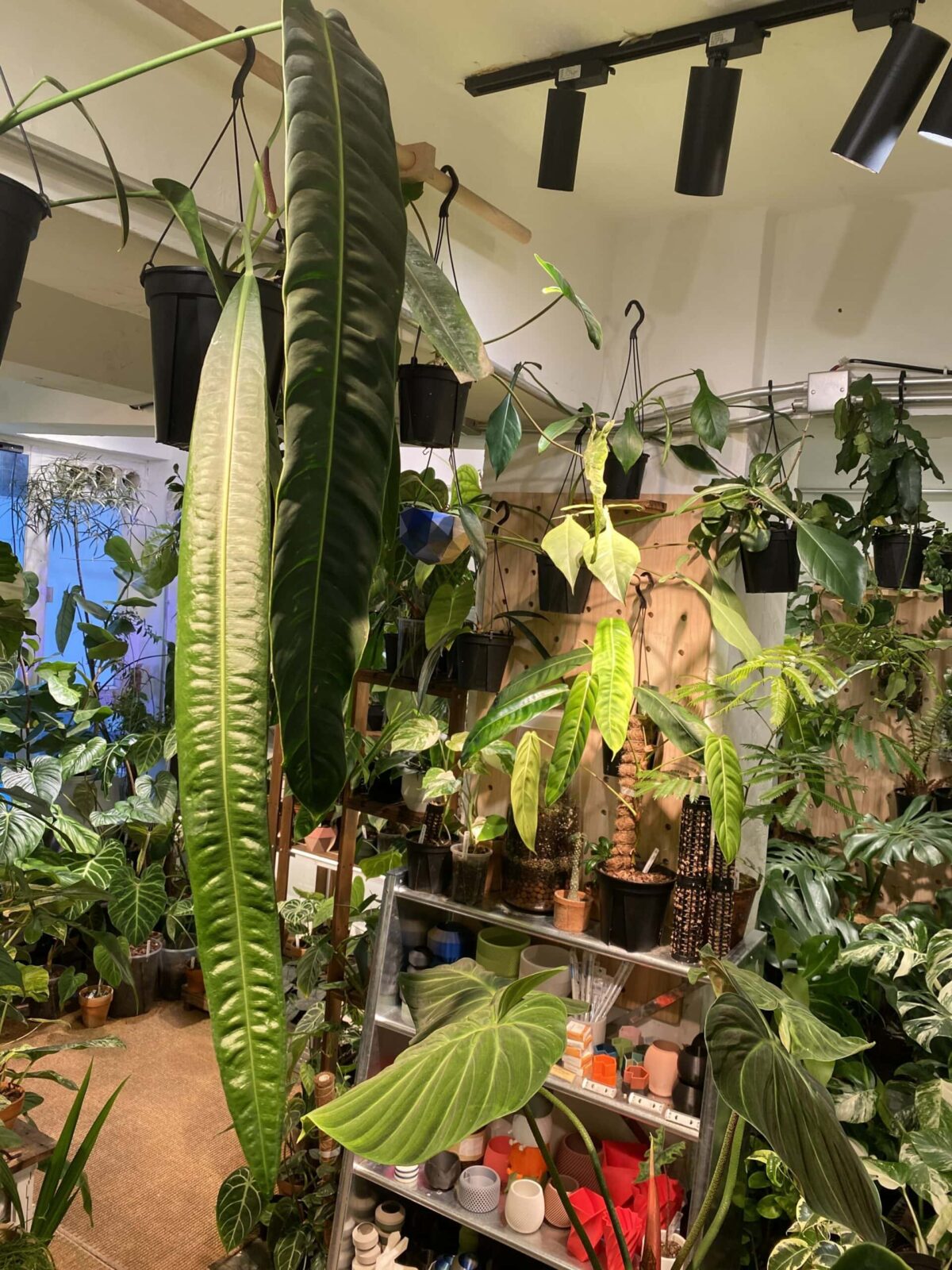
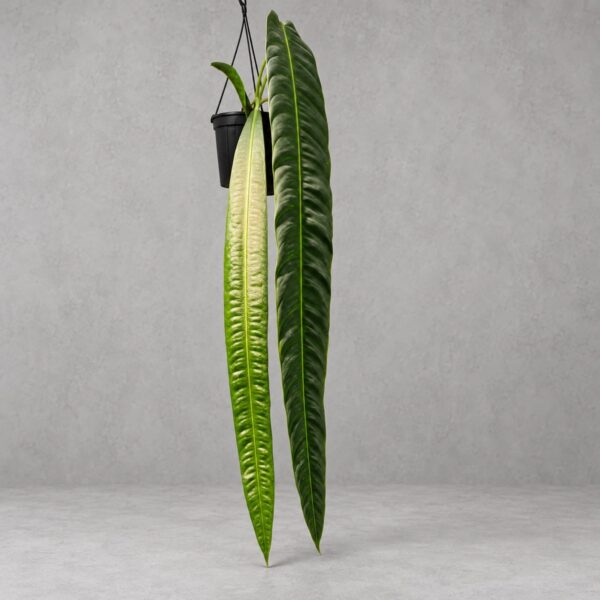
Kelp Anthurium, also known as "Wave Anthurium," is native to the tropical rainforests of Morona-Santiago province in Ecuador, with its formal botanical name still pending final confirmation. Its most distinctive feature is the narrow, wavy-edged, downward-hanging leaf, shaped just like kelp drifting in the sea — hence the name. The leaf has a thick, glossy texture, emerald green with wavy margins, growing in a pendant habit that makes it especially well suited to a hanging basket or high display, letting its natural flowing form take centre stage. This is a genuinely distinctive collector-grade cultivar within the Anthurium genus.
Light
- Ideal placement: bright, diffused light, near an east- or north-facing window
- Light intensity: medium-to-bright diffused light (roughly 8,000–15,000 lux)
- Note: avoid direct midday sun, which will scorch the leaves; light too dim causes leaves to lose their sheen and grow sparse
- Tip: the leaves grow toward the light source, so rotate the pot periodically to keep the form even
Watering
- Frequency: water once the top 2–3 cm has dried — roughly every 7–10 days in summer, reducing to every 10–14 days in winter
- Method: water slowly along the pot's edge until it flows from the base, then empty the standing water
- Water quality: room-temperature plain water, rainwater, or distilled water is best — avoid chlorinated tap water
- Note: Kelp Anthurium's root system is finer than most and more prone to rot — better to run slightly dry
Soil & pot
- Medium: an extremely well-draining, aerated aroid-specific mix — 2 parts orchid bark + 1 part perlite + 1 part coco coir
- pH: 5.5–6.5
- Pot: a breathable ceramic pot or orchid-specific pot, drainage holes at the base essential
- Repotting: roughly every 1–2 years, once roots become tangled or drainage slows
Temperature & humidity
- Temperature: ideally 18–25°C; growth stalls below 15°C, and cold damage becomes possible below 10°C
- Humidity: 60–80% is best, with the wavy leaf margins most prone to browning from dry air
- Humidification methods: a humidifier is most effective; misting also helps (avoid water pooling in leaf axils)
- Note: maintain good air circulation, avoiding stuffy, humid conditions
Common problems
| Issue | Likely cause | What to do |
|---|---|---|
| Scorched wavy leaf margins | Humidity too low | Increase environmental humidity immediately |
| Drooping, limp leaves | Overwatering leading to root rot / too dry | Check soil moisture; remove from pot to check roots if necessary |
| Small new leaves | Insufficient light or nutrient deficiency | Move closer to a window, start feeding at the beginning of the growing season |
| Leaves losing their sheen | Water too hard or humidity insufficient | Switch to rainwater, increase humidity |
| Slow growth | Temperature too low | Keep above 18°C |
⚠️ Toxicity note: Anthuriums contain calcium oxalate crystals; ingestion can cause oral burning, drooling, and vomiting, and sap contact may irritate skin. Keep out of reach of children and pets; wearing gloves during pruning is recommended.
How to explain to customers
"Kelp Anthurium has such a distinctive form — those long, wavy-edged leaves hang down beautifully, and it looks stunning grown in a tall cabinet or hanging basket. It really hates being stuffy and hates root rot, so remember to keep it somewhere well-ventilated, and always check whether the topsoil is actually dry before watering."
Fun facts
Kelp Anthurium's name comes from Ecuador's Morona-Santiago province, where the local climate is cooler and more humid than most tropical regions — which is why this plant can tolerate slightly cooler conditions than other tropical Anthuriums.
Keywords
Kelp Anthurium, Wave Anthurium, hanging plant, strap-leaf, tropical rainforest plant, foliage plant, high humidity, aerated medium, botanical name unconfirmed
In-depth care guide
Introduction
Kelp Anthurium, scientifically Anthurium sp. 'Morona' (formal botanical name still pending), is a rare Anthurium cultivar that has drawn considerable attention within foliage plant collecting circles in recent years. Its most eye-catching characteristic is its slender, flowing leaf — elongated and strap-like, reminiscent of kelp swaying underwater — which is why Hong Kong and Taiwanese plant enthusiasts have taken to calling it "Kelp Anthurium."
According to Shop Atlas Exotics, this species is an as-yet formally undescribed new species, currently found only in low-elevation forest in Morona Santiago province in southeastern Ecuador (Shop Atlas Exotics, 2024). When first discovered, collectors initially believed it to be another form of A. pallidiflorum, given the similar size and darker leaf colour of both, but it was later confirmed to be a completely distinct species, circulating in the collector community under the provisional name "sp. Morona."
Kelp Anthurium's leaves are deep green to nearly black, with a thick velvety texture and white or silvery-white contrasting venation. It's a pendant epiphytic plant, and mature leaves can grow extremely long, forming a dramatic cascading, waterfall-like display. According to Grow Tropicals, mature plants can reach an impressively large size, making this a genuinely stunning focal point plant (Grow Tropicals, 2025).
A note on the botanical name
It should be specifically noted that Anthurium sp. 'Morona' remains, as of now, a species without formal taxonomic description. Its botanical name awaits further research and confirmation by plant taxonomists — for now, "morona" is simply a convenient provisional identifier referring to its type locality, Morona Santiago province in Ecuador. When purchasing or trading this species, it's recommended to retain relevant provenance information, so it can be cross-referenced once the formal botanical name is eventually published.
Native environment
Kelp Anthurium comes from the low-elevation tropical rainforest of Morona Santiago province in southeastern Ecuador (Shop Atlas Exotics, 2024). This region sits at the edge of the Amazon basin, with a warm, humid climate and abundant rainfall year-round. In its native environment, it grows epiphytically on large trees, with roots exposed to the air, absorbing rainwater and moisture from the surrounding humidity.
According to Carnivero Living Wall, Kelp Anthurium, like many Andean species, is adapted to cool-to-moderate temperatures, high humidity, and bright diffused light (Carnivero, n.d.). Its native elevation is relatively low, so compared to some high-elevation Anthurium species, it can tolerate warmer conditions better, though it still needs stable temperature and humidity to grow healthily.
Light requirements
Kelp Anthurium needs bright but gentle, diffused light, mimicking the light conditions filtered through the rainforest canopy. It's recommended to place it near an east- or north-facing window, letting it enjoy plenty of gentle, non-glaring natural light. If placed near a south- or west-facing window, a sheer curtain or shade netting must be used to filter strong light, avoiding direct exposure to the leaves.
This species has moderate light requirements. Insufficient light causes slow growth, thinner leaves, and dull colour; but overly strong direct light will scorch the velvety leaf surface, causing irreversible brown burn spots. When grown indoors, if natural light isn't sufficient, consider using a full-spectrum grow light, providing roughly ten to twelve hours of daily illumination.
Watering method
The watering principle for Kelp Anthurium is "moist but never waterlogged." According to Lost in the Forrest Co, it's recommended to water once the top two inches of the potting medium has dried out (Lost in the Forrest Co, 2025). Since it's a pendant epiphytic plant, its roots need plenty of air, so the medium absolutely cannot stay wet and stuffy for extended periods.
To judge when to water, use the knuckle test: insert a finger roughly two to three inches into the medium — if it feels dry, it's time to water. In summer's active growing period, water roughly every five to seven days; in winter, extend this to every ten to fourteen days. The best water to use is filtered water, rainwater, or tap water left to stand overnight.
Because Kelp Anthurium's leaves are quite long, take care when watering to avoid water droplets sitting on the leaf surface for extended periods, especially at leaf axils, since standing water there easily triggers bacterial rot. It's recommended to water along the pot's edge or use the soak method directly.
Humidity requirements
As an epiphytic plant native to the rainforest, Kelp Anthurium has fairly high humidity requirements, with ideal humidity maintained at 60% or above. If indoor humidity stays below 50% for extended periods, leaf edges easily become dry and brittle, and new leaves may struggle to unfurl properly.
Practical ways to raise humidity include: using an ultrasonic humidifier (most reliable); grouping plants together to create a humid microclimate; placing a pebble tray with water beneath the pot (water level below the pot's base); or placing the plant in a naturally more humid space like a bathroom. Pay attention to maintaining good air circulation, avoiding hot, humid, stagnant air that encourages fungal growth.
Temperature control
Kelp Anthurium prefers a warm environment, with an ideal growing temperature range of 18–27°C. According to observations by Shop Atlas Exotics, it grows noticeably faster in warmer greenhouse conditions, proving it's a relatively heat-tolerant species (Shop Atlas Exotics, 2024). But it's equally intolerant of cold — below 15°C, growth slows noticeably, and prolonged exposure below 10°C can lead to cold damage or even death.
In summer, avoid direct AC airflow; in winter, keep it away from cold window drafts. If you live somewhere with colder winter temperatures, it's recommended to take warming measures when temperatures drop sharply, such as moving the plant to a warmer indoor spot or using a plant-specific heating mat.
Growing medium
Kelp Anthurium's roots need excellent aeration, so the growing medium must be chunky and well-draining. It's recommended to use an extremely coarse recipe: 50% orchid bark + 30% perlite + 20% sphagnum moss. This combination ensures water drains quickly while the sphagnum moss retains a little moisture for the roots to absorb.
According to Lost in the Forrest Co, Anthurium-type plants particularly need a "super chunky, extremely well-draining" medium (Lost in the Forrest Co, 2025). Avoid using ordinary potting soil, since it's too dense and easily leads to waterlogging and root rot. Choose a pot with drainage holes — plastic or mesh pots both work — the key is letting the roots breathe freely.
Since Kelp Anthurium is a pendant plant, with mature leaves spreading outward and downward, it's recommended to use a hanging basket or place it on a high surface, letting the long leaves cascade down naturally for their most attractive display.
Feeding recommendations
During the growing season (spring through autumn), apply a diluted balanced liquid fertiliser (such as NPK 20-20-20) at half strength every two to three weeks. Since Anthurium-type plants have growth habits similar to orchids, the Royal Horticultural Society recommends using an orchid-specific fertiliser (RHS, 2026). Make sure the medium is already moist before feeding, avoiding root damage from concentrated fertiliser.
Reduce feeding frequency to once a month, or pause entirely, when growth slows in winter. If new leaves appear pale in colour and growth is slow, that may signal insufficient nutrients; conversely, scorched leaf tips or white salt deposits on the medium surface indicate overfeeding.
Repotting timing
Kelp Anthurium generally needs repotting every one to two years, with spring being the best time. Before repotting, check the root system first — if roots have filled the pot's base or are emerging from the drainage holes, it's time to repot. The new pot should be roughly 2–3 cm larger in diameter than the current one — there's no need to jump to a much larger size.
When repotting, gently separate any tangled roots, trim away any rotten or blackened sections, then plant into fresh medium. After repotting, place the plant in bright, diffused light, avoiding strong direct light for the first few days, then resume normal care once the plant has adjusted.
Propagation methods
Kelp Anthurium can be propagated through division. Once the plant develops side shoots or multiple growth points, you can carefully separate the root clusters during repotting, ensuring each division retains healthy roots and leaves. After division, maintain high humidity and avoid strong light, and new growth should typically begin within two to three weeks.
Since this species is still quite rare, take extra care during propagation, ensuring tools are clean and sterilised to avoid cross-contamination. After successful propagation, it's recommended to record provenance information for future tracking and exchange with other growers.
Common problems
Browning leaf tips: usually caused by humidity too low or insufficient watering. Check whether environmental humidity reaches 60% or above, and confirm watering frequency is adequate.
Drooping leaves: if soil moisture is normal but leaves are still drooping, this may indicate a root problem such as root rot. Repotting to check root health is necessary.
Small new leaves: may be caused by insufficient light or inadequate feeding. Check whether light intensity at the plant's location is sufficient, and consider increasing feeding frequency.
Spots on the leaf surface: if the spots are brown and gradually expanding, this may be a fungal infection, usually related to water sitting on the leaf surface for too long or poor ventilation. Improve air circulation and avoid splashing water on the leaves when watering.
Stalled growth: winter's low temperatures may cause slower growth, which is normal. But if the plant still isn't growing in spring and summer, check light, humidity, and root condition.
Toxicity information
Like all Anthurium species, Kelp Anthurium contains calcium oxalate crystals, toxic to both humans and pets. Ingestion may cause irritation to the mouth and throat, drooling, vomiting, and difficulty swallowing. Skin contact with the sap may also cause irritation, so wearing gloves when handling is recommended. Placing the plant somewhere children and pets can't reach is the safest approach.
參考資料(想知來源可展開)
References
- Shop Atlas Exotics. (2024). Anthurium sp. Morona (strap leaf). https://shopatlasexotics.com/products/anthurium-sp-morona-strap-leaf-species
- Grow Tropicals. (2025). Anthurium sp. Morona. https://growtropicals.com/products/anthurium-sp-morona-1
- Carnivero. (n.d.). Living Wall – Anthurium sp morona. https://www.carnivero.com/pages/living-wall
- Lost in the Forrest Co. (2025). Anthurium Sp. Morona. https://www.lostintheforrestco.com/products/anthurium-sp-morona
- Royal Horticultural Society (RHS). (2026). How to grow anthuriums. https://www.rhs.org.uk/plants/anthuriums/how-to-grow-anthuriums
- Proven Winners. (n.d.). Caring for Anthurium Plants Indoors. https://www.provenwinners.com/learn/houseplants/anthurium
Plantjai shop · In stock online
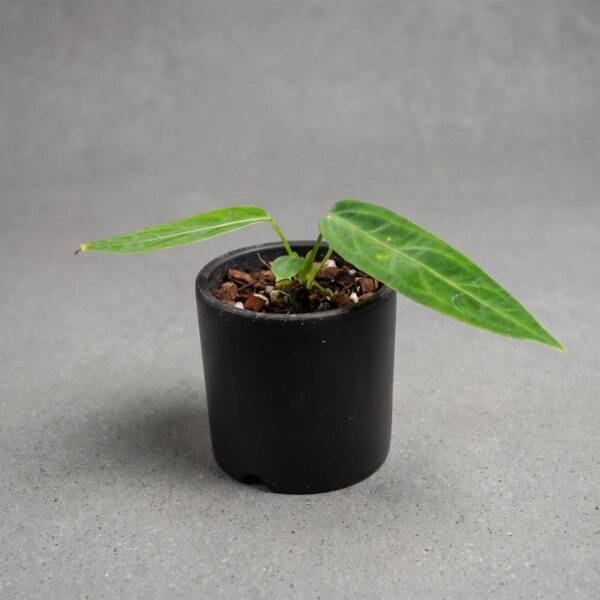
Anthurium morona
Anthurium morona
Original price was: HK$4,680.00.HK$1,980.00Current price is: HK$1,980.00.
Hong Kong delivery · Causeway Bay pickup
For Hong Kong homes and offices. Stock and pricing follow the product page.
IN STORE NOW
Plants for this guide
Related plants in stock now — live prices, delivery or Causeway Bay pickup.
Anthurium chrystallinum Turtle
Original price was: HK$780.00.HK$138.00Current price is: HK$138.00.
In stock · store pickup
View plantAnthurium crystallinum
Anthurium crystallinum
Original price was: HK$780.00.HK$380.00Current price is: HK$380.00.
In stock · store pickup
View plant
FREE PLANT ADVICE
Send us a photo before you change anything
WhatsApp a photo of the plant and your window light. Our Causeway Bay team will suggest care steps or plants that suit your space.
STORE · CAUSEWAY BAY
4/F, 39 Yiu Wa Street, Causeway Bay
Daily 12:30–8:00pm · ~3 min walk from Times Square
Map & directionsPlant Care