

How to Care for Amydrium Medium Blue in Hong Kong | Plantjai

Plantjai 植仔 · Care Encyclopedia
Amydrium Medium Blue
Hong Kong care guide — useful before you buy and after it arrives.
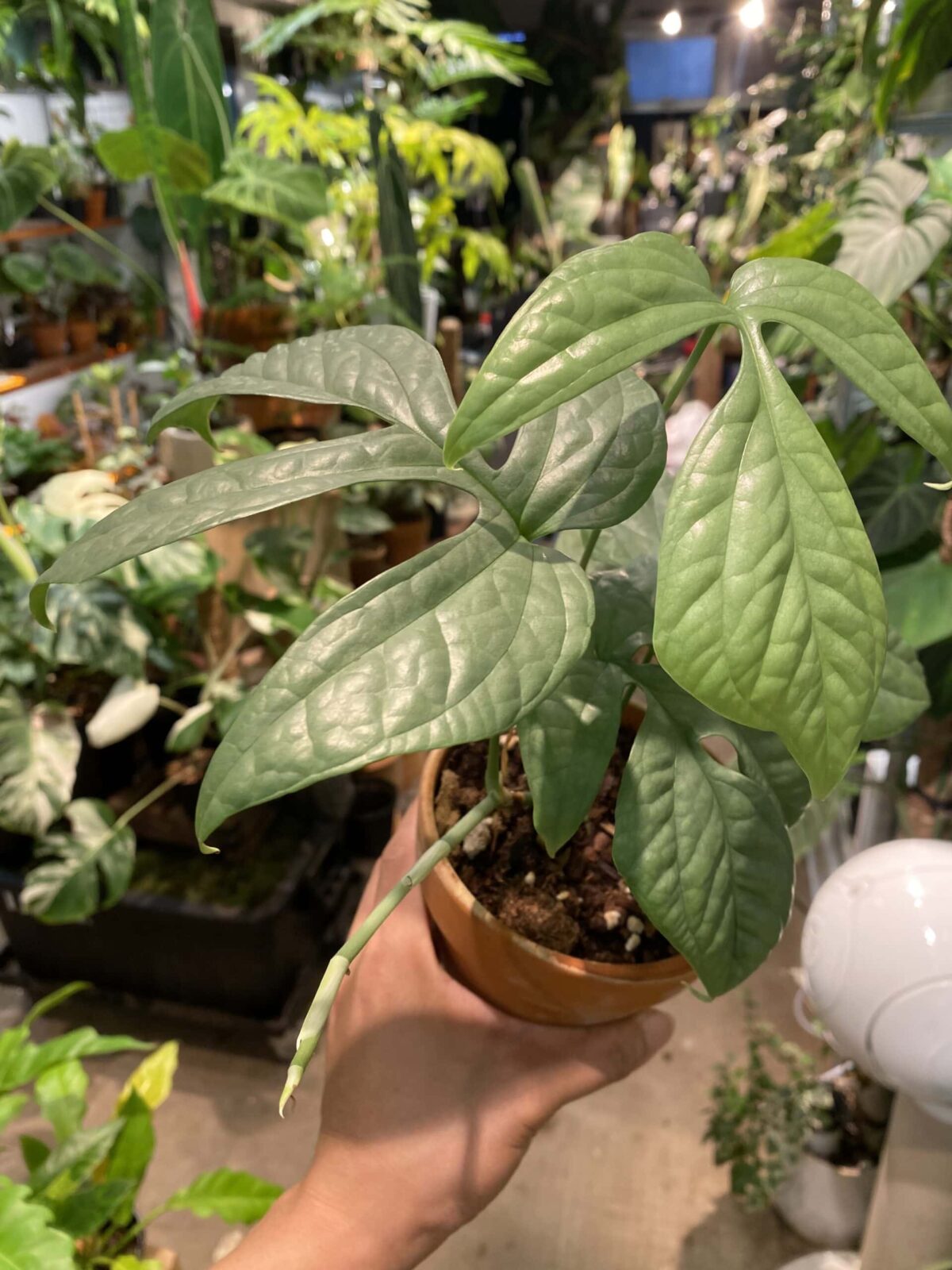
Shop this plantDeep blue-green leaves laced with silvery-white veins — a striking, fenestrated showpiece once mature.
Botanical name unconfirmed: "Amydrium medium blue" is a trade name in general horticultural circulation; its formal taxonomic status is still being confirmed — it may represent a blue-toned form of Amydrium medium or a closely related variant.
Origin & characteristics
An evergreen vine in the Araceae family, native to lowland tropical rainforest in Southeast Asia. Leaves are a deep blue-green to grey-blue, overlaid with a prominent network of silvery-white veins that give the foliage a velvety appearance. Young leaves are long and oval; as the plant matures, they gradually split into multiple pinnate leaflets, with the form changing dramatically over time. Aerial roots are well developed and the plant is a natural climber, making it well suited to vertical display — one of the more sought-after rare cultivars in the foliage-plant world in recent years.
Light
- Ideal light: bright, indirect light to partial shade, roughly 6–8 hours of gentle daily light.
- Placement: east- or northeast-facing windowsills, or 1–2 m from a south-facing window.
- How it responds: enough light produces a deep blue-green colour with crisp venation; too little light shifts the colour toward plain green and loses the blue tone.
- Avoid: strong midday direct sun in summer, which causes irreversible brown sunburn patches.
- Artificial lighting: a full-spectrum grow light, positioned 30–50 cm from the leaves, running 10–12 hours daily.
Watering
- Frequency: every 5–7 days in spring/summer, every 8–12 days in autumn/winter.
- How to judge: insert a finger 2–3 cm into the soil — if it feels dry, or a wooden skewer inserted to the pot base comes out dry, it's time to water.
- Method: water slowly around the rim until it drains from the base, ensuring the roots are thoroughly moistened.
- Water quality: filtered water, rainwater, or tap water rested for over 24 hours.
- Seasonal adjustment: reduce watering in winter, keeping the medium just lightly moist; also cut back during the rainy season.
- Important: never let the pot sit in standing water — root rot is very hard to reverse once it sets in.
Soil & pot
- Medium requirements: must be highly aerated and well-draining, rich in organic matter.
- Recommended recipe:
- Sphagnum moss + perlite + coco chips + bark, in a 4:2:2:2 ratio
- Or an Araceae specialty mix + 30% perlite or coco chips for extra aeration
- pH: 5.5–6.5 (slightly acidic).
- Pot choice: a ceramic pot with drainage holes (better airflow) or a plastic pot (better moisture retention), chosen based on your home's humidity.
- Climbing support: essential — a moss pole or coir pole allows the aerial roots to attach and encourages larger, more deeply divided mature leaves.
- Repotting: every 1–2 years in spring; size up by only one pot size at a time to avoid an oversized pot holding excess water.
Temperature & humidity
- Ideal temperature: 22–28°C.
- Acceptable range: 18–32°C.
- Minimum: briefly tolerates down to 15°C; sustained cold stalls growth and risks frost damage.
- Ideal humidity: 65–85%.
- Signs of insufficient humidity: browning leaf tips, distorted new leaves, stalled growth.
- Raising humidity:
- An ultrasonic humidifier (most recommended)
- A tray of moist pebbles beneath the pot
- Grouping with other high-humidity plants to build a microclimate
- Ventilation: high humidity must be paired with good airflow to prevent fungal and bacterial disease.
Common problems
| Issue | Likely cause | What to do |
|---|---|---|
| Losing its blue colour | Insufficient light or humidity too low | Adjust placement and increase humidity |
| Small new leaves, no fenestration | Plant not yet mature, no climbing support, or insufficient nutrients | Provide a moss pole and check feeding |
| Yellowing leaves | Overwatering leading to root rot, poor drainage, or natural ageing of lower leaves | Check watering and drainage; lower-leaf yellowing alone is normal |
| Powdery patches on leaves | Possible powdery mildew | Improve ventilation and use an appropriate fungicide |
| Spider mites | Common in hot, dry, stuffy conditions | Raise humidity and treat with neem oil |
| Stalled growth | Normal in winter cold; in the growing season, check whether the pot is root-bound or the plant needs feeding | — |
How to explain to customers
"The blue on this one is genuinely special — you don't see that grey-blue tone in many plants, and it instantly elevates any room it's in. It likes things warm and humid, so if you run the AC a lot at home, put a small humidifier nearby and it'll be much happier."
"It's a natural climber too — get it a moss pole and once it takes hold, the leaves will start to split open, and it looks genuinely spectacular at that stage — friends who visit will definitely ask about it!"
Fun facts
The grey-blue leaf colour of this Amydrium is actually an adaptation for low-light environments — the blue-toned surface layer helps reduce excessive light absorption, protecting leaf tissue from damage under strong light.
Keywords
Blue Amydrium, Amydrium medium blue, Araceae, grey-blue leaf, silver-white venation, climbing plant, moss pole, high humidity, foliage plant, rare cultivar, fenestrated leaf
參考資料(想知來源可展開)
References
- Plants of the World Online (Kew) — Amydrium medium. https://powo.science.kew.org
- Foliage Factory — Amydrium Plants | Shingling Aroid Vines. https://foliage-factory.com/collections/amydrium
- PLNTS.com — How to Care for Amydrium: Expert Tips for Thriving Plants. https://plnts.com/en/care/houseplants-family/amydrium
⚠️ Pet / toxicity note: Like other Araceae members, contains calcium oxalate crystals; ingestion can cause oral and digestive irritation. Keep away from pets and small children.
In-depth care guide
Introduction
Blue Amydrium is one of the more visually striking and increasingly sought-after members of the genus Amydrium within the Araceae family, prized above all for its unusual grey-blue leaf colouring and the fine, silvery-white venation that traces across each leaf like a delicate net. This gives the foliage a genuinely velvety, almost otherworldly appearance quite different from the more familiar green or metallic-blue forms found in related cultivars like Cebu Blue.
Native to lowland tropical rainforest in Southeast Asia, this Amydrium is a hemi-epiphytic climber, meaning it begins life rooted in the forest floor and gradually transitions to a climbing habit as it matures, using aerial roots to grip tree trunks and other vertical surfaces. This growth pattern is directly tied to one of the plant's most dramatic features: as it climbs and matures, its leaves transform from simple, undivided ovals into large, deeply pinnate leaves — a genuinely striking metamorphosis that makes mature specimens highly prized among collectors.
Growth habit and leaf transformation
Like other members of its genus, Blue Amydrium exhibits pronounced ontogenetic change — meaning its leaf form changes significantly as the plant ages. Juvenile leaves are simple, elongated ovals, while mature leaves (achieved only once the plant has been given a climbing support and enough time) become large and deeply divided into multiple leaflets, resembling a feather or a hand with many fingers.
This transformation won't happen on a plant kept trailing in a hanging basket — it requires vertical support to trigger the shift into mature growth. This is one of the most important things to understand about growing this plant successfully: if you want to see its full potential, a moss pole isn't optional.
Light requirements
Blue Amydrium needs bright, indirect light to semi-shade, with roughly 6–8 hours of gentle daily light being ideal. Position it near an east- or northeast-facing window, or 1–2 m back from a south-facing window.
When light is adequate, the plant develops its signature deep blue-green colour with sharply defined silvery venation. When light is insufficient, the colour drifts toward plain green and loses much of its distinctive blue cast — a useful visual cue that it's time to move the plant somewhere brighter.
Avoid direct midday summer sun, which will cause irreversible brown sunburn patches on the leaves. If natural light is limited, a full-spectrum grow light positioned 30–50 cm above the plant, run for 10–12 hours daily, works well as a supplement.
Watering technique
The watering principle for Blue Amydrium is straightforward: water thoroughly, then let the medium dry out somewhat before watering again — never let the pot sit in standing water. In spring and summer, this typically works out to every 5–7 days; in autumn and winter, extend the interval to every 8–12 days.
To judge timing, insert a finger 2–3 cm into the soil, or push a wooden skewer down to the base of the pot and check whether it comes out dry. Water slowly around the rim of the pot until it drains freely from the base, ensuring the whole root system gets moistened rather than just the surface.
Use filtered water, rainwater, or tap water that's been left to stand for at least 24 hours — this reduces the mineral and chlorine content that can otherwise build up and stress the roots over time. During the rainy season and in winter, reduce watering frequency further, keeping the medium just lightly moist rather than consistently wet.
Soil and potting
Blue Amydrium needs a medium that is both highly aerated and rich in organic matter, striking a careful balance between drainage and moisture retention.
Recommended recipe:
- Sphagnum moss + perlite + coco chips + bark, in a 4:2:2:2 ratio
- Alternatively, an Araceae specialty mix with an added 30% perlite or coco chips for extra aeration
Maintain a slightly acidic pH of 5.5–6.5. For pots, a ceramic pot with drainage holes offers better airflow, while a plastic pot retains moisture longer — choose based on your home's ambient humidity and how often you're able to water.
A climbing support — a moss pole or coir pole — is essential rather than optional if you want to see the plant's dramatic mature leaf form. Once the aerial roots grip the support, new leaves begin to grow noticeably larger and more deeply divided.
Repot every 1–2 years in spring, sizing up by only one pot size at a time. An oversized pot holds excess moisture for too long and significantly increases the risk of root rot.
Temperature and humidity
Blue Amydrium's ideal temperature range is 22–28°C, with an acceptable range of 18–32°C. It can briefly tolerate temperatures down to 15°C, but sustained cold will stall growth and risks lasting frost damage.
Humidity is genuinely important for this plant, with an ideal range of 65–85%. Signs of insufficient humidity include browning leaf tips, distorted new leaves, and stalled growth overall. The most reliable way to raise humidity is with an ultrasonic humidifier; a tray of moist pebbles beneath the pot and grouping the plant with other humidity-loving specimens both help as secondary measures.
It's worth stressing that high humidity must be paired with good ventilation — a stuffy, poorly ventilated high-humidity environment is actually more likely to encourage fungal and bacterial disease than to help the plant thrive.
Feeding
During the growing season, feed Blue Amydrium every 4–6 weeks with a balanced liquid fertiliser diluted to half strength. This supports steady leaf development without pushing the plant into weak, overly fast growth. Stop feeding entirely once temperatures drop in autumn and winter, allowing the plant to rest.
Always water before feeding to avoid concentrated fertiliser contacting dry roots, which can cause burning. Periodically flushing the soil with plain water helps prevent salt buildup from repeated feeding.
Common problems in detail
Losing its blue colour: almost always caused by insufficient light or humidity that's too low. Move the plant to a brighter spot and check that ambient humidity is adequate.
Small new leaves with no fenestration: the plant may simply not be mature enough yet, or it may lack a climbing support — both are common and easily fixed by adding a moss pole and being patient. Insufficient feeding can also slow this transformation.
Yellowing leaves: if it's just the lower, older leaves yellowing occasionally, that's natural ageing and nothing to worry about. If multiple leaves yellow at once, suspect overwatering leading to root rot, or poor drainage — check the root system and adjust watering accordingly.
Powdery patches on leaves: likely powdery mildew, often linked to poor airflow combined with high humidity. Improve ventilation and treat with an appropriate fungicide if needed.
Spider mites: thrive in hot, dry, stuffy conditions. Raise humidity as the primary prevention, and treat active infestations with neem oil.
Toxicity information
Like other members of the Araceae family, Blue Amydrium contains calcium oxalate crystals throughout the plant, which can cause oral and digestive irritation if ingested. Keep it out of reach of pets and small children, and wash your hands after handling the plant, particularly after pruning.
References
- Plants of the World Online (Kew) — Amydrium medium. https://powo.science.kew.org
- Foliage Factory — Amydrium Plants | Shingling Aroid Vines. https://foliage-factory.com/collections/amydrium
- PLNTS.com — How to Care for Amydrium: Expert Tips for Thriving Plants. https://plnts.com/en/care/houseplants-family/amydrium
- Folia Collective — Plant Know-How: Amydrium medium 'Silver'. https://foliacollective.com/blogs/plant-care/plant-know-how-amydrium-medium-silver/

Plantjai shop · In stock online
Amydrium medium blue
HK$398.00
Hong Kong delivery · Causeway Bay pickup
For Hong Kong homes and offices. Stock and pricing follow the product page.
IN STORE NOW
Plants for this guide
Related plants in stock now — live prices, delivery or Causeway Bay pickup.


FREE PLANT ADVICE
Send us a photo before you change anything
WhatsApp a photo of the plant and your window light. Our Causeway Bay team will suggest care steps or plants that suit your space.
STORE · CAUSEWAY BAY
4/F, 39 Yiu Wa Street, Causeway Bay
Daily 12:30–8:00pm · ~3 min walk from Times Square
Map & directionsPlant Care


