
How to Care for Alocasia Reginae in Hong Kong | Plantjai

Plantjai 植仔 · Care Encyclopedia
Alocasia Reginae
Hong Kong care guide — useful before you buy and after it arrives.
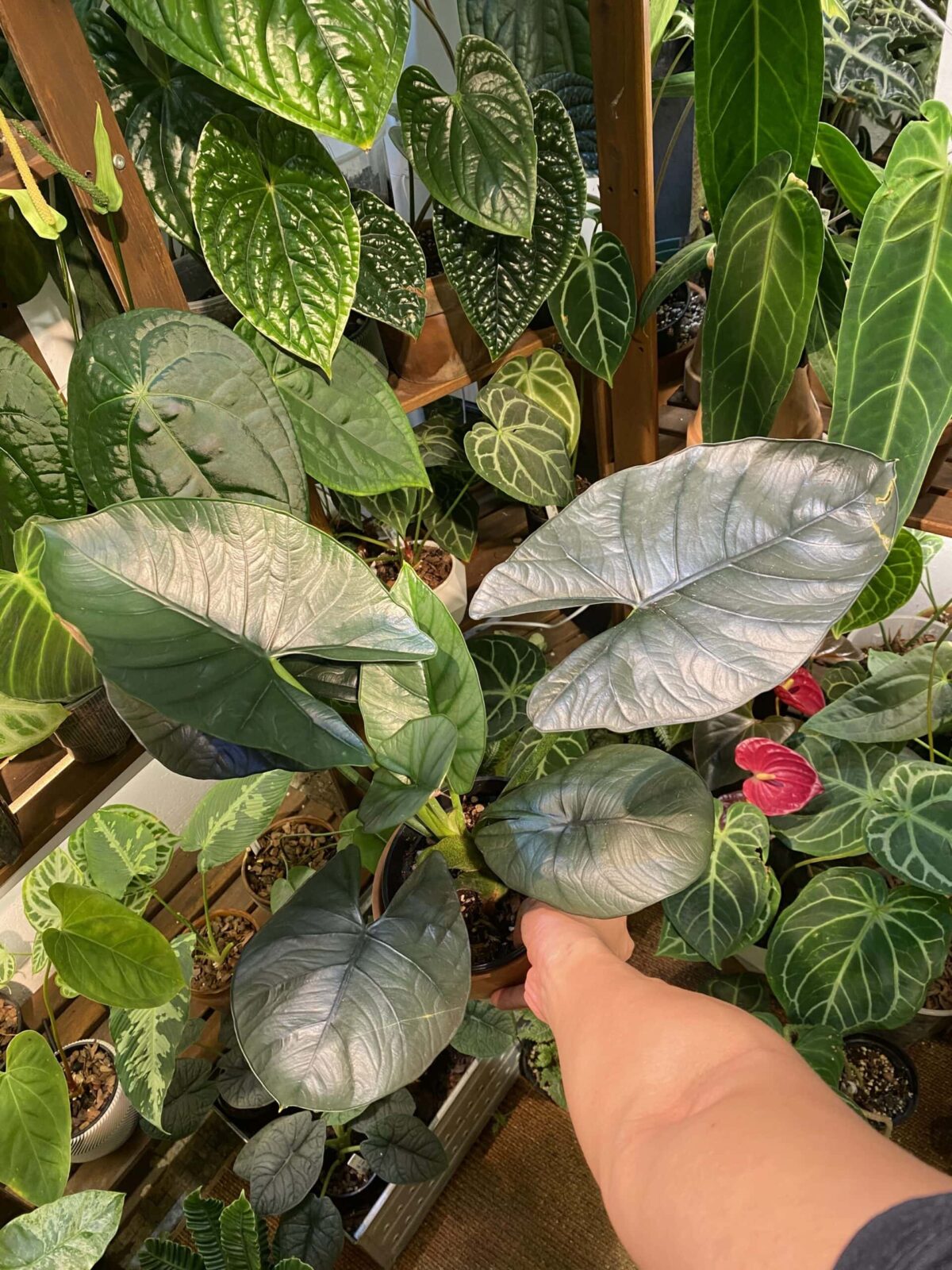
Shop this plantSilver-blue velvet leaves with a dramatic wine-red underside — a genuinely regal jewel Alocasia.
Origin & characteristics
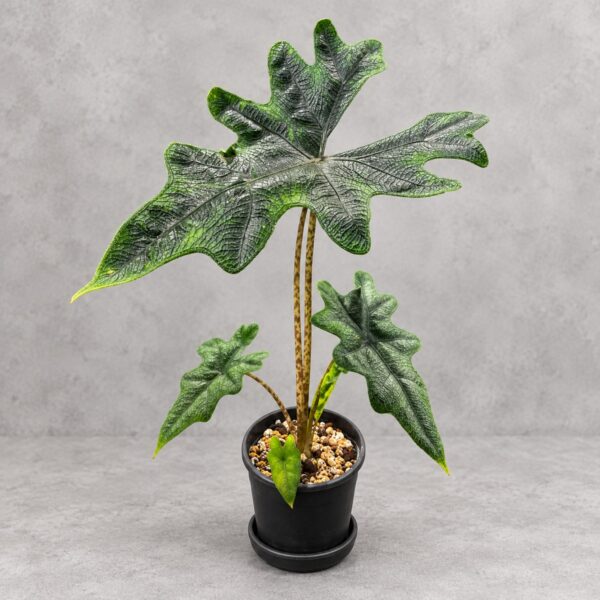
Elaine Alocasia is a celebrated cultivar of Alocasia reginae, a species native to the tropical rainforests of Borneo. The cultivar is named after Florida plant collector Elaine Speer, hence 'Elaine'. Its broad, heart-shaped leaves have a silver-blue to blue-green upper surface with a velvet sheen, set off by dark green to near-black veining — but the real surprise is the underside, which flashes a striking wine-red when you flip the leaf. Mature plants reach around 40–60 cm, with thick, resilient leaves that feel like high-grade velvet.
Light
Loves bright, indirect light, with east- or north-facing windows ideal. A spot 1–2 m from a south- or west-facing window also works, but avoid direct summer afternoon sun. The silver-blue colouring is most vivid with good light; too little light causes it to green out and lose its velvety sheen. Supplemental LED grow lighting for 10–12 hours daily helps maintain leaf colour.
Watering
Wait until the top 2–3 cm of soil has dried before watering; keep evenly lightly moist but never waterlogged. This silver-blue cultivar's roots are especially sensitive to overwatering, and root rot is hard to reverse once it sets in. Reduce watering as growth slows in winter, keeping the soil just lightly moist. Use room-temperature filtered or rested water to avoid mineral staining on the leaf surface.
Soil & pot
Needs a highly aerated aroid mix: peat or coco coir 40%, perlite 30%, orchid bark/pine bark 20%, activated charcoal 10%. Drainage holes are essential; a layer of leca at the base helps. Plastic or ceramic pots both work, but beginners may prefer a clear orchid pot to monitor root health.
Temperature & humidity
Ideal temperature 18–27°C; growth slows and dormancy may set in below 15°C — keep it away from AC vents in Hong Kong winters. Humidity of 60% or higher really brings out the velvety leaf texture; below 50%, leaf tips dry out. A humidifier, pebble tray, or grouping with other plants all help build a stable, humid microclimate.
Common problems
| Issue | Likely cause | What to do |
|---|---|---|
| Yellowing, soft leaves | Usually overwatering and root rot | Stop watering immediately, check roots, trim rot, repot into fresh dry mix |
| Brown, crispy leaf tips | Insufficient humidity or hard water | Raise humidity and switch to filtered water |
| Silver-blue colour fading to green | Insufficient light | Move closer to a window or add supplemental light |
| Drooping leaves | Possible underwatering or root problems | Check soil moisture and root health |
| Winter leaf drop | Possible dormancy | Reduce watering, keep lightly moist — new leaves return in spring |
How to explain to customers
"The underside of Elaine's leaves is genuinely wine-red — flip a leaf over and people are always surprised! Its silver-blue colour only really shows with enough light, but keep it out of direct sun — a spot near a window with a sheer curtain works best."
Fun facts
The species name reginae is Latin for "queen," forming an informal "royal family" of Alocasia names alongside reginula ("little queen") and baginda ("your majesty"). The cultivar name 'Elaine' honours Florida plant collector Elaine Speer, who introduced this form from Miri, Malaysia, to the United States, making a significant contribution to the Alocasia collecting community.
Keywords
Elaine Alocasia, Alocasia reginae Elaine, Alocasia reginae, queen Alocasia, silver-blue Alocasia, velvet Alocasia, wine-red leaf underside, medium Alocasia, collector grade, Borneo, bright indirect light, high humidity, well-draining soil
參考資料(想知來源可展開)
References
- Plants of the World Online (Kew) — Alocasia reginae. https://powo.science.kew.org/taxon/urn:lsid:ipni.org:names:84234-1
- RHS — Alocasia care. https://www.rhs.org.uk/plants/alocasia
- Proven Winners — How to Grow Alocasia Indoors and Outdoors. https://www.provenwinners.com/learn/houseplants/alocasia
⚠️ Pet / toxicity note: Contains calcium oxalate crystals throughout the plant; ingestion causes oral pain, swelling and digestive upset. Keep away from pets and small children, and wash hands after handling.
In-depth care guide
Introduction
Elaine Alocasia (Alocasia reginae 'Elaine') is a highly ornamental and collectible "jewel Alocasia" cultivar in the Araceae family. Its parent species, Alocasia reginae, is native to Borneo, primarily found in the humid tropical rainforests of Sarawak and Central Kalimantan. 'Elaine' is a named cultivar of Alocasia reginae, ranking alongside 'Miri' as one of the two most popular selections of this species among collectors.
The species name reginae comes from Latin for "of the queen," and carries an interesting piece of history: in 1884, Dutch botanist Pieter Willem Korthals first described the species, which was later presented to the Russian Tsar and Tsarina at the St. Petersburg International Exhibition by the "Compagnie Continentale d'Horticulture." The species name reginae honours the Tsarina of that era — over 140 years later, this cultivar still carries an air of royal elegance.
What makes 'Elaine' so appealing is its thick foliage — a silver-blue velvet sheen on the upper surface with deep green to near-black veining, contrasted against a vivid red-purple underside, creating a striking two-tone effect. The leaves feel leather-thick with a soft sheen, and the plant maintains a compact overall shape, typically staying 20–30 cm tall — ideal for a tabletop or shelf display. In horticultural circles it's also known as the "Silver Velvet Alocasia," a name that perfectly captures its most distinctive quality.
Native habitat and growth habit
In the wild, Alocasia reginae grows on limestone-rich lowland rainforest slopes in Borneo, as an understorey plant. Its thick leaves and low, ground-hugging growth habit reflect its native environment — warm, humid, and lit by filtered light passing through the forest canopy. As a cultivated selection, 'Elaine' retains its parent's humidity and temperature requirements, though with somewhat improved adaptability.
Growth rate is on the slower side, averaging 3–5 new leaves per growing season under ideal conditions. It grows via a rhizome, forming a tight, upright clump. Individual leaves are long-lived, staying healthy for 9–12 months under good care — making it a genuinely "low-maintenance, high-beauty" houseplant.
It's worth noting that Alocasia reginae and Alocasia reginula (the parent species behind Ninja and Black Velvet) are entirely different species, despite the similar names — they come from different regions of Borneo and differ noticeably in leaf shape, venation, and ecological habit, though collectors sometimes confuse the two.
Light requirements
Elaine Alocasia needs bright, indirect light, with an ideal leaf-level light intensity of roughly 10,000–20,000 lux. Its silver-blue leaf surface has a specialised epidermal cell structure that makes it vulnerable to irreversible sunburn from direct light — even filtered morning sun or western exposure can cause damage.
Ideal placement:
- East- or west-facing windows, at a moderate distance from the glass
- A south-facing window with 70% shade cloth or frosted glass filtering
- A north-facing window with a white sheer curtain (particularly good at higher latitudes)
- A well-lit interior space with sufficient artificial lighting
Signs of insufficient light:
- Stretched stems, thinner leaves
- Fading silver-blue sheen, turning dull grey-green
- Slow or stalled new leaf growth
Signs of too much light:
- Translucent, papery necrotic patches on the leaf surface
- Silvery areas turning white or scorched
- Overall leaf yellowing
Rotate the pot roughly 90 degrees every two weeks to ensure even light exposure on all sides and maintain its compact, elegant shape.
Watering technique
Elaine Alocasia requires fairly precise watering — its fine roots wilt if allowed to dry out too fast, but rot if kept too wet for too long. The correct approach is "moist, not wet."
Watering principles:
- Wait until roughly 40–60% of the soil has dried before watering; test by inserting a finger 2–3 cm into the soil
- Use room-temperature rainwater, distilled water, or filtered water — tap water with TDS above roughly 100 ppm can cause leaf-tip burn
- Water thoroughly — slowly until it runs freely from the drainage holes — then immediately empty any water collected in the saucer
- Water in the morning rather than the evening, to avoid roots sitting wet overnight
Recommended technique — bottom watering:
- Fill a shallow tray with about 1.3 cm of room-temperature filtered water or rainwater
- Place the pot (with drainage holes) into the tray
- Let capillary action draw water upward for a precisely timed 15 minutes
- Remove the pot and pour off any remaining water
- Let excess water drain freely for 20 minutes before returning the pot to its spot
This method keeps rhizome moisture consistent without oversaturating it.
Seasonal adjustment:
- Spring/summer growing season (24–28°C, 60–70% humidity): roughly every 4–5 days
- Mild weather (20–23°C, 45–55% humidity): roughly every 6–7 days
- Cooler autumn/winter (17–19°C, below 40% humidity): extend to every 9–10 days, or pause watering entirely if growth has stalled
Soil and potting
Elaine Alocasia needs an exceptionally aerated, well-draining substrate with just a touch of moisture retention. Standard peat-based potting mixes are typically too heavy for it.
Recommended soil mix:
- 35% coarse perlite (¼-inch grade)
- 30% baked clay granules (such as Turface MVP or similar)
- 25% quality orchid bark (medium-coarse, ⅜–½ inch)
- 10% horticultural charcoal (non-activated)
This recipe gives a saturated hydraulic conductivity of roughly 0.8–1.2 cm/sec — fast enough to prevent oxygen deprivation, but with enough structure to support the shallow root system.
Pot selection:
- Material: terracotta is strongly recommended — it wicks away excess surface moisture while moderating temperature swings.
- Size: choose a pot only 2.5–5 cm larger in diameter than the root ball.
- Depth: avoid pots deeper than 15 cm, since the rhizome sits within the top 7–8 cm of soil.
- Drainage: drainage holes are essential.
Repotting: every 2–3 years in spring (mid-March to early April), ideally when new leaf primordia appear as tight pink cones at the crown.
Humidity and temperature
Humidity: Elaine needs 60–80% relative humidity. Below 50% for more than 48 hours, stomatal conductance drops by roughly 62%, triggering rapid leaf ageing.
Important note: humidity should be measured at leaf height, not eye height. Humidity near the floor or inside a plant cabinet can be 20–30% lower than at eye level.
Ways to raise humidity:
- Ultrasonic humidifier: run continuously at low output (150–200 mL/hour), positioned about 90 cm from the plant, angled toward a wall
- Group 3–5 humidity-loving plants together on a shared shallow gravel tray (ensuring pots don't sit in water)
- A clear acrylic cloche for plants under 30 cm, with 3–4 small ¼-inch ventilation holes
Temperature: ideal range is 18–29°C, avoiding below 15°C. Growth stalls below 17°C; sustained temperatures below 13°C cause irreversible cell membrane damage. Above 31°C, respiration outpaces photosynthesis, and leaves may curl inward with heat-stress spotting.
Feeding
Elaine Alocasia is native to nutrient-poor volcanic soils in Borneo's limestone karst regions, and has modest fertiliser needs. Overfeeding causes salt buildup, root-tip damage, and fading of the red-purple leaf underside.
Feeding recommendations:
- Feed only during active growth (April–September), and only when new leaves are unfurling
- Use a balanced, urea-free formula (such as Dyna-Gro Foliage Pro 9-3-6), diluted to a quarter strength
- Apply via bottom watering — never foliar feed
- Flush the soil with three times the pot's volume of distilled water every 8 weeks to remove accumulated salts
When to stop feeding:
- New leaves take more than 18 days to unfurl
- Leaf margins start feeling brittle even with adequate humidity
- White crystalline deposits appear on the soil surface
Avoid: "bloom booster" or high-phosphorus formulas (which disrupt calcium uptake and accelerate leaf drop), and slow-release fertiliser pellets (which create toxic high-salt microzones near the rhizome).
Dormancy management
Elaine Alocasia doesn't enter true dormancy in autumn/winter, but does experience a seasonal metabolic slowdown:
Signs:
- No new leaves for 45+ days
- Existing leaves stay plump, vivid, and undiscoloured
- Soil dries more slowly than usual
Care:
- Don't prune leaves (unless yellowing or browning)
- Maintain humidity above 50%
- Don't fertilise or repot
- Maintain stable temperature and a consistent (but reduced) watering routine
Growth naturally resumes once day length exceeds 11 hours and temperatures stay above 18°C for five or more consecutive days.
Propagation
Elaine Alocasia can only be propagated through rhizome division — leaf or petiole cuttings won't root, since all growth tissue is concentrated at the rhizome tip.
Rhizome division steps:
- Wait until the mother plant has ≥5 mature leaves with a visibly swollen rhizome.
- In mid-spring, gently remove the plant from its pot and rinse soil from the roots with lukewarm water.
- Using a sterilised single-edge blade, cut the rhizome vertically — each division must include ≥1 visible growth bud (a small pink protrusion) and ≥2 healthy roots.
- Dust the cut surface with sulfur powder (not cinnamon or neem oil).
- Plant immediately into pre-moistened soil, burying the rhizome no deeper than ½ inch.
- Place in a sealed clear plastic bag with 3–4 ventilation slits; maintain 24–26°C, away from direct light, for 21 days.
Root systems typically establish within 28–35 days. Avoid watering again until you see new leaf growth. Success rates can exceed 92% with this method.
Common problems and solutions
Lower leaves yellowing: not necessarily natural ageing. Check soil moisture — if dry, increase watering frequency; if moist, reduce frequency and check the roots, trimming any rotten tissue before replanting.
Leaves folding downward: indicates acute water stress. Bottom watering for 15 minutes usually reverses this within 4–6 hours.
Stalled growth with small, pale leaves: almost certainly insufficient light. Move closer to a light source or add supplemental lighting — don't fertilise.
Black, oily spots on leaves: possibly a Phytophthora nicotianae infection. Remove affected leaves, improve air circulation, and drench with a copper-based fungicide.
Fading red-purple underside: most commonly insufficient light or excess nitrogen. Move to a brighter, indirect-light spot and pause feeding for 8 weeks.
Toxicity information
Like all Araceae family members, Elaine Alocasia contains insoluble calcium oxalate crystals. Ingestion causes oral irritation, swelling, and difficulty swallowing. It's toxic to pets and children — keep it well out of reach.
References
- The Sill — How To Care for an Alocasia Reginae. https://www.thesill.com/pages/how-to-care-for-an-alocasia-reginae
- Plant Proper — Alocasia Reginae Care Guide. https://plantproper.com/blogs/plant-care-guides/alocasia-reginae-care
- Costa Farms — Alocasia reginae Plant Features & Growing Instructions. https://costafarms.com/blogs/plant-finder/alocasia-reginae
- Foliage Factory — Alocasia reginae. https://foliage-factory.com/products/alocasia-reginae
- Plants of the World Online (Kew) — Alocasia reginae N.E.Br. https://powo.science.kew.org/taxon/urn:lsid:ipni.org:names:84234-1
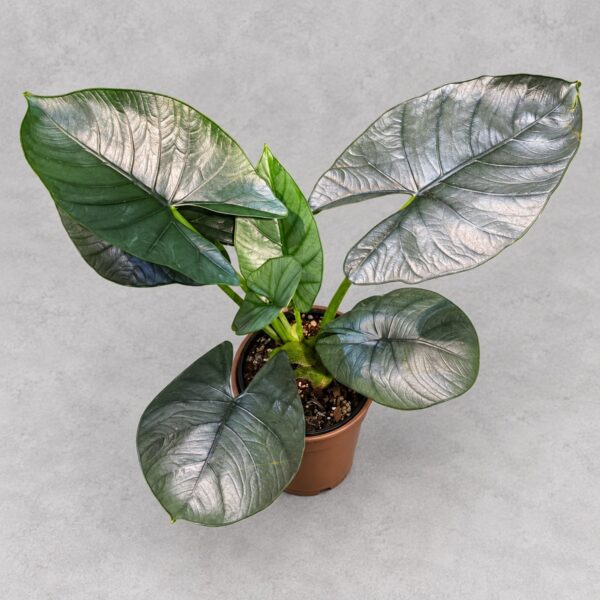
Plantjai shop · In stock online
Alocasia 'reginae'
Alocasia 'reginae'
HK$388.00
Hong Kong delivery · Causeway Bay pickup
For Hong Kong homes and offices. Stock and pricing follow the product page.
IN STORE NOW
Plants for this guide
Related plants in stock now — live prices, delivery or Causeway Bay pickup.
FREE PLANT ADVICE
Send us a photo before you change anything
WhatsApp a photo of the plant and your window light. Our Causeway Bay team will suggest care steps or plants that suit your space.
STORE · CAUSEWAY BAY
4/F, 39 Yiu Wa Street, Causeway Bay
Daily 12:30–8:00pm · ~3 min walk from Times Square
Map & directionsPlant Care