

How to Care for Syngonium Christmas in Hong Kong | Plantjai

Plantjai 植仔 · Care Encyclopedia
Syngonium Christmas
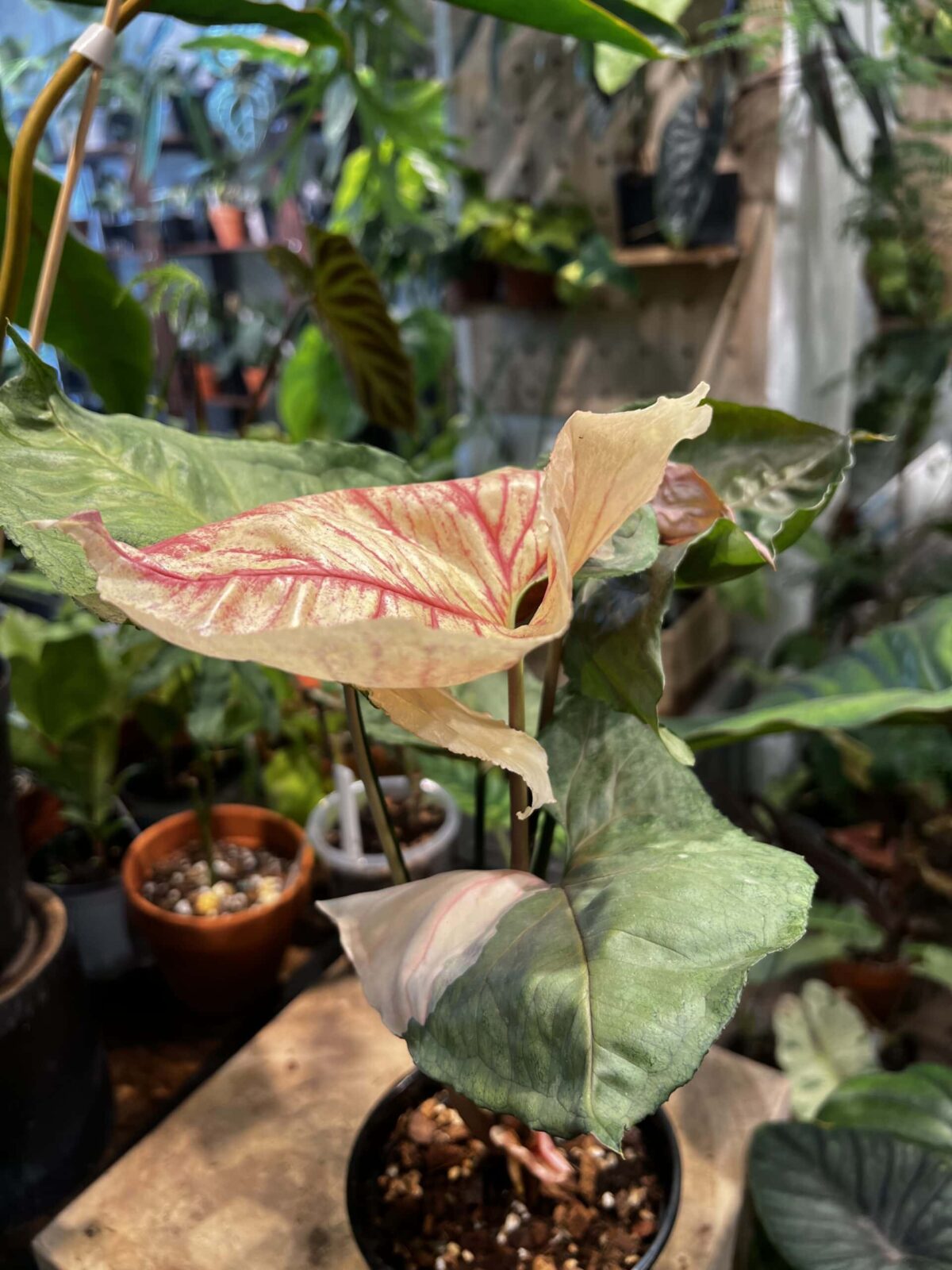
Syngonium podophyllum 'Christmas' 聖誕合果芋
Hong Kong care guide — useful before you buy and after it arrives.
Shop this plantRed-and-green leaves that carry a festive spirit all year round — bring this one home and it's always party season.
⚠️ Toxicity warning: an Araceae family plant, containing calcium oxalate crystals throughout; ingestion causes mouth pain, swelling, and drooling, and sap contact may irritate skin. Keep out of reach of children and pets, and wear gloves when pruning or repotting.
Origin & characteristics
'Christmas' is a horticultural cultivar of Syngonium podophyllum in the family Araceae, genus Syngonium. The species is native to the tropical rainforests of Central and South America, found from Mexico down to Brazil.
The name "Christmas" refers to its distinctive leaf colouring — new and young leaves come in a rich red, pink, or wine-red, gradually turning deep green as they mature, though a hint of red often lingers near the veins or on the underside, creating a red-and-green interplay that echoes the classic Christmas colour scheme. This colour change comes from anthocyanin accumulation, and the red colouring in new leaves is actually a natural sunscreen mechanism, protecting the delicate young tissue from damaging light.
Leaves have the typical arrowhead shape, developing lobed edges at maturity. The plant can grow upright, climb, or trail, with moderate growth and strong adaptability, making it a hugely popular festive-themed foliage plant.
Light
- Bright indirect light is best: an east- or north-facing windowsill, or 1.5-2 metres from a south-facing window
- Key to keeping red: ample indirect light helps new leaves maintain a vivid red; too little light causes new leaves to come in green instead, losing the festive look
- Avoid intense direct light: overly strong sun will scorch the leaf surface, and the red areas are especially prone to crisping at the edges
- Winter supplemental light: during shorter, dimmer autumn/winter days, a grow light for 6-8 hours daily can help maintain the red colouring
Watering
- Check before you water: water once the top 2 cm of soil feels dry
- Water thoroughly, then drain: water until it drains from the base, and empty tray runoff after 15 minutes
- Water quality: filtered water, water left standing, or rainwater is recommended
- Seasonal adjustment:
- Spring/summer growing season: keep the soil lightly moist, roughly once a week
- Autumn/winter: extend to every 10-14 days, letting the soil dry out a bit before watering
- Key point: while red new leaves are developing, they need a stable water supply — a lack of water can cause new leaves to deform or colour unevenly
Soil & pot
- Soil recipe:
- Peat soil 35% + coco coir 25% + perlite 25% + bark chips 10% + charcoal 5%
- Prioritise drainage and breathability while remaining rich in organic matter
- pH: slightly acidic (pH 5.5-6.5)
- Pot choice:
- Plastic or terracotta pots both work, with drainage holes essential
- A small to medium pot (12-20 cm diameter)
- Can be paired with a moss pole for climbing, or grown as a trailing plant
Temperature & humidity
| Factor | Ideal range | Notes |
|---|---|---|
| Temperature | 18-27°C | No lower than 12°C; sustained cold causes leaf drop |
| Humidity | 50-75% | Moderate humidity is sufficient |
- Temperature and red colouring: a slightly cooler environment (18-22°C) helps the red colour last longer; too hot accelerates the transition to green
- Air-conditioned rooms: Hong Kong summers with AC running can dry the air out — mist occasionally or use a pebble tray to raise humidity
- Seasonal changes: reduce watering as autumn/winter temperatures drop, and avoid placing near AC vents
Feeding
- Growing season (April-October): apply a diluted balanced liquid fertiliser (half strength) every 2-3 weeks
- Off-season (November-March): an extremely diluted liquid fertiliser once a month, or stop feeding entirely
- Phosphorus-potassium boost: an appropriate amount of phosphorus-potassium fertiliser helps maintain vivid leaf colour — occasionally substitute a bloom-boosting fertiliser for the balanced one
- Remember: excess nitrogen fertiliser causes leaves to turn green, reducing the red display — dilute rather than concentrate
Pruning and propagation
- Regular pruning: remove old, yellowing leaves to keep the plant tidy
- Encouraging red leaves: pruning the growing tip appropriately encourages more new shoots, producing more red new leaves
- Propagation by cuttings:
- Take a stem section with 2-3 leaves, keeping the aerial root nodes
- Insert into moist sphagnum moss or perlite, keeping humidity high
- Roots typically form within 2-4 weeks
- Water propagation: stem sections with aerial roots can be rooted directly in water, then transferred to soil once rooted
Common problems
| Symptom | Likely cause | What to do |
|---|---|---|
| New leaves not turning red, coming in green | Insufficient light or excess nitrogen fertiliser | Increase indirect light, reduce nitrogen proportion |
| Red leaves turning green too quickly | Temperature too high or light too intense | Move to a cooler spot, adjust light exposure |
| Leaves turning yellow and mushy | Overwatering / root rot | Stop watering, check roots, repot if needed |
| Leaf tips browning | Air too dry | Increase surrounding humidity |
| Elongated stems, sparse leaves | Insufficient light | Move to a brighter spot or add a grow light |
| Spider mites/scale insects | Dry air or poor airflow | Increase humidity, improve airflow, treat as needed |
How to explain to customers
"Syngonium 'Christmas' has a festive spirit right in its name! What's great about it is that new leaves come in red, gradually turning green as they mature, so the whole plant shows both red and green at once, just like a little Christmas tree. It's a fairly easy plant to grow too — indirect light and the 'check before you water' method are all it takes. To keep the red colouring at its best, remember not to keep it too dim — enough light is what keeps the red vivid. Also keep it away from children and pets, since it's a toxic plant. It makes a great gift for the holidays or for yourself — it's genuinely mood-lifting to look at all year round!"
Fun facts
- A natural sunscreen mechanism: the red colour in new leaves comes from a high concentration of anthocyanins, a natural pigment that absorbs UV light and protects delicate young leaf tissue from light damage. As leaves mature and their tissue thickens, the anthocyanins gradually break down and green chlorophyll takes over as the dominant colour.
- A whole Christmas plant family: besides Syngonium 'Christmas,' the horticultural world also has Christmas cactus and poinsettia named for the holiday — all popular festive decorating choices.
- Colour psychology: the red-and-green colour combination is thought to evoke feelings of warmth and joy, which perhaps explains why Syngonium 'Christmas' brings such positive energy into a home.
Keywords
Syngonium Christmas, Syngonium podophyllum, Christmas, Syngonium, Araceae, red-and-green leaf, festive plant, Christmas theme, variegated foliage, indoor plant, indirect light, easy-care plant, beginner-friendly, toxic plant
參考資料(想知來源可展開)
References
- Missouri Botanical Garden — Plant Finder: Syngonium podophyllum, https://www.missouribotanicalgarden.org/PlantFinder/PlantFinderDetails.aspx
- ASPCA — Toxic and Non-Toxic Plant List, https://www.aspca.org/pet-care/animal-poison-control/toxic-and-non-toxic-plants
⚠️ Contains calcium oxalate crystals; toxic to humans and pets if ingested. Keep out of reach of children and pets.
Plantjai · Causeway Bay collector indoor plants · WhatsApp +852 66807550

Plantjai shop · In stock online
Syngonium podophyllum 'Christmas'
Syngonium podophyllum 'Christmas'
Original price was: HK$1,880.00.HK$480.00Current price is: HK$480.00.
Hong Kong delivery · Causeway Bay pickup
For Hong Kong homes and offices. Stock and pricing follow the product page.
IN STORE NOW
Plants for this guide
Related plants in stock now — live prices, delivery or Causeway Bay pickup.
Syngonium podophyllum 'Milk Confetti'
Syngonium podophyllum 'Milk Confetti'
HK$168.00
In stock · store pickup
View plantSyngonium podophyllum 'Pink Salmon'
Syngonium podophyllum 'Pink Salmon'
HK$380.00
In stock · store pickup
View plantSyngonium podophyllum 'Infrared'
Syngonium podophyllum 'Infrared'
HK$138.00
In stock · store pickup
View plant


FREE PLANT ADVICE
Send us a photo before you change anything
WhatsApp a photo of the plant and your window light. Our Causeway Bay team will suggest care steps or plants that suit your space.
STORE · CAUSEWAY BAY
4/F, 39 Yiu Wa Street, Causeway Bay
Daily 12:30–8:00pm · ~3 min walk from Times Square
Map & directionsPlant Care


