

How to Care for Schismatoglottis Pusilla in Hong Kong | Plantjai

Plantjai 植仔 · Care Encyclopedia
Schismatoglottis Pusilla
Hong Kong care guide — useful before you buy and after it arrives.
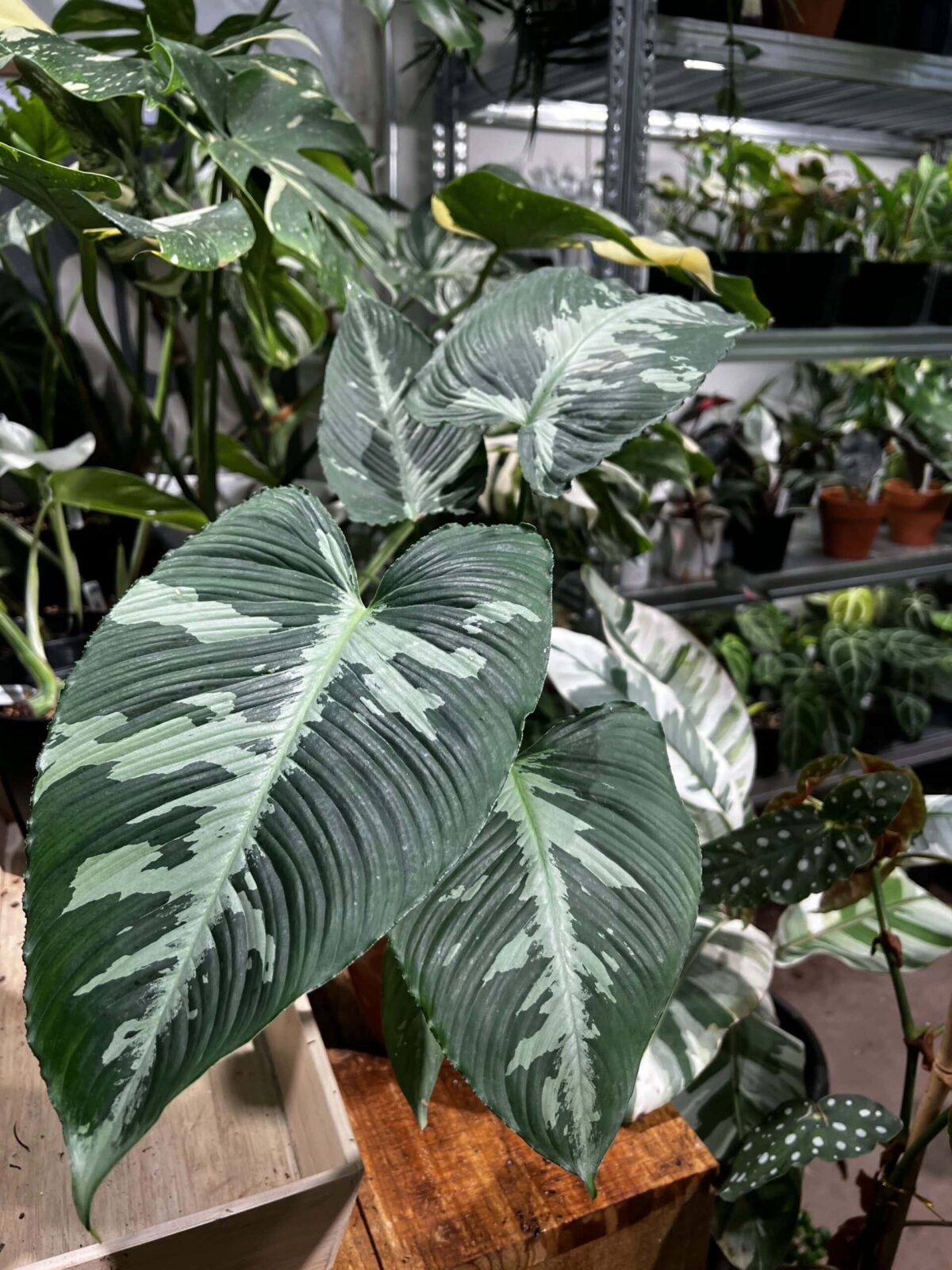
Shop this plantLeaves come naturally patterned in camouflage, like a tiny superhero's battle armour — even at a small size it commands attention, instantly turning a desk into a tropical rainforest command post.
Botanical name pending confirmation — "Schismatoglottis pusilla" is commonly used in horticultural trade, though literature and the exact species in circulation may not fully align; identification is best based on physical characteristics.
Origin & characteristics
The camo schismatoglottis is native to the tropical rainforests of Southeast Asia, mainly found across Borneo, the Malay Peninsula, and Sumatra. It belongs to the family Araceae, genus Schismatoglottis, a terrestrial or lithophytic (rock-dwelling) herbaceous plant. It's a genuinely small plant, typically only 10-20 cm tall at maturity, making it perfect for a desktop display. Leaves are long-oval with a deep green base, covered in irregular light green to yellow-green blotches that resemble military camouflage from a distance — hence the name. These markings aren't just decorative; they also help blur the leaf's outline in the rainforest understory, reducing the chance of being spotted by herbivores.
It grows in a clustering habit, continuously sending up new shoots from the base of the rhizome, gradually forming a dense little colony. Flowering produces a small spathe-and-spadix inflorescence, though this is rarely seen indoors.
Light
- Bright indirect light is best: mimicking its native rainforest understory environment, with soft but ample light. A spot near an east- or north-facing window is ideal.
- Avoid direct sun: harsh midday light scorches the leaf surface, fading the camo pattern or causing crisp edges
- Moderate shade tolerance: it can adapt to dimmer spots, though growth slows and new leaf patterning becomes duller
- Grow light tip: if using a grow light as a supplement, 8-10 hours daily at roughly 1,000-2,000 lux is sufficient
Watering
- Keep it lightly moist, avoid standing water: water once the top 1-2 cm of soil starts to dry, stopping as soon as water just begins to drip from the base
- Water sensitivity: fairly sensitive to chlorine and high mineral content — filtered water, tap water left standing overnight, or rainwater is recommended
- Seasonal adjustment: during spring/summer growth, keep the soil lightly moist; in cooler autumn/winter weather, wait until the topsoil is slightly drier before watering to avoid root rot
- Misting: occasionally mist the surrounding air to boost humidity — avoid constantly spraying the leaf surface directly, which can lead to bacterial issues
Soil & pot
- Soil recipe: a well-draining, breathable mix, such as:
- Peat soil 40% + perlite 30% + coco coir 20% + bark 10%
- Or use a dedicated Araceae mix with extra perlite added for drainage
- pH: slightly acidic to neutral (pH 5.5-6.5) is ideal
- Pot choice:
- A terracotta or plastic pot works, with drainage holes at the base essential
- Don't oversize the pot — one size larger than the root ball is sufficient; too large a pot causes waterlogging
- Since the plant is small, a shallow pot is all that's needed
Temperature & humidity
| Factor | Ideal range | Notes |
|---|---|---|
| Temperature | 20-28°C | No lower than 15°C; growth slows above 32°C |
| Humidity | 60-80% | Typical Hong Kong indoor humidity is generally acceptable; air-conditioned rooms need extra humidifying |
- Cold protection: winter AC or drafty windows are a real risk — below 15°C, leaves can develop water-soaked cold-damage spots
- Humidifying methods: a pebble tray, grouping with other plants, or a small humidifier all work well
- Ventilation: high humidity must be paired with good airflow to avoid stuffy conditions that trigger fungal issues
Feeding
- Growing season (March-October): apply a diluted balanced liquid fertiliser (NPK 20-20-20, diluted to half strength) every 2-3 weeks
- Off-season (November-February): reduce to once a month, or stop entirely
- Foliar feeding: an occasional foliar spray containing trace elements helps keep the camo pattern vivid
- Remember: it's better to under-fertilise than over-fertilise — over-feeding burns the roots, and browning leaf tips are the warning sign
Common problems
| Symptom | Likely cause | What to do |
|---|---|---|
| Leaves yellowing, softening | Overwatering / root rot | Stop watering, check the roots, trim away rot and repot in fresh soil |
| Leaf tips browning and dry | Air too dry or water too hard | Increase surrounding humidity, switch to filtered water |
| Camo pattern fading | Insufficient light | Move closer to a window or add a grow light |
| Growth stalled | Temperature too low or roots have filled the pot | Check the environmental temperature, consider repotting |
| Brown spots on leaves | Fungal infection or sunburn | Isolate the affected plant, reduce leaf surface moisture, adjust light |
| Pests (aphids, scale) | Poor airflow or introduced by a new plant | Spray with diluted soapy water or neem oil, use pesticide if severe |
How to explain to customers
"This camo schismatoglottis is a miniature tropical rainforest in a pot! What's great about it is that its leaves come naturally patterned in camouflage, with every leaf's pattern a little different, and it looks really striking on a desk or in a study. It doesn't need much sun — an east-facing windowsill or a bright spot indoors is enough. For watering, remember the 'check before you water' rule — let the topsoil dry out a little before watering, don't keep it soaked. Humidity is usually fine in Hong Kong most of the time; if you're running the AC, just mist it occasionally. Most importantly, keep it warm in winter — it won't be happy below 15°C!"
Fun facts
- Camouflage as protection: in nature, this kind of leaf patterning is called "variegated camouflage," working on the same principle as military uniforms — breaking up the outline to make it harder for herbivorous insects to locate the leaf edges.
- A Schismatoglottis secret: plants in the genus Schismatoglottis commonly share a trait — when flowering, the spathe releases a faint amount of heat to help disperse scent and attract pollinating insects, a phenomenon known as "thermogenesis."
- A true rainforest floor-dweller: unlike many climbing Araceae, the camo schismatoglottis is a genuine "ground dweller" — it spends its entire life creeping along the forest floor and never climbs.
Keywords
Camo Schismatoglottis, Schismatoglottis pusilla, Araceae, variegated foliage, desktop plant, miniature foliage plant, rainforest plant, high humidity, indirect light, easy-care plant, botanical name pending confirmation, Plantjai
參考資料(想知來源可展開)
References
- Missouri Botanical Garden — Plant Finder: Schismatoglottis, https://www.missouribotanicalgarden.org/PlantFinder/PlantFinderDetails.aspx
- Royal Botanic Gardens, Kew — Plants of the World Online: genus Schismatoglottis, https://powo.science.kew.org/
Plantjai · Causeway Bay collector indoor plants · WhatsApp +852 66807550

Plantjai shop · In stock online
Schismatoglottis pusilla
Schismatoglottis pusilla
HK$588.00
Hong Kong delivery · Causeway Bay pickup
For Hong Kong homes and offices. Stock and pricing follow the product page.
IN STORE NOW
Plants for this guide
Related plants in stock now — live prices, delivery or Causeway Bay pickup.
Aglaonema pictum 'Tricolor'
Aglaonema pictum 'Tricolor'
from HK$88.00
In stock · store pickup
View plant


FREE PLANT ADVICE
Send us a photo before you change anything
WhatsApp a photo of the plant and your window light. Our Causeway Bay team will suggest care steps or plants that suit your space.
STORE · CAUSEWAY BAY
4/F, 39 Yiu Wa Street, Causeway Bay
Daily 12:30–8:00pm · ~3 min walk from Times Square
Map & directionsPlant Care


