

Large Foliage Plant Buying Guide: Placement and Care for Floor Plants—A Practical Guide for Hong Kong Homes


Introduction
Last month, a customer walked into the Specimen Archive with a determined look and said: “I want a plant that can change the energy of this room.” She rented an open-plan studio in Sai Ying Pun, just over 300 square feet, with white walls, light-colored floors—clean but slightly monotonous. What she wanted was a green protagonist to bring the space to life.
I showed her several large foliage plants. When that two-meter-tall fiddle-leaf fig was placed in the corner of her simulated room layout, her eyes lit up—the feeling was like a puzzle finally finding its last piece.
Floor plants possess a kind of magic. They’re not just decorations; they’re the soul of a space. But today, the curator must be honest with you: keeping a large indoor plant healthy is a completely different endeavor from maintaining a small desktop Pothos. From selection and transport to long-term care, every step requires more careful consideration—especially in Hong Kong, where every square foot is precious and elevators are narrow.
Let’s start from the beginning and discuss how to find that perfect green protagonist for your space.
What Is a “Large Foliage Plant”?
In the Specimen Archive’s classification, we categorize plants that reach or exceed 1.4 meters (approximately four and a half feet) in height as large foliage plants. This height is a watershed—beyond this point, a plant is no longer simply “something to put on a table,” but begins to become part of the space, influencing light, traffic flow, and overall atmosphere.
These plants typically share the following characteristics:
– Woody or semi-woody stems: Capable of self-support without needing to cling to other structures
– Extensive root systems: Require a larger soil volume to maintain stability
– Large leaves: Proportionate to the plant’s scale, creating strong visual impact
– Slow growth but long lifespan: Once acclimated to their environment, they can accompany you for many years
Recommended Varieties: Which One Suits Your Space?
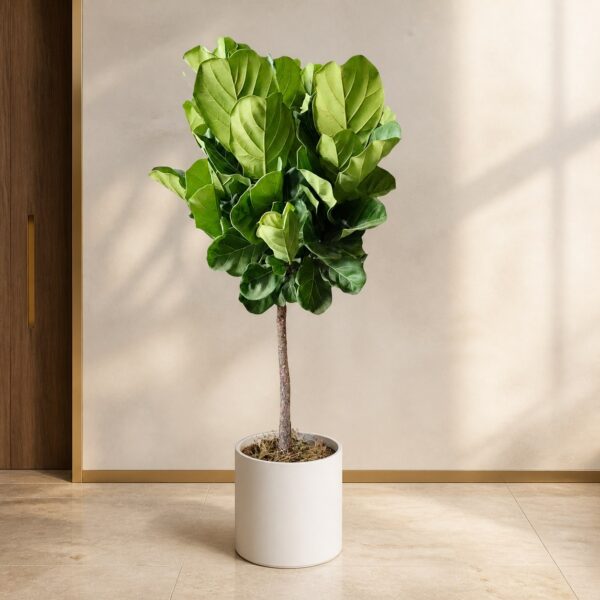
Fiddle-Leaf Fig (Ficus lyrata) — The Elegant Indoor Tree
The fiddle-leaf fig is probably the most popular large indoor plant of the past decade, bar none. Its violin-shaped large leaves, straight stem, and slightly prim posture carry an indescribable artistic temperament.
Pros: Extremely strong visual impact, perfect for minimalist spaces, thick and textured leaves
Challenges: Sensitive to environmental changes, prone to leaf drop after being moved; requires bright indirect light
Best for: Those willing to invest care effort, spaces with ample light
Rubber Plant (Ficus elastica) — The Steadfast Green Guardian
Compared to the fiddle-leaf fig’s “artsy” temperament, the rubber plant exudes more stability and grandeur. Deep green (or deep purple-red, depending on variety) thick leaves paired with a robust stem give a sense of reliability and calm.
Pros: Extremely shade-tolerant, highly adaptable, moderate growth rate, rarely drops leaves
Challenges: Large specimens are very heavy and difficult to move; sap is sticky, exercise caution when pruning
Best for: Beginners, darker spaces, those who prefer a grounded aesthetic
Bird of Paradise (Strelitzia nicolai or S. reginae) — Tropical Vacation Vibes
If you want your home to feel like you’re “always on vacation,” Bird of Paradise is an excellent choice. Strelitzia nicolai (White Bird of Paradise) can grow over three meters tall, with enormous banana-like leaves unfurling from the stem top like green fans. S. reginae (Orange Bird of Paradise) stays shorter, but its bird-shaped flowers when blooming are truly stunning.
Pros: Maximum tropical atmosphere, beautiful leaf form, vigorous growth
Challenges: Requires abundant light; leaves tear easily (this is normal); very large size
Best for: Those with ample space and light who love tropical styling
Dragon Tree (Dracaena marginata) — Understated Sculptural Presence
Dragon trees possess a unique “sculptural quality.” Slender stems grow upward with clusters of narrow leaves at the top like upward-pointing swords. Multi-stem dragon trees are especially attractive, with several stems at varying heights creating tremendous design appeal.
Pros: Very drought and shade tolerant, nearly impossible to kill; unique form perfect for modern spaces
Challenges: Slow growth; leaf tips tend to dry out (when humidity is insufficient)
Best for: Frequent travelers and irregular waterers; those who prefer modern minimalist aesthetics
Various Palms — Bringing the Rainforest Home
Areca Palm (Dypsis lutescens), Majesty Palm (Ravenea rivularis), Chinese Fan Palm (Livistona chinensis)—palm species are born to be spatial focal points. Their fronds spread outward from the top, creating an open, airy visual effect.
Pros: Strong tropical feel, elegant leaf posture, some varieties purify air
Challenges: Require higher humidity; sensitive to water quality (fluoride in tap water can cause leaf tip burn); extremely difficult to repot once they reach a certain height
Best for: Those willing to invest more maintenance effort, with sufficient ceiling height
Pre-Purchase Space Assessment: Measure First, Buy Second
This is the step that nine out of ten people skip. Then regret.
Ceiling Height
Large foliage plants don’t just occupy floor space; they grow upward. Fiddle-leaf figs can reach over three meters, Bird of Paradise can exceed four meters. Before purchasing, always measure your ceiling height and reserve at least 30-50 cm of growth space. Many older Hong Kong buildings have lower ceilings (around 2.5 meters), in which case you should choose varieties that spread horizontally rather than grow vertically.
Light Conditions
Different positions have dramatically different light levels. Direct light near windows suits Bird of Paradise and fiddle-leaf fig; areas further from windows with indirect light suit rubber plants and dragon trees; dark corners—honestly, aren’t suitable for any large foliage plant’s long-term survival.
A simple test: At the spot where you plan to place the plant, extend your hand and look—if you can clearly see the outline and details of your hand, the light is sufficient. If your hand appears blurry and dim, there likely isn’t enough light to support healthy growth of a large plant.
Traffic Flow Clearance
Large plants affect walking paths. A pot 60 cm in diameter plus spreading leaves may occupy over a square meter of floor space. In narrow Hong Kong homes, this is no small matter. Before purchasing, confirm the placement won’t obstruct daily passage or block door openings.
Transport and Elevator Access: The Brutal Reality of Hong Kong Residences
This is perhaps the most underestimated aspect of buying large plants in Hong Kong.
The Brutal Math of Elevator Dimensions
Hong Kong residential elevators vary wildly in size. Older tong lau buildings may have no elevator at all; newer private building elevators are typically about 1.2-1.5 meters wide and 1.5-2 meters deep. A large fiddle-leaf fig with pot and soil may reach 2 meters tall with a spread over 80 cm—meaning it might not fit in your elevator.
Solutions:
1. Measure your elevator before purchasing: Bring a tape measure to check interior dimensions and door width
2. Consider compact varieties: Choose species with slender stems and leaves that can be moderately gathered (like dragon trees)
3. Select plants in removable pots: Some large plants use detachable root-control pots that can be removed during transport
4. Plan for stair carry backup: If the elevator won’t work, can it be carried via stairs? How many people will you need?
The Value of Professional Delivery Service
This is why I strongly recommend choosing sellers who offer delivery service. PLANTJAI’s professional delivery team has experience handling the transport challenges of floor-standing potted plants, including elevator assessment, stair carrying, and in-home positioning. This isn’t simply “delivering a plant to your door”—it’s ensuring the plant isn’t damaged during transport and lands in the right spot.
Care Challenges for Large Plants
Watering: From “Watering a Pot” to “Watering a Tree”
Watering large plants is a completely different concept from watering small ones. A pot 40 cm in diameter can hold over 20 liters of soil, and thoroughly watering it may require several liters of water. The question is—how do you know when it needs water?
My recommendations:
– Use a long-stem soil moisture meter: Insert deep into the soil for measurement—far more reliable than the finger test
– Pot weight method: Effective for small plants, but for large plants…honestly, you probably can’t lift it. Instead, observe moisture 2-3 cm below the soil surface
– Keep a watering calendar: Record each watering date and how quickly the soil dries to gradually establish a pattern
Repotting: A “Surgery” That Requires Advance Planning
Repotting a large plant is a major operation. You may need:
– Two or more people to work together
– A sufficiently large new pot and fresh potting medium
– A space that can get dirty (or lots of waterproof sheeting)
– Time and energy for cleanup afterward
Therefore, the best strategy is to choose an adequately large initial pot that allows the plant to grow for 2-3 years without needing repotting. If repotting becomes absolutely necessary, consider hiring professional gardening services to assist.
Support and Shaping
As plants grow taller, some large specimens (especially fiddle-leaf figs) may need support to prevent leaning. You can use discreet plant support stakes, or gently secure stems with twine. Regularly rotating the pot (90 degrees every two weeks) ensures even light exposure and prevents one-sided growth.
Design Aesthetics of Placement
Large foliage plants are powerful spatial design tools. A few placement principles:
– As spatial dividers: In open-plan units, large plants can serve as visual “soft partitions” separating living and dining areas
– Filling empty corners: Empty room corners are often visual “dead zones”—a large plant can bring that area to life
– Creating visual focal points: Place a large plant at the first sightline when entering a room to set the tone for the entire space
– Coordinating with furniture height: Large plant height should contrast with or complement surrounding furniture to avoid visual imbalance from being too tall or too short
Conclusion: A Big Tree Changes a Space, and Changes a Person Too
I’ve always believed that having a large foliage plant standing in a space makes the feeling completely different. It’s not just a decoration; it’s a companion—you glance at it when leaving in the morning, and it’s still there when you return in the evening, quietly growing.
In Hong Kong, a city where everything is small, fast, and expensive, a floor-standing large plant is a gentle resistance against “smallness” and “haste.”
Want to find that perfect green protagonist for your space? Browse [plantjai.com](https://plantjai.com) to view our large foliage plant collection, or visit the Specimen Archive in person at 4/F, Nam Hing Fong, 39 Yiu Wa Street, Causeway Bay. We offer professional delivery and placement services to ensure your green protagonist arrives home safely.
IN STORE NOW
Plants for this guide
Related plants in stock now — live prices, delivery or Causeway Bay pickup.
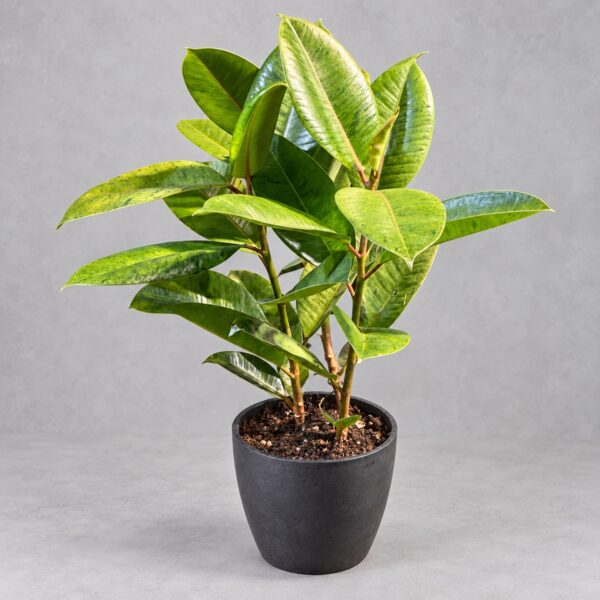
Ficus elastica 'Shivereana'
Ficus elastica 'Shivereana'
from HK$198.00
In stock · store pickup
View plant
FREE PLANT ADVICE
Send us a photo before you change anything
WhatsApp a photo of the plant and your window light. Our Causeway Bay team will suggest care steps or plants that suit your space.
STORE · CAUSEWAY BAY
4/F, 39 Yiu Wa Street, Causeway Bay
Daily 12:30–8:00pm · ~3 min walk from Times Square
Map & directionsChoosing Plants


