

Buying Monstera Cuttings: Check Nodes, Buds and Roots

In this guide (7)
- 01Know the five structures you are being shown
- 02A top cutting, a mid-cut and a leafless node are different purchases
- 03Request photographs of the actual piece being sold
- 04A node still needs a usable growing point
- 05A very white leaf does not guarantee the next pattern
- 06Five final questions to make the purchase clear
- 07Further reading and next steps
Before admiring a Monstera cutting’s leaf pattern, establish that it has suitable stem tissue and a viable growing point, then assess its roots. A beautiful leaf, a long aerial root or even rooted material does not independently prove the ability to produce a complete plant. In ordinary home propagation, a Monstera leaf and petiole without a node-bearing stem section should not be treated as a normally propagatable new plant.
This guide concerns typical stem cuttings of Monstera deliciosa and its variegated cultivated forms. It is not a tissue-culture protocol or a universal rule for leaf propagation. Begonias, African violets and other plants have different regenerative abilities.
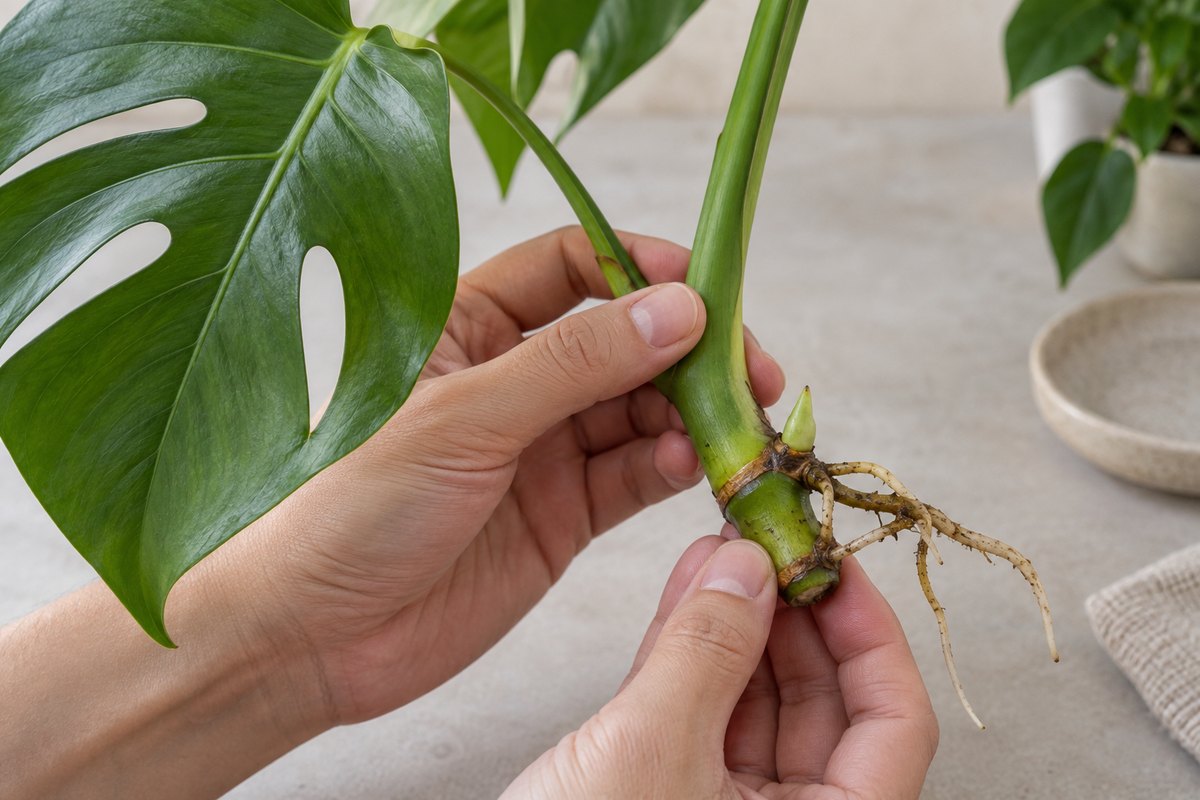
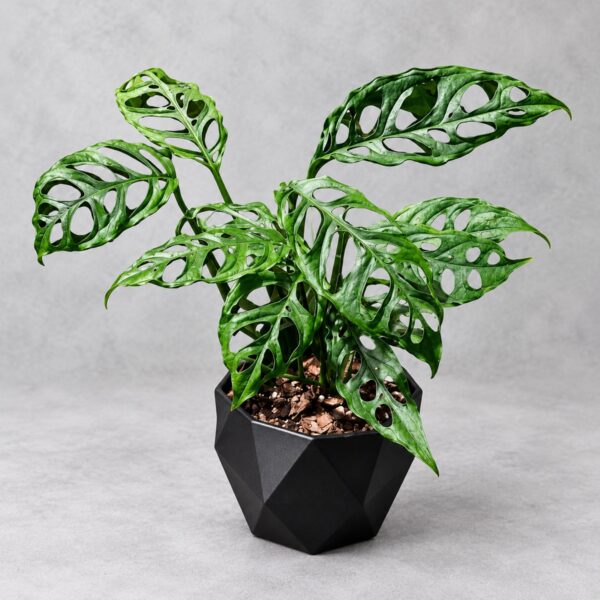
The lead image illustrates variegated Monstera foliage; it cannot establish whether a cutting has a node or viable bud. Inspect the actual stem section being sold.
Know the five structures you are being shown
| Structure | What it is | What to establish |
|---|---|---|
| Leaf blade | The visible leaf surface | Condition and pattern; not proof of a growing point |
| Petiole | The stalk connecting leaf and stem | A long petiole is not a node-bearing stem cutting |
| Stem node | The stem region where a leaf attaches | That the actual cutting includes the relevant stem tissue |
| Bud or growing point | Tissue capable of developing a shoot, terminal or axillary | Its location, integrity and any damage |
| Aerial and other roots | Root tissue | Functioning roots, not length alone |
The University of Illinois distinguishes stem, leaf and leaf-bud cuttings, while the University of Wisconsin describes stem cuttings and layering for Monstera. The practical distinction is that rooting and producing a new shoot are different capabilities. Check both.
A top cutting, a mid-cut and a leafless node are different purchases
A top cutting typically retains the terminal growing point, but its integrity, roots and any vulnerable emerging leaf still need assessment. A mid-stem cutting generally depends on an available axillary bud for a new shoot. Inspect that node and bud, not merely the attractive top of the mother plant.
A leafless node section can potentially develop with viable tissues, a growing point and suitable conditions, but it offers less foliage evidence and requires different management. It is not the same immediate display purchase as an established potted plant.
“Rooted” also needs clarification: one newly emerging root, branched roots, or established growth in the current medium? Those descriptions are more useful than an undefined “healthy cutting”. None justifies a guaranteed number of days to a new leaf.
Request photographs of the actual piece being sold
- The complete cutting: leaf, petiole, stem and roots together, showing exactly what is included.
- A node close-up: the connection between petiole and main stem, not only a root.
- The growing point: a visible bud or terminal tip. Ask for clarification if obscured, not destructive exposure for a photograph.
- Cut surfaces and stem base: enough detail to assess suspicious damage or spreading soft decay.
- Root condition: recent images showing integrity where practical, without repeatedly dismantling an established root ball.
- Identification and date: a clear connection between the label, image date and piece offered.
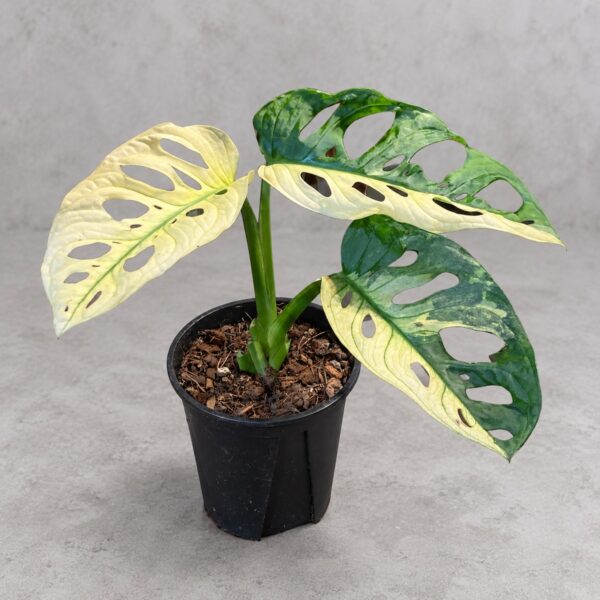
A mother-plant photograph provides context, not proof of the actual cutting. If all you have is a striking white-leaf close-up, request more information. Not visible does not mean absent—but it is not a reason to assume the structure is present either.
A node still needs a usable growing point
A node photograph is not the final check. Ask whether a shoot has already emerged there, whether it was removed and what viable growing point remains. A label such as “spent node” is not a substitute for inspecting the actual structure; equally, that label alone does not establish the fate of every piece.
A useful buying rule is: if the seller cannot explain the viable growing point, tissue condition and identity of the offered piece, do not include guaranteed shoot growth in your expectations. That is an information-quality decision, not a remote diagnosis.
Assess root integrity and firmness too. An older aerial root can have a naturally darker exterior; non-white does not automatically mean rotten. Soft disintegration, shedding tissue and a worsening cut surface deserve attention. Common root-rot symptoms provide clues, not a pathogen diagnosis from a photograph.
A very white leaf does not guarantee the next pattern
A half-moon leaf on the mother plant, a white stem stripe or one highly white leaf should not be converted into a guarantee of the next leaf. The mechanism of variegation and the tissue composition of a growing point cannot be fully established from a product photograph.
Instead of asking for an unsupported “stable variegation percentage”, ask whether images document the same shoot over time, what its recent growth looks like, whether it has a sustained all-white or all-green trend and how much healthy green tissue the cutting retains. These remain clues, not guarantees.
Do not make whiteness the only quality measure. You are buying material that must continue growing. A sound growing point, healthy roots and traceable information affect what you can do with it afterwards.
Five final questions to make the purchase clear
- Am I receiving a top cutting, mid-cut, leafless node or established plant?
- Where is the usable growing point, and is there recent evidence?
- In what medium did the roots form, and is the plant established there?
- Which identity, parentage and variegation claims are documented rather than inferred?
- Are transport expectations and the response to arrival problems clear before purchase?
On arrival, document and identify the piece before making changes. Collector status is not a reason for immediate extensive repotting or concentrated feeding. Use suitable protection when handling sap or pruning, and keep fragments away from children and pets. The RHS arum-houseplant guide also flags contact and ingestion risks.
Obtain enough information to evaluate the cutting before comparing leaf colour. Knowing which growth stage you are buying is more useful than discovering later that the photograph never answered whether it could produce a shoot.
Further reading and next steps
IN STORE NOW
Plants for this guide
Related plants in stock now — live prices, delivery or Causeway Bay pickup.
Monstera obliqua Peru
Original price was: HK$480.00.HK$280.00Current price is: HK$280.00.
In stock · store pickup
View plant
FREE PLANT ADVICE
Send us a photo before you change anything
WhatsApp a photo of the plant and your window light. Our Causeway Bay team will suggest care steps or plants that suit your space.
STORE · CAUSEWAY BAY
4/F, 39 Yiu Wa Street, Causeway Bay
Daily 12:30–8:00pm · ~3 min walk from Times Square
Map & directionsChoosing Plants


