

Aglaonema pictum ‘Tricolor’: The Hidden Treasure from Indonesia’s Rainforest Depths


Introduction
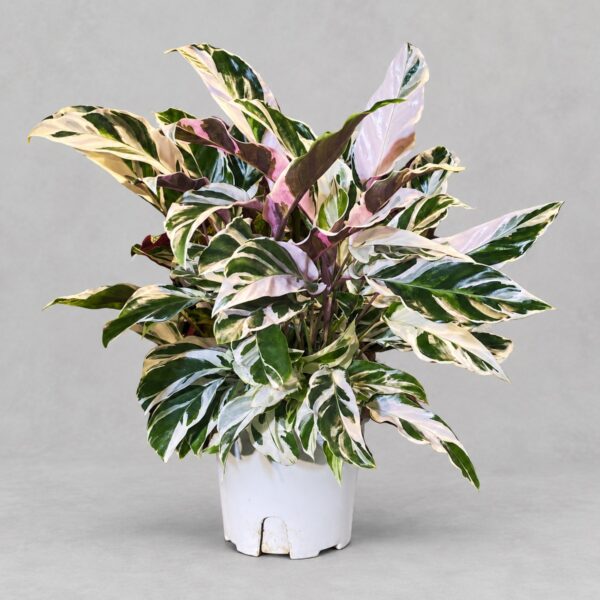
The first time I laid eyes on an Aglaonema pictum ‘Tricolor’, I genuinely thought someone had cut a piece of military camouflage fabric into the shape of a leaf and pasted it onto the plant. The blade carried three tones—deep green, light green, and grey-white—woven together in a pattern so random it seemed chaotic, yet somehow perfectly harmonious. Like the layers of fallen leaves and moss that accumulate naturally over centuries on a rainforest floor.
I later learned that this plant does indeed grow in the understorey of Sumatran rainforests, and those camouflage markings are nature’s own protective colouration. In the world of plant enthusiasts, it goes by a more evocative name: the camouflage aglaonema.
From the Rainforest Understorey of Sumatra
Aglaonema pictum is native to the tropical rainforests of Sumatra, Indonesia, typically found at elevations between 500 and 1,500 metres. There, it lives beneath dense forest canopies where direct sunlight rarely penetrates, and the air remains warm and humid throughout the year.
The ‘Tricolor’ cultivar was selected from wild A. pictum populations for its distinctive three-toned camouflage markings. Unlike many highly bred ornamental plants, the camouflage aglaonema retains a wild, untamed character—thick, waxy leaves with a texture reminiscent of waxed canvas, elongated blades with subtle undulations, and an overall presence that radiates primitive, quiet strength.
Why “Camouflage”? Nature’s Art of Protective Colouration
The leaves display three primary tones: deep green (approaching forest green), light green (the colour of fresh shoots), and grey-white or silver-green. These three colours interweave randomly to create patterns resembling military camouflage, hence the brilliantly apt Chinese common name.
Botanically, this pattern is called mottled foliage, fundamentally different from variegation. Variegation is a cellular-level genetic mutation, while the camouflage aglaonema’s markings are a stable cultivar characteristic—every plant displays the camouflage pattern, though the intensity and distribution vary slightly. This means you never need to worry about reversion. Camouflage is its birthright, not a fleeting mutation.
Easier Than You Think: A Beginner-Friendly Rainforest Plant
Here’s perhaps the most important sentence in this article: the camouflage aglaonema is far easier to grow than most people assume.
Many assume that anything from a Sumatran rainforest must be “high maintenance” or “needs a greenhouse.” This is a misconception. As a member of the Aglaonema genus, it inherits this group’s most powerful traits: shade tolerance, drought resilience, and remarkable adaptability. These three qualities make it an outstanding houseplant.
Light: Thrives Even in Lower Light
The camouflage aglaonema is remarkably flexible with light. Bright, indirect light is ideal, but it adapts well to medium and even lower light conditions. I’ve seen healthy specimens thriving on bookshelves two metres or more from the nearest window in the archive. Of course, very low light will reduce the contrast of the camouflage patterning and may result in smaller new leaves.
Like all tropical understorey plants, it is completely intolerant of direct sunlight. Midday summer sun can scorch leaves within hours, so keep this in mind.
Watering: A Very Forgiving Plant
Aglaonemas have thick root systems and somewhat succulent stems that store moisture. This means an occasional missed watering won’t trigger an immediate crisis. My routine: water thoroughly when the top two to three centimetres of soil feel dry, roughly every seven to ten days depending on the season. During winter when growth slows, reduce frequency further.
Humidity and Temperature
Although it hails from humid rainforests, the camouflage aglaonema adapts surprisingly well to average indoor humidity. Hong Kong summers present no challenge whatsoever; during winter heating season, an occasional leaf misting helps if air becomes very dry. The ideal temperature range is 18-28°C—avoid prolonged exposure below 15°C.
Growing Medium Recommendation
A standard houseplant mix works well, with drainage being the priority. I typically use a peat moss blend with perlite and some orchid bark at roughly a 5:3:2 ratio. Ensure your pot has drainage holes.
Observations from the Archive: Growth Rhythm and Repotting
The camouflage aglaonema grows at a moderate pace—not as vigorously as a pothos, but it won’t leave you waiting indefinitely either. In suitable conditions, it produces a new leaf approximately every four to six weeks.
Repotting becomes necessary when you see roots emerging from drainage holes, or when water takes noticeably longer to absorb (indicating the root ball has filled the pot). Generally, repotting every two years is sufficient. Repotting also offers an opportunity to divide—the plant produces basal offsets that can be separated to create new plants. One pot becomes two.
Pricing and Selection Guide
At Plantjai, camouflage aglaonemas range widely in price—from HKD 380 for young seedlings to HKD 3,880 for large, mature specimens. Pricing reflects plant size, leaf count, and the contrast intensity of the camouflage pattern.
When selecting, I recommend prioritising:
1. Leaf health: No significant yellowing, browning, or disease spots.
2. Stem stability: The plant shouldn’t wobble in its pot, indicating a well-developed root system.
3. Camouflage contrast: Colour boundaries should be crisp and clear, not blurred or faded (which may indicate insufficient light or plant stress).
4. New growth: Look for active shoot development at the stem base, indicating the plant is in an active growth phase.
Conclusion
The camouflage aglaonema is one of the few plants in the archive that strikes me as “both extraordinary and approachable.” Its appearance is wild, yet its temperament is gentle; it comes from the distant rainforests of Sumatra, yet it settles comfortably into a Hong Kong living room. Every time I study those camouflage markings, I’m reminded of the countless life forms still hidden in rainforest depths, undiscovered by humans—nature is always more abundant than our imagination.
If you’d like to bring a camouflage aglaonema home, Plantjai’s Causeway Bay store welcomes you to see these rainforest gems in person. Various sizes and price points are available, and our archive staff will recommend the best care approach for your specific environment. Or visit plantjai.com first to browse our online collection—you might recognise the one camouflage plant that belongs with you.
The rainforest’s secret lies within this camouflage.
IN STORE NOW
Plants for this guide
Related plants in stock now — live prices, delivery or Causeway Bay pickup.
Aglaonema pictum 'Tricolor'
Aglaonema pictum 'Tricolor'
from HK$88.00
In stock · store pickup
View plant

FREE PLANT ADVICE
Send us a photo before you change anything
WhatsApp a photo of the plant and your window light. Our Causeway Bay team will suggest care steps or plants that suit your space.
STORE · CAUSEWAY BAY
4/F, 39 Yiu Wa Street, Causeway Bay
Daily 12:30–8:00pm · ~3 min walk from Times Square
Map & directions