
Is Your Window Bright Enough? A Home Light Audit


In this guide (7)
- 01Measure the leaf’s position, not the room’s impression
- 02Lux, PPFD and duration answer different questions
- 03Use a phone for comparison, with clear limits
- 04Build a light record for three real positions
- 05Turn observations into a placement decision
- 06When adding a lamp, ask about coverage before watts
- 07Further reading and next steps
A useful plant position is defined by the light reaching the leaves, how long it lasts, and the plant’s response—not simply by how bright the room feels. In a Hong Kong flat, neighbouring buildings, curtains, an overhang and distance from the window can make two south-facing rooms very different growing spaces. Comparing the positions you actually have is more useful than immediately buying a stronger lamp.
This is a practical home-observation method, not a universal pass mark for every plant. You do not need to start with a professional meter. You do need to understand what your observations and instruments can—and cannot—tell you.
Measure the leaf’s position, not the room’s impression
A well-exposed photograph taken beside a window does not describe the light reaching a leaf next to the sofa. Observe at the height of the main foliage, including any shading from window frames, furniture or other plants. The window-facing and room-facing sides of a large plant may receive different amounts of light.
Record the window direction, but do not let it replace observation. An east-facing window blocked by another building may receive little morning sun. A position normally behind closed curtains should be assessed with those curtains in their usual state. The University of Minnesota’s indoor-lighting guide emphasises both light availability and duration, and notes that plants generally grow more slowly and use less water in low light.
Lux, PPFD and duration answer different questions
| Information | Useful for | Not sufficient to prove |
|---|---|---|
| Lux | Comparing positions under similar light sources | The amount of plant-usable light under every spectrum |
| PPFD | Measuring photosynthetic photons reaching a unit area each second, usually in µmol m⁻² s⁻¹ | A whole day’s light supply from one instantaneous reading |
| Lighting hours | Establishing how long light is available | Whether the light is strong enough |
| Lamp wattage | Comparing electrical consumption | Light reaching a leaf or useful coverage |
Do not use one online divisor to convert every lux reading into PPFD. Apogee’s conversion guidance explicitly gives different factors for different light sources. Daylight, a white LED and a red–blue lamp are not interchangeable.
Use a phone for comparison, with clear limits
Until you have checked its performance, use a phone to answer “which position is brighter?” rather than to certify that a plant receives an exact PPFD target. Phones, sensor locations, app calculations and required accessories differ. A display with several decimal places is not evidence of equivalent accuracy.
- Follow the app’s instructions, identify the sensing area and check whether a particular diffuser is required.
- Use the same phone, settings and sensor orientation for a comparison. Keep your body out of the light path.
- If readings fluctuate, repeat them and record a range instead of selecting the highest value.
- For numerical decisions about valuable plants, compare the setup with a suitable quantum sensor or use reliable PPFD measurements directly.
Build a light record for three real positions
Choose A: the current position, B: a practical position nearer the window, and C: another realistic option. Observe in the morning, around midday and in the afternoon, ideally on both a clear and an overcast day. This is manageable sampling, not a complete daily light integral measurement. If a short beam of direct sun crosses a position, separately record when it arrives and leaves.
| Field | What to record |
|---|---|
| Date, time and weather | A clear morning, for example—not just “bright” |
| Position and leaf height | A, B or C; curtains and obstructions in their usual state |
| Light | Direct sun, its duration, and a reading or range from the same instrument |
| Practical limits | Heat beside the glass, direct air-conditioning and safe access |
| Subsequent response | New growth, scorch and drying rate; photographs from the same angle |
Avoid repotting, fertilising and relocating at the same time. Date one change first, so that later observations remain interpretable.
Turn observations into a placement decision
- B is brighter across several observations without excessive heat: consider moving towards it gradually, rather than abruptly exposing the plant to strong sun.
- There is only a brief, intense midday beam: consider a sheer curtain or a different angle. A peak is not an all-day suitability rating.
- All three positions are dim: reconsider the plant choice or plan supplemental lighting. Shade tolerance does not mean healthy long-term growth without light.
- Better light does not resolve yellowing: investigate roots and watering instead of continually increasing lamp intensity.
These are ways to choose the next check, not diagnoses from a single symptom. The RHS guide to leaf damage describes several environmental causes. Assess new growth and a sustained trend rather than expecting an old scar to disappear.
When adding a lamp, ask about coverage before watts
Ask for a PPFD distribution at relevant distances, not only the highest reading directly beneath the lamp. Consider the width of the plant and the positions of its highest and lowest leaves. Follow the fixture’s safety instructions and keep water away from equipment not rated for the conditions.
A white LED is not useless simply because it does not look red and blue. Spectrum, light at the leaves and duration matter. Do not use continuous 24-hour lighting to compensate for a poor position or unsuitable lamp distance. Establish a consistent day–night schedule, then adjust to the plant and its response. Better lighting may change drying speed: check more often if necessary, but continue to water according to root-zone conditions.
The most valuable result is a repeatable record, not one lux number: the position, the settings and what happened afterwards. When the season, curtains or furniture change, you will know what to compare again.
Further reading and next steps
IN STORE NOW
Plants for this guide
Related plants in stock now — live prices, delivery or Causeway Bay pickup.
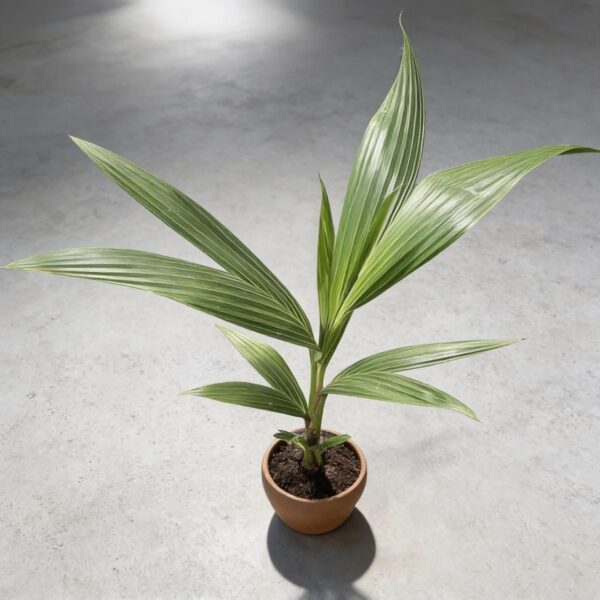
Cocos nucifera
Cocos nucifera
Original price was: HK$398.00.HK$298.00Current price is: HK$298.00.
In stock · store pickup
View plant
FREE PLANT ADVICE
Send us a photo before you change anything
WhatsApp a photo of the plant and your window light. Our Causeway Bay team will suggest care steps or plants that suit your space.
STORE · CAUSEWAY BAY
4/F, 39 Yiu Wa Street, Causeway Bay
Daily 12:30–8:00pm · ~3 min walk from Times Square
Map & directionsPlant Care