
How to Care for Ficus Benjamina Barok in Hong Kong | Plantjai


Plantjai 植仔 · Care Encyclopedia
Ficus Benjamina Barok
Hong Kong care guide — useful before you buy and after it arrives.
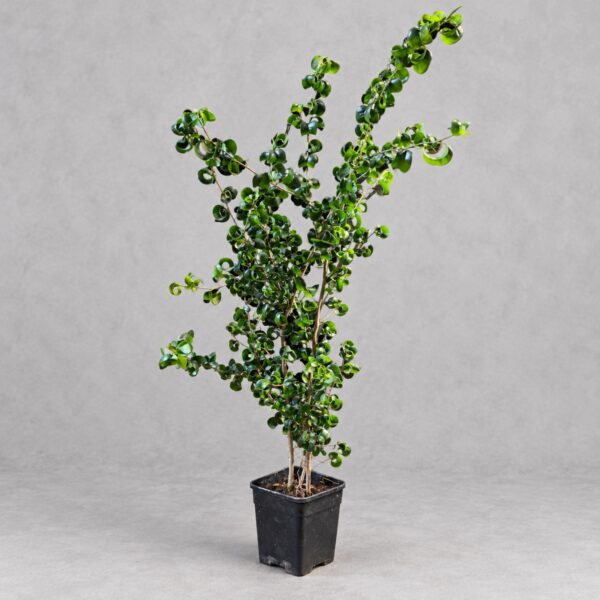
Shop this plantLeaves that naturally curl into delicate little trumpets, glossy and elegantly poised — an instantly recognisable "self-styling" foliage plant that lifts the character of any corner it's placed in.
Botanical name: Ficus benjamina 'Barok' (confirmed)
Origin & characteristics
Native to Southeast Asia and northern Australia, this evergreen tree belongs to the fig family (Moraceae) and is a curly-leaved cultivar of the weeping fig (Ficus benjamina). The standout feature of 'Barok' is its uniquely curled, wave-like leaves — thick, glossy, and especially striking as new leaves unfurl, each one twisting like a small green trumpet or ribbon.
Indoors it typically grows 60–150 cm, with grey-white to light brown bark and soft, gracefully drooping branches. Growth is moderate, and with stable care it can live for over a decade. It's quite sensitive to environmental change — moving it or shifting its position often triggers leaf drop, so once you find it a good spot, it's best left there.
⚠️ Toxicity note: the sap contains proteolytic enzymes (ficin) and furanocoumarins (psoralen), toxic to cats and dogs — ingestion can cause oral irritation, vomiting, and skin allergies; human skin contact may also cause irritation, so wear gloves when pruning.
Light
- Bright, indirect light: needs ample, soft light — position it somewhere with good indirect brightness
- Ideal spot: within about 3 metres of a south-facing window, or within 1 metre of an east/west window
- Can tolerate a little gentle morning or evening direct sun, but avoid harsh midday direct sun, which will scorch the leaves
- Insufficient light leads to loss of leaf sheen, slower growth, leggy stems, and even leaf drop
- If you need to move it after a long time in one position, transition gradually rather than shifting it straight from a dark spot to a bright one
Watering
- Principle: "let it dry out fully, then water thoroughly" — wait until the soil is dry about 5 cm down
- Roughly every 5–7 days during summer's peak growth, extending to every 10–14 days as growth slows in winter
- Water slowly and thoroughly until it drains from the base, then promptly empty the saucer
- Avoid waterlogging: while figs enjoy moisture, standing water at the base leads quickly to root rot
- Testing soil moisture with a finger is most reliable — water when it feels cool but not damp; wait another day or two if it's still moist
- Use water close to room temperature — cold water can shock the roots
Soil & pot
- Well-draining and aerated: use a quality, well-draining potting mix, such as:
- Peat/coco coir 40% + perlite 30% + pine bark or coconut husk chips 20% + worm castings 10%
- Keep it slightly acidic to neutral (pH 6.0–7.0)
- Pot selection:
- Must have drainage holes; terracotta is ideal (good airflow and drainage)
- Curly fig has a shallow, wide root system, so a broad, shallow pot suits it well
- Repot every 2–3 years in spring
- Note: figs dislike frequent repotting, which often triggers leaf drop — unless it's genuinely root-bound, try to avoid disturbing it unnecessarily
Temperature & humidity
- Ideal temperature: 18–27°C, with minimal day/night fluctuation
- Minimum temperature: 5°C or above — below 5°C risks cold damage, and growth stalls below 10°C
- Keep away from AC vents, heaters, and drafts from doors and windows
- Curly fig is extremely sensitive to environmental change, so once you find a good spot, avoid moving it
- Humidity: ideal range 50–70%; typical Hong Kong indoor humidity is generally suitable
- Overly dry air (from prolonged AC or heater use) can cause brown leaf edges — mist around the plant or use a pebble tray to raise humidity
- Keep the environment well-ventilated, but avoid strong direct drafts
Common problems
Extensive leaf drop
Curly fig's most notorious "dramatic reaction," usually triggered by moving its location, sudden temperature change, or a new environment. Find it a spot with stable light and try not to move it again — new leaves will regrow once it settles in.
Yellowing leaves
Most often caused by overwatering or poor drainage leading to root rot. Check soil moisture and drainage, repotting if needed. If it's uniform yellowing and dropping of older leaves, this may simply be natural ageing.
Brown, dry leaf edges
Air too dry or salt buildup from fertiliser. Raise ambient humidity (misting/pebble tray), and flush the soil thoroughly with water every couple of months to wash out accumulated fertiliser salts.
Leaves losing their curl, becoming flatter
Possibly insufficient light or cultivar reversion. Improve light conditions first; if new leaves still won't curl, the plant may be reverting.
Pests
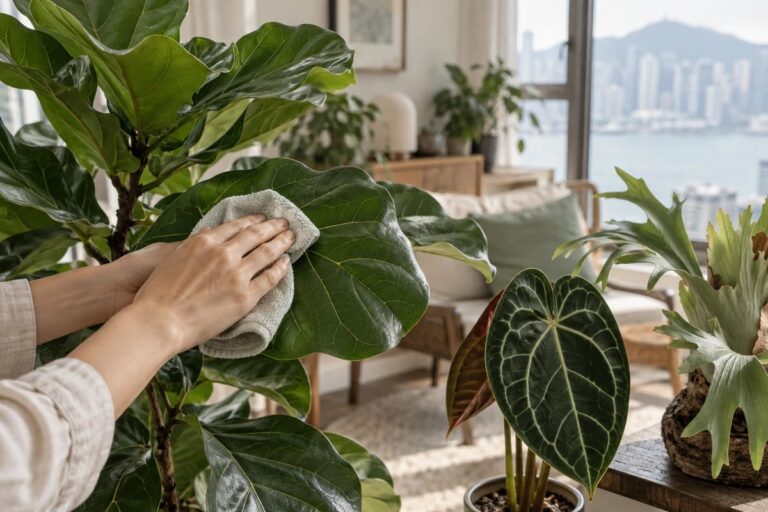
Common pests include spider mites (in dry conditions), scale, and whitefly. Regularly wipe both sides of the leaves with a damp cloth, and maintain humidity to help prevent spider mites. Treat infestations with diluted neem oil or soapy water spray.
Pale leaves with white spotting
May indicate pest infestation or powdery mildew. Check leaf undersides for insects or webbing; mild cases can be gently brushed off with a soft toothbrush and water, then moved somewhere well-ventilated.
How to explain to customers
Introducing it: "The curly fig is a really special cultivar — its leaves naturally curl up like little green trumpets, with such a glossy finish that it instantly elevates any spot in the home. It's a cultivar of the weeping fig, has a very elegant form, and with good care can be with you for a decade or more."
Care essentials: "The most important thing for curly fig is 'stability' — find it a spot with good indirect light and try not to move it around, since it's sensitive and drops leaves easily if disturbed. For watering, remember 'let it dry before you water' — check about 5 cm down with your finger, and water thoroughly once it's dry. Use well-draining soil, and terracotta is the best pot choice."
A gentle reminder: "Keep it above 5°C in winter, and don't place it near AC vents or doorways. If you have cats or dogs at home, keep it up high — the sap is toxic to pets. Also, figs don't like being repotted often — every two to three years is plenty, no need to disturb it constantly."
Addressing leaf-drop worries: "If it drops leaves after you bring it home, don't worry too much — that's a normal reaction, not a sign you're doing something wrong. Just keep things stable, don't move it again, and don't overwater. Once it settles in, new (often even nicer) leaves will grow back."
Fun facts
- The secret behind the curl: the curled leaves of the curly fig are actually the result of a genetic mutation — cells on the upper leaf surface divide faster than those below, causing the leaf to curl inward into its distinctive spiral shape.
- A weeping fig family member: 'Barok' is a cultivar of the weeping fig (Ficus benjamina), part of a large family that also includes the white-edged 'Starlight', the deep green 'Midnight', and the smaller-leaved 'Nuda', among many other cultivars.
- An air-purifying champion: NASA research has identified the weeping fig as an effective air-purifying plant, capable of absorbing formaldehyde, benzene, and trichloroethylene — and as a cultivar of the same species, curly fig shares this benefit.
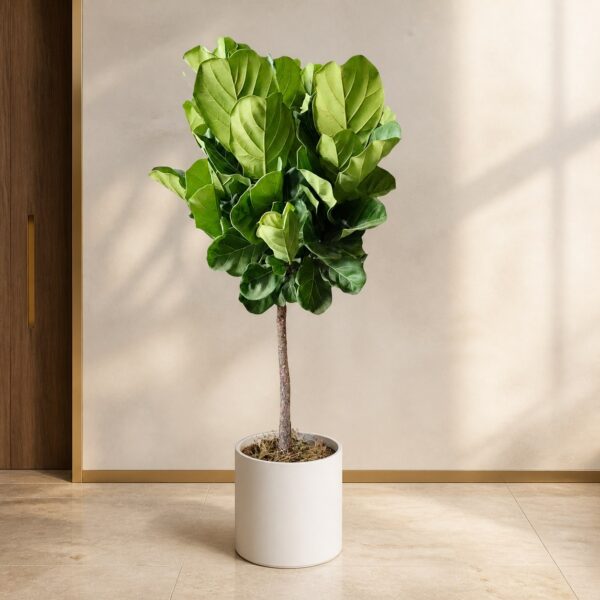
- Cousin of the rubber plant: the genus Ficus is enormous, and besides the curly fig, familiar relatives include the rubber plant (Ficus elastica), fiddle-leaf fig (Ficus lyrata), and the small-leaved Chinese banyan.
- Doesn't like moving house: the weeping fig and its cultivars are extremely sensitive to environmental change — a phenomenon botanists call "positional memory," where leaves grow according to the light angle of their original position. Moving the plant triggers a "shed and regrow" response, which has earned this species a reputation as the "drama queen" of the plant world.
Keywords
Curly fig, weeping fig cultivar, Ficus benjamina 'Barok', Curly Fig, curled foliage, bright indirect light, dry-then-thorough watering, cold-sensitive, above 5°C, stable environment, avoid moving, terracotta pot, well-draining soil, air-purifying, toxic to pets, humidity 50-70%, ventilation, leaf-drop response, moderate growth, evergreen tree, foliage plant
Plantjai · Causeway Bay collector indoor plants · WhatsApp +852 66807550
Plantjai shop · In stock online
Ficus benjamina 'Barok'
Ficus benjamina 'Barok'
HK$168.00
Hong Kong delivery · Causeway Bay pickup
For Hong Kong homes and offices. Stock and pricing follow the product page.
IN STORE NOW
Plants for this guide
Related plants in stock now — live prices, delivery or Causeway Bay pickup.
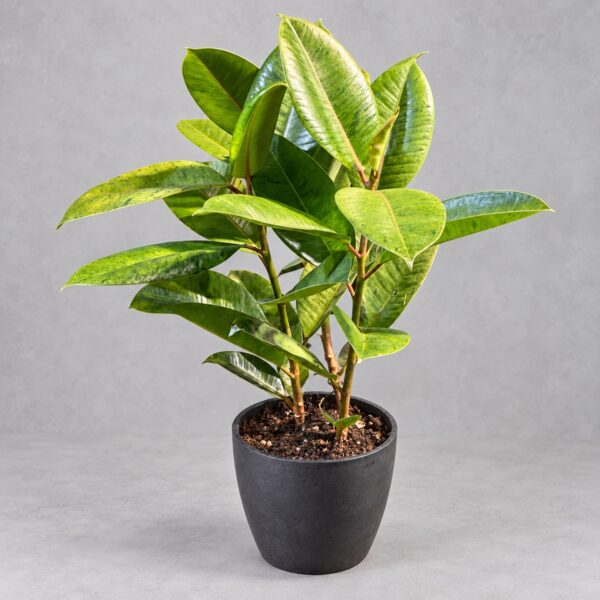
Ficus elastica 'Shivereana'
Ficus elastica 'Shivereana'
from HK$198.00
In stock · store pickup
View plant
FREE PLANT ADVICE
Send us a photo before you change anything
WhatsApp a photo of the plant and your window light. Our Causeway Bay team will suggest care steps or plants that suit your space.
STORE · CAUSEWAY BAY
4/F, 39 Yiu Wa Street, Causeway Bay
Daily 12:30–8:00pm · ~3 min walk from Times Square
Map & directionsPlant Care