
How to Care for Epipremnum Pinnatum Albo in Hong Kong | Plantjai

Plantjai 植仔 · Care Encyclopedia
Epipremnum Pinnatum Albo
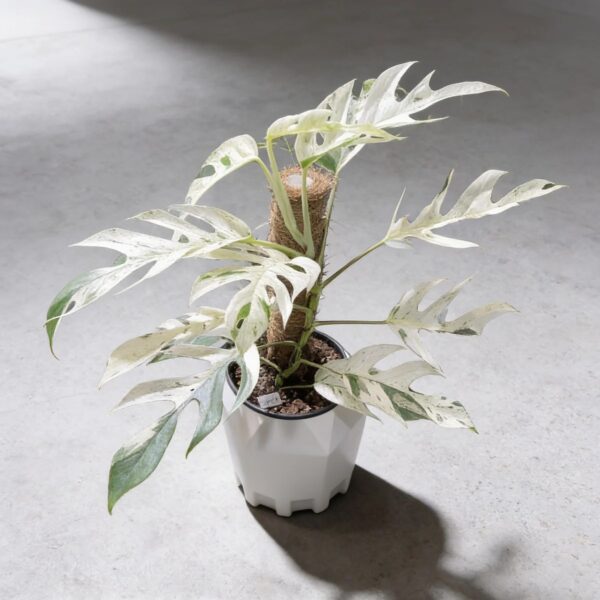
Epipremnum pinnatum albo variegata 麒麟尾錦
Hong Kong care guide — useful before you buy and after it arrives.
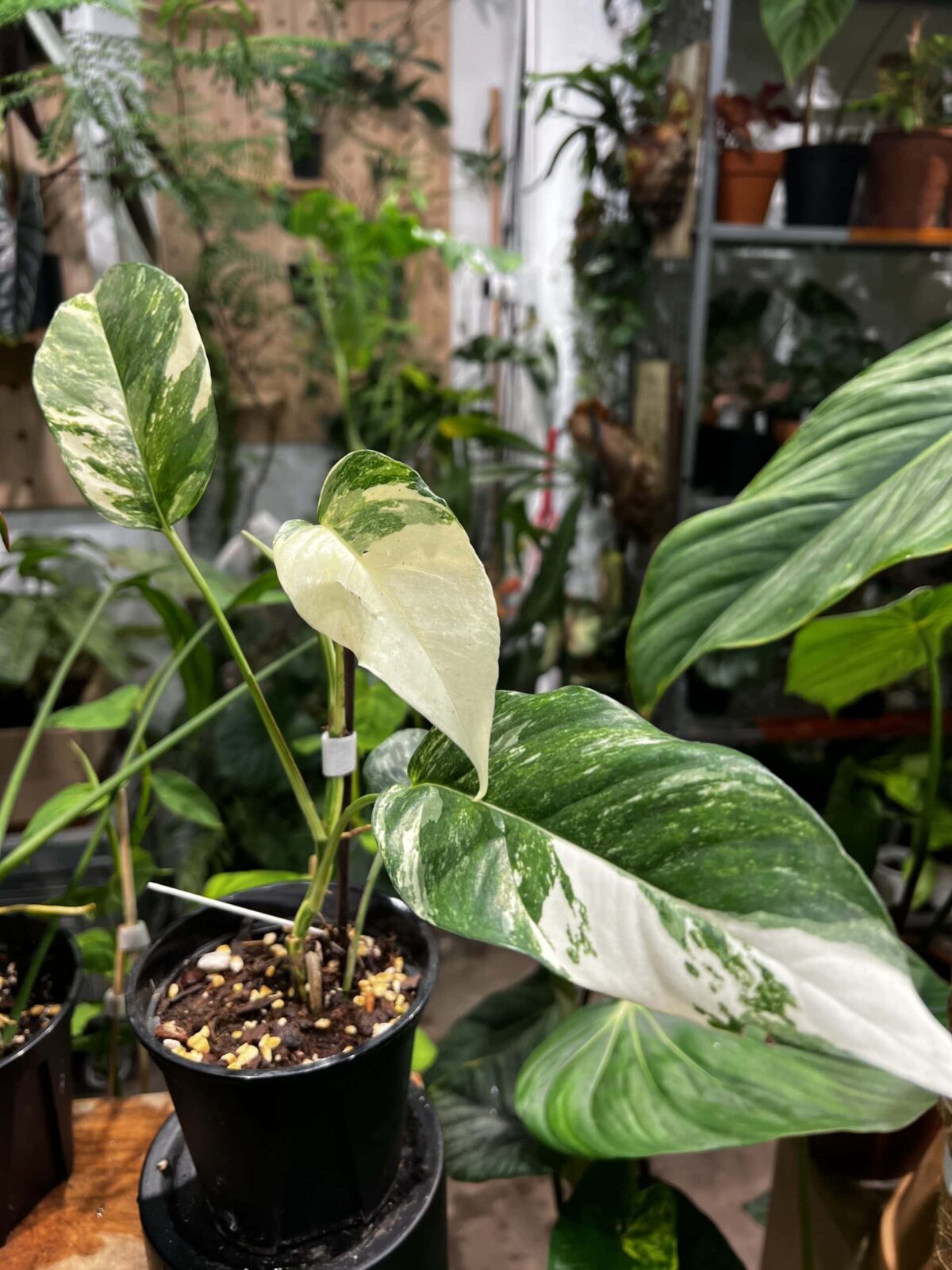
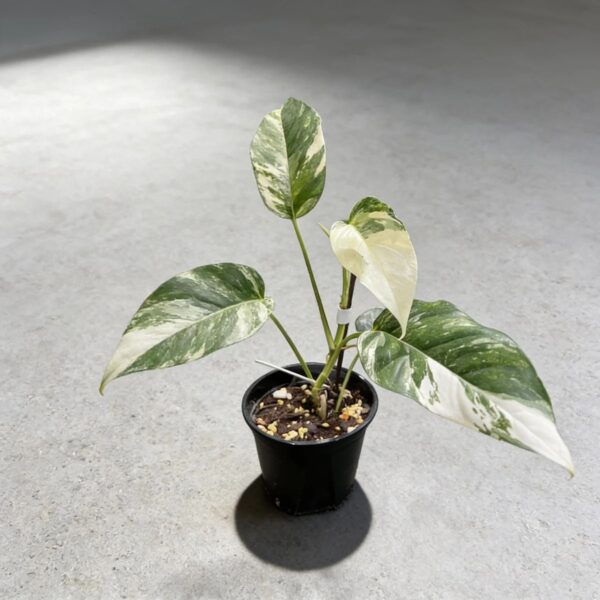
Shop this plantEvery leaf carries its own one-of-a-kind splash of white — random patches of pure white to cream scattered across deep green foliage, with mature, fenestrated leaves reaching true collector's-piece status.
Origin & characteristics
Origin: the albo variegata is a horticultural sport of Epipremnum pinnatum, whose parent species is native to the tropical rainforests of Southeast Asia, including the Philippines, Indonesia, and Malaysia. The white variegation arose either in the wild or through cultivation as a genetic mutation (loss of chlorophyll) that has since been selectively propagated — it isn't found as a stable wild form.
Characteristics:
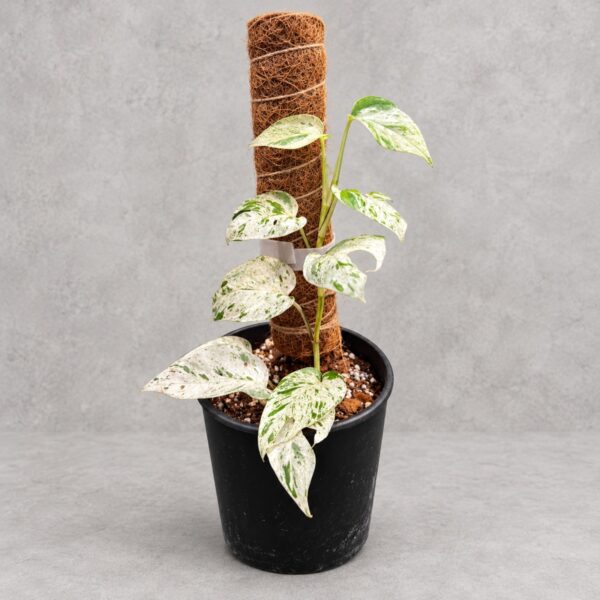
- Variegation: leaves show random patches of white, creamy-white, or pale yellow, with no fixed pattern — every new leaf is a surprise. The degree of variegation ranges from mostly green to half-white/half-green ("yin-yang" variegation) to almost entirely white.
- Juvenile stage: leaves are heart-shaped to oval, carrying white patches, with a slightly thinner texture than the plain green form.
- Mature leaves: once the plant is given something to climb, the leaves gradually split into the characteristic deeply fenestrated Epipremnum form, with the white variegation adding extra dimension to the already dramatic silhouette.
- Growth rate: somewhat slower than the plain green form, since the white tissue lacks chlorophyll and photosynthesises less efficiently.
Light
Ideal environment: bright, indirect light — variegated forms need more light than solid-green plants to maintain their variegation.
- Key point: because the white areas lack chlorophyll, the plant needs more light overall to compensate for reduced photosynthetic efficiency. At the same time, the white tissue is more sun-sensitive, so a balance is needed.
- Best spot: an east- or southeast-facing window, 1–2 metres back, or with a sheer curtain to filter direct light.
- Reading the signs:
- New leaves losing variegation and reverting toward solid green → not enough light, increase it
- White patches showing scorched, yellow-brown spots → too much light, move away from the window or provide shade
- Supplemental light: north-facing or dimmer units benefit from a full-spectrum grow light for 6–8 hours a day.
Watering
Principle: water when the top 2–3 cm of soil has dried out. Variegated forms are more sensitive to waterlogging — err on the dry side.
| Season | Watering frequency | Notes |
|---|---|---|
| Spring/summer (active growth) | Roughly every 7–10 days | In hot weather, a light mist around the foliage helps (avoid midday); keep water off the leaf centre |
| Autumn/winter (slow growth) | Roughly every 10–16 days | Cut back significantly — drier soil is safer |
- Method: water slowly around the rim until it runs from the base, then empty the saucer after 30 minutes.
- Water quality: room-temperature settled tap water, filtered water, or rainwater are all suitable. The variegated tissue is more sensitive to water quality — avoid cold or freshly drawn tap water.
- Special note: white variegated patches are prone to water-mark browning if wet or poorly ventilated — try to water only the soil, not the leaves, and keep the foliage dry.
Soil & pot
Soil recipe:
Variegated forms need extra-loose drainage:
- 40% quality indoor plant potting mix
- 30% perlite
- 20% bark or coco husk chips
- 10% coco coir
Goal: a loose, airy medium that drains quickly after watering, so roots are never left sitting in moisture.
Choosing a pot:
- Terracotta: strongly recommended — best drainage and airflow, lowest risk of rot.
- Plastic: usable, but requires more careful watering and good drainage holes.
- Size: one size up (about 3 cm wider) is plenty — smaller is safer than larger for this plant.
Repotting: every 1–2 years, or once roots emerge from the drainage holes. Check root health at repotting time and trim away any soft, blackened roots.
Temperature & humidity
Temperature:
- Ideal range: 20–28°C
- Minimum tolerance: around 15°C; below 12°C may cause cold-damage spotting
- Hong Kong summer: avoid direct AC airflow — sudden temperature swings can stress the variegated leaves
- Hong Kong winter: generally safe indoors, but north-facing windows can get cold at night — move it away from the window or add extra glazing insulation
Humidity:
- Ideal humidity: 60–80%
- Why it matters: the thinner variegated leaves benefit from higher humidity, which helps preserve leaf texture and reduce browning
- How to raise humidity:
- A humidifier (the most reliable option)
- A pebble tray with damp gravel under the pot (keep the base clear of the water)
- Grouping with other plants for a shared microclimate
- Occasional misting around the foliage (with good airflow to avoid standing water)
Common problems
| Issue | Likely cause | What to do |
|---|---|---|
| New leaves turning solid green, losing variegation | Insufficient light | Gradually increase light, move closer to a bright window or add a grow light |
| White patches turning brown or scorched yellow | Direct sun exposure / air too dry | Move away from direct light, raise humidity |
| Water-mark browning on white patches | Leaf surface staying wet / poor airflow / fungal issue | Improve ventilation, avoid wetting leaves, use fungicide if needed |
| Slow growth, no new leaves for a long time | Insufficient light / root issues / temperature too low | Check root health, adjust light and temperature |
| Yellowing lower (older) leaves | Overwatering | Reduce watering, check drainage |
| Fast-wilting fully white leaves | Fully white leaves lack chlorophyll and can't sustain themselves | Normal — the plant naturally sheds them; if many appear, increase light to restore balance |
| Inconsistent variegation from leaf to leaf | Variegation is inherently random | Can't be fully controlled — this is a natural trait of variegated plants |
How to explain to customers
This is a fantastic starter piece for anyone getting into variegated plants — every leaf is genuinely one of a kind, since the white pattern is completely down to chance, and occasionally you'll get a stunning half-and-half "yin-yang" leaf. To keep the variegation looking its best, give it plenty of light, but never direct sun — the white parts scorch easily. Water on the dry side; variegated plants are more prone to root rot than solid green ones. Higher humidity makes the leaves look their best, so if you run the AC a lot, a nearby humidifier helps. Keep it away from kids and pets, since it's toxic, and wash your hands after handling.
Fun facts
- Variegation happens at the cellular level: white variegation isn't simply "missing pigment" — it results from underdeveloped or absent chloroplasts in the leaf mesophyll cells, a form of somatic mutation. This mutation occurs at the growing tip, so variegation patterns shift continuously as new leaves emerge.
- "Half-moon" variegation is the holy grail: when a leaf splits almost perfectly in half — one side white, one side green, with a crisp dividing line — collectors call this "yin-yang" or "half-moon" variegation, one of the most sought-after forms among variegated plant enthusiasts. It occurs entirely at random, which is exactly what makes it so prized.
- Fully white leaves are "beautiful but costly": when a plant produces a completely white leaf, it looks stunning but, lacking chlorophyll entirely, can't photosynthesise — it actually draws on the plant's stored energy rather than contributing to it. These leaves typically have a shorter lifespan and drop sooner. This is entirely normal and doesn't indicate an unhealthy plant.
- Not the same as Monstera: customers often confuse mature, split-leaf Epipremnum pinnatum with Monstera. While both are aroids, they belong to different genera. Epipremnum leaf splits typically don't produce the signature "windows" (fenestrations) of Monstera, and its stems are thinner with a stronger climbing habit.
Keywords
Epipremnum pinnatum albo variegata, variegated pothos, Epipremnum pinnatum, variegated plant, arum family, climbing plant, half-moon variegation, white patches, collector's plant, indoor foliage, aerial roots, moss pole, high humidity plant, toxic plant, calcium oxalate, Hong Kong indoor plants, variegated plant, rare cultivar, horticultural sport
Plantjai · Causeway Bay collector indoor plants · WhatsApp +852 66807550
Plantjai shop · In stock online
Epipremnum pinnatum albo variegata
HK$238.00
Hong Kong delivery · Causeway Bay pickup
For Hong Kong homes and offices. Stock and pricing follow the product page.
IN STORE NOW
Plants for this guide
Related plants in stock now — live prices, delivery or Causeway Bay pickup.
Epipremnum pinnatum variegated
Original price was: HK$2,680.00.HK$480.00Current price is: HK$480.00.
In stock · store pickup
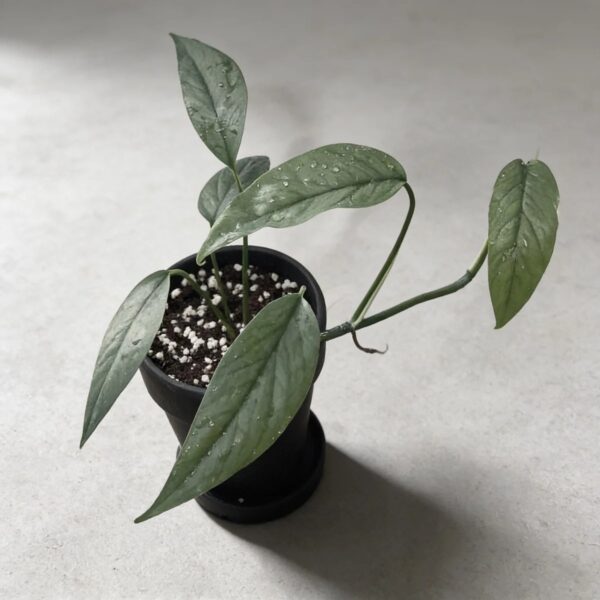
View plantEpipremnum pinnatum 'Cebu Blue'
Epipremnum pinnatum 'Cebu Blue'
HK$298.00
In stock · store pickup
View plant
FREE PLANT ADVICE
Send us a photo before you change anything
WhatsApp a photo of the plant and your window light. Our Causeway Bay team will suggest care steps or plants that suit your space.
STORE · CAUSEWAY BAY
4/F, 39 Yiu Wa Street, Causeway Bay
Daily 12:30–8:00pm · ~3 min walk from Times Square
Map & directionsPlant Care