How to Care for Dracaena Marginata in Hong Kong | Plantjai


Plantjai 植仔 · Care Encyclopedia
Dracaena Marginata
Hong Kong care guide — useful before you buy and after it arrives.
Shop this plantThe ultimate low-maintenance indoor tree — a few slender stems carry a whole tropical mood in miniature.
Origin & characteristics
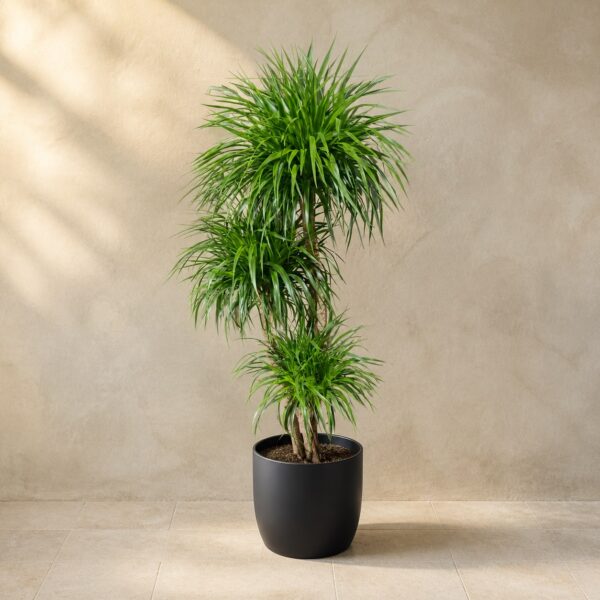
Also known as the red-edge dracaena, this evergreen shrub in the asparagus family (Asparagaceae) is native to Madagascar. It has slender, woody stems topped with clusters of narrow, strap-like leaves edged in reddish-brown or magenta. It's slow-growing but exceptionally tolerant, making it a classic indoor tree — striking whether displayed as a single specimen or with several stems braided together.
⚠️ Toxicity note: toxic to cats and dogs; ingestion can cause vomiting, drooling, and loss of appetite. Keep it out of reach of pets.
Light
- Highly adaptable — tolerates everything from low to medium-bright indirect light
- Best positioned at an east- or west-facing window, or a south-facing window filtered by sheer curtains
- Can hold up under office fluorescent lighting
- Avoid intense summer direct sun, which can scorch the leaves
- Long-term low light causes fading colour and slower growth
Watering
- Let the top 3–5 cm of soil dry out before watering — err on the dry side
- Roughly every 7–10 days in spring/summer, adjusted for ambient humidity
- Can stretch to every 10–14 days in autumn/winter
- Water thoroughly, then tip out any standing water in the saucer to avoid waterlogged roots
- Filtered water or rainwater is best — tap water fluoride can cause brown leaf tips
Soil & pot
- A well-draining, aerated, slightly acidic potting mix
- Suggested recipe: peat-free potting soil : perlite : orchid bark, roughly 3:1:1
- Repot every 2–3 years, ideally in spring
- One size up with drainage holes is enough
- Avoid oversized pots — prolonged wet soil invites root rot
Temperature & humidity
- Ideal range: 18–30°C; a 5–8°C day/night swing supports healthy growth
- Minimum tolerance around 13°C; avoid dropping below 10°C
- Keep away from AC vents, heaters, and draughty spots
- Ideal humidity 40–60%; the occasional mist or a pebble tray helps
- In winter with heating on, consider boosting nearby humidity
Common problems
| Issue | Likely cause | What to do |
|---|---|---|
| Brown leaf tips | The most common complaint — usually hard water (fluoride/chlorine), low humidity, or over-fertilising | Switch to filtered water and raise humidity |
| Yellowing, dropping leaves | Overwatering/root rot or underwatering | Check soil moisture and adjust |
| Soft stems | Severe overwatering causing root rot | Inspect the roots as soon as possible |
| Stalled growth | Insufficient light or temperatures too low | Move somewhere warmer and brighter |
| Pests | Watch for spider mites, scale, and whitefly | Keep leaves clean to help prevent infestation |
| Drooping leaves | May indicate thirst or root trouble | Check both soil moisture and root condition |
How to explain to customers
"This is a genuinely lazy-person-proof plant — you could forget to water it and it'll still pull through. Just remember the rule: let it dry out fully before watering again. Those red-edged leaves add real style to any room the moment you set it down."
Fun facts
In the wild, dragon trees can grow past 6 metres tall, though indoor potted specimens usually stay around 1–2 metres. Their resin was historically known as "dragon's blood," used as a dye and in traditional medicine. The braided "twisted trunk" look you see in shops comes from weaving several young stems together as they grow.
Keywords
Dracaena, dragon tree, low-maintenance plant, shade-tolerant, indoor tree, air-purifying, well-draining soil, toxic to pets, Dracaena marginata, indoor plant
參考資料(想知來源可展開)
References
- Wolverton, B. C. (1997). How to Grow Fresh Air: 50 Houseplants that Purify Your Home or Office. Penguin Books. ISBN 978-0-14-026243-5.
- Royal Horticultural Society. "Dracaena marginata — Madagascar Dragon Tree." RHS Plants Database. https://www.rhs.org.uk/plants/6401/dracaena-marginata/details
- Missouri Botanical Garden. "Dracaena marginata — Madagascar Dragon Tree." Plant Finder. http://www.missouribotanicalgarden.org/PlantFinder/PlantFinderDetails.aspx?taxonid=279538
- American Society for the Prevention of Cruelty to Animals (ASPCA). "Madagascar Dragon Tree — Toxic and Non-Toxic Plants." https://www.aspca.org/pet-care/animal-poison-control/toxic-and-non-toxic-plants/madagascar-dragon-tree
- University of Florida IFAS Extension. "Dracaena marginata — Madagascar Dragon Tree." https://gardeningsolutions.ifas.ufl.edu/plants/houseplants/dracaena-marginata.html
⚠️ Pet/toxicity note: contains saponin-type compounds toxic to cats and dogs; if ingested, symptoms may include vomiting, diarrhoea, drooling, and lethargy. Not usually fatal, but uncomfortable enough that pet owners should keep it out of reach or consider a non-toxic alternative.
In-depth care guide
Introduction
The Madagascar dragon tree, botanically Dracaena marginata, belongs to the asparagus family (Asparagaceae) and is one of the most popular indoor foliage plants worldwide. Native to the tropical and subtropical regions of Madagascar and East Africa, it can grow into a small tree up to 5 metres tall in the wild. Its most recognisable feature is a slender, woody trunk topped with a burst of narrow, sword-like leaves edged in red or magenta — the whole plant reads almost like a bundled sheaf of long blades, giving it a distinctly architectural, on-trend look.
There are several popular cultivars beyond the straight species (green leaf, red edge), including 'Colorama' (leaves almost entirely red), 'Tricolor' (green, cream, and red striping), and 'Magenta' (a deeper purple-red tone). Care requirements are broadly similar across cultivars — all are excellent, forgiving houseplants.
Dragon trees were included in NASA's Clean Air Study and shown to help remove common indoor volatile organic compounds like formaldehyde, benzene, and trichloroethylene, earning them a reputation as a natural air purifier. For city dwellers, keeping one in the office or at home adds greenery while genuinely helping indoor air quality.
Light needs
Dragon trees are famously adaptable when it comes to light, tolerating anything from very low to moderately bright conditions. The ideal is bright, indirect light — for instance 1–3 metres from a window, or sunlight filtered through curtains. Under these conditions, the red leaf margins will be at their most vivid, and growth will be steady.
But its real strength is genuine shade tolerance. Even in dimmer spots — office corners, hallways, near a sink — it will keep going, just more slowly, with somewhat paler red edges. This is exactly why it's such a favourite for commercial spaces, malls, and homes without great natural light.
That said, if it's kept in complete darkness indefinitely, it will eventually show leggy stretching (elongated internodes, sparse leaves) and colour fade. If the space is genuinely too dark, consider giving it a "vacation" in a brighter spot every couple of weeks, or supplementing with artificial light.
In summer, avoid intense midday direct sun, especially through a west-facing window, or leaves may develop scorch marks. Dragon trees aren't fussy about photoperiod — as long as light conditions stay reasonably consistent year-round, growth continues steadily.
Temperature requirements
The dragon tree's comfort zone is 18°C to 26°C, a range easily achieved indoors in Hong Kong and other subtropical regions. It can briefly tolerate 10°C to 15°C, but sustained exposure below 15°C stalls growth completely, with leaves starting to yellow and droop.
Its lowest survivable temperature is around 5°C — below that, cold damage becomes a real risk, typically showing as water-soaked black spots that later dry and brown. In winter, if it's noticeably cold near a window, move the plant further in, or draw curtains at night for extra warmth.
It also tolerates heat well — even indoor temperatures above 30°C in summer are rarely a problem, provided watering and airflow are adequate. Just note that the soil dries faster in heat, so watering frequency needs to increase accordingly.
Air-conditioned rooms are entirely fine for dragon trees; they can even handle offices with AC running continuously. The one thing to avoid is direct airflow from the AC vent, since sustained strong drafts will dry out the leaf tips.
Humidity management
Compared to many tropical houseplants, the dragon tree's humidity needs are fairly relaxed. It grows well at typical indoor humidity (40–60%) and can even tolerate drier conditions (30–40%). This makes it well suited to ordinary city apartments, where most households don't actively humidify.
That said, if you can provide higher humidity (60%+), the leaf tips will stay greener and neater, with less browning. Especially in winter with heaters running, or with long-term air conditioning use, indoor humidity can drop quite low — worth countering with:
- A pebble tray under the pot
- Regular misting of the foliage
- Grouping plants together to raise ambient humidity around each other
One important tip: dragon trees generally respond well to leaf misting, but avoid the hottest midday hours — mist in the morning or evening so leaves have time to dry off. Persistently damp foliage combined with poor airflow can invite bacterial leaf spot.
Watering method
The dragon tree is well known for being drought-tolerant, one of its most popular traits. Its stems and roots store water, so it won't collapse just because you forgot to water once. The general rule is "err dry, not wet" — let the top 2–3 cm of soil dry out fully before watering again.
Actual frequency depends on season and environment:
- Spring/summer (active growth): roughly every 7–10 days
- Autumn/winter (slow growth): roughly every 10–14 days, sometimes longer
Water thoroughly until it runs from the drainage holes, ensuring even the lower root zone gets moisture. Don't just wet the surface — that encourages shallow, unstable rooting.
Dragon trees are very intolerant of waterlogging — overwatering is the number one cause of death. Persistently soggy soil leads to root rot, showing up as yellowing from the base up, a soft, browning stem base, and sometimes an odour. Once rot sets in, recovery is difficult, so well-draining soil and a pot with drainage holes are essential.
As for water quality, dragon trees tolerate tap water reasonably well, but long-term use of hard water (high in calcium/magnesium) can cause white mineral deposits on the leaf tips. Filtered water or tap water left to sit overnight is preferable.
Winter watering calls for extra caution — cold soil evaporates slowly and root water uptake slows, so overwatering is easy to fall into. Wait until the top 3–5 cm is fully dry before watering in winter.
Soil recipe
Dragon trees aren't fussy about soil composition, but the priority is always good drainage and aeration. They dislike dense, overly moisture-retentive soil, which invites root rot.
Suggested mixes:
- Option 1 (standard): 50% general potting soil, 30% perlite, 20% coarse sand
- Option 2 (extra drainage): 40% coco coir, 30% perlite, 20% bark chips, 10% coarse sand
- Option 3 (simple): 70% cactus/succulent mix, 30% general potting soil
Perlite and coarse sand improve drainage and aeration, preventing waterlogging. For large pots (over 30 cm diameter), add a 3–5 cm drainage layer of clay pebbles or gravel at the bottom.
For pH, dragon trees prefer slightly acidic to neutral soil, 6.0–7.0. Overly acidic or alkaline soil can interfere with nutrient uptake.
Feeding
Dragon trees grow at a moderate pace and have moderate-to-low fertiliser needs. Overfeeding actually causes damage — brown tips, distorted leaves. During the growing season (spring/summer), feed monthly with liquid fertiliser diluted to half the label-recommended strength.
A balanced formula (NPK 20-20-20), or one slightly higher in nitrogen, works well. Nitrogen keeps leaves lush and green, while phosphorus and potassium support overall root health and recovery capacity. Organic options like diluted seaweed extract or well-composted liquid fertiliser are gentle and unlikely to burn roots.
Slow-release granular fertiliser also works — sprinkle a small amount on the soil surface each spring (at half the package rate), and it will release nutrients gradually with each watering. This suits busy urban schedules perfectly — set it and forget it.
Stop feeding entirely through autumn and winter. If it's showing continued growth in a heated room during winter, an extremely diluted liquid feed every couple of months is fine.
One important note: if the plant is kept somewhere darker long-term, growth slows considerably, so feeding frequency should be reduced further, or skipped altogether. In low light, the plant simply can't use that much nutrient, and excess fertiliser just accumulates as salt buildup in the soil.
Repotting
Dragon trees generally only need repotting every 2–3 years; they actually grow slightly better when a little pot-bound. The best time is spring (March–May), when new growth is starting.
Signs it's time to repot:
- Roots emerging from the drainage holes
- Water running through very quickly after watering, indicating reduced water-holding capacity
- The plant looking visibly top-heavy and prone to tipping
- Growth clearly stalled even with feeding
Dragon trees often grow fairly tall, so stability matters when choosing a pot — a heavier terracotta or concrete pot with a wide base helps prevent tipping. A new pot 3–5 cm wider in diameter than the old one is enough; it doesn't need much extra room.
Repotting steps:
- Reduce watering a few days beforehand so the soil is slightly drier and easier to work with
- Gently remove the plant from its old pot, loosening old soil from the base and sides
- Inspect the roots, trimming away any rotten or dried-out sections
- Add a drainage layer to the new pot, then fresh soil
- Position the plant upright, backfill gradually, and firm gently
- Water thoroughly and place in a shaded, well-ventilated spot for one to two weeks to recover
Tall, mature dragon trees may need a second pair of hands during repotting to avoid snapping the stem. Larger specimens can benefit from a stake or tie for extra support.
Pruning and shaping
The dragon tree's natural form is already attractive, but appropriate pruning can make it even neater. Over time, lower leaves naturally yellow and die — this is normal and they can simply be pulled or trimmed off at the base.
To control height, prune the top of the stem in spring. After the tip is cut, new side shoots will emerge below the cut, creating a fuller, bushier form. The cut top section can also be used for propagation (see below).
The stem gradually becomes more woody and thicker over time. If a stem feels too long and bare, moving the plant to a brighter spot encourages new shoots along the stem. Pruning the growing tip also stimulates side branching, filling out the overall shape.
Brown leaf tips are a common cosmetic issue for dragon trees — they don't affect plant health, but do affect appearance. To minimise them, maintain higher humidity, use softer (filtered) water, avoid over-fertilising, and keep a consistent watering rhythm.
Propagation
1. Tip cuttings
The most common method. In spring, using a clean, sharp knife or scissors, cut a 15–20 cm section from the top of the stem. Let the cut end air-dry for a day or two to callus over, then insert it into moist propagation medium (perlite and coco coir, 1:1). Keep the medium lightly moist and the environment warm (around 22–25°C); rooting takes a few weeks. Avoid strong direct light during rooting, and high humidity speeds things up.
2. Stem section cuttings
If a dragon tree's stem has grown very long, it can be cut into several 10–15 cm sections. Keep track of the correct orientation of each section (the growing-point end faces up), and insert it about 2–3 cm into soil. New shoots and roots gradually emerge from the nodes on the stem. This is a good way to "refresh" an overly tall, leggy old plant.
3. Air layering
For larger specimens, air layering works well. Choose a node on the stem, strip a ring of bark about 1 cm wide, wrap the area in damp sphagnum moss, and seal it with cling film. After 1–2 months, once roots have developed, cut below the rooted section and plant it independently.
Toxicity
Dragon trees are toxic to cats and dogs, containing saponin-type compounds. If a pet ingests any part, it may cause vomiting, diarrhoea, drooling, or lethargy. The toxicity is generally not fatal, but is unpleasant enough to warrant caution. If you have cats or dogs at home, it's best to place the dragon tree somewhere they can't reach, or consider a non-toxic alternative.
For humans, toxicity is low, but avoid ingestion and wash your hands after handling.
References
- Wolverton, B. C. (1997). How to Grow Fresh Air: 50 Houseplants that Purify Your Home or Office. Penguin Books. ISBN 978-0-14-026243-5.
- Chen, J., Henny, R. J., & McConnell, D. B. (2002). Development of New Foliage Plant Cultivars. Advances in Ornamental Horticulture, 2, 466-493.
- Royal Horticultural Society. "Dracaena marginata — Madagascar Dragon Tree." RHS Plants Database. https://www.rhs.org.uk/plants/6401/dracaena-marginata/details
- Missouri Botanical Garden. "Dracaena marginata — Madagascar Dragon Tree." Plant Finder. http://www.missouribotanicalgarden.org/PlantFinder/PlantFinderDetails.aspx?taxonid=279538
- American Society for the Prevention of Cruelty to Animals (ASPCA). "Dracaena marginata — Toxic and Non-Toxic Plants." https://www.aspca.org/pet-care/animal-poison-control/toxic-and-non-toxic-plants/madagascar-dragon-tree
- University of Florida IFAS Extension. "Dracaena marginata — Madagascar Dragon Tree." https://gardeningsolutions.ifas.ufl.edu/plants/houseplants/dracaena-marginata.html
Plantjai · Causeway Bay collector indoor plants · WhatsApp +852 66807550
Plantjai shop · In stock online
Madagascar dragon tree
HK$980.00
Hong Kong delivery · Causeway Bay pickup
For Hong Kong homes and offices. Stock and pricing follow the product page.
IN STORE NOW
Plants for this guide
Related plants in stock now — live prices, delivery or Causeway Bay pickup.
FREE PLANT ADVICE
Send us a photo before you change anything
WhatsApp a photo of the plant and your window light. Our Causeway Bay team will suggest care steps or plants that suit your space.
STORE · CAUSEWAY BAY
4/F, 39 Yiu Wa Street, Causeway Bay
Daily 12:30–8:00pm · ~3 min walk from Times Square
Map & directionsPlant Care