
How to Care for Begonia Venosa in Hong Kong | Plantjai

Plantjai 植仔 · Care Encyclopedia
Begonia Venosa
Hong Kong care guide — useful before you buy and after it arrives.
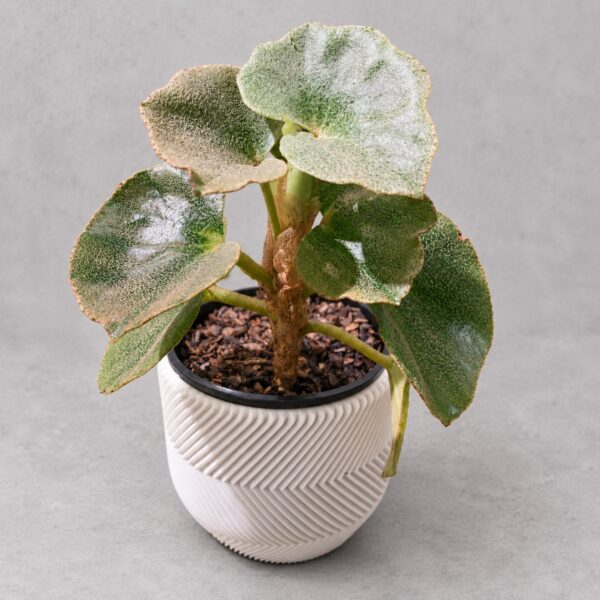
Shop this plantVelvety silver-green leaves with a red-brown underside — a treat for both touch and sight.
Origin & characteristics
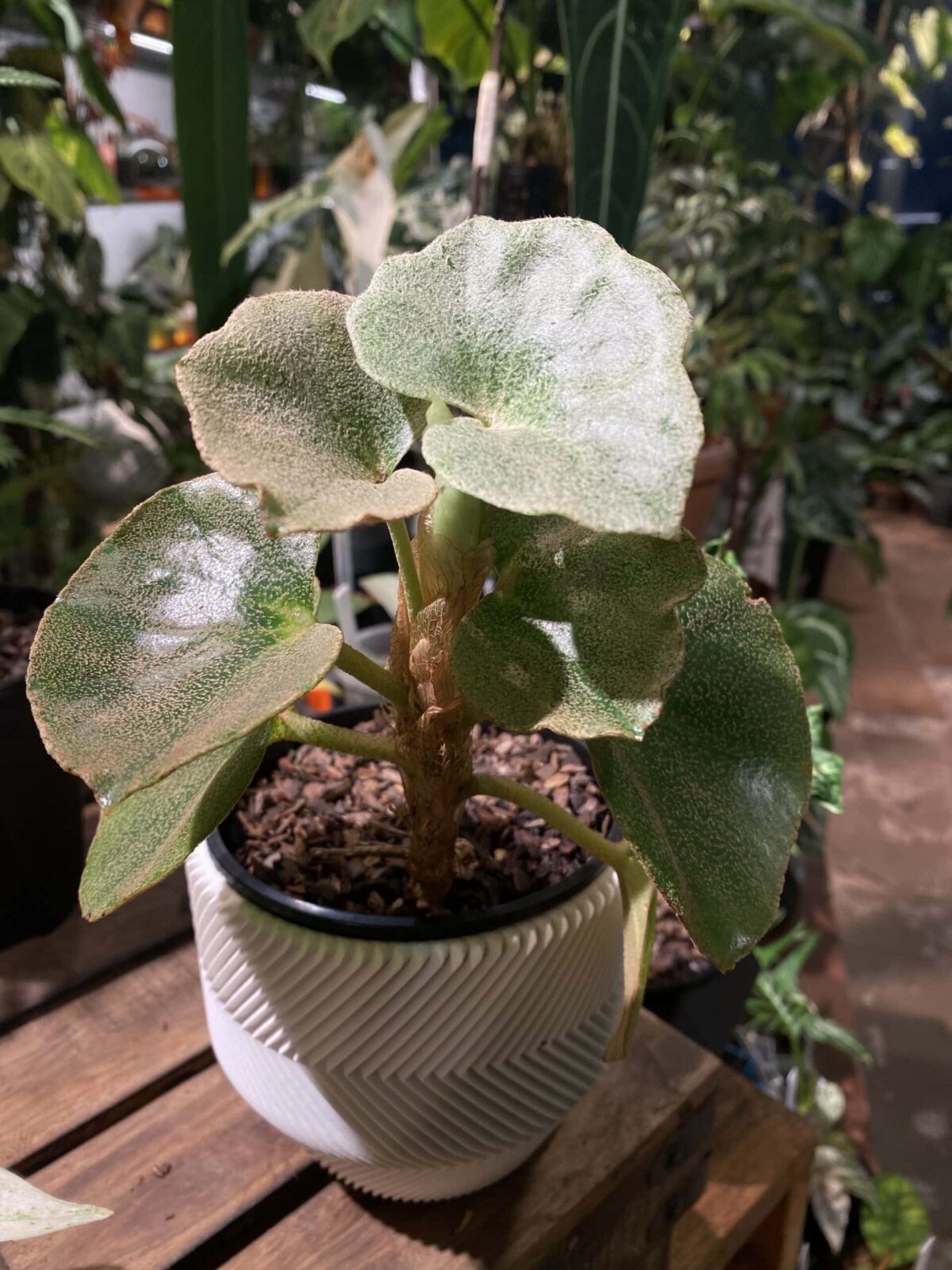
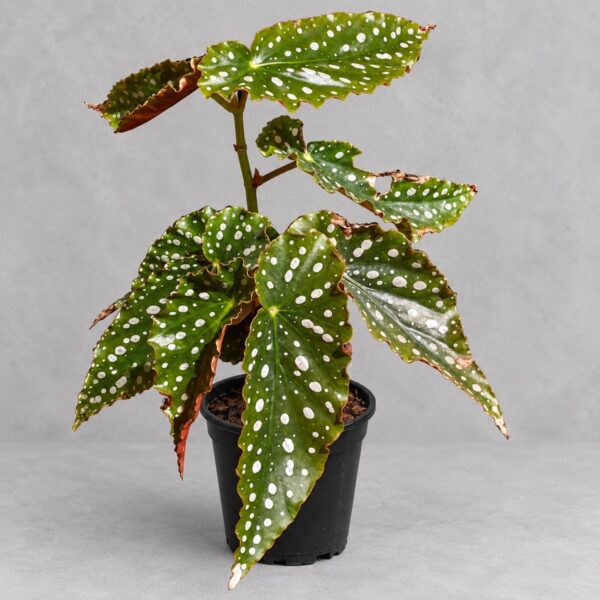
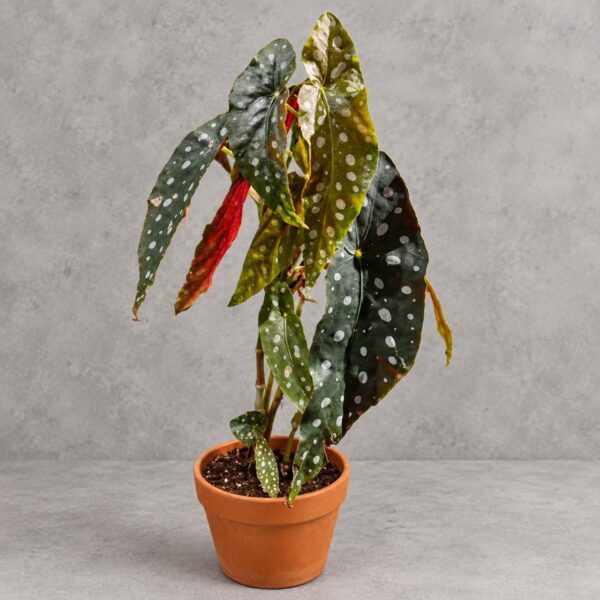
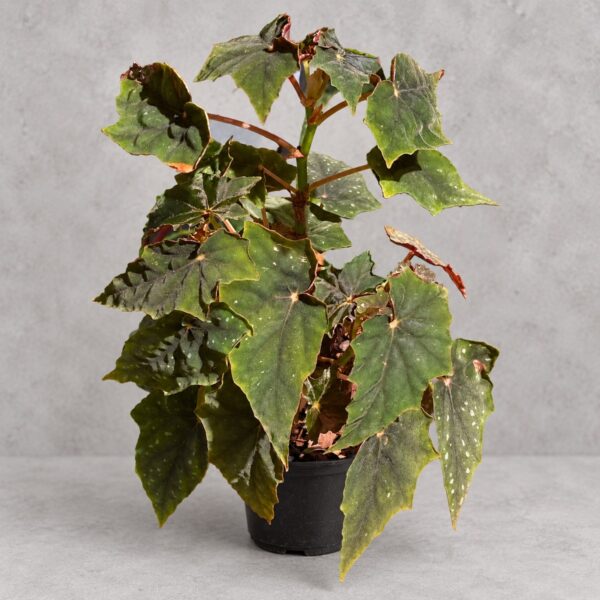
Begonia venosa is native to the arid, rocky regions of northeastern Brazil, making it a rather unusual member of the begonia family. Unlike most begonias, it has a thick, succulent, upright stem and leaves covered in silvery-white fuzz, with a pale green to grey-green top surface and a reddish-brown underside, soft to the touch like velvet. Its growth habit is more upright than the typical creeping begonia, making it a distinctive species that combines drought tolerance with genuine ornamental appeal.
Light
- Tolerates brighter light, including some gentle direct sun
- Compared with other begonias, B. venosa handles strong light much better, with its fuzzy leaves helping reflect excess light
- Indoors, a south- or east-facing windowsill both work
- Insufficient light causes the stem to soften, leaves to thin out, and the plant to lose its upright posture
Watering
- Water once the topsoil is dry about 3–5 cm down — noticeably more drought-tolerant than typical begonias
- The succulent stem stores water, so short dry spells aren't a major concern
- Reduce watering substantially in winter when growth slows, letting the soil run nearly fully dry before watering
- Room-temperature filtered water is recommended, avoiding chlorine damage
- The pot base must never be left standing in water
Soil & pot
- Needs an extremely fast-draining recipe: cactus soil + perlite + coarse sand + a little peat (roughly 4:3:2:1)
- The medium should have a coarse, gritty texture to ensure rapid drainage
- Terracotta is the top choice for its excellent drainage, reducing waterlogging risk
- The pot doesn't need to be large, since B. venosa's root system is fairly shallow
- Repotting once every 2 years is sufficient
Temperature & humidity
- Optimal temperature: 18–28°C
- Can briefly tolerate a minimum of 12°C, but prolonged exposure below 15°C affects growth
- Humidity of 40–60% is sufficient — more tolerant of dry conditions than typical begonias
- Hong Kong's indoor environment is usually well suited
- In high-humidity conditions, pay particular attention to ventilation to avoid stuffiness
Common problems
| Issue | Likely cause | What to do |
|---|---|---|
| Fuzzy leaves yellowing and dropping | Overwatering or poor ventilation | Reduce watering, move to a well-ventilated spot |
| Stems going soft and rotting | Severe waterlogging causing root rot | Cut away the rotten stem, propagate fresh cuttings |
| Leaves thinning, losing their fuzzy texture | Severe light deficiency | Move closer to a light source |
| Extremely slow growth | Temperature too low or dormancy period | Check temperature; normal in winter |
| White powdery coating on leaves | Possible powdery mildew infection | Improve ventilation, use an organic fungicide |
⚠️ Plant safety note: Begonias are generally considered mildly toxic to humans and pets, and ingestion may cause gastrointestinal upset. Keep out of reach of children and pets.
How to explain to customers
"Begonia venosa is a bit different from typical begonias — it comes from a dry region, so it's much less fussy about drought. Even if you occasionally forget to water it during a busy week, it won't die on the spot, making it perfect for beginners or people who travel a lot for work."
"Its leaves have a fuzzy layer that's lovely to touch, and the silver-green colour with the red underside gives it real character at home. Just remember not to water too often — better a bit dry than wet."
Fun facts
Begonia venosa's fuzzy leaves are an evolutionary adaptation to arid environments — the fine hairs reduce direct sun damage to the leaves while also cutting down water loss through evaporation, allowing the plant to survive in drier conditions. This trait makes it one of the few begonias genuinely well suited to Hong Kong's dry, air-conditioned rooms!
Keywords
Begonia, Begonia venosa, fuzzy leaves, succulent stem, drought-tolerant plant, foliage plant, silver-green leaves, well-draining soil, mildly toxic, pet safety
In-depth care guide
Introduction
Begonia venosa, commonly known as Veined Begonia, is an evergreen perennial herb in the family Begoniaceae, genus Begonia, native to eastern Brazil. It belongs to the rhizomatous begonia group, but what sets it apart most is its thick, fleshy leaves and distinctive fuzzy texture — the leaf surface is covered in a layer of white fuzz, giving the entire plant a silvery-grey, "frosted" appearance with striking architectural quality.
Begonia venosa's leaves are ovate to round, with clearly indented veins forming a three-dimensional, net-like texture. The leaves are thick and succulent, capable of storing water, making this species notably more drought-tolerant than typical begonias. The plant grows in a clumping, shrub-like form, reaching a mature height and spread of roughly 10–50 cm. Under the right conditions, it can flower nearly year-round with small white or pink blooms — not especially showy, but a pleasant addition to a plant grown primarily for its foliage.
According to the Royal Horticultural Society (RHS), Begonia venosa is well suited to indoor growing in indirect light, primarily valued for its foliage, and is relatively easy to care for compared with most begonias, tolerating more sun than the majority of its relatives.
Native habitat and growth habits
Begonia venosa is native to the tropical forests of eastern Brazil, growing in the forest understory and rocky crevices. In the wild, it's accustomed to warm, humid but well-draining conditions, and its thick, succulent leaves and fuzzy coating are protective mechanisms that evolved in response to the intermittent drought and strong light of its native habitat.
Growth rate is moderate to slow, typically taking 2–5 years to reach mature size. Its rhizome spreads horizontally over time, forming a dense clump of growth. Although it can flower, its horticultural value is concentrated primarily in its distinctive leaf texture and colour.
Light requirements
Begonia venosa needs ample bright indirect light, but tolerates stronger light better than most begonias.
Ideal light conditions:
- East-, south-, or west-facing windowsills all work, but avoid harsh midday direct sun that could scorch the leaves
- With a sheer curtain or shade screen filtering the light, a south-facing position is actually ideal
- It adapts to a range from full sun to partial shade
- When grown indoors, ensure at least 3–6 hours of indirect light daily
Signs of insufficient light:
- Leaf colour fading, losing its silvery-grey sheen
- Elongated internodes, plant becoming loose and leggy
- Thinner new leaves, overall growth stalling
Signs of excessive light:
- Yellow-brown sunburn patches on the leaf surface
- Damaged fuzzy coating, leaves becoming dry and brittle
- Curled, brittle leaf edges
Since Begonia venosa's leaf surface is covered in fine hairs, rotating the pot regularly (roughly 90 degrees every two weeks) helps ensure even light exposure on all sides, maintaining a tidy growth form.
Watering technique
As a succulent-leaved species, Begonia venosa has a broader tolerance for water variation, but fundamentally still prefers moist, non-waterlogged conditions.
Watering principles:
- Wait until the topsoil is dry roughly 1–2 inches (2.5–5 cm) down before watering. Testing with a finger is the simplest, most accurate method.
- Water thoroughly, letting water flow from the pot's base, then discard any standing water.
- The succulent leaves can store some water, so mild drought is easier to manage than overwatering.
- Avoid water pooling on the leaf surface — the fuzz easily traps moisture, increasing fungal infection risk.
Seasonal adjustment:
- Spring/summer growing season: check roughly every 5–7 days, watering based on ambient humidity and temperature.
- Autumn/winter slower growth: extend to every 7–10 days or longer, since soil dries more slowly during this period.
Water quality: Like other begonias, Begonia venosa is somewhat sensitive to chemicals in tap water. Rainwater, distilled water, or tap water left standing overnight is recommended.
Overwatering warning signs: yellowing leaves, softening and browning at the stem base, soil staying wet for extended periods.
Underwatering warning signs: slightly shrivelled leaves, drooping, softening (though not as rapidly wilting as non-succulent species).
Soil and pots
Begonia venosa needs well-draining, lightweight, loose soil that absolutely must never become waterlogged.
Recommended soil recipe:
- 40% quality peat-free potting mix
- 25% perlite (improves drainage and aeration)
- 20% coco coir or peat moss (moisture retention and organic matter)
- 10% orchid bark or coarse sand (increases aeration)
- 5% worm castings (natural fertility)
This recipe is light and "fluffy," avoiding root compaction while retaining enough moisture to support steady growth.
Pot selection:
- Must have drainage holes.
- Begonias generally prefer a slightly "snug" root environment, so avoid an oversized pot.
- A single rooted cutting typically does well in a 3- or 4-inch (7.5–10 cm) pot.
- Terracotta or plastic both work, with terracotta helping the soil dry out faster.
Repotting: once every 1–2 years in spring, or when roots start circling the pot's base. Repotting is also a good opportunity to divide for propagation.
Humidity and temperature
Humidity: Begonia venosa prefers 50–70% relative humidity. Although its succulent leaves make it more drought-tolerant than typical begonias, prolonged exposure to low humidity will still cause leaf edges to become brittle.
- Use a humidifier, pebble tray, or grouping method to raise local humidity.
- Avoid misting the leaves directly — the fuzz traps moisture easily, increasing the risk of bacterial leaf spot or powdery mildew.
- Ensure gentle air circulation — stagnant air leads to mould growth.
Temperature: the ideal range is 18–24°C (65–75°F), never sustained below 12°C.
- Sustained temperatures below 12°C can cause leaf rot and stalled growth.
- Avoid placing near AC vents, heaters, or drafty doors and windows.
- Temperatures above 25°C accelerate growth, but ensure sufficient humidity and moisture are available.
Fertilising guidance
Begonia venosa is a light feeder; excess nitrogen fertiliser causes weak, easily broken stems and reduces flowering.
Fertilising recommendations:
- Use a balanced liquid fertiliser (such as 5-5-5 or 10-10-10), diluted to half strength.
- Once a month during the growing season (spring and summer) is sufficient.
- Stop fertilising completely from autumn through winter.
- Only begin fertilising once you observe clear new leaf growth.
Notes:
- Excess fertiliser causes salt buildup, burning root tips and discolouring leaf edges.
- If you want to restrain growth and keep the plant more compact, reduce fertilising frequency or use a lower concentration.
Pruning and maintenance
Begonia venosa has low pruning needs:
- Remove yellowed, browned, or damaged leaves to keep the plant tidy.
- If the plant becomes loose with age, light pruning can encourage new branch growth.
- After flowering, trim the flower stalks to redirect energy toward leaf growth.
- Wipe leaf surface dust gently with a soft, slightly damp cloth, taking care not to damage the fuzzy layer.
Propagation methods
Begonia venosa propagates very easily, mainly through the following methods:
Rhizome division (simplest):
When repotting, cut the rhizome into several sections, each with at least one growth point, and plant separately in fresh soil. Keep the soil lightly moist and the environment warm; new shoots should emerge within a few weeks.
Stem cuttings:
- Choose a healthy, firm stem section, cutting about 7–10 cm long with a sterilised sharp blade or floral scissors.
- Make a clean cut, avoiding crushing the vascular tissue.
- Root in perlite, vermiculite, or water.
- Maintain bright indirect light, around 18–24°C, and high humidity.
- Once roots reach at least 2.5 cm long, transplant into a pot.
Leaf cuttings:
One of begonias' most remarkable traits is their ability to grow an entirely new plant from a single leaf:
- Whole leaf method: cut off the leaf along with its petiole (the small stalk connecting leaf to main stem), insert the petiole into moist soil, and a new plant will grow from the leaf base.
- Leaf vein cutting method: cut the leaf into several wedge-shaped pieces, each including part of the main vein, and bury the cut edges into soil. Within a few weeks, tiny green shoots will emerge from the leaf pieces — a process that feels almost like magic.
Propagation environment tips:
- Use a clear plastic bag or storage container as a simple "greenhouse" to maintain high humidity.
- Open it for a few minutes daily for ventilation to avoid mould growth.
- If you see heavy condensation dripping inside the cover, this indicates humidity is too high and more ventilation is needed.
Common problems and solutions
Soft, browning stem base (rot): usually caused by overly wet soil or insufficient ventilation. Immediately remove the rotten portion, let the cut air-dry for an hour, then re-root in drier perlite.
Drooping leaves: cuttings or new plants may lose water faster than they can absorb it in the first few days. Check that the humidity dome is properly sealed; if water-propagating, ensure the nodes are fully submerged. Light misting of the leaves can provide temporary moisture relief.
Slow growth: Begonia venosa naturally grows at a slower pace. As long as the stem is firm and leaves are green, the plant is likely developing its root system underground. If there's no growth for an extended period, check whether light is sufficient and temperature is warm enough.
Powdery mildew: occurs easily with high humidity but insufficient ventilation. Improve air circulation, and use a dedicated fungicide if necessary.
Grey mould (Botrytis): appears when water pools on leaves for extended periods or the environment is too damp. Remove infected tissue, improve ventilation, and avoid misting the leaves.
Pests: may suffer from scale insects, spider mites, thrips, or whitefly. Check leaf undersides regularly, and wipe off with a damp cloth or treat with soapy water/dedicated insecticide upon discovery.
Toxicity information
Begonia venosa is toxic to pets (cats, dogs) due to soluble calcium oxalates. While the leaves have relatively lower toxicity, the underground rhizome and tubers carry the highest concentration. Ingestion may cause oral irritation, drooling, and vomiting. Please keep the plant somewhere pets cannot reach.
參考資料(想知來源可展開)
References
- RHS. (2026). Begonia venosa – Plant Details. Retrieved from https://www.rhs.org.uk/plants/27720/begonia-venosa/details
- Longfield Gardens. (2026). Mastering Begonia Venosa Propagation for Success. Retrieved from https://www.longfield-gardens.com/blogs/begonia-care/mastering-begonia-venosa-propagation-for-success
- Prickle Plants. (2025). Begonia Plant Care Guide. Retrieved from https://prickleplants.co.uk/blogs/plant-guides/begonia-plant-care-guide
- LifeTips – Alibaba. (2026). Begonia Inside Plant: Care Guide. Retrieved from https://lifetips.alibaba.com/plant-care/begonia-inside-plant
- BWH Plant Co. (2025). How to Care for Begonia Plants & Detect Issues. Retrieved from https://bwhplantco.com/blogs/care-guides/begonia-care-the-complete-guide
Plantjai shop · In stock online
Begonia venosa
Begonia venosa
HK$228.00
Hong Kong delivery · Causeway Bay pickup
For Hong Kong homes and offices. Stock and pricing follow the product page.
IN STORE NOW
Plants for this guide
Related plants in stock now — live prices, delivery or Causeway Bay pickup.
FREE PLANT ADVICE
Send us a photo before you change anything
WhatsApp a photo of the plant and your window light. Our Causeway Bay team will suggest care steps or plants that suit your space.
STORE · CAUSEWAY BAY
4/F, 39 Yiu Wa Street, Causeway Bay
Daily 12:30–8:00pm · ~3 min walk from Times Square
Map & directionsPlant Care