
How to Care for Begonia Sierra Mountain King in Hong Kong | Plantjai

Hong Kong care guide for Begonia Sierra Mountain King.
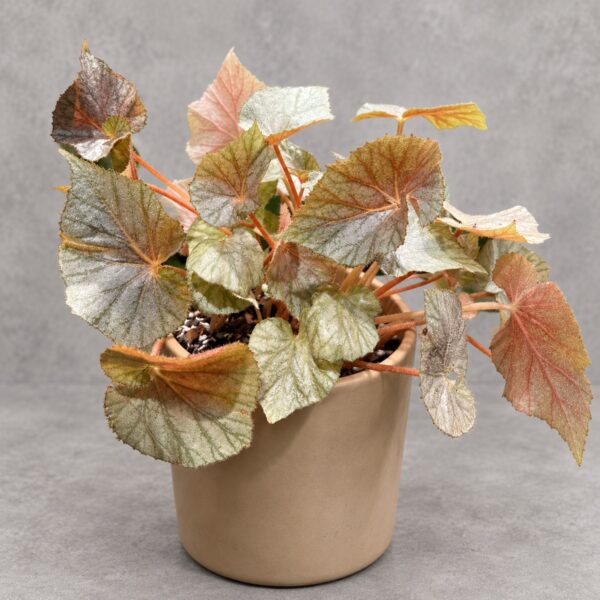
Bold, dramatic leaf patterning with a mountain-king presence — the showpiece of any indoor plant collection.
⚠️ Toxicity warning: Begonias contain soluble calcium oxalate, which can cause oral burning and vomiting if ingested, and are toxic to pets and children. Keep out of reach.
Origin & characteristics
Sierra Mountain King is a garden hybrid with its botanical name still unconfirmed. The leaves are large and deeply textured, in a rich green with a metallic sheen — as commanding as a mountain range. A medium-sized foliage plant with a moderate growth rate, it suits bright indoor conditions and has become one of the most sought-after collector's begonias among Hong Kong plant enthusiasts in recent years.
Light
- Prefers bright, diffused light, tolerating brief periods of gentle morning sun
- Avoid direct summer midday sun, which easily scorches the leaves with crisp edges
- Insufficient light causes the leaf patterning to fade and the plant to become leggy, reducing ornamental value
- An east- or north-facing windowsill suits it well, positioned about 0.5–1 metre from the window
- If using a grow light, about 8–10 hours daily is sufficient
Watering
- Follow the "let it dry, then water" principle: water once the topsoil is dry about 2–3 cm down
- Roughly every 5–7 days during spring/summer's active growth
- Roughly every 7–10 days in autumn/winter as growth slows
- Never let it sit waterlogged — root rot is the most common cause of death in begonias
- Water slowly along the pot's edge, avoiding the leaves, until it drips from the drainage holes
- Room-temperature water is recommended, avoiding cold water that shocks the roots
Soil & pot
- Needs an excellent-draining, loose substrate
- Recommended recipe: peat 40% + perlite 30% + coco coir 20% + bark 10%
- A quality foliage plant potting mix with extra perlite added also works well
- Pot must have drainage holes; plastic or ceramic both suitable
- Repot when roots fill the pot or growth clearly stalls, roughly once a year in spring
Temperature & humidity
- Ideal temperature: 18–26°C
- Minimum tolerance: about 10°C; move indoors for warmth below this
- Avoid placing near AC vents or heaters — large temperature swings easily cause leaf drop
- Humidity requirement: 50–70%
- Hong Kong's spring humidity is usually sufficient; use a humidifier or pebble tray in dry autumn/winter conditions
- Enclosed growing (under a clear cover or in a glass cabinet) can help maintain humidity
Common problems
| Issue | Likely cause | What to do |
|---|---|---|
| Scorched, yellowing leaf edges | Light too strong or air too dry | Move to a shadier spot, increase surrounding humidity |
| Leaves going soft and drooping | Underwatering or overwatering causing root rot | Check soil moisture, adjust watering frequency |
| Leaf patterning fading | Insufficient light | Move to a brighter position, but avoid direct sun |
| Leggy, thin stems | Insufficient light | Increase diffused light, use a grow light if necessary |
| Brown spots on leaves | Water splashed on leaves causing fungal issues | Water along the pot's edge instead, keep leaves dry |
| Leaf drop | Temperature too low or improper watering | Check ambient temperature, maintain a consistent watering routine |
How to explain to customers
"Sierra Mountain King looks so dramatic — it really commands attention in the living room! Just remember, no direct sun, diffused light is what suits it best."
"For watering, better a bit dry than waterlogged — water once the top couple of centimetres are dry, and it'll grow beautifully."
Fun facts
All begonias contain calcium oxalate crystals — a natural defence mechanism that discourages herbivores from eating them. Sierra Mountain King's leaf texture displays a subtle shift in metallic colouring depending on the light angle, like a painting that changes as you move.
Keywords
Sierra Mountain King Begonia, Begonia Sierra Mountain King, ornamental begonia, medium potted plant, diffused light, high humidity, well-draining, toxic plant, indoor plant, Plantjai, Hong Kong plant shop
In-depth care guide
Introduction
Sierra Mountain King, botanically Begonia 'Sierra Mountain King', is a strikingly imposing cane-type hybrid within the family Begoniaceae, genus Begonia. It was bred by begonia enthusiasts by crossing the classic Begonia maculata (Polka Dot Begonia) with Begonia lubbersii, inheriting the best qualities of both parents to form a robust, upright, medium-sized shrub-like plant. The name "Sierra Mountain King" vividly captures its tall, commanding presence, standing among other plants like a king of the mountains. This cultivar represents an excellent example of modern ornamental begonia breeding, drawing on species ancestry from northeastern India and Southeast Asia, prized for its large dramatic leaves, strongly contrasting leaf colour layers, and vigorous growth habit. Indoors, Sierra Mountain King can serve as a visual centrepiece, and its upward-growing habit combined with drooping large leaves makes it well suited to corners or as a backdrop plant.
Morphological features
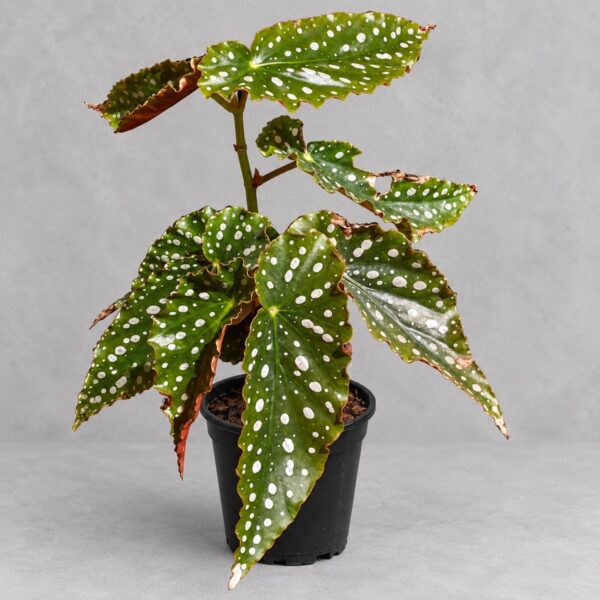
The most eye-catching feature of Sierra Mountain King is its large, angel-wing-shaped leaves. The leaves are elongated ovals, tapering at both ends, with a deep green surface dotted with silvery-white spots arranged between the veins, creating a jewel-like shimmering effect — a feature clearly inherited from its B. maculata parentage. The underside is reddish-brown, forming a strong contrast with the deep green top surface. The leaf texture has a slight sheen and grows in a drooping habit; as the plant matures, the leaves become larger and more elegant. The overall growth form is upright, with bamboo-like jointed stems typical of cane-type begonias. Mature plants can reach 60–90 cm tall, potentially taller still with appropriate staking. The flowers are white or pale pink-tinged, with female flowers showing pink ovaries; though the flowers are small and less showy than the foliage, they add ornamental value when blooming in clusters.
Light requirements
Sierra Mountain King prefers bright, diffused light, echoing the light conditions at the edge of its native rainforest habitat. The ideal placement is an east- or west-facing windowsill, receiving gentle direct morning or afternoon light without harsh midday exposure. South-facing windows need a sheer curtain to filter strong light, or the plant should be placed 1.5–2 metres from the window. If light is too weak, the plant becomes leggy, with elongated internodes, thinner and smaller leaves, less visible silvery spots, and fading red on the underside. Conversely, intense direct sun causes sunburn spots that turn white or brown, significantly reducing ornamental value. Under good light, growth is more compact, leaves are thick and glossy, and the silvery spots are clear and bright. If your home lacks sufficient light, consider a full-spectrum LED grow light, running 10–12 hours daily, positioned about 30–45 cm from the leaves.
Temperature requirements
Sierra Mountain King's optimal growing temperature is between 18°C and 24°C, sitting in the transitional climate zone between temperate and tropical. It can tolerate a minimum of around 15°C, below which growth noticeably slows; prolonged exposure below 10°C causes frost damage spots on the leaves, and severe cases can harm the plant. At the high end, while it can briefly tolerate temperatures above 30°C, anything above 28°C requires increased humidity and good ventilation, or the leaves will lose moisture too quickly and their edges will dry out. Hong Kong's spring, summer, and autumn temperatures are generally suitable, but during sustained hot, humid summer weather, pay attention to ventilation to avoid stuffy conditions that trigger disease. In winter, if temperatures are forecast to drop below 15°C, move the plant indoors or provide protection. Avoid placing it near AC vents, heaters, or doors and windows, since sudden temperature changes and cold drafts stress the plant, showing as browning leaf edges or malformed new growth.
Humidity management
Sierra Mountain King prefers moderate to relatively high humidity, with an ideal relative humidity range of 50–70%. In higher humidity, the leaves stay more supple and glossy, and new leaves unfurl more smoothly. Hong Kong's natural humidity in spring and summer is usually sufficient, but during autumn and winter with AC or heating running in dry mode, indoor humidity can drop below 40%, causing leaf edges to dry out. Methods to raise humidity include grouping several plants together to create a microclimate, placing a bowl of water nearby, using a humidifier, or setting the pot on a tray filled with moist pebbles (ensuring the pot base doesn't directly touch the water). While Sierra Mountain King can tolerate occasional misting, avoid keeping the leaf surface consistently wet in poorly ventilated conditions, since begonias are prone to powdery mildew. If you notice white powdery spots on the leaves, improve ventilation immediately and reduce misting.
Watering technique
The key to watering Sierra Mountain King is "keep it lightly moist, allow the topsoil to dry." During the growing season (spring, summer, and autumn), water once the top 2–3 cm (roughly 1 inch) of soil is dry. Water thoroughly each time, letting water flow completely from the pot's base, then empty any standing water from the saucer — never let the plant sit in water. Although the cane stems have some water storage capacity, the roots are quite sensitive to excess moisture, and overwatering quickly leads to root rot. In winter, as temperatures drop and growth slows, reduce watering frequency, waiting until the soil surface is half to two-thirds dry before watering again. For water quality, room-temperature filtered water, rainwater, or tap water left standing overnight is best, avoiding water directly from the tap that's high in chlorine or minerals. The most reliable way to check soil moisture is inserting a finger about two knuckles deep — if it feels dry, it's time to water; if there's still moisture, wait a few more days.
Soil recipe
Sierra Mountain King needs a light, well-draining, organic-matter-rich growing medium. A recommended recipe: quality peat or coco coir at 40%, providing water retention and organic matter; perlite at 25%, for drainage and aeration; orchid bark or coarse coconut husk chips at 20%, providing structural air channels; and compost or leaf mould at 15%, providing nutrients. This recipe ensures the roots have plenty of airflow while not drying out too quickly. For pH, begonias prefer slightly acidic conditions, around pH 5.8–6.5. Ensure the pot has good drainage holes, and use a breathable terracotta or plastic pot. If you find the soil stays wet for a week after watering, this indicates insufficient drainage, and you should increase the perlite or bark ratio; conversely, if the soil dries out within two or three days, increase the peat or coco coir ratio.
Fertilising method
Sierra Mountain King needs regular fertilising during the growing season to maintain strong growth and beautiful leaf colour. During spring, summer, and autumn (roughly March to September), apply a diluted balanced liquid fertiliser (such as NPK 20-20-20) once a month, diluted to half the recommended concentration. Additionally, since it's a fast-growing cane-type begonia, you can alternate with a high-nitrogen fertiliser (such as NPK 30-10-10) every other application in spring and summer to promote leaf growth and deepen the green colour. From October onward, gradually reduce fertilising, stopping completely in winter. For organic options, a diluted liquid seaweed fertiliser once a month is beneficial, helping strengthen the plant's resistance. A slow-release fertiliser such as Osmocote can be applied once each in spring and summer, simply scattered on the soil surface. Always ensure the soil is moist before fertilising, never applying directly to dry soil, or you risk burning the roots. If you notice pale leaf colour and slow growth, this may indicate a nutrient deficiency; if leaf edges show brown scorching, this may indicate overfertilising.
Repotting timing
Sierra Mountain King grows at a moderate to fast pace, and generally needs repotting every 12–18 months. The best time is spring (March to April), when new growth is beginning. Signs it's time to repot include roots emerging from the drainage holes, water draining very slowly after watering, or the plant starting to lean unsteadily. The new pot should be 5–7 cm larger in diameter than the old one, since this vigorous grower will fill a new pot relatively quickly. When repotting, gently loosen the old soil ball, check root health, and trim away any rotten roots. Fill the new pot with fresh soil, firm it gently, then water thoroughly. Keep the plant in a shaded, well-ventilated spot for one to two weeks after repotting to help it adjust to the new environment. As a cane-type begonia, the stems will gradually become woody as it grows; if you want it to grow taller, gradually move it into larger pots and provide a support stake to help it stay upright.
Pruning and shaping
Sierra Mountain King naturally tends to grow upward, and without pruning it may become tall and thin. To keep it fuller and more compact, pinch the growing tips during the growing season using your fingers or sterilised scissors, which encourages side branches to develop. If the plant grows too tall, you can also cut back the overly long tip growth, and the trimmed cuttings can be used for propagation. Additionally, regularly remove yellowed old leaves from the base and any spent flowers to keep the plant tidy. If the plant's form becomes too sparse, consider planting several cuttings together in the same pot to create a fuller, denser appearance. During winter's slower growth, you can do a more substantial shaping prune, removing overly dense, weak, or diseased branches, giving the plant better ventilation and light exposure when it resumes vigorous growth in spring.
Propagation methods
The easiest way to propagate Sierra Mountain King is via stem cuttings. The best time for cuttings is late spring to summer (May to August), when the plant is in active growth. Select a healthy stem and cut a tip section about 10–15 cm long, ensuring the cutting includes at least two or three nodes. Remove the lower leaves, keeping only one or two pairs at the top. Cuttings can be inserted directly into pre-prepared propagation soil (equal parts perlite and peat), or rooted in water. If using soil, keep it lightly moist and place the cutting in bright, diffused light — roots typically form within about two to four weeks. If water-rooting, change the water every few days, and once roots reach about 3–5 cm, transplant into soil. Sierra Mountain King also produces side shoots at its base, which can be separated with roots attached during repotting to obtain new plants. The key to successful propagation is maintaining warmth (20–25°C) and high humidity, while also ensuring good ventilation.
Common problems and solutions
Browning, dry leaf edges: Most commonly caused by humidity too low or water too hard. Increase ambient humidity, switch to filtered water or rainwater. Additionally, cold drafts or large temperature swings can cause the same symptom.
Fading or disappearing silvery spots: Insufficient light is the main cause. Move the plant closer to a window or increase artificial lighting, while avoiding sudden exposure to strong sun.
Elongated internodes, thinner leaves: Also caused by insufficient light. Cane begonias are particularly prone to legginess in low light — increasing light exposure is the only solution.
Powdery mildew: A common fungal disease in begonias, appearing as white powdery patches on the leaves. Caused by high humidity combined with poor ventilation. Remove severely affected leaves, improve ventilation, and spray with a diluted baking soda solution or dedicated fungicide if needed.
Root rot: If the plant wilts and the base feels soft, suspect root rot. Remove from the pot immediately to check, trim away rotten roots, and repot in fresh soil, controlling watering strictly afterward.
Pests: Common pests include whitefly, aphids, spider mites, and scale insects. Spray with diluted neem oil every five days for three treatments. Keeping the leaves clean and maintaining good ventilation is the best prevention.
參考資料(想知來源可展開)
References
- Begin With Plants. "Begonia 'Sierra Mountain King'." Product Listing, beginwithplants.com/products/begonia-sierra-mountain-king
- Plant That Plant. "Begonia Sierra Mountain King." Product Catalog, plantthatplant.com/products/begonia-sierra-mountain-king
- RHS. "Begonias as Houseplants." Royal Horticultural Society Advice, rhs.org.uk/plants/begonias/houseplants
- Proven Winners. "Begonia Growing Guide: How to Plant and Care." Gardening Resources, provenwinners.com/learn/how-plant/begonia
- Longfield Gardens. "How to Care for Begonia Plant: Expert Tips for Success." Gardening Blog, longfield-gardens.com/blogs/begonia-care/how-to-care-for-begonia-plants-for-success
For Hong Kong homes and offices. Stock and pricing follow the product page.
IN STORE NOW
Plants for this guide
Related plants in stock now — live prices, delivery or Causeway Bay pickup.
FREE PLANT ADVICE
Send us a photo before you change anything
WhatsApp a photo of the plant and your window light. Our Causeway Bay team will suggest care steps or plants that suit your space.
STORE · CAUSEWAY BAY
4/F, 39 Yiu Wa Street, Causeway Bay
Daily 12:30–8:00pm · ~3 min walk from Times Square
Map & directionsPlant Care