
How to Care for Begonia Phuthoensis in Hong Kong | Plantjai

Plantjai 植仔 · Care Encyclopedia
Begonia Phuthoensis
Hong Kong care guide — useful before you buy and after it arrives.
Shop this plantA rare miniature begonia from the deep mountains of Vietnam, with leaf colours like a watercolour painting — highly collectible.
Origin & characteristics
Native to the tropical rainforest mountains of Phú Thọ Province in northern Vietnam, growing in shaded, humid forest understory. The species name "phuthoensis" refers to its home province, Phú Thọ. Leaves are ovate to heart-shaped with distinctive mottled patterning, ranging from olive-green through copper-red to deep purple depending on growth stage and conditions. The plant stays delicately small, typically only 10–20 cm tall, well suited to miniature pots, terrariums, or moss balls, and is a prized find for begonia collectors.
Light
- Needs soft, diffused light, mimicking a shaded forest understory
- Place indoors 1–2 metres from a window, or supplement with a grow light
- Avoid direct sun entirely — the delicate leaves scorch very easily
Watering
- Prefers consistently moist soil, but roots must never sit in standing water for long
- Room-temperature rainwater, distilled water, or tap water left to stand is best
- Water slightly more often in summer's heat, slightly less in winter
Soil & pot
- Needs a medium that's both highly breathable and moisture-retentive
- Recommended recipe: peat, perlite, coco coir, and bark chips in a 2:1:1:1 ratio
- Smaller plants suit a shallow pot or moss ball; larger plants can move to a wider pot
Temperature & humidity
- Optimal temperature 18–24°C; a cold-sensitive species
- Never below 15°C in winter; take particular care to keep it warm
- Needs high humidity — 60–80% is ideal; a humidifier or terrarium setup is recommended
Common problems
| Issue | Likely cause | What to do |
|---|---|---|
| Leaves going soft, colour fading | Humidity too low or temperature too cold | Increase humidity, check ambient temperature |
| Slow or stalled growth | Light too weak or nutrients insufficient | Adjust position slightly, feed diluted fertiliser during the growing season |
| Water-marked spots on leaves | Bacterial or fungal infection | Improve ventilation, avoid water on leaves, use fungicide if necessary |
| Scorched leaf edges | Water too hard or air too dry | Switch to rainwater, increase surrounding humidity |
How to explain to customers
"Phu Tho Begonia is a rare find from deep in the Vietnamese mountains — the leaf patterning is so fine and detailed it looks painted, a real find for serious collectors!"
"It's a bit more delicate — needs it humid and warm, so we'd suggest a bathroom windowsill or a terrarium. Watching the colour slowly change is genuinely relaxing."
Fun facts
Like other Southeast Asian native begonias, Phu Tho Begonia's leaf patterning shifts with the strength of ambient light and humidity — this "colour-changing" trait is believed to be an evolved protective mechanism for adapting to the variable lighting conditions of the forest understory.
Keywords
Phu Tho Begonia, Begonia phuthoensis, Vietnamese begonia, rare begonia, miniature begonia, foliage plant, rainforest plant, terrarium plant, indoor plant, Hong Kong care, collector's plant
In-depth care guide
One-line pitch
A rare begonia from the limestone hideaways of Phú Thọ Province in northern Vietnam, its near-perfect disc-shaped leaves radiating vein patterns like sunbeams — a geometric work of natural art, and a plant collector's dream foliage specimen.
Origin & characteristics
Phu Tho Begonia, botanically Begonia phuthoensis H.Q. Nguyen, belongs to the family Begoniaceae, genus Begonia, classified within section Coelocentrum. It was formally described in 2015 by Vietnamese botanist Nguyen H.Q., with the type locality in the limestone regions of Phú Thọ Province and Thanh Hóa Province in northern Vietnam. The species name "phuthoensis" refers to its discovery location, Phú Thọ Province.
Phú Thọ Province lies in northern Vietnam within the Red River basin, characterised by extensive karst limestone formations, warm and humid conditions year-round, and dense forest cover. In the wild, Phu Tho Begonia grows in the humid, shaded rainforest understory and in crevices of limestone cliffs, adapted to low light, high humidity, and cool microclimates. As a member of section Coelocentrum, it's related to other Southeast Asian limestone begonias (such as the Begonia rex species complex), sharing traits including rhizomatous growth, asymmetrical leaf shapes, and strong adaptation to shaded, humid environments.
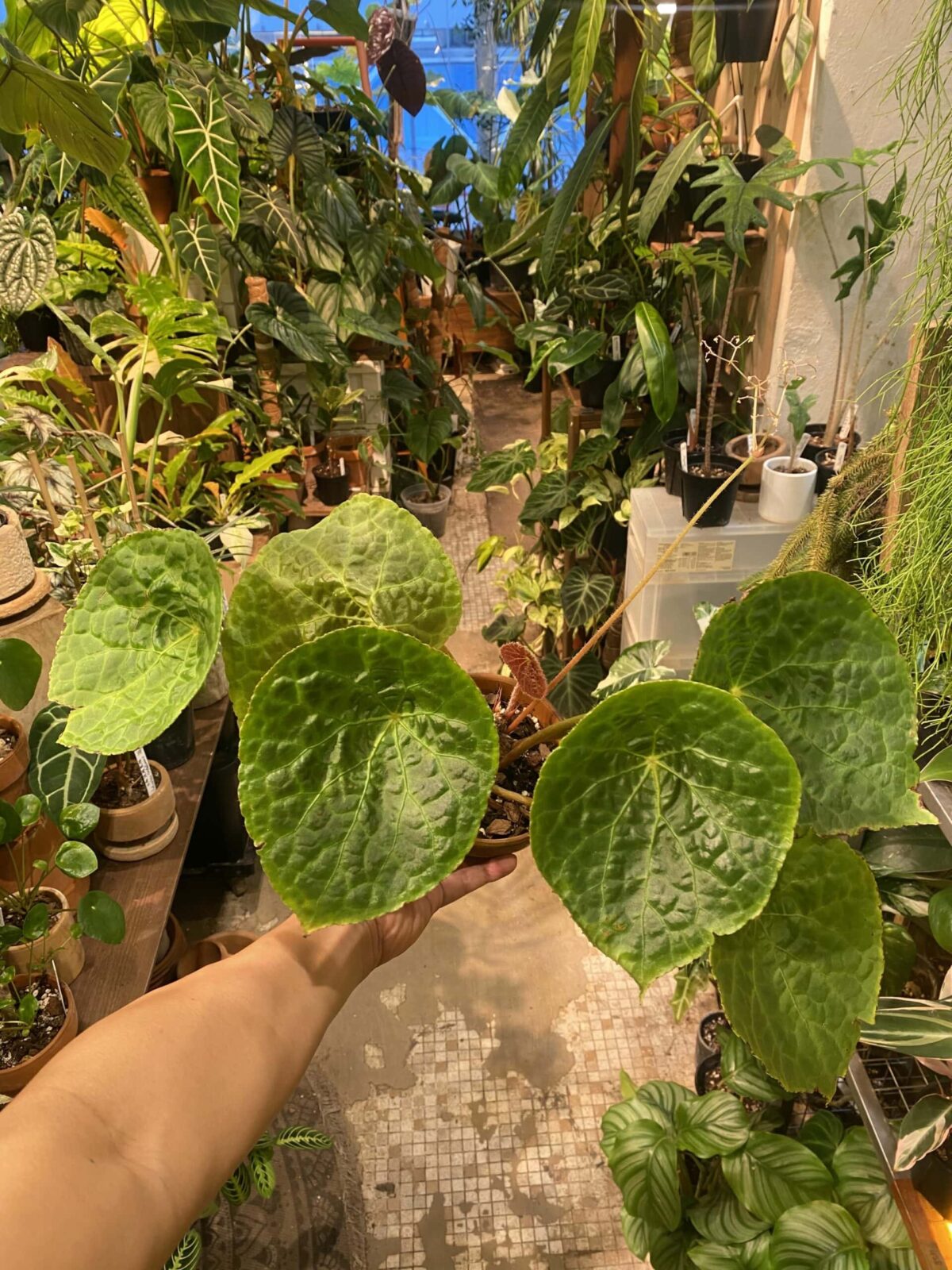
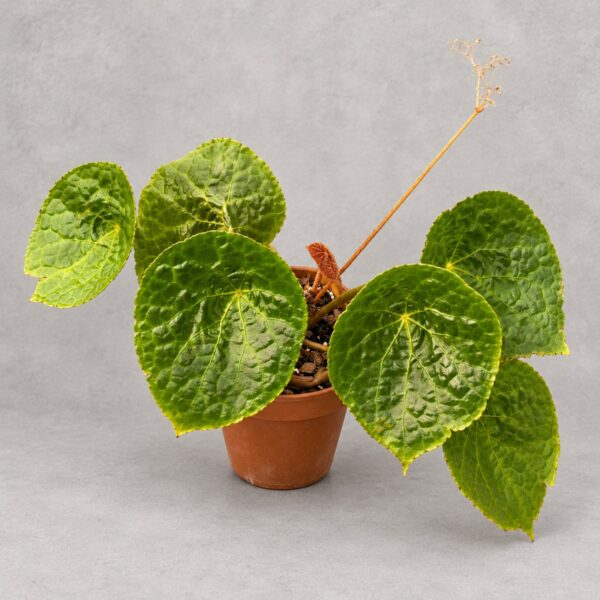
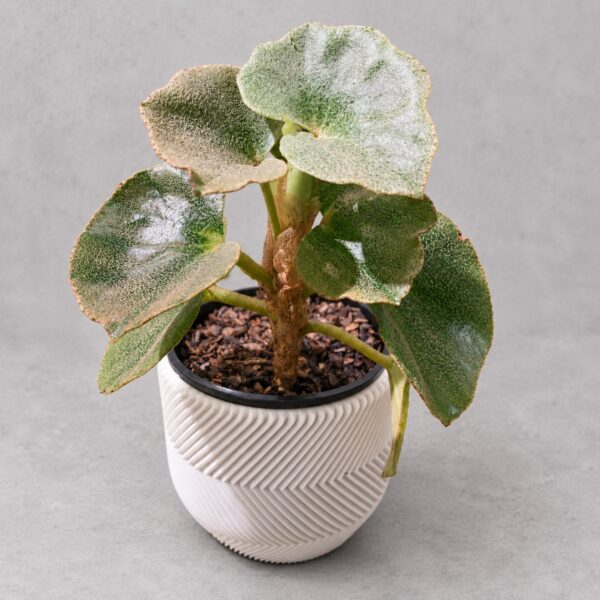
Morphologically, Phu Tho Begonia is an evergreen perennial herb with a creeping rhizome and no aboveground stem. The leaves are its greatest highlight: nearly perfectly disc-shaped, thick and firm in texture, with a bright green, matte surface and subtle texturing; pale, highly decorative veins radiate outward from the leaf centre (where the petiole attaches), resembling sunbeams and giving the whole leaf a strong geometric quality. The petiole is long and reddish-brown, adding further colour contrast. Mature plants reach about 35–40 cm tall, forming a dense, clumping, shrub-like habit.
Notably, section Coelocentrum begonias typically display "peltate leaves" — where the petiole attaches to the underside of the leaf blade rather than at the edge. Phu Tho Begonia's round leaf shape and radiating vein pattern are a textbook example of this section's characteristic form, setting it apart from most other begonias.
Light
Phu Tho Begonia needs moderate to bright diffused light, and absolutely no direct sun. In its native habitat, it grows on the forest floor beneath tall trees, receiving only faint filtered light. Direct sun will instantly and permanently scorch, bleach, and dry out its beautiful round leaves.
Recommended placement:
- East- or north-facing windowsill (ideal)
- 1.5–2 metres from a south- or west-facing window
- A window filtered by a sheer curtain
You can roughly measure light using a phone light meter app, aiming for 800–1,500 lux. If new leaves become thin and pale-coloured, light may be too weak; if leaves develop yellow spots or scorched edges, light is too strong.
Watering
Phu Tho Begonia needs stable, balanced moisture management. Its roots must never dry out completely, but must also never sit in standing water for extended periods — rhizome rot is the most common cause of death.
Watering points:
- Water once the top 1–2 cm of soil begins to dry
- The soil should stay in a state "like a wrung-out sponge" — moist but not dripping
- Water slowly and thoroughly along the pot's edge until it flows from the base, emptying the saucer within 30 minutes
- Avoid pouring water directly onto the leaves, since the round leaf shape collects water easily, risking fungal infection
- Use room-temperature water; winter water shouldn't be too cold
Keep the soil lightly moist through spring and summer; in autumn and winter as growth slows, extend the interval between waterings slightly, letting the topsoil dry a day or two more before watering. If in doubt, err on the side of slightly dry rather than wet — the rhizome has some water storage capacity, and mild drought stress is far safer than waterlogging.
Soil & pot
Phu Tho Begonia needs a lightweight soil that's highly breathable yet moisture-retentive. A recommended recipe:
- 2 parts quality peat moss or coco coir (moisture-retentive base)
- 1 part perlite (drainage and aeration)
- 1 part fine orchid grit or coconut husk chips (extra breathability and drainage)
- A little compost or worm castings (slow-release base nutrients)
The key is balancing "light, breathable, and moisture-retentive" all at once. If the soil is too heavy, retained moisture will cause rhizome rot; if too free-draining, the roots will dry out and wither. A thin layer of clay pellets or gravel at the pot's base can further improve drainage.
The pot must have drainage holes; terracotta or quality plastic both work. Since Phu Tho Begonia grows at a moderate pace, frequent repotting isn't necessary — roughly once every 1–2 years, or when roots emerge from the drainage holes or the soil dries unusually fast after watering. When repotting, choose a pot only about 2–3 cm larger than the current one.
Temperature & humidity
Phu Tho Begonia is a tropical plant but native to a high-humidity forest environment, giving it specific temperature and humidity requirements:
Temperature:
- Optimal range: 18–24°C
- Minimum: never below 15°C, or growth will stall
- Maximum: sustained temperatures above 28°C create stress, especially if humidity is insufficient
- Avoid direct AC airflow and cold winter drafts near windows
Humidity:
- Ideal range: 55–70%
- Never below 50%, or the round leaf edges will easily dry out
Ways to raise humidity:
- Humidifier: the most reliable method, especially useful when running heating in autumn/winter
- Pebble tray: a large tray of pebbles and water, with the pot placed on top (not touching the water)
- Bathroom placement: if the bathroom has a window providing natural light, the high humidity there is ideal
- Glass container/plant cabinet: for particularly prized specimens, consider a glass display cabinet or terrarium
Hong Kong's natural summer humidity is usually sufficient, but running AC constantly dries the air out, requiring supplementary humidity measures. Pay extra attention to humidity management when running heating in autumn and winter.
Common problems
| Symptoms | Likely cause | What to do |
|---|---|---|
| Round leaf edges scorching, browning | Humidity too low / air too dry | Increase humidity above 55%; use a humidifier or pebble tray |
| Leaves yellowing, soft, dropping | Overwatering causing root rot | Stop watering immediately, remove from pot to check the rhizome, trim rotten sections, repot in fresh soil |
| Leaves shrinking, colour fading | Light too weak | Move to a brighter diffused-light position |
| Yellow spots on leaves | Sunburn from strong light | Move to a shadier spot; damaged leaves won't recover |
| Growth stalled (over 2 months) | Temperature too low / nutrients insufficient / root-bound | Ensure temperature stays above 18°C; begin diluted liquid fertiliser in spring; consider repotting |
| Brown spots on leaves (with yellow halo) | Fungal infection (high humidity, poor ventilation) | Improve air circulation; reduce leaf humidity; use fungicide if necessary |
| Pests (scale insects, whitefly) | Poor ventilation / environmental stress | Check leaf undersides regularly; wipe with alcohol swab; use neem oil for severe infestations |
How to explain to customers
"Phu Tho Begonia is a top-tier collector's plant, from the limestone forests of northern Vietnam — the leaf is round like a plate, with veins radiating out from the centre, really artistic. The most important things are humidity and avoiding sun, so an east-facing window or a bright indoor spot is best. Remember not to overwater — let it dry a bit between waterings, since standing water leads to rot very easily. Having a humidifier nearby will make a big difference."
Fun facts
Section Coelocentrum, to which Phu Tho Begonia belongs, is a group centred on the limestone regions of Southeast Asia, with members generally displaying rhizomatous growth and highly specialised leaf shapes. This section is thought to represent an evolutionary response to karst limestone terrain — the rhizomes can cling to rock surfaces, while the leaf forms have evolved into diverse geometric patterns, possibly linked to light capture and moisture management strategies.
Begonia is one of the most diverse flowering plant genera in the world, with over 2,000 known species, and new species are still being described every year. Vietnam alone has published dozens of new begonia species over the past two decades, showing just how much biodiversity in this region remains to be discovered. Phu Tho Begonia is part of this wave of "begonia discovery," having been formally described in 2015 and gradually introduced to the international horticultural market, becoming a sought-after item among collectors.
Another interesting feature of the genus Begonia is its "sexual expression" — most plants are monoecious, bearing both male and female flowers on the same plant, but female flowers are typically rarer than male ones, and their flowering may be staggered to encourage cross-pollination. Phu Tho Begonia rarely flowers in cultivation, generally directing its energy toward leaf growth instead.
Keywords
Phu Tho Begonia, Begonia phuthoensis, Coelocentrum, Vietnamese begonia, limestone begonia, round-leaf begonia, radiating vein pattern, rhizomatous begonia, high humidity plant, collector-grade foliage plant
參考資料(想知來源可展開)
References
- Nguyen, H. Q. (2015). Six new species of Begonia (Begoniaceae) from limestone areas in Northern Vietnam. Botanical Studies, 56(1), 1–9.
- Nguyen, H. Q., & Tebbitt, M. C. Additional new species of Begonia from Vietnam.
- Kiew, R. (2004, 2007). New Begonia species from Indochina.
- Augi Plants. Begonia phuthoensis – Care Instructions. https://www.augi-plants.lv/en/products/begonia-phuthoensis
- ResearchGate. A new species of a peltate-leaved Begonia (Begoniaceae) from Vietnam. https://www.researchgate.net/publication/299237271
- Xishuangbanna Tropical Botanical Garden, CAS. Six new species of Begonia from northern Vietnam. https://www.xtbg.cas.cn/
⚠️ Toxicity/pet warning: Like most begonias, Phu Tho Begonia (Begonia phuthoensis) contains soluble calcium oxalates, toxic to cats and dogs. If a pet chews on the leaves or rhizome, it may experience oral irritation, drooling, and vomiting, with the roots being particularly high in toxicity. Keep the plant well out of reach of pets and young children. Wash your hands after handling.
Plantjai shop · In stock online
Begonia phuthoensis
Begonia phuthoensis
from HK$198.00
Hong Kong delivery · Causeway Bay pickup
For Hong Kong homes and offices. Stock and pricing follow the product page.
IN STORE NOW
Plants for this guide
Related plants in stock now — live prices, delivery or Causeway Bay pickup.
FREE PLANT ADVICE
Send us a photo before you change anything
WhatsApp a photo of the plant and your window light. Our Causeway Bay team will suggest care steps or plants that suit your space.
STORE · CAUSEWAY BAY
4/F, 39 Yiu Wa Street, Causeway Bay
Daily 12:30–8:00pm · ~3 min walk from Times Square
Map & directionsPlant Care