
How to Care for Begonia Pavonina in Hong Kong | Plantjai

Plantjai 植仔 · Care Encyclopedia
Begonia Pavonina
Hong Kong care guide — useful before you buy and after it arrives.
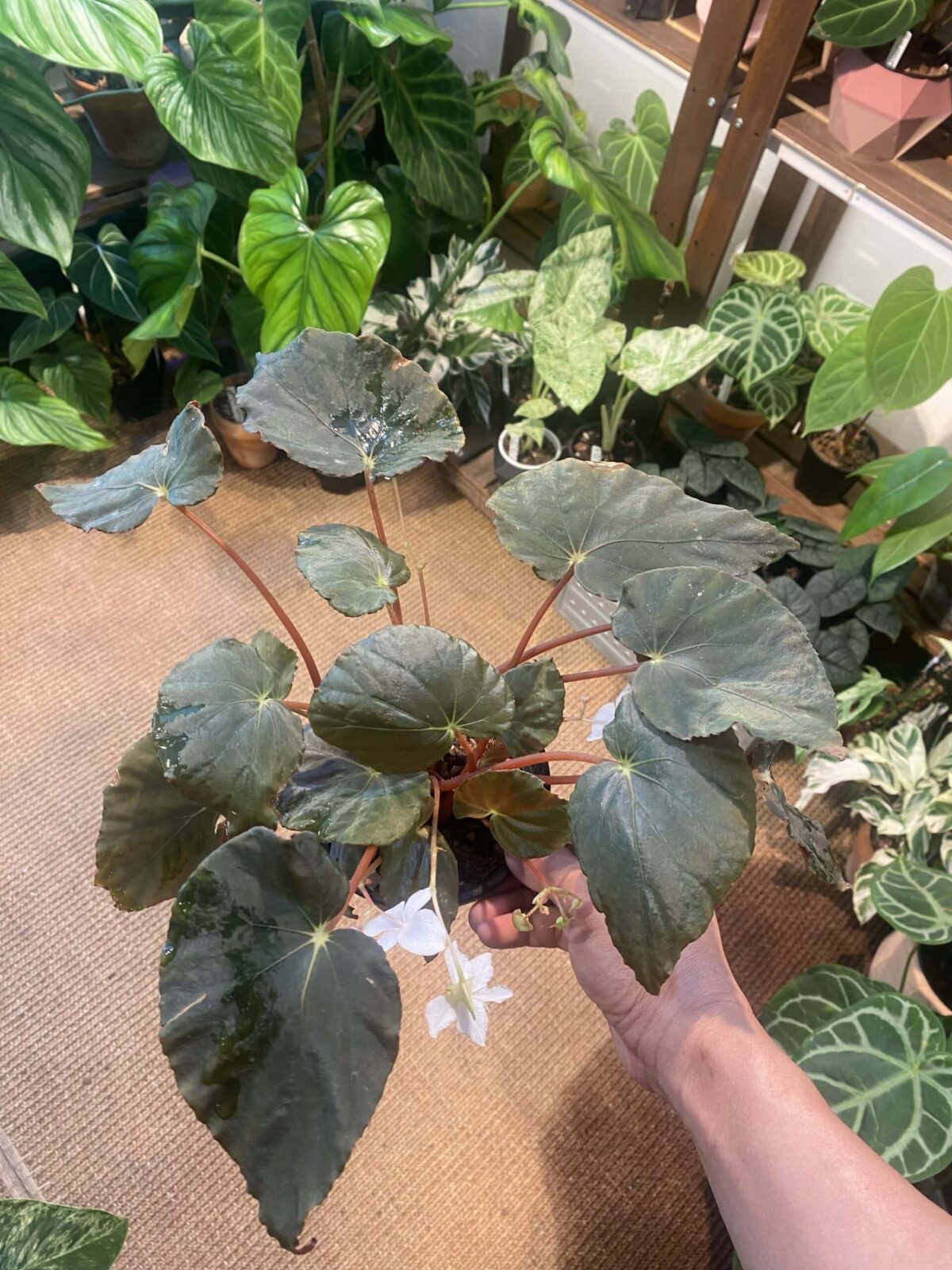
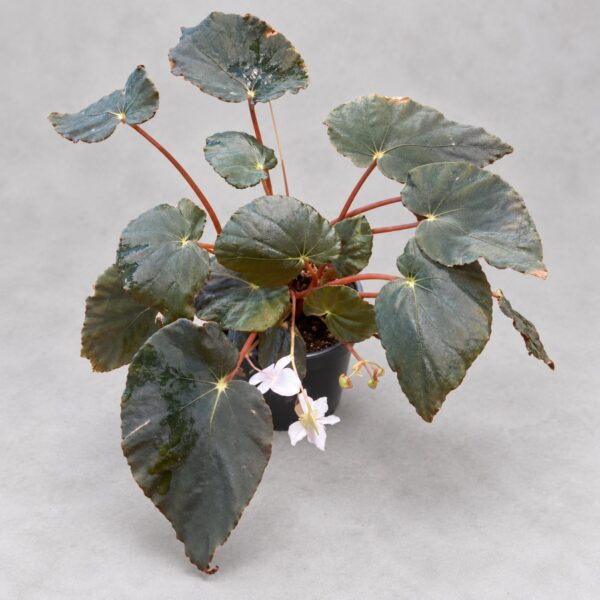
Shop this plantLeaves shimmer with metallic blue-green depending on the light angle, as dazzling as peacock feathers.
Origin & characteristics
Native to the tropical rainforests of Peninsular Malaysia, growing at elevations of 800–1,500 metres in shaded, humid mountain terrain. "Pavonina" comes from the Latin for "peacock," describing the iridescent metallic sheen its leaves display under certain lighting. The leaf shape is a narrow oval, and depending on the light angle, the leaf surface refracts blue-green, purple-blue, or even copper tones — a genuinely striking effect. The plant stays fairly compact, typically 15–30 cm tall, suiting a terrarium or refined tabletop pot.
Light
- Needs soft, diffused light — avoid any direct sun
- Grows healthily under artificial light (such as grow lights), making it very well suited to indoor environments
- Excessive light will dull the leaf's metallic sheen and can even scorch it
Watering
- Prefers soil that stays consistently lightly moist, but never waterlogged
- Use distilled water, rainwater, or tap water left to stand overnight, to avoid chlorine damage
- Water that's too cold will shock the roots; use room-temperature water
Soil & pot
- Needs a highly breathable medium — mix peat, perlite, and bark in a 2:1:1 ratio
- Adding a little sphagnum moss can boost moisture retention
- A transparent or semi-transparent pot makes it easier to monitor root health
Temperature & humidity
- Optimal temperature 20–26°C; a relatively cold-sensitive species
- Never let temperatures drop below 16°C; take particular care to keep it warm in winter
- Requires notably high humidity — 70% or above is ideal; a humidifier or terrarium setup is recommended
Common problems
| Issue | Likely cause | What to do |
|---|---|---|
| Leaves losing their metallic sheen | Light too strong or humidity too low | Move to a shadier spot, increase ambient humidity |
| Leaves yellowing and dropping | Overwatering or temperature too low | Check the roots, improve drainage, keep it warm |
| Growth stalling | Environment too dry or temperature unsuitable | Increase humidity, ensure temperature stays above 20°C |
| Brown spots on leaves | Fungal infection or water quality issues | Switch to rainwater, improve ventilation |
How to explain to customers
"Peacock Begonia is a variety only advanced growers really appreciate — under the light, the leaves genuinely change colour, shifting through blue-green, absolutely beautiful!"
"This one needs it humid and warm to really thrive — we'd suggest a bathroom or somewhere with a humidifier, otherwise it can struggle."
Fun facts
The metallic sheen on Peacock Begonia's leaves comes from a special structure called "iridoplasts," which reflect blue light and absorb red light, helping the plant capture faint light more efficiently for photosynthesis in the dim rainforest understory.
Keywords
Peacock Begonia, Begonia pavonina, metallic begonia, iridescent begonia, Peacock Begonia, foliage plant, rainforest plant, indoor plant, terrarium plant, Hong Kong care, Malaysian native plant
In-depth care guide
One-line pitch
Leaves that flash a metallic blue iridescence from certain angles, as resplendent as peacock feathers — one of the few plants in nature capable of "manipulating light," hiding a quantum-mechanics-level secret behind its photosynthesis.
Origin & characteristics
Peacock Begonia is native to the high-elevation rainforests of Peninsular Malaysia, distributed mainly along mountain streams and limestone formations at 1,000–2,000 metres elevation. It belongs to the family Begoniaceae, genus Begonia, with the Latin species name "pavonina" derived from "pavo" (peacock), describing the blue iridescence its leaves display under certain lighting. Locally it's known as "Peacock Begonia" or "Blue Begonia."
The most striking feature of Peacock Begonia is its leaf iridescence. In shaded conditions or under specific lighting angles, the deep green leaf surface flashes with a shimmering metallic blue, an effect similar to the wings of a Morpho butterfly. This colouring isn't produced by pigment but rather by "structural colour" — created by highly ordered layered structures called thylakoids within specialised chloroplasts (known as iridoplasts) in the leaf's epidermal cells, which generate an optical interference effect.
In 2016, Professor Heather Whitney's team at the University of Bristol published groundbreaking research in Nature Plants, revealing that the photonic crystal structure of iridoplasts can slow down light (the "slow light effect") and concentrate the green-red light spectrum abundant on the rainforest floor toward the photosynthetic system, boosting photosynthetic efficiency by 5–10%. The discovery was described in media coverage as a plant "surviving through quantum mechanics."
Morphologically, Peacock Begonia is a rhizomatous begonia, spreading via a creeping underground rhizome, with leaves about 10–15 cm long, obovate to lanceolate in shape, with a wine-red or copper-brown underside and clearly visible veins. The flowers are small and pinkish-white, and may bloom throughout the year.
Light
Peacock Begonia needs shade to bright diffused light, and absolutely no direct sun. In its native habitat, it grows on the dense forest floor where light is extremely dim. According to horticultural experts' practical experience, it can tolerate roughly 1,000–2,000 foot-candles (about 10,000–20,000 lux), equivalent to "10–20% filtered direct sunlight."
Notably, the blue iridescence is most pronounced in dimmer conditions. If light is too strong, the structural colour produced by the iridoplasts fades or disappears entirely, leaving the leaf looking like an ordinary deep green; conversely, in a shadier position, the blue sheen becomes more prominent. A north-facing windowsill, or a spot 1.5–2 metres from an east-facing window, works well. A sheer curtain can help filter light further.
Watering
Peacock Begonia needs soil that stays consistently moist but never waterlogged. Its root system is shallow and delicate, easily damaged by drying out completely.
Watering points:
- Water once the top 1–2 cm of soil starts to dry, rather than waiting for it to dry out fully
- Use the "thorough soak" method — water slowly along the pot's edge until it flows from the drainage holes, then empty the saucer after 30 minutes
- Use room-temperature water, avoiding cold water that shocks the roots
- If using soft water (low mineral content), consider adding a CalMag supplement monthly, since the plant's native habitat is limestone-based and it's accustomed to relatively mineral-rich water
- A pH of 5.8–6.5 (slightly acidic) is ideal. If your tap water is alkaline (Hong Kong tap water is roughly pH 7.5–8), you can lightly acidify it with citric acid to around pH 6 every other watering
Keep the soil lightly moist through spring and summer's active growth; in autumn and winter, extend the interval between waterings slightly, but still avoid letting it dry out completely. Drooping petioles or leaves usually signal a need for water — respond promptly.
Soil & pot
Peacock Begonia needs a soil that drains well, stays breathable, and retains moisture at the same time. A recommended recipe:
- 1 part peat moss or coco coir
- 1 part large-chunk perlite
- A little fine bark or coconut husk chips (for extra breathability)
- A small amount of oyster shell grit (about 1/4 teaspoon per pot), to mimic the slightly alkaline buffering of its native limestone habitat
The key to this recipe is "moisture-retentive yet breathable" — the roots need consistent moisture alongside plenty of oxygen. Avoid overly heavy garden soil.
For pots, use a shallow pot, since Peacock Begonia's roots are shallow and a deep pot invites waterlogging. Terracotta or plastic both work, as long as there are drainage holes. Since it prefers being slightly root-bound, frequent repotting isn't necessary — once every 1–2 years is generally enough.
Temperature & humidity
Peacock Begonia is native to high-elevation tropical regions, giving it particular temperature requirements — it's essentially a "cool tropical grower":
- Daytime temperature: 20–27°C is ideal
- Nighttime temperature: 12–18°C, ideally about 5–8°C cooler than daytime
- Minimum temperature: never below 10°C; prolonged low temperatures stall growth
- Maximum temperature: sustained temperatures above 28°C (especially if nights also stay warm) put significant stress on the plant, leading to poor growth
This is especially important for Hong Kong. Hong Kong summers are hot and humid, with daytime temperatures often exceeding 30°C; if ventilation is poor or nights also stay warm, Peacock Begonia can struggle considerably. During summer, keep it somewhere air-conditioned or well-ventilated, and ensure it cools down at night.
For humidity, Peacock Begonia needs relatively high levels, ideally 60–80%. While some growers report success even at 35–50% humidity, it's generally best not to go below 50%, or leaf edges will easily dry out. Ways to raise humidity:
- Humidifier: the most direct and effective option
- Pebble tray: a large tray of pebbles and water, with the pot placed on top
- Glass cloche or terrarium: for particularly prized plants, consider growing in an enclosed glass container to create a high-humidity microclimate
- Regular misting: mist the surrounding air in the morning, avoiding direct misting of the leaves (which risks fungal issues)
Common problems
| Symptoms | Likely cause | What to do |
|---|---|---|
| Blue iridescence disappearing, leaves turning plain green | Light too strong / environment too bright | Move to a shadier spot; the blue colour will gradually return |
| Drooping petioles, soft leaves | Underwatering / roots drying out | Water thoroughly right away; if this happens often, check whether watering is too infrequent |
| Leaf edges turning brown, scorched | Humidity too low / air too dry | Increase humidity to above 60%; use a humidifier or pebble tray |
| Slow growth, leaves shrinking | Temperature too high (especially at night) / insufficient light | Ensure nighttime temperature drops below 18°C; adjust light exposure |
| Black or rotten patches on leaves | Fungal infection (high humidity, poor ventilation) | Improve air circulation; reduce leaf misting; use fungicide if necessary |
| Rhizome rot, plant collapsing | Waterlogged soil / overwatering | Remove from pot to check the rhizome, trim away rotten sections, repot in fresh soil |
How to explain to customers
"The best thing about Peacock Begonia is how the leaf changes colour — in a dim spot, or if you shine a torch at a certain angle, you'll see a blue iridescence that's just gorgeous, like peacock feathers. But it's a mountain plant, so it fears heat more than cold — in Hong Kong summer, keep it somewhere air-conditioned or well-ventilated, and ideally a bit cooler at night. Humidity needs to be high too, 60% or more is best, so a humidifier really helps."
Fun facts
Peacock Begonia's iridescence is one of the most striking optical structures in the plant world. The 2016 University of Bristol study found that within its iridoplasts, thylakoids are stacked in an extremely regular 3–4 layer arrangement, forming a structure similar to a man-made photonic crystal. This structure serves two main functions:
- Reflecting blue light, giving the leaf its blue iridescence (actually a "side effect")
- Concentrating green and red light: on the rainforest floor, most blue light has already been absorbed by the canopy above, leaving mostly green and red light; the iridoplasts' crystal structure slows down this light, increasing its contact time with photosynthetic pigments, boosting photosynthetic efficiency by 5–10%
Even more remarkably, the research found that almost all begonia species (including some with no visible iridescence at all) possess iridoplasts, just with varying degrees of structural regularity. In other words, Peacock Begonia is simply the "most evolutionarily refined" example of a trait shared across the genus. The research team believes this natural "nanotechnology" could one day inspire more efficient solar cell and optical device designs.
Keywords
Peacock Begonia, Begonia pavonina, iridescent leaves, structural colour, iridoplasts, photonic crystal, slow light effect, high-elevation begonia, high humidity plant, shade plant, Nature Plants
參考資料(想知來源可展開)
References
- Jacobs, M., Lopez-Garcia, M., Phrathep, O. P., Lawson, T., Oulton, R., & Whitney, H. M. (2016). Photonic multilayer structure of Begonia chloroplasts enhances photosynthetic efficiency. Nature Plants, 2, 16162. https://doi.org/10.1038/nplants.2016.162
- Whitney, H. M. (2016). Behind This Plant's Blue Leaves Lies a Trick of Quantum Mechanics. University of Bristol News, October 20, 2016. https://www.bristol.ac.uk/news/2016/october/begonia.html
- Here But Not. (2022). Begonia pavonina Care & Culture. https://herebutnot.com/begonia-pavonina-care-culture/
- Strange & Wonderful Things. (n.d.). Begonia pavonina – "Peacock Begonia". https://www.strangewonderfulthings.com/318.htm
- Steve's Leaves. (2022). Begonia Pavonina. https://stevesleaves.com/products/begonia-pavonina
- Phrathep, O. P. (2020). Structural colour in Begonia. University of Bristol PhD thesis.
⚠️ Toxicity/pet warning: Peacock Begonia (Begonia pavonina) contains soluble calcium oxalates, toxic to cats and dogs. If a pet chews on the leaves or rhizome, it may experience oral irritation, drooling, and vomiting. Keep the plant well out of reach of pets. It may also cause skin sensitivity in humans; wash your hands after handling.
Plantjai shop · In stock online
Begonia pavonina
Begonia pavonina
Original price was: HK$488.00.HK$198.00Current price is: HK$198.00.
Hong Kong delivery · Causeway Bay pickup
For Hong Kong homes and offices. Stock and pricing follow the product page.
IN STORE NOW
Plants for this guide
Related plants in stock now — live prices, delivery or Causeway Bay pickup.
FREE PLANT ADVICE
Send us a photo before you change anything
WhatsApp a photo of the plant and your window light. Our Causeway Bay team will suggest care steps or plants that suit your space.
STORE · CAUSEWAY BAY
4/F, 39 Yiu Wa Street, Causeway Bay
Daily 12:30–8:00pm · ~3 min walk from Times Square
Map & directionsPlant Care