
How to Care for Begonia Masoniana in Hong Kong | Plantjai

Hong Kong care guide for Begonia Masoniana.
Leaves that look like iron armour, with bold rugged texture — a strong-featured foliage plant that even the guys will love.
Origin & characteristics
Native to limestone regions of Guangxi and Yunnan in China and northern Vietnam, this species was published and named by a British botanist in 1955. The broad, shield-shaped leaves are covered in dark, raised bumps resembling a tortoise shell or armour plate, hence the alternative name "Iron Cross Begonia." A prominent dark brown cross-shaped marking sits at the leaf centre, with finely serrated edges and a thick, rough texture. The plant stays compact, generally 20–40 cm tall, making it ideal for a desk or bookshelf.
Light
- Prefers bright, diffused light; an east-facing windowsill is ideal
- Can tolerate partial shade, though the patterning will be less vivid
- Avoid direct sun; despite the thick leaves, they will still scorch and develop crisp edges
Watering
- Water once the topsoil is dry, keeping the soil lightly moist but never waterlogged
- Use the "soak method" or water along the pot's edge, avoiding water on the leaves
- Reduce watering in winter, roughly every 10–14 days
Soil & pot
- Prefers loose, organic-matter-rich, slightly acidic soil
- Use peat mixed with perlite (roughly 3:1 ratio), with a little coco coir added for extra breathability
- A wide, shallow pot is recommended, since roots grow mainly horizontally
Temperature & humidity
- Optimal temperature is 18–25°C; above 30°C the plant tends toward dormancy
- Moderate cold tolerance; keep above 12°C in winter
- Humidity of 50–70% is ideal; occasional misting of the surrounding air can help
Common problems
| Issue | Likely cause | What to do |
|---|---|---|
| Leaves going soft and rotting | Overwatering or water sitting on leaves | Improve drainage, avoid wetting the leaves |
| New leaves small and dull | Insufficient light or lacking nutrients | Adjust position, feed diluted liquid fertiliser every two weeks during growth |
| Scorched leaf edges | Overly dry air or sunburn | Move away from direct light, increase surrounding humidity |
| Leggy growth with wider leaf spacing | Severe light deficiency | Gradually move to a brighter position |
How to explain to customers
"Iron Cross Begonia has such a tough, sturdy look — the texture on the leaves really does resemble a tortoiseshell, giving it real character in a study or office."
"This is one of the easier begonias to care for — just remember not to water it every day, let it dry out a bit first, since it hates wet feet."
Fun facts
The "Iron Cross" pattern isn't purely decorative — evolutionary biologists believe this distinctive leaf marking may confuse the vision of herbivorous insects, making it harder for them to identify the leaf's true edges.
Keywords
Iron Cross Begonia, Begonia masoniana, Iron Cross Begonia, foliage plant, rainforest plant, indoor plant, tabletop plant, Hong Kong care, limestone plant
In-depth care guide
One-line pitch
A cross-shaped dark brown emblem stamped onto a sandpaper-rough leaf surface — like the iron cross on a medieval knight's shield, one of the most recognisable and storied foliage plants around.
Origin & characteristics
Iron Cross Begonia (Begonia masoniana) is a perennial herbaceous plant in the family Begoniaceae, genus Begonia, native to limestone hillside forests and cave edges in southern Guangxi, China (around Daxin and Pingxiang) and northern Vietnam, at elevations of roughly 100–300 metres. According to Flora of China Volume 13, it grows on "rocky limestone slopes, in caves under dense forests or shrubberies," which points to its notable adaptation to low light, high humidity, and alkaline soils.
The species was formally described by German botanist Edgar Irmscher in 1971. Its species epithet, masoniana, honours British plant collector L. Maurice Mason, who brought the plant from Singapore to England in 1952 and introduced it to horticulture under the name "Iron Cross." The dark brown to chocolate-coloured cross-shaped marking at the leaf centre evokes the iron cross emblem carried on shields during the medieval Crusades, giving the plant its name.
Iron Cross Begonia is a rhizomatous begonia, spreading via a thick, fleshy rhizome that creeps along or just beneath the soil surface. The rhizome serves as a storage organ for water and nutrients, giving the plant a degree of drought tolerance. Mature plants reach about 30–50 cm tall, with all leaves arising from the base on petioles 10–30 cm long, densely covered in coarse hairs; leaves are asymmetrically broad-ovate to nearly round, 10–25 cm long, with a deeply heart-shaped base and finely serrated margins.
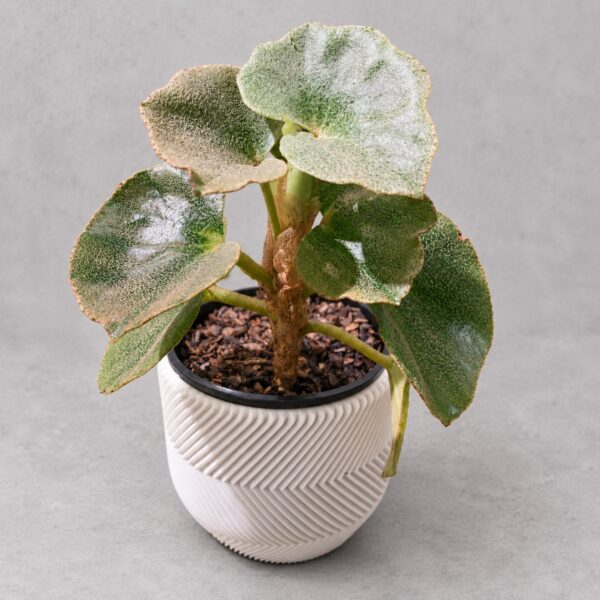
The most distinctive feature is the leaf texture and patterning: the leaf surface is covered in countless fine reddish-brown bristles and conical raised bumps (bullae), giving it a sandpaper-like roughness; a broad, dark chocolate-brown band runs along the midrib, forming the clear cross-shaped pattern; the underside is pale green with sparse coarse hairs along the veins. This distinctive leaf structure is fairly typical within Begonia section Coelocentrum, a group that includes other bump-leaved species like B. ferox and B. melanobullata.
Flowering occurs from March to September, with flower stalks 10–54 cm tall bearing terminal dichasial cymes of 20–100 small, pale greenish-white flowers. However, flowering is relatively rare in indoor cultivation, with ornamental value concentrated primarily in the foliage.
Light, watering, soil & pot, temperature & humidity
Light
Iron Cross Begonia needs bright, diffused light, avoiding direct sun entirely, or the rough leaf surface will scorch and develop brown patches. The ideal position is about 1–2 metres from an east-, south-, or west-facing window, allowing it to receive soft light filtered through a curtain. A north-facing window may provide slightly weaker light, resulting in slower growth and paler leaf colour.
Notably, the intensity of the cross-shaped marking's colour is influenced by light levels — under ample light, the brown cross pattern is vivid and strongly contrasted; under weak light, the pattern becomes dull and blurred. If you notice new leaves showing a faded cross pattern, this is a signal that light is insufficient.
Watering
As a rhizomatous plant, Iron Cross Begonia stores water in its rhizome, giving it some tolerance for brief dry spells. The watering principle is "better dry than wet": water only once the soil feels dry roughly 3–5 cm below the surface, and avoid keeping the soil consistently moist over time.
Water roughly every 5–7 days during summer's active growth, extending to every 10–14 days in winter. Water slowly along the pot's edge, avoiding splashing the leaves — the rough leaf surface holds water easily, increasing the risk of powdery mildew. Water thoroughly each time, letting excess drain from the pot's base, and empty the saucer after half an hour.
A special note: although Iron Cross Begonia enjoys high humidity, never mist the leaves directly. The rough, hairy leaf surface traps water droplets easily, which can trigger mould or powdery mildew in poorly ventilated conditions.
Soil and pot
Iron Cross Begonia needs a well-draining, organic-matter-rich, slightly acidic soil. A recommended recipe (by volume):
- 40% quality potting mix
- 20% perlite (for drainage)
- 20% orchid bark (for structure and aeration)
- 10% peat moss or coco coir (moisture retention and acidity)
- 10% worm castings or well-rotted compost (natural nutrients)
Commercially available African violet potting mix also suits this plant well, since its formula emphasises similar drainage and acidity properties. The rhizome likes to sit "snugly" in its pot, so avoid an oversized pot — increase pot size by only one step at a time when repotting. A wide, shallow pot suits the horizontally-growing rhizome better than a deep, narrow one.
Repot once a year in spring, checking the rhizome's health at the same time — a healthy rhizome should feel firm and full; any soft, discoloured sections should be trimmed away immediately.
Temperature and humidity
Iron Cross Begonia grows best between 18–25°C, never below 12°C. It's notably sensitive to cold and cold drafts, so move it away from windows or AC vents during winter cold snaps.
For humidity, the ideal range is 50–70%. Although it prefers higher humidity, avoid raising it via misting (as noted above). Recommended methods:
- A pebble tray with water beneath the pot — make sure the pot sits raised, not touching the water
- Grouping several plants together
- An evaporative humidifier
- A well-ventilated bathroom (if it has a window providing natural light)
Good air circulation is essential — high humidity combined with stagnant air easily causes mould issues.
Common problems
| Issue | Symptoms | Likely cause | What to do |
|---|---|---|---|
| Browning, scorched leaf edges | Leaf edges or tips turning brown and dry | Overly dry air, insufficient watering, or humidity too low | Increase surrounding humidity (using a pebble tray rather than misting); check watering frequency |
| Yellowing leaves, soft stem base | Leaves yellowing from the base upward, rhizome going soft | Overwatering causing root or rhizome rot | Stop watering immediately, dig up and inspect the rhizome, trim away rotten sections, repot in fresh soil |
| Powdery mildew | White powdery coating on leaves | High humidity with poor ventilation, or leaves staying wet long-term | Trim badly affected leaves; improve ventilation; treat with a dedicated fungicide; avoid misting |
| Leggy, distorted growth | Elongated petioles, thinner leaves, faded cross pattern | Severe light deficiency | Move to a brighter position; prune in spring to encourage new growth |
| Scale insects/whitefly | White cottony masses or tiny black specks on leaf undersides or petioles | Poor ventilation or spread from nearby plants | Wipe off pests with an alcohol-dipped cotton swab; spray with neem oil or insecticidal soap; isolate affected plants |
| Winter "false death" | Leaves gradually wither in autumn/winter, appearing dead | Natural dormancy — the rhizome remains alive | Reduce watering, keep soil slightly dry; new growth returns once spring warms up |
How to explain to customers
"The best thing about Iron Cross Begonia is that cross-shaped pattern on the leaf — it really does have a medieval knight's shield feel to it, and the leaf surface feels rough like sandpaper, very distinctive. The key points for caring for it: first, diffused light only, never direct sun; second, water only once the soil is dry, better too dry than waterlogged; third, humidity should be high but don't mist the leaves — use a pebble tray or humidifier instead. It might drop leaves and go dormant in winter, don't worry, the rhizome is still alive and it'll sprout again in spring. Keep it away from pets, since begonias are toxic to cats and dogs."
Fun facts
- Named after a British plant collector: The species epithet masoniana honours L. Maurice Mason, who introduced the plant from Singapore to England in 1952. Mason wasn't a professional scientist but an amateur plant enthusiast, yet his discovery and introduction work brought this beautiful plant from the limestone forests of the China-Vietnam border into the global horticultural trade. He also coined the name "Iron Cross."
- Belongs to the "hollow-anther" section: Iron Cross Begonia belongs to Begonia section Coelocentrum, a group distributed primarily across the karst limestone regions of southern China through northern Vietnam. Shared features across this section include rhizomatous growth, raised leaf bumps (bullae), and a concave stigma structure. Fellow section members B. melanobullata (black-bump begonia) and B. ferox (spiny begonia) have also become popular collector's targets in recent years.
- The cross pattern is natural camouflage: The dark brown cross marking at the leaf centre is thought to function as a form of natural crypsis — in limestone forests where fallen leaves and rocks cast dappled shadows, the cross-shaped dark pattern helps break up the leaf's outline, reducing the chance of detection by herbivorous insects.
- The leaf bumps have a function too: The countless conical bumps and bristles covering the leaf surface may serve multiple purposes — in the humid native habitat, these structures may help channel away water pooling on the leaf, preventing fungal growth, while also potentially increasing light scattering to help light penetrate deeper into the leaf tissue. Despite the rough, sandpaper-like feel, it doesn't prick the skin at all.
- A single leaf can propagate several plants: Iron Cross Begonia's propagation is genuinely fascinating — beyond the common method of rhizome division, it can also be propagated via vein cutting: cut a healthy large leaf with its petiole attached, make several cross-cuts (not all the way through) along the main veins on the underside roughly every 2–3 cm, then lay the leaf face-up on moist propagation medium, pinning it down with small stones or hairpins to keep it in contact with the soil. After about 4–8 weeks, new plantlets will emerge at each cut point — a single leaf can produce five or more new plants!
- Extremely narrow wild distribution: According to Flora of China, Iron Cross Begonia is found in China only in southwestern Guangxi (Daxin, Pingxiang), growing on limestone hillsides or in caves under dense forest at elevations of 100–300 metres. Given the fragility of karst ecosystems and pressure from wild collection, wild populations may face threats. Nearly all plants in the horticultural trade today are propagated commercially, making sustainable cultivation practices important.
Keywords
Begonia masoniana, Iron Cross Begonia, Iron cross begonia, Begoniaceae, rhizomatous begonia, section Coelocentrum, cross-shaped pattern, limestone plant, native to China-Vietnam border, foliage plant, indoor potted plant, vein cutting propagation, Plantjai
參考資料(想知來源可展開)
References
- eFloras.org. "Flora of China, Vol. 13: Begonia masoniana." http://www.efloras.org/florataxon.aspx?flora_id=2&taxon_id=242412320
- North Carolina Extension Gardener Plant Toolbox. "Begonia masoniana (Iron Cross Begonia)." https://plants.ces.ncsu.edu/plants/begonia-masoniana/
- North Carolina Extension Gardener Plant Toolbox. "Begonia – Rhizomatous Types." https://plants.ces.ncsu.edu/plants/begonia-rhizomatous-types/
- Patch Plants. "Complete guide to 'Iron Cross' begonia care." https://www.patchplants.com/pages/plant-care/complete-guide-to-iron-cross-begonia-care/
- Longfield Gardens. "Iron Cross Begonia Care Indoors: Grow Striking Foliage." https://www.longfield-gardens.com/blogs/begonia-care/iron-cross-begonia-care-indoors-a-guide-to-striking-foliage
- Longfield Gardens. "Iron Cross Begonia Propagation: Easy Step-by-Step Guide." https://www.longfield-gardens.com/blogs/begonia-care/easy-methods-for-iron-cross-begonia-propagation
- Plants of the World Online (POWO). "Begonia masoniana Irmsch. ex Ziesenh." https://powo.science.kew.org/taxon/urn:lsid:ipni.org:names:105166-1
- Peng, C.I., et al. (2021). "Begonia catbensis (sect. Coelocentrum, Begoniaceae), a new species from northern Vietnam." PhytoKeys, 181, 145–158. https://doi.org/10.3897/phytokeys.181.65812
- Gabriella Plants. "Begonia masoniana 'Iron Cross' care guide." https://www.gabriellaplants.com/products/begonia-masoniana-iron-cross
⚠️ Toxicity/pet warning: Iron Cross Begonia is toxic to cats and dogs. Its roots, rhizome, and leaves contain soluble calcium oxalates, and pets that chew on the plant may experience oral irritation, drooling, vomiting, difficulty swallowing, and gastrointestinal upset. Keep the plant somewhere pets can't reach, such as a high shelf, cabinet top, or enclosed glass cabinet. If you suspect a pet has ingested any part of the plant, contact a vet immediately.
For Hong Kong homes and offices. Stock and pricing follow the product page.
IN STORE NOW
Plants for this guide
Related plants in stock now — live prices, delivery or Causeway Bay pickup.
FREE PLANT ADVICE
Send us a photo before you change anything
WhatsApp a photo of the plant and your window light. Our Causeway Bay team will suggest care steps or plants that suit your space.
STORE · CAUSEWAY BAY
4/F, 39 Yiu Wa Street, Causeway Bay
Daily 12:30–8:00pm · ~3 min walk from Times Square
Map & directionsPlant Care