
How to Care for Begonia Maculata in Hong Kong | Plantjai

Plantjai 植仔 · Care Encyclopedia
Begonia Maculata
Hong Kong care guide — useful before you buy and after it arrives.
Shop this plantLeaves scattered with silvery-white polka dots, like nature's own hand-painted artwork — instantly recognisable.
Origin & characteristics
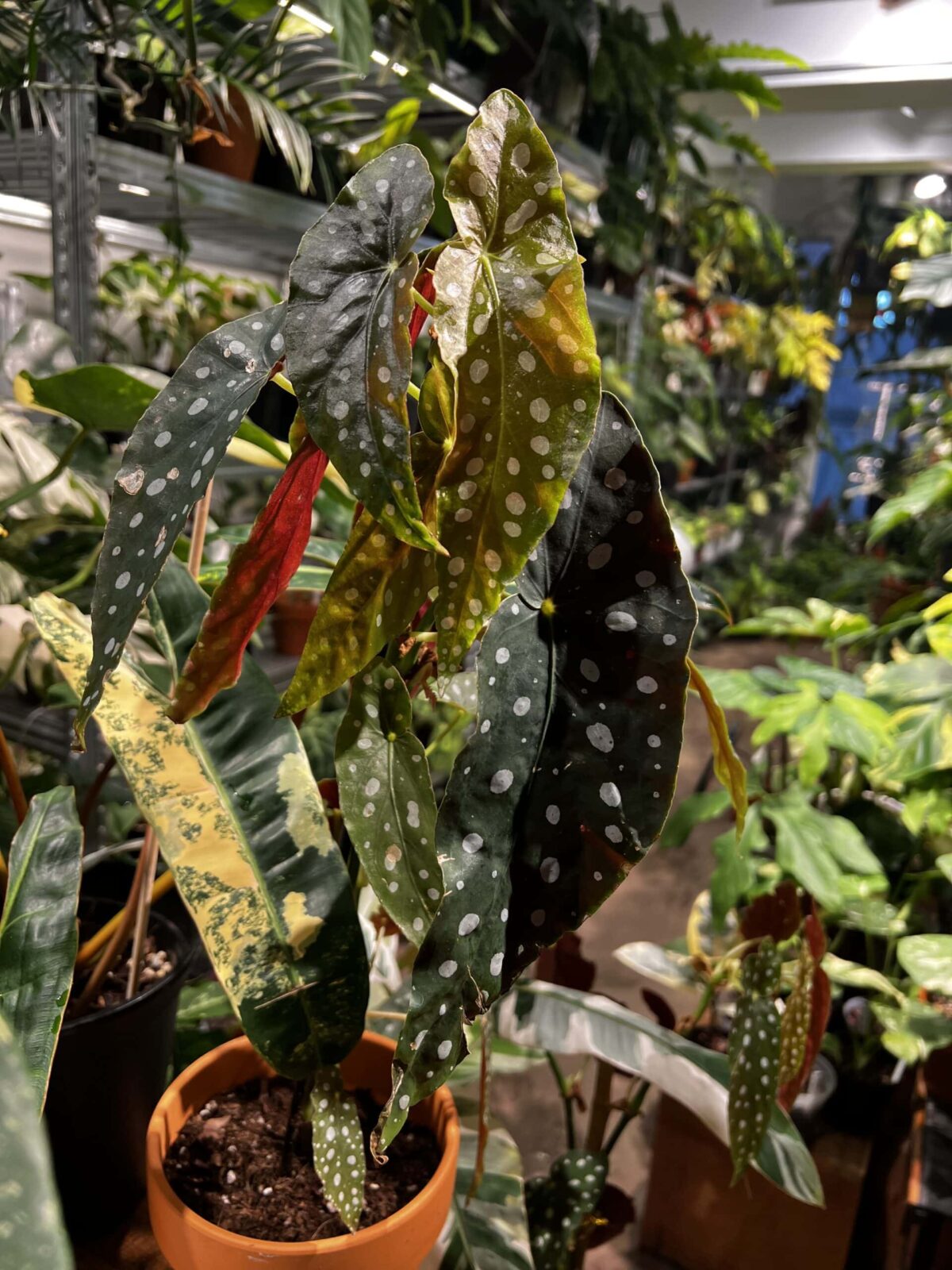
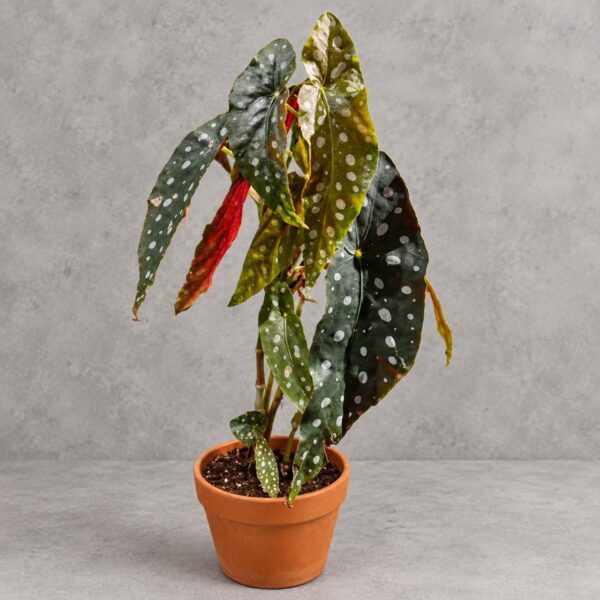
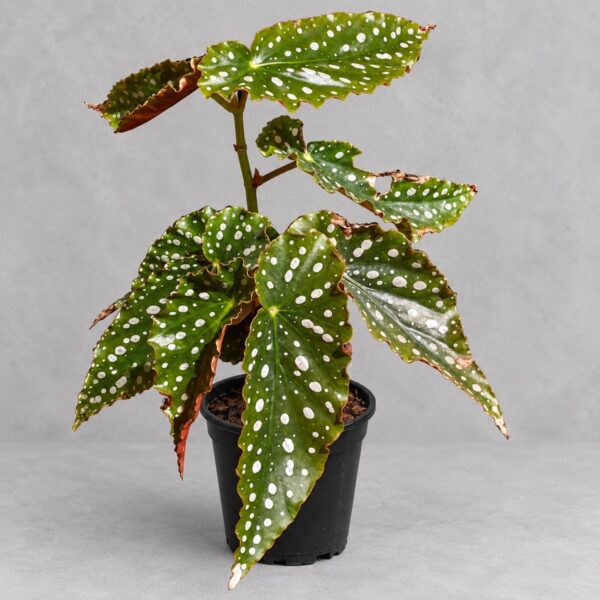
Native to the tropical rainforests of southeastern Brazil, Polka Dot Begonia belongs to the cane-type begonia group. The lance-shaped leaves are covered in striking silvery-white dots on top, with a contrasting red-brown underside. Plants can grow over 1 metre tall, suiting a vertical display or a tall plant stand. It grows quickly and produces clusters of pale pink or white flowers in spring and summer, making it one of the most popular "Instagram-famous" houseplants in recent years.
Light
- Bright, diffused light is best — place near an east- or north-facing window
- Avoid direct midday sun, which can scorch and yellow the leaves
- Insufficient light causes legginess and fading of the polka dots, greatly reducing ornamental value
Watering
- Water once the topsoil is dry about 2–3 cm down; better slightly dry than wet
- Avoid wetting the leaves, especially overnight, as this can cause bacterial rot
- Reduce watering frequency in winter as growth slows
Soil & pot
- A well-draining, breathable peat-based mix is recommended, with perlite, bark, or coco coir added to improve drainage
- Choose a terracotta or plastic pot with drainage holes to prevent waterlogged roots
- Roots are shallow, so avoid an overly deep pot
Temperature & humidity
- Optimal growing temperature is 18–27°C; growth stalls below 15°C
- Not cold-hardy; keep above 10°C in winter
- Humidity of 50% or above is preferable; a humidifier or a more humid location helps
Common problems
| Issue | Likely cause | What to do |
|---|---|---|
| Leaf tips yellowing | Overwatering or poor drainage | Check pot drainage, adjust watering frequency |
| Polka dots fading | Insufficient light | Move to a brighter position |
| Leaves going soft and drooping | Underwatering or root rot | Check soil moisture, repot to check roots if necessary |
| Brown spots on leaves | Sunburn or fungal infection | Avoid direct light, ensure good ventilation |
How to explain to customers
"Polka Dot Begonia is one of the hottest Instagram plants of recent years — those silvery dots on the leaves are genuinely stunning!"
"Just remember, no direct sun — a spot near a window with a bit of light is best, and it's better to water too little than to let it sit waterlogged."
Fun facts
The silvery dots on Polka Dot Begonia's leaves are actually a special epidermal cell structure that reflects excess light, helping the plant survive in the dim understory of the rainforest.
Keywords
Polka Dot Begonia, Begonia maculata, silver-spot begonia, cane begonia, Polka Dot Begonia, foliage plant, rainforest plant, indoor plant, Hong Kong care
In-depth care guide
One-line pitch
Deep green angel-wing leaves scattered with silvery-white polka dots, with a wine-red underside that glows when backlit — a slice of tropical rainforest for your home.
Origin & characteristics
Polka Dot Begonia (Begonia maculata) is a perennial herbaceous plant in the family Begoniaceae, genus Begonia, native to the mountain forests of southeastern Brazil — particularly around Rio de Janeiro. In 1820, Italian botanist Giuseppe Raddi formally described and named the species based on a specimen collected at Rio's famous landmark, Corcovado mountain. Raddi is said to have collected over 4,000 plant specimens during a seven-month expedition through Brazil in 1817, with B. maculata being among the most notable of his discoveries.
The species epithet "maculata" comes from the Latin for "spotted," accurately describing its most iconic feature — the silvery-white dots on the leaf surface. These dots aren't pigmentation at all, but a special structural feature known as "blister variegation" or "airspace variegation": tiny air pockets form between the epidermal layer and the underlying leaf tissue, and light scattering within these pockets produces the silvery-white visual effect. Botanists have proposed two main hypotheses for the evolutionary function of this patterning: first, that the spots mimic butterfly eggs, discouraging butterflies from laying more eggs on a leaf they believe is already occupied (thus reducing larval feeding damage); second, that the spots mimic leaf-miner damage, making the leaf appear already "claimed" and deterring real leaf miners.
Polka Dot Begonia belongs to the cane-type begonia group, so named because its stems are sturdy and upright with distinct nodes, resembling bamboo cane. Mature plants can reach 1–1.5 metres tall, with clusters of small white or pink flowers appearing at the stem tips, each with a yellow-stamened centre. Though the flowers are delicate, most enthusiasts grow this plant for its foliage — the deep to almost black-green leaves are elongated ovals tapering to a point at each end, resembling angel wings (hence the English name "Angel-wing begonia"); the underside is a vivid red-purple that glows faintly when backlit, adding tremendous ornamental value.
Notably, before the mid-19th century, Polka Dot Begonia's English common name was "trout begonia" or "fish begonia," referring to the resemblance of its leaf spots to the markings on a trout's body. It wasn't until the "polka dot" fashion term became popular in the mid-1800s that it began to be called "Polka Dot Begonia."
Light, watering, soil & pot, temperature & humidity
Light
Polka Dot Begonia needs bright, diffused light, avoiding harsh midday direct sun (especially in summer), which easily scorches the leaves with burn patches. The ideal position is an east- or west-facing windowsill — east-facing catches gentle morning sun, while west-facing offers afternoon light but shouldn't receive more than 1–2 hours of harsh direct sun. A north-facing window also works, though growth will be slower and leaf colour paler.
If your west-facing window receives direct afternoon sun, use a sheer curtain to filter it, or move the plant about 1 metre back from the window. Polka Dot Begonia is fairly sensitive to changes in light, so transition it gradually when moving it to a brighter spot rather than shifting it abruptly from shade to strong light.
Watering
Polka Dot Begonia prefers soil that stays consistently lightly moist but never waterlogged. To judge timing, insert a finger into the soil about 2–3 cm deep — if it feels dry, water. In summer's active growth, this might mean every 5–7 days; in winter, this can extend to 10–14 days.
A few watering notes:
- Water along the pot's edge, avoiding splashing the leaves as much as possible, since standing water can lead to powdery mildew or botrytis (grey mould)
- Water thoroughly, until it flows from the drainage holes
- Check the saucer after half an hour and empty any collected water
- Use room-temperature water; overly cold water can shock the roots
Polka Dot Begonia isn't as fussy about water quality as prayer plants (Calathea), so ordinary tap water is generally fine — but if you notice leaf tips consistently browning, consider switching to filtered water or rainwater.
Soil and pot
Polka Dot Begonia needs a light, breathable, organic-matter-rich soil. A recommended recipe (by volume):
- 2 parts coco coir (moisture retention and breathability)
- 2 parts perlite or pumice (drainage and aeration)
- 1 part worm castings (natural nutrients)
If you'd rather not mix your own, a quality indoor potting mix with an equal volume of perlite added works well too, ensuring good drainage. Polka Dot Begonia's roots need airflow, and overly compacted soil leads to root rot.
For pots, terracotta or plastic pots both work, as long as they have drainage holes. Polka Dot Begonia grows quickly — check the root system each spring, and if roots are emerging from the drainage holes, it's time to size up. Choose a new pot about 2–3 cm larger in diameter, rather than jumping several sizes at once.
Temperature and humidity
Polka Dot Begonia's optimal growing temperature is 18–27°C, tolerating brief dips to as low as 15°C, though prolonged exposure below 15°C noticeably stalls growth, and below 10°C may cause cold damage. Hong Kong winters are generally fine, but if your balcony is particularly exposed and windy, it's worth moving the plant indoors.
For humidity, the ideal range is 45–60%. Hong Kong's natural summer humidity is usually sufficient, but winter AC or heating can dry the air out too much. Ways to raise humidity include:
- Grouping several plants together to create a shared microclimate
- Using a pebble tray (tray with pebbles and water)
- Placing the plant in a bathroom or kitchen with higher humidity
- Using a humidifier
Avoid misting the leaves directly, since Polka Dot Begonia is prone to developing powdery mildew from this. If you need to raise humidity via misting, spray into the air around the plant rather than onto the foliage.
Common problems
| Issue | Symptoms | Likely cause | What to do |
|---|---|---|---|
| Leaves yellowing and dropping | Lower leaves yellow first, spreading upward | Overwatering causing root rot | Reduce watering, check pot drainage, repot and trim rotten roots if necessary |
| Scorched, browning leaf tips | Leaf tips or edges turning brown and dry | Humidity too low, water too hard, or fertiliser too concentrated | Increase surrounding humidity; use filtered water; dilute fertiliser to half strength |
| Leggy stems | Elongated internodes, sparse and small leaves | Insufficient light | Move to a brighter position; prune leggy stems in spring to encourage side shoots |
| Powdery mildew | White powdery coating on leaves | High humidity with poor air circulation, or foliage staying wet long-term | Remove badly affected leaves; improve ventilation; spray with fungicide (sulphur powder or a dedicated product) |
| Spider mites | Fine yellow dots on leaves, faint webbing on undersides | Hot, dry conditions | Increase humidity; wipe leaf undersides with a damp cloth; treat with neem oil or insecticidal soap |
| Growth stalling | No new leaves for a long time, stem tips drying out | Natural winter dormancy, or roots have filled the pot | Growth resumes once spring warms up; check whether repotting is needed |
How to explain to customers
"Polka Dot Begonia is one of our most popular plants — beautiful and not too difficult to care for. The key points: keep it near a window with diffused light, avoiding harsh midday sun; water once the top inch or two of soil is dry, water thoroughly, then empty the saucer; humidity ideally 40–50% or more, but never mist the leaves directly, or it's prone to powdery mildew. It grows quickly, so you can prune and shape it in spring, and the cuttings root easily in water — a great one to share with friends. Keep it away from pets, since begonias are toxic to cats and dogs."
Fun facts
- The evolutionary secret of the spots: The silvery-white dots on Polka Dot Begonia's leaves are structural variegation rather than pigmentation. Tiny air pockets form between the epidermal cells and the leaf tissue beneath, scattering light to produce the silvery effect — a mechanism similar in principle to the silvery scales of certain tropical fish.
- One of the most Instagram-popular begonias: According to 2023 social media data analysis, #begoniamaculata ranks as the second most popular species-specific begonia hashtag on Instagram, second only to Begonia rex. As early as 1871, the American horticultural journal California Horticulturist described it as "a very desirable variety" — a testament to its enduring popularity across more than 150 years.
- Cane stems can grow nearly as tall as a person: In ideal conditions, Polka Dot Begonia can grow over 1.5 metres tall, with clusters of white or pink flowers appearing at the stem tips. Although the flowers are delicate, the horticultural community generally considers the foliage more worthy of attention, so many growers pinch off flower buds to redirect the plant's energy into leaf growth.
- From "trout" to "polka dot": Before the mid-19th century, Polka Dot Begonia was called "trout begonia," due to its leaf spots resembling the markings on a trout's body. It wasn't until the 1850s, when "polka dot" became a fashionable term alongside the popularity of the polka dance across Europe, that the leaf's dotted pattern was likened to polka-dot fabric, giving rise to its current name.
- Extremely easy to propagate: Polka Dot Begonia is one of the easiest foliage plants to propagate. Simply cut a stem section with 1–2 nodes and place it in water — roots typically appear within 10–14 days, and once roots reach about 5 cm, it can be transplanted into soil. Soil propagation also works, and you can even use the leaf-vein cutting method — cutting the main veins of a healthy large leaf and laying it flat on moist propagation soil, with new plantlets emerging at each cut point.
Keywords
Begonia maculata, Polka Dot Begonia, Angel-wing Begonia, cane begonia, Begoniaceae, blister variegation, native to Brazil, foliage plant, indoor potted plant, stem cutting propagation, high-humidity plant, Plantjai
參考資料(想知來源可展開)
References
- Wikipedia. "Begonia maculata." https://en.wikipedia.org/wiki/Begonia_maculata
- PlantMyHome. "Begonia Maculata Care Tips for Fast Growth and Propagation." https://plantmyhome.com/begonia-maculata-care-polka-dot-begonia/
- Longfield Gardens. "How to Grow Begonia Maculata for Stunning Indoor Color." https://www.longfield-gardens.com/blogs/begonia-care/how-to-grow-begonia-maculata-for-stunning-indoor-color
- Longfield Gardens. "Begonia Maculata Water Propagation: A Simple Guide." https://www.longfield-gardens.com/blogs/begonia-care/begonia-maculata-water-propagation-a-simple-guide
- Leafy Life. "How to care for begonia maculata." https://leafy-life.com/how-to-care-for-begonia-maculata/
- Missouri Botanical Garden. "Begonia maculata." https://www.missouribotanicalgarden.org/PlantFinder/PlantFinderDetails.aspx?taxonid=275994
- Kew Plants of the World Online. "Begonia maculata Raddi." https://powo.science.kew.org/taxon/urn:lsid:ipni.org:names:105903-1
⚠️ Toxicity/pet warning: Polka Dot Begonia is toxic to cats and dogs. Its roots and stems contain soluble calcium oxalates, and pets that chew on the plant may experience oral irritation, drooling, vomiting, and difficulty swallowing. Keep the plant somewhere pets can't reach, such as a high shelf or hanging planter. If you suspect a pet has ingested any part of the plant, contact a vet immediately.
Plantjai shop · In stock online
Begonia maculata
Begonia maculata
HK$208.00
Hong Kong delivery · Causeway Bay pickup
For Hong Kong homes and offices. Stock and pricing follow the product page.
IN STORE NOW
Plants for this guide
Related plants in stock now — live prices, delivery or Causeway Bay pickup.
FREE PLANT ADVICE
Send us a photo before you change anything
WhatsApp a photo of the plant and your window light. Our Causeway Bay team will suggest care steps or plants that suit your space.
STORE · CAUSEWAY BAY
4/F, 39 Yiu Wa Street, Causeway Bay
Daily 12:30–8:00pm · ~3 min walk from Times Square
Map & directionsPlant Care