
How to Care for Begonia Ferox in Hong Kong | Plantjai

Plantjai 植仔 · Care Encyclopedia
Begonia Ferox
Hong Kong care guide — useful before you buy and after it arrives.
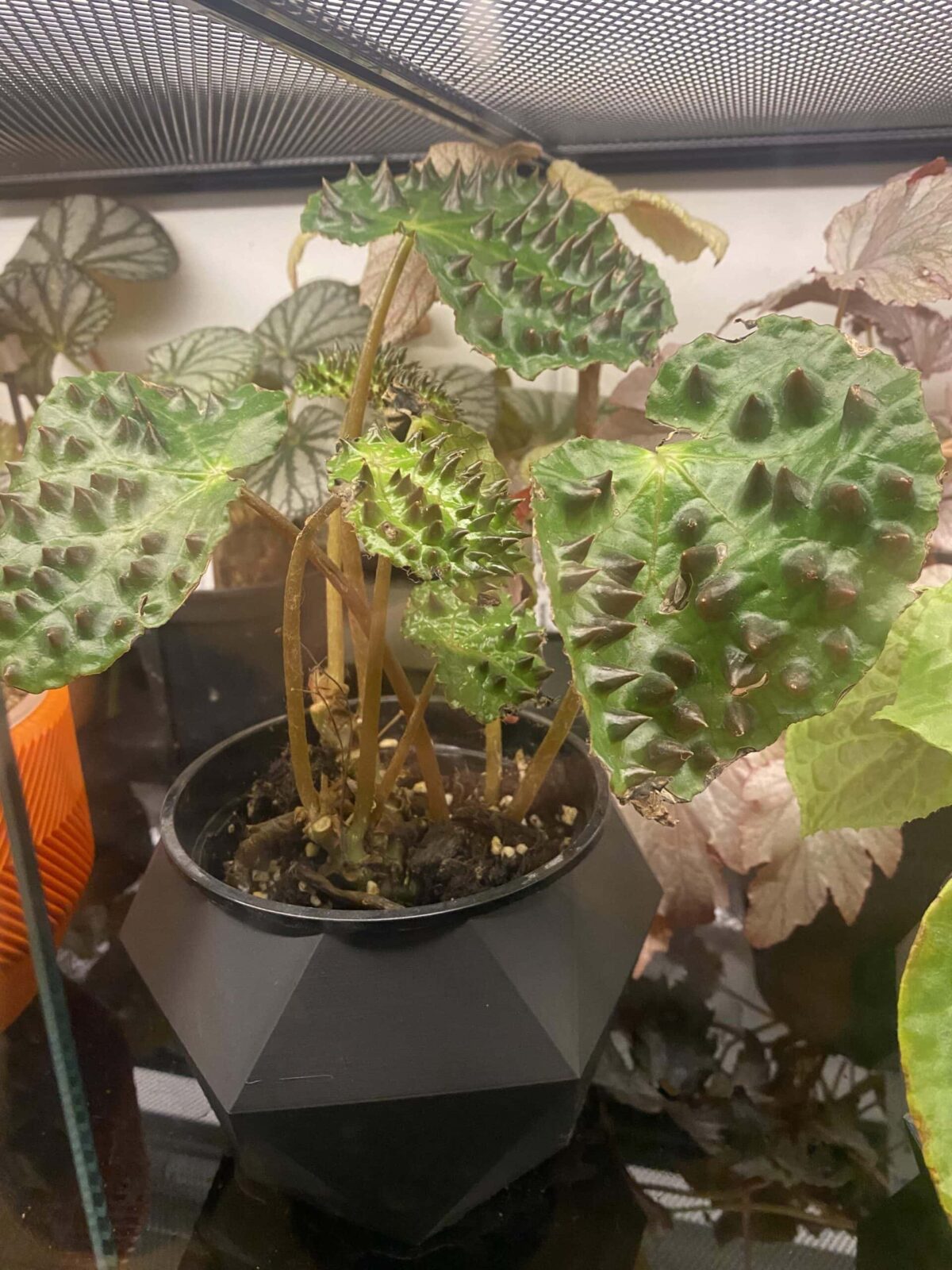
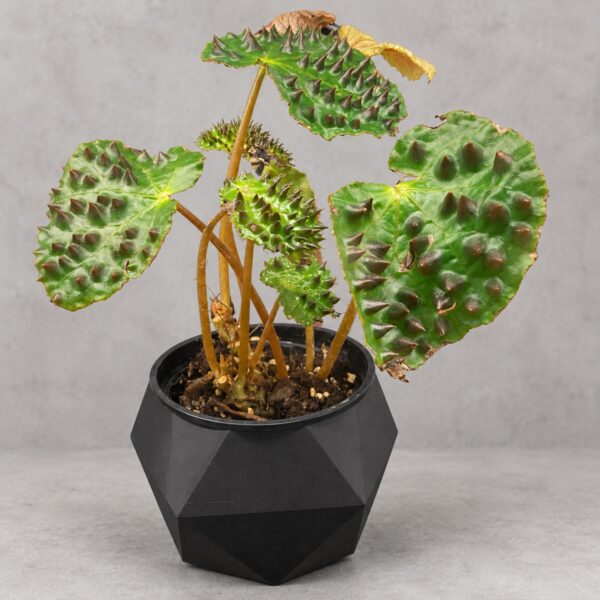
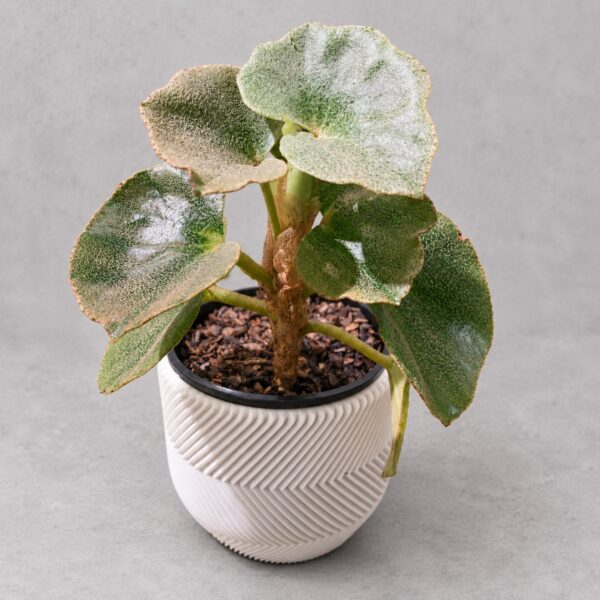
Shop this plantBlack spiky projections cover the leaf surface — a miniature dark warrior with real attitude.
Origin & characteristics
Native to the limestone mountains of Nonggang, Guangxi, China, and only formally described in 2013, this is a terrestrial, small herbaceous begonia species. The leaf surface is covered in prominent black, spike-like projections with a distinctively rough texture and real ornamental appeal. Because wild populations are extremely limited, it has been classified as Critically Endangered (CR), and most plants available on the market are cultivated propagations.
⚠️ Contains calcium oxalate crystals — toxic to children and pets; ingestion may cause oral irritation, drooling, and vomiting.
Light
- Prefers bright, diffused light, and can accept gentle direct morning sun
- Avoid harsh midday direct sun, which easily scorches the leaf surface
- Indoors, position near an east- or north-facing window, or supplement with a grow light for 8–10 hours daily
- Insufficient light causes the leaf colour to fade and the plant to grow leggy
Watering
- Keep the soil lightly moist in spring and autumn, watering once the top 2–3 cm of soil has dried
- In summer heat, watering frequency can increase slightly, but never let water stand
- Reduce watering in winter, letting the soil run on the drier side
- Use room-temperature water, poured along the pot's edge, avoiding wetting the leaves
- As a species native to limestone terrain, it tolerates brief drought reasonably well — err on the dry side rather than wet
Soil & pot
- Choose a loose, airy, well-draining, slightly acidic to neutral soil
- Recommended recipe: peat moss 4 parts + perlite 3 parts + coco coir 2 parts + a small amount of crushed limestone (mimicking its native limestone habitat)
- Pot must have drainage holes; terracotta or cement pots are preferred, helping with aeration and root stability
- As a small species, it doesn't need an oversized pot, which would keep the soil too wet for too long
Temperature & humidity
- Ideal growing temperature: 18–26°C
- Tolerates a minimum of around 12°C; growth stalls above 32°C
- In Hong Kong summers, pay attention to ventilation and cooling to avoid stuffy conditions
- Recommended humidity: 60–75%, achievable with a humidifier or a water tray (keeping the pot base off the water surface)
- Growing under a clear enclosure can promote growth, but requires regular venting for fresh air
Common problems
| Issue | Likely cause | What to do |
|---|---|---|
| Leaves yellowing and dropping | Overwatering causing root rot | Check roots, reduce watering frequency, improve drainage |
| Leaf projections becoming soft | Insufficient light or humidity too low | Move to a brighter spot, increase ambient humidity |
| Leaf edges scorching | Sun too strong or water too alkaline | Provide shade, switch to filtered water or rainwater |
| Growth stalling | Temperature too low or roots filling the pot | Check temperature, consider a larger pot |
| Leggy growth (long stems, sparse leaves) | Severely insufficient light | Gradually increase light intensity |
How to explain to customers
"This Black Peak Begonia is genuinely special — those black spikes on the leaves evolved as natural 'armour' in its native environment, and every single projection is one of a kind! It's from the limestone mountains of Guangxi, and while it looks rugged, it's actually fairly easy to care for — just remember not to overwater, and give it enough diffused light."
Fun facts
Black Peak Begonia was only formally described by science in 2013, making it one of the more recently discovered begonia species — found in a tiny area of Guangxi in the wild, it's classified as critically endangered. The black projections on its leaves are actually a protective mechanism, helping reduce insect grazing in its native habitat.
Keywords
Black Peak Begonia, Begonia ferox, foliage plant, limestone begonia, endangered plant, black-textured leaves, miniature begonia, indoor plant, Plantjai, Hong Kong plant shop, diffused light, high-humidity plant
參考資料(想知來源可展開)
References
- Thursd. Begonia Ferox Care Guide for Spiky Leaf Foliage. https://thursd.com/articles/the-spikey-looks-of-the-begonia-ferox-can-be-deceiving
- Longfield Gardens. Easy Steps for Successful Begonia Ferox Propagation. https://www.longfield-gardens.com/blogs/begonia-care/easy-steps-for-successful-begonia-ferox-propagation
- Rural Sprout. Begonia Ferox – The Weirdest Houseplant of 2024 & How To Care For It. https://www.ruralsprout.com/begonia-ferox/
In-depth care guide
Introduction
Black Peak Begonia, botanically Begonia ferox, is one of the most eye-catching and genuinely "sci-fi looking" species within the entire Begonia genus. Its species epithet, "ferox," comes from Latin meaning "fierce" or "ferocious," describing the plant's striking black, spike-like projections that cover the leaf surface. Don't let its intimidating appearance fool you, though — while it looks like a hedgehog leaf, these "spikes" are actually soft to the touch and won't prick your hand.
Black Peak Begonia's most iconic feature is what's called "bulla" (Latin for "bump" or "protrusion") on the leaf surface. These black, cone-shaped protrusions are evenly distributed across mature leaves, each capped with a tiny fine hair (trichome). According to plant media outlet Thursd, the bulla on mature leaves give the plant an intensely three-dimensional, layered appearance, almost as if it were a plant from another planet (Thursd, 2026). Young plants or newly emerged leaves typically lack these protrusions, which develop gradually as the leaf matures — many new growers mistakenly think they've bought the wrong variety when their young plant lacks the signature texture, when in fact it's simply a matter of patience.
This species is rhizomatous, meaning it spreads via a thick, horizontally growing rhizome along or near the soil surface. The rhizome stores water and nutrients, giving the plant a degree of drought tolerance. Leaves are typically deep green to olive green, roughly heart-shaped or ovate, and overall appear thick and glossy.
Discovery history and native habitat
Black Peak Begonia is a relatively recently discovered species, first collected in the wild in China's Guangxi Zhuang Autonomous Region. Its native habitat is the karst limestone region of southern Guangxi, growing on limestone cliffs and rock faces (Rural Sprout, 2023).
According to Longfield Gardens, the Guangxi region has a warm, humid climate with dense forest cover, and Black Peak Begonia grows in the shaded, moist positions of the forest floor, clinging to limestone surfaces or growing in rock crevices (Longfield Gardens, 2026). The limestone geology means the native soil is slightly alkaline with excellent drainage — both factors we need to consider when growing it indoors.
Light requirements
Black Peak Begonia needs bright but gentle, indirect light. In its native environment, it grows on the forest floor, receiving diffused light filtered through the canopy above. Position it near an east-facing window to enjoy gentle morning light, or place it roughly one to two metres from a south- or west-facing window with a sheer curtain for protection (Thursd, 2026).
Avoid direct sunlight, as overly strong light will scorch the leaves, causing fading or brown spotting. If light is too weak, the plant becomes leggy with thin stems, smaller leaves, and impaired bulla development. Regularly rotating the pot helps ensure even growth on all sides.
According to observations from Rural Sprout, while rhizomatous begonias generally grow robustly, they still need adequate light to maintain good growth — so if you're looking for a plant that can survive with essentially no light at all, Black Peak Begonia may not be the best choice (Rural Sprout, 2023).
Watering method
Watering Black Peak Begonia requires a "balanced moisture" approach. It's recommended to wait until the top one to two inches of soil have dried before watering again (Thursd, 2026). The rhizome can store a certain amount of water, so it can tolerate the occasional missed watering day or two; however, prolonged dryness will cause the leaves to begin wilting.
According to experience shared by Rural Sprout, bottom-watering (soaking) is the best watering method for rhizomatous begonias (Rural Sprout, 2023). Placing the pot in a shallow water tray allows the soil to absorb water naturally from below, avoiding water pooling around the rhizome and reducing rot risk. This method also avoids wetting the leaves — for Black Peak Begonia, the bulla structure on the leaf surface makes standing water difficult to evaporate, easily causing problems.
In summer during peak growth, water roughly every five to seven days; in winter, extend to every seven to ten days. Water quality is best filtered water, rainwater, or tap water left standing overnight.
Humidity requirements
Black Peak Begonia loves high humidity, with ideal humidity maintained between 60% and 80% (Thursd, 2026). If humidity remains below 50% for extended periods, leaf edges easily become dry, brittle, or yellow.
Methods to increase humidity: an ultrasonic humidifier is the most direct and effective method; grouping plants together creates a shared micro-humid climate; placing a tray of pebbles filled with water beneath the pot (water level below the pot's base) also helps. Pay particular attention to maintaining good air circulation — stagnant, humid conditions without airflow easily invite powdery mildew and botrytis.
According to Grow Tropicals, if growing Black Peak Begonia in an enclosed space (such as a glass terrarium or greenhouse), you must ensure adequate air circulation to prevent excessive moisture buildup (Grow Tropicals, n.d.). You can install a small fan within the growing space to promote air circulation.
Temperature control
Black Peak Begonia's ideal growing temperature range is 18–27°C (65–80°F) (Thursd, 2026). It doesn't tolerate cold well — below 13°C (55°F) it begins showing stress responses such as stalled growth or leaf drop. Prolonged exposure to low temperatures may cause rhizome rot or plant death.
In summer, avoid direct AC airflow; in winter, keep away from cold drafts near windows and heating vents. Sudden temperature changes have a particularly strong impact on begonias, so try to keep the plant in a position with stable temperature.
Growing medium
Black Peak Begonia needs a lightweight, well-draining, organic-matter-rich growing medium, with an ideal pH of slightly acidic to neutral (6.0–7.0) (Thursd, 2026). According to Longfield Gardens, a mix of 50% peat moss or coco coir and 50% perlite can be used (Longfield Gardens, 2026). Some growers also add a small amount of crushed limestone to the medium, simulating its native alkaline environment.
Since Black Peak Begonia is native to limestone regions, its tolerance for soil pH may be broader than some other begonias. According to experience shared by Reddit users, adding a small amount of limestone to the growing medium can help simulate its native environment (Reddit r/begonias, n.d.).
Avoid using general-purpose garden soil, as it's typically too dense with poor drainage. Choose a pot style with drainage holes — either plastic or ceramic works. Black Peak Begonia prefers being slightly "root-bound," so it doesn't need frequent repotting — once every one to two years is sufficient.
Feeding recommendations
During the growing season (spring through early autumn), apply a diluted, half-strength balanced liquid fertiliser every two to four weeks (Thursd, 2026). Overfertilising damages the roots and causes leaf tip browning, so it's better to feed lightly and frequently than to apply too much at once. Pause feeding entirely during winter when growth slows.
Before feeding, ensure the soil is already moist — avoid applying concentrated fertiliser to dry roots. If new leaves appear pale with slow growth, this may signal a nutrient deficiency; conversely, if leaf tips turn yellow-brown or you see white salt deposits on the soil surface, this indicates overfertilising.
Repotting timing
Black Peak Begonia doesn't need frequent repotting — roughly once every one to two years is sufficient, with the best timing being early spring before the growing season begins (Thursd, 2026). The new pot should only be slightly larger than the current one, and must have drainage holes. Handle the plant gently during repotting, avoiding damage to the rhizome and leaves.
After repotting, place the plant in bright, diffused light, avoiding direct strong light for the first few days. Since the rhizome stores nutrients, brief stalled growth after repotting is nothing to worry about — it typically recovers within one to two weeks.
Pruning and maintenance
Daily maintenance for Black Peak Begonia is relatively simple. Promptly remove withered or yellowing leaves, which encourages new growth and improves airflow (Thursd, 2026). Its textured leaves easily accumulate dust, which can be gently wiped away with a soft, damp cloth to keep the leaf surface clean and support photosynthesis.
Regularly check the leaf undersides for pest signs, especially spider mites, aphids, and whitefly. Begonias sometimes attract these pests, and early detection allows treatment with soapy water or neem oil.
Propagation methods
Black Peak Begonia can be propagated via leaf cuttings or rhizome division.
Leaf cuttings are the most commonly used method. Select a healthy, mature leaf, retaining about an inch of petiole, and insert the petiole into moist propagation medium (50% perlite mixed with 50% peat moss or coco coir). Place inside a clear plastic container or resealable bag to maintain high humidity, positioned in bright, indirect light. After roughly three to four weeks, new roots and shoots will begin emerging from the base of the petiole (Longfield Gardens, 2026).
Wedge cuttings offer another way to propagate multiple plants from a single leaf. Lay the leaf flat on a clean cutting surface, and cut it into triangular wedges along the main veins, ensuring each wedge includes a section of main vein. Insert the wedges into moist medium, maintaining high humidity — after about a month, tiny new shoots will emerge from the cut edges of the veins.
Rhizome division suits already-established plants with a spreading rhizome. In spring, remove the plant from its pot and use a clean, sterilised knife to cut the rhizome into several sections, each with at least one healthy leaf and some roots, then pot separately.
Note that newly propagated seedlings will initially produce smooth green leaves — the signature bulla only appears once the plant matures, so there's no need to worry if young plants lack the texture (Longfield Gardens, 2026).
Common problems
New leaves lacking bulla (protrusions): this is normal. Black Peak Begonia needs to reach a certain maturity before new leaves develop bulla — be patient, and you'll see them appear as the plant grows (Longfield Gardens, 2026).
Dry, browning leaf edges: usually caused by humidity too low or air too dry. Increase ambient humidity and avoid placing the plant near heating vents.
Root rot: overwatering is the primary cause. While the rhizome can store water, prolonged exposure to overly wet growing medium will still cause it to rot. Ensure good medium drainage and check soil moisture before watering.
Powdery mildew: a common fungal disease in begonias, appearing as white powdery deposits on the leaf surface. Usually related to excess humidity combined with poor ventilation. Improve air circulation, reduce standing water on leaves, and use an organic fungicide if necessary.
Spider mites: particularly likely to occur in dry environments. Regularly wiping the leaf surface with a damp cloth and maintaining humidity is an effective preventive measure.
Toxicity information
Like all Begonia species, Black Peak Begonia contains calcium oxalate crystals, toxic to pets such as cats and dogs. Ingestion may cause oral irritation, excessive drooling, and vomiting. It's recommended to keep the plant out of reach of pets (Longfield Gardens, 2026). For humans, sap contact with skin may also cause mild irritation, so it's advisable to wear gloves when handling.
References
- Thursd. (2026). Begonia Ferox Care Guide for Spiky Leaf Foliage. https://thursd.com/articles/the-spikey-looks-of-the-begonia-ferox-can-be-deceiving
- Longfield Gardens. (2026). Easy Steps for Successful Begonia Ferox Propagation. https://www.longfield-gardens.com/blogs/begonia-care/easy-steps-for-successful-begonia-ferox-propagation
- Rural Sprout. (2023). Begonia Ferox – The Weirdest Houseplant of 2024 & How To Care For It. https://www.ruralsprout.com/begonia-ferox/
- Grow Tropicals. (n.d.). Begonia Ferox. https://growtropicals.com/products/begonia-ferox
- Reddit r/begonias. (n.d.). My first Begonia ferox – tips about care. https://www.reddit.com/r/begonias/comments/12rtpiu/my_first_begonia_ferox_tips_about_care/
Plantjai shop · In stock online
Begonia ferox
Begonia ferox
HK$288.00
Hong Kong delivery · Causeway Bay pickup
For Hong Kong homes and offices. Stock and pricing follow the product page.
IN STORE NOW
Plants for this guide
Related plants in stock now — live prices, delivery or Causeway Bay pickup.
FREE PLANT ADVICE
Send us a photo before you change anything
WhatsApp a photo of the plant and your window light. Our Causeway Bay team will suggest care steps or plants that suit your space.
STORE · CAUSEWAY BAY
4/F, 39 Yiu Wa Street, Causeway Bay
Daily 12:30–8:00pm · ~3 min walk from Times Square
Map & directionsPlant Care