
How to Care for Begonia Escargot in Hong Kong | Plantjai

Plantjai 植仔 · Care Encyclopedia
Begonia Escargot
Hong Kong care guide — useful before you buy and after it arrives.
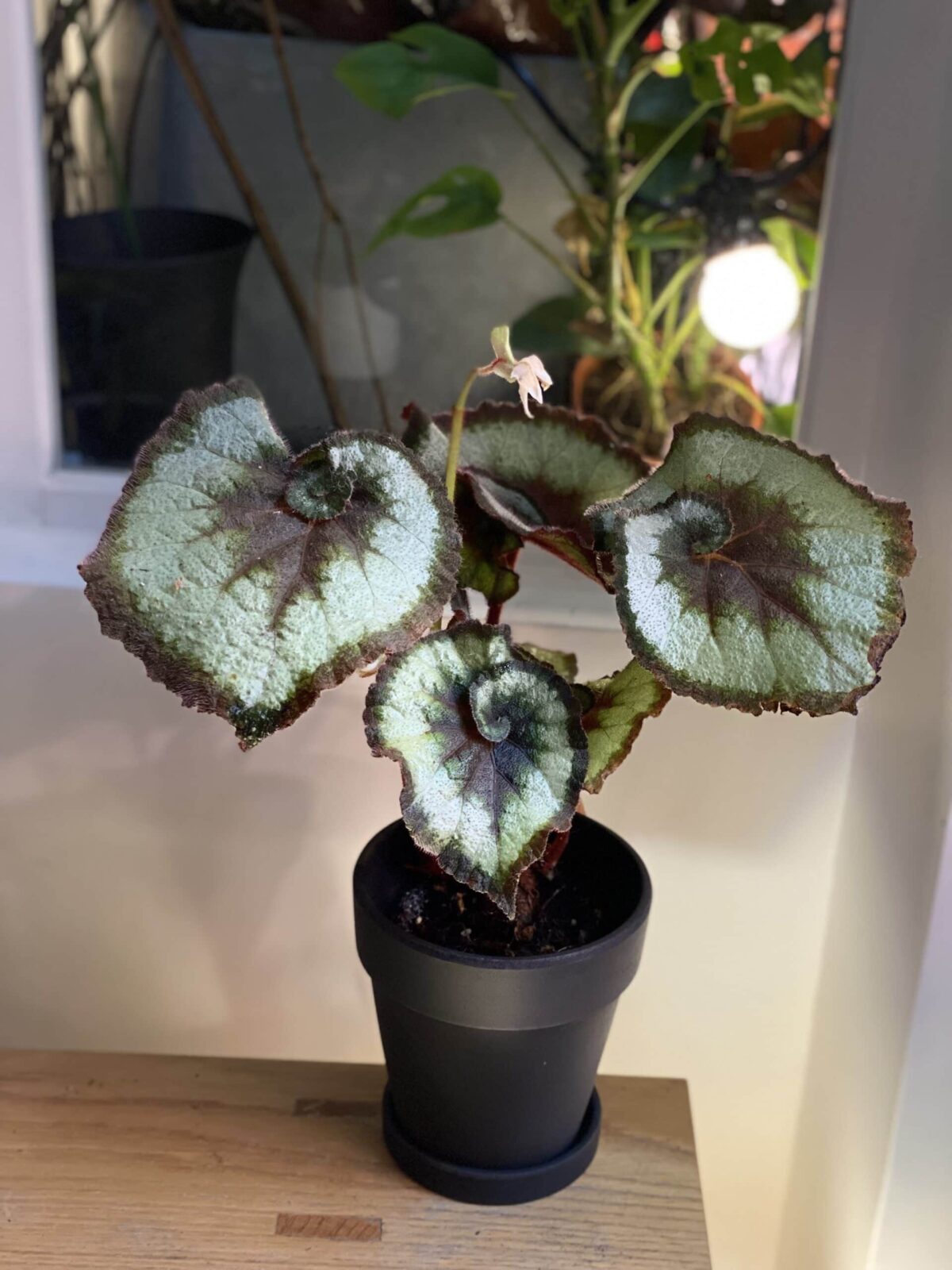
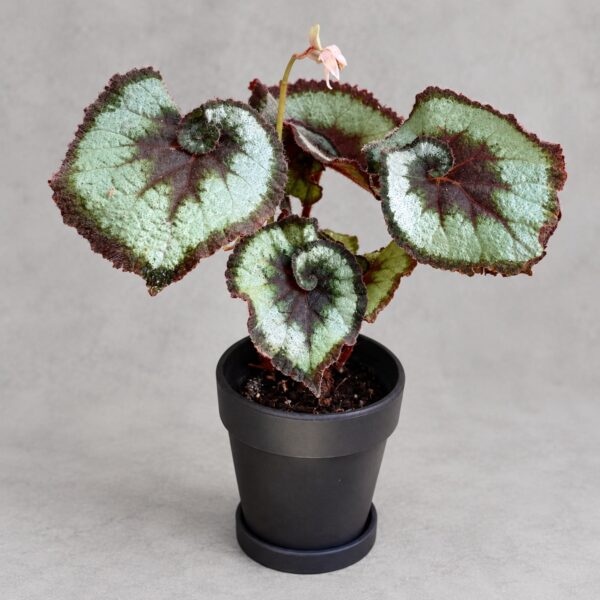
Shop this plantLeaves spiral like a snail shell, in gorgeous silver-green patterning — one of the most beloved cultivars in the Rex Begonia family.
Origin & characteristics
'Escargot' is a classic cultivar within the Begonia rex group, with B. rex itself native to the subtropical mountains of India, Nepal, and China's Yunnan province. "Escargot" is French for "snail," describing the leaf's distinctive spiral shape, curling inward from the centre outward. The leaf surface has a silvery-white base overlaid with olive-green and deep reddish-brown concentric rings, creating a strikingly ornate pattern. The plant grows to a medium size, with a spread of 30–40 cm, and its plush, velvety leaf texture makes it a favourite accent plant among interior designers.
Light
- Prefers bright, diffused light; an east- or north-facing windowsill is best
- Ample light makes the silver patterning more vivid
- Avoid harsh midday sun, which easily scorches and blemishes the velvety leaves
Watering
- Water once the topsoil is dry about 2–3 cm down; avoid waterlogging and root rot
- Avoid wetting the leaves — moisture on the velvety surface easily leads to fungal infection
- Extend the watering interval to 10–14 days once growth slows in winter
Soil & pot
- Needs a well-draining, slightly acidic soil
- Recommended recipe: peat, perlite, and coarse sand in a 3:1:1 ratio
- Choose a pot with drainage holes — Rex Begonia's delicate roots are especially prone to waterlogging
Temperature & humidity
- Optimal temperature 18–24°C; growth slows above 28°C
- Not cold-hardy; keep above 13°C in winter
- Humidity of 50–70% is ideal; a humid tray (with the pot base not touching the water) can help
Common problems
| Issue | Likely cause | What to do |
|---|---|---|
| Leaves going soft and rotting | Overwatering or poor drainage | Stop watering immediately, check roots, repot and trim rotten sections if necessary |
| Leaf colour fading, losing lustre | Insufficient light or lacking nutrients | Adjust position, feed diluted foliage plant fertiliser every two weeks during growth |
| Scorched leaf edges | Air too dry or water too hard | Increase humidity, switch to rainwater or distilled water |
| Legginess, stretched petioles | Severe light deficiency | Gradually move to a brighter position |
How to explain to customers
"Escargot Begonia has such a distinctive look — the leaves curl up like a snail shell, and putting it in the living room instantly upgrades the whole space!"
"The most important thing with Rex Begonias is never letting them sit waterlogged — let it dry out first before watering, since it would rather be a bit dry than have soggy roots."
Fun facts
'Escargot's spiral leaf shape is believed to have come from horticulturists selectively breeding and intensifying the naturally twisting leaf tendency already present in Begonia rex — it's not a genetically modified trait, but a beautiful result of traditional breeding techniques.
Keywords
Escargot Begonia, Begonia rex Escargot, Escargot Begonia, Rex Begonia, spiral begonia, foliage plant, indoor plant, decorative plant, Hong Kong care, popular cultivar
In-depth care guide
One-line pitch
Leaves spiralling upward like a snail's shell, silver-green interwoven with a wine-red edge — the most artistic cultivar in the entire begonia family, instantly elevating any indoor space.
Origin & characteristics
Escargot Begonia (Begonia rex 'Escargot') belongs to the family Begoniaceae, genus Begonia. The genus is one of the most diverse in the plant kingdom, with over 2,000 recognised species distributed across tropical and subtropical regions worldwide. 'Escargot' belongs to the Begonia rex lineage (also known as Rex Begonia or Painted-Leaf Begonia), a group renowned for its extraordinarily decorative foliage, with the original species native to the subtropical regions of Southeast Asia.
Cultivar history
The horticultural history of Rex Begonia dates back to the mid-19th century. In 1858, the native begonia Begonia rex from Assam, India was introduced to Britain, and its striking metallic-sheened leaves immediately caused a sensation in horticultural circles. Over the following century and more, breeders created thousands of Rex Begonia cultivars through repeated crossing, with 'Escargot' standing as one of the most representative classics among them.
'Escargot's French name means "snail," perfectly describing its leaf's spiral shape curling from the centre outward — a striking resemblance to a snail shell viewed from above. Each leaf can reach 10–15 cm in diameter, with a silver-green base colour and deep green to wine-red patterning tracing the main veins and spiral pattern, and the edges typically finished in a deep purple-red, creating an overall effect with tremendous dimensionality and artistic quality.
Rhizome characteristics
Rex Begonia is a rhizomatous begonia, with a horizontally creeping, fleshy rhizome at the plant's base. This rhizome spreads horizontally over time, which is why B. rex needs a wide, shallow pot rather than a deep one. The rhizome is extremely prone to rot — once left in waterlogged conditions for an extended period, it can begin softening and rotting within 48 hours, which is the greatest risk in growing 'Escargot'.
Growth habits
- Mature size: typically maintained at 20–30 cm tall, 30–40 cm wide indoors
- Growth rate: moderate, faster in spring and summer, slowing in autumn and winter
- Lifespan: can survive for many years with proper care, with the rhizome enlarging year on year
- Flowering: mature plants may send up slender flower stalks in spring, producing small pink or white flowers. Though inconspicuous, they're a sign of good health.
Light
'Escargot' needs ample bright, diffused light to maintain vivid leaf colour, but must never receive direct sun.
Practical recommendations
- Ideal light level: bright, diffused light, roughly 800–1,500 lux. An east-facing windowsill is ideal — receiving gentle morning sun with no direct exposure after midday.
- Avoid direct sun: intense direct sun will scorch the leaves within hours, causing brown burn patches on the silver areas. Summer midday sun is particularly dangerous.
- Effects of low light: insufficient light causes the silver patterning to fade and the spiral texture to blur, with internodes elongating and the plant becoming loose, losing its compact, elegant form.
- Hong Kong practicalities:
- East-facing windowsill: ideal, usually fine placed directly on the windowsill
- South- or west-facing: keep 1–1.5 metres from the window, or filter with a sheer curtain
- North-facing: may provide enough light in Hong Kong summer, but likely too dim in winter — supplement with a grow light
- AC environments: avoid placing directly in AC airflow, since cold air causes leaf edges to dry out
Watering
'Escargot's watering rule is "let it dry, then water thoroughly" — never keep it consistently damp. The rhizome is extremely sensitive to waterlogging.
Practical recommendations
- Finger test: insert your index finger about 2.5–3 cm (roughly 1–1.5 inches) into the soil. If it feels dry with no moisture, water; if still slightly damp, wait another 2–3 days.
- Frequency: generally every 5–9 days, depending on season, pot size, and ambient humidity. Roughly every 5–6 days in summer; every 8–10 days or longer in winter.
- Watering method: water slowly along the pot's edge until it flows from the base, then empty the saucer within 15 minutes. The rhizome must never sit in standing water for long.
- Water quality: filtered water, rainwater, or tap water left standing overnight is recommended. Highly chlorinated or fluoridated tap water can gradually cause leaf tip browning. A TDS meter can help — if total dissolved solids exceed 75 ppm, switch to filtered water.
- Seasonal adjustment:
- Spring/summer (growing season): check every 5–7 days, water when dry
- Autumn/winter (slower growth): check every 7–10 days, and let the soil dry deeper than in summer before watering
- Absolute no-nos:
- Never use a self-watering pot — the rhizome will rot from constant moisture
- Never bury the rhizome too deep — the rhizome top should sit at or slightly above the soil surface, with partial exposure helping prevent rot
Soil & pot
Drainage speed is the key to 'Escargot's long-term survival. The soil must be loose and breathable, draining quickly while retaining moderate moisture.
Recommended soil mixes
- Recipe A (standard): peat or coco coir 40% + perlite 30% + fine orchid bark 20% + vermiculite 10%. NC State Extension and multiple horticultural resources recommend a light, breathable peat- or coir-based mix.
- Recipe B (Hong Kong humid-climate version): increase perlite to 40%, reduce peat to 30%, add 10% volcanic rock, to speed up drainage in response to Hong Kong's high humidity.
- Recipe C (rhizome-specific version):
- 40% quality coco coir or aged peat moss (pH 5.5–6.2)
- 30% horticultural perlite (avoid "alternatives")
- 20% fine orchid bark (¼–⅜ inch pieces)
- 10% worm castings (avoid compost or manure — too concentrated and unstable)
Materials to avoid entirely
- Garden soil (compacts, carries pathogens, restricts oxygen diffusion)
- Vermiculite (retains too much water and breaks down into a mud-like consistency over time)
- Uncomposted wood chips (the decomposition process robs nitrogen from the soil)
- "Moisture-control" potting mixes (contain water-absorbing gel beads that swell into a clogging, gelatinous mass)
Pot selection
- Wide, shallow pot: the rhizome grows horizontally, needing more lateral than vertical space. Choose a pot roughly 15–20 cm in diameter and 10–12 cm deep.
- Must have drainage holes: at least 3 holes. If there's only one small hole, drill a few more yourself.
- Material:
- Terracotta: best airflow, dries fastest, the top choice for growing Rex Begonia
- Glazed ceramic or plastic: retains more moisture, requiring stricter drainage control in the soil (increase perlite ratio)
- Planting depth: plant the rhizome very shallow, with the rhizome top sitting at the soil surface or covered by only a thin layer of soil. Burying it too deep is the most common cause of rhizome rot.
Temperature & humidity
Temperature
- Ideal range: 18–24°C (65–75°F)
- Minimum tolerance: about 15°C; prolonged exposure below this stalls growth, and leaves may soften and yellow
- Maximum tolerance: about 28°C, but high heat must be paired with high humidity, or the leaves will rapidly dehydrate and curl
- Hong Kong practicalities: indoor AC maintaining 24–26°C suits this plant very well. But avoid AC vent airflow — cold drafts dry out the leaf edges. If indoor temperatures drop below 15°C in winter, move to a warmer spot.
Humidity
- Ideal humidity: 50–70% RH. Below 45%, leaf edges dry out and curl; above 85% invites powdery mildew.
- Hong Kong practicalities: Hong Kong's average annual humidity is around 70%, reaching 90% in summer, so extra humidification usually isn't needed. But summer AC use can cause a sharp drop in indoor humidity, so pay attention to:
- Grouping method: place 'Escargot' with other humidity-loving plants; their collective transpiration raises local humidity
- Pebble tray: place on a pebble tray with water (ensure the pot base doesn't touch the water)
- Humidifier: an ultrasonic humidifier placed about 1 metre away, maintaining 60–70% RH
- Never mist the leaves: water sitting on the leaves long-term invites powdery mildew and grey mould (botrytis). Raising ambient humidity is the correct approach instead.
- Ventilation is essential: high humidity must be paired with good air circulation. Stagnant, warm conditions are a breeding ground for fungal disease.
Fertilising
'Escargot' is a light feeder. Excess nitrogen fertiliser causes leaf colour to fade (the silver patterning diminishes) and promotes leggy growth.
- Growing season (April–September):
- April–June: apply a balanced liquid fertiliser (such as 10-10-10 or 20-20-20) every 4 weeks, diluted to half strength
- July–September: switch to a low-nitrogen formula (such as 1-2-2 or 0-10-10), diluted to ¼ strength, every 4–6 weeks. Lower nitrogen promotes potential flowering and strengthens the plant
- Timing: fertilise when the soil is slightly moist, never on dry soil
- Winter (October–March): stop fertilising entirely. Low temperatures and light reduce root nutrient absorption, so fertilising only causes salt buildup
- Regular flushing: during the growing season, flush the soil thoroughly with clean water (roughly 3 times the pot volume) every two months to remove accumulated fertiliser salts, which can burn tender roots and leaf edges
Pruning & propagation
Pruning
- Pinching to encourage branching: if the plant becomes loose or leggy, pinch the stem tip (cutting just above a leaf node) in spring or early summer to stimulate side shoot growth, creating a more compact form
- Remove dead leaves: promptly trim yellowed or damaged leaves to reduce pest and disease risk
- Don't prune healthy green leaves: every green leaf is photosynthesising and supporting new growth
Propagation
'Escargot' is primarily propagated through leaf cuttings or rhizome division:
Leaf cutting propagation (the classic Rex Begonia method):
- Select a healthy, mature leaf and cut it off with the petiole attached
- Make several light cuts along the main veins on the underside (or cut wedge-shaped pieces at vein junctions)
- Lay the leaf flat on moist propagation soil, securing it with U-shaped pins or hairpins to keep the cuts in contact with the soil
- Keep the soil moist and humidity high (cover with a plastic bag or place in a propagation box), in bright, diffused light
- New plantlets emerge from the cut points after about 4–8 weeks
Rhizome division:
- When repotting in spring, cut the rhizome into several sections, each with at least one growth point
- Let the cut ends air-dry for 1–2 hours, then plant shallowly in fresh soil
- Keep the soil lightly moist; new shoots emerge after about 2–3 weeks
Common problems
| Issue | Likely cause | What to do |
|---|---|---|
| White powdery coating on leaves | Powdery mildew (Erysiphe or Oidium fungi), from high humidity and poor ventilation | Trim badly affected leaves immediately, improve ventilation, spray with fungicide if needed |
| Grey fuzzy coating followed by rot | Grey mould (Botrytis cinerea), from low temperature, high humidity, and poor ventilation | Trim affected sections, reduce humidity, increase air circulation |
| Browning, dry, curling leaf edges | Humidity too low, soil drying too fast, or water too hard | Increase humidity, switch to filtered water, check watering frequency |
| Soft, rotten, foul-smelling rhizome | Overwatering, rhizome buried too deep, or poor pot drainage | Dig out and check the rhizome, trim away rotten sections, replant shallowly in fresh soil |
| Fading leaf colour, diminished silver patterning | Insufficient light or excess nitrogen fertiliser | Move to a brighter position, pause fertilising for 4 weeks |
| Elongated internodes, loose growth | Severe light deficiency | Move to a brighter position, combine with pinching to encourage branching |
| White cottony masses on leaf undersides or stems | Mealybugs | Wipe individually with a cotton swab dipped in 70% isopropyl alcohol, every 5 days for 3 treatments |
How to explain to customers
"Escargot Begonia is one of the most beautiful cultivars in the whole begonia family — the leaf spirals like a snail shell, and the silver-green with a wine-red edge is stunning. The most important thing is good drainage — don't water too often, let the soil dry out a bit first. When planting, the rhizome should sit slightly proud of the soil, not buried too deep. Hong Kong summer humidity is usually plenty, but if you're running AC, keep it further away so the cold air doesn't hit the leaves directly."
Fun facts
The genus name Begonia honours a French governor
The genus name Begonia commemorates Michel Bégon (1638–1710), the 18th-century governor of French Saint-Domingue (now Haiti). Bégon himself wasn't a botanist, but a nobleman and official with a passion for natural history. French botanist Charles Plumier collected an unknown plant in the Caribbean and, to honour his patron Bégon, named the genus Begonia in his memory. The name has been used ever since Linnaeus formally published it in Species Plantarum in 1753, now covering over 2,000 species.
Rex Begonia's "metallic sheen" comes from specialised cell structures
The silver, copper, or metallic sheen on Rex Begonia leaves doesn't come from pigment, but from a specialised cell structure beneath the leaf's epidermis — sometimes called "iridescent cells" or thickened cell wall regions. These structures produce a metallic effect through light interference and reflection. This kind of structure is relatively uncommon in nature, with similar phenomena seen on the wings of certain tropical butterflies. So it's fair to say 'Escargot's leaves genuinely "glow with their own light."
The genus Begonia's "unisexual flower" strategy
All begonias are monoecious, meaning the same plant bears both male and female flowers, but each individual flower is single-sex. This strategy enables cross-pollination, increasing genetic diversity in offspring. More interestingly, begonia male flowers are typically showier than female ones (larger petals, brighter colours), a strategy to attract pollinating insects — insects are drawn in by the attractive male flowers first, then incidentally carry pollen to the more modest nearby female flowers.
'Escargot' is actually a "veteran"
Although 'Escargot' remains extremely popular today, it actually has decades of history behind it. Among the thousands of Rex Begonia cultivars, very few have remained widely grown for decades — 'Escargot' is one of them. Its success comes from having a distinctive, stable leaf shape (many Rex Begonia cultivars vary dramatically in leaf colour depending on conditions) and being relatively easy to care for (by Rex Begonia standards). Experienced begonia growers often recommend 'Escargot' as a starting point for newcomers to the Rex Begonia world, since it's more forgiving of small care mistakes than most other cultivars.
Keywords
Begonia rex Escargot, Escargot Begonia, Rex Begonia, painted-leaf begonia, rhizomatous begonia, ornamental begonia, spiral leaf plant, Hong Kong indoor plant, begonia care, Plantjai begonia
參考資料(想知來源可展開)
References
- NC State Extension. "Rex Begonia." NC State University Extension Gardener Plant Toolbox. https://plants.ces.ncsu.edu
- Growli. "Escargot Begonia (Begonia rex-cultorum 'Escargot') care guide." GetGrowli, 2026. https://www.getgrowli.app/plant-care/begonia-escargot
- Anoka County Master Gardeners. "Rex Begonia Relationship Advice." University of Minnesota Extension, 2025. https://anokamastergardeners.org/gardening-articles/rex-begonia-relationship-advice
- Grow Tropicals. "Begonia – Frequently Asked Questions." https://growtropicals.com/collections/begonia
- RHS. "Begonia rex." RHS Plant Finder. https://www.rhs.org.uk/plants
- ASPCA. "Rex Begonia Toxicity to Dogs, Cats and Horses." https://www.aspca.org/pet-care/animal-poison-control/toxic-and-non-toxic-plants
- Tebbitt, M.C. (2005). Begonias: Cultivation, Identification, and Natural History. Timber Press, Portland, Oregon.
⚠️ Toxicity/pet warning: Escargot Begonia (Begonia rex) is toxic to cats and dogs and is explicitly listed as toxic by the ASPCA. The toxic component is soluble calcium oxalates, concentrated mainly in the rhizome and roots. Ingestion can cause oral burning, excessive drooling, vomiting, and difficulty swallowing. The rhizome carries the highest toxicity and must be kept completely out of pets' reach. It's also irritating to humans — wash your hands after handling the rhizome and avoid contact with your eyes.
Plantjai shop · In stock online
Begonia rex 'Escargot'
Begonia rex 'Escargot'
HK$168.00
Hong Kong delivery · Causeway Bay pickup
For Hong Kong homes and offices. Stock and pricing follow the product page.
IN STORE NOW
Plants for this guide
Related plants in stock now — live prices, delivery or Causeway Bay pickup.
FREE PLANT ADVICE
Send us a photo before you change anything
WhatsApp a photo of the plant and your window light. Our Causeway Bay team will suggest care steps or plants that suit your space.
STORE · CAUSEWAY BAY
4/F, 39 Yiu Wa Street, Causeway Bay
Daily 12:30–8:00pm · ~3 min walk from Times Square
Map & directionsPlant Care