
How to Care for Begonia Dolce Vita in Hong Kong | Plantjai


Plantjai 植仔 · Care Encyclopedia
Begonia Dolce Vita
Hong Kong care guide — useful before you buy and after it arrives.
Shop this plantSpiralling heart-shaped leaves with a silver shimmer — a luxurious pick for indoor plant lovers.
Origin & characteristics
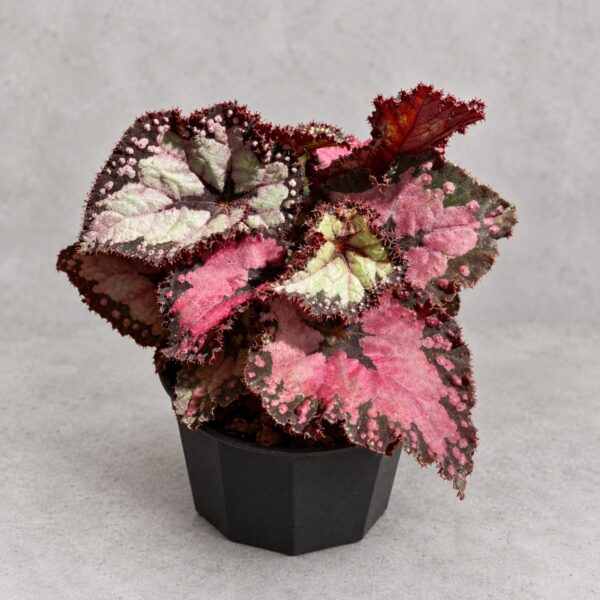
Bred by Ukrainian breeder Elena Enikeeva, Dolce Vita is a Rex Begonia hybrid that won the "Hybrid of Distinction" award from the American Begonia Society. Its heart-shaped leaves grow in a spiral arrangement, with a deep olive-green to wine-red base colour accented by silver or metallic-sheened patterning, edged in deep red — the colours subtly shift depending on the light angle, giving the leaves remarkable visual depth.
Light
- Ideal placement: east- or north-facing windowsill, or 1–2 metres from a south-facing window
- Light intensity: bright indirect light
- Notes: avoid direct sun, which will fade or even scorch the leaves; insufficient light causes the silver patterning to dull
Watering
- Frequency: water once the top 2 cm of soil has dried, roughly every 7–10 days
- Method: water slowly along the pot's edge until it flows from the drainage holes; avoid wetting the leaves
- Notes: keep the soil lightly moist but never waterlogged; reduce watering in winter as growth slows, erring on the dry side
Soil & pot
- Soil recipe: a light, well-draining peat-based mix — peat moss, perlite, and bark in roughly a 3:1:1 ratio
- Pot selection: must have drainage holes; a wide, shallow pot suits the horizontally spreading rhizome
- Repotting timing: once every 1–2 years, ideally in spring
Temperature & humidity
- Ideal temperature: 18–26°C; not cold-hardy — below 10°C the plant may enter dormancy or suffer cold damage
- Humidity requirement: 50–70% is ideal
- Humidification methods: place near a humidifier, group with other plants, or use a pebble tray
- Avoid: placing near AC vents or heaters; avoid misting directly onto leaves, which can cause fungal issues
Common problems
| Issue | Likely cause | What to do |
|---|---|---|
| Dry, brittle leaf edges | Air too dry | Increase surrounding humidity, avoid AC or heater vents |
| Dull colour, fading silver patterning | Insufficient light | Move to a brighter, diffused-light position |
| Soft, rotting leaves | Overwatering | Reduce watering frequency, check pot drainage |
| Powdery mildew (white powder on leaves) | Poor ventilation, prolonged leaf moisture | Improve ventilation, remove affected leaves, use an organic fungicide if needed |
| Slow growth | Temperature too low or nutrient deficiency | Ensure stable temperature, fertilise appropriately during the growing season |
How to explain to customers
"Dolce Vita is an award-winning cultivar from a Ukrainian breeder — the silver flecking shifts with the light, so elegant in any home! It's easy to care for, just keep it in diffused light, never direct sun. For watering, wait until the topsoil is dry before watering — too much moisture leads to root rot."
Fun facts
"Dolce Vita" is Italian for "the sweet life," a perfect description of the visual pleasure this plant brings. This cultivar won the "Hybrid of Distinction" award at an American Begonia Society national show, cementing its status as a star performer in the Rex Begonia world.
Keywords
Dolce Vita Begonia, Begonia, Rex Begonia, award-winning cultivar, spiral leaves, silver patterning, heart-shaped leaves, foliage plant, indoor plant, Hong Kong plant, toxic plant, Ukrainian breeding, Plantjai
參考資料(想知來源可展開)
References
- Begin With Plants. Begonia Dolce Vita for Sale. https://beginwithplants.com/products/begonia-dolce-vita
- RHS. Begonias as Houseplants. https://www.rhs.org.uk/plants/begonias/houseplants
- Logee's. Rex Begonia Propagation & Care Guide – Easy Methods. https://www.logees.com/blogs/growing-tips/grow-rex-begonias
- University of Connecticut. Rex Begonia. https://homegarden.cahnr.uconn.edu/factsheets/rex-begonia/
⚠️ Toxicity warning: Begonias contain calcium oxalate crystals throughout. Ingestion may cause oral pain and vomiting — keep out of reach of infants and pets.
In-depth care guide
Introduction
Dolce Vita Begonia is a striking Rex Begonia hybrid bred by Ukrainian horticulturist Elena Enikeeva in 2020, taking its name from the Italian phrase meaning "the sweet life" — a fitting description for the visual pleasure and gardening joy this cultivar brings its owners. What makes Dolce Vita truly remarkable is its leaf design: heart-shaped leaves display a gradient of colour, transitioning from deep olive green or wine-red through to silver or metallic sheen, with subtle colour shifts visible as the viewing angle or light changes, giving the plant an almost shape-shifting quality. The deep green base colour is paired with a striking dark red edge and silver patterning, while the spiral arrangement of the leaf surface adds further dimension and texture, making it a genuine focal point in any space.
Notably, Begonia 'Dolce Vita' won the "Hybrid of Distinction" award at an American Begonia Society national show, a recognition that speaks to both its exceptional aesthetic value and its horticultural significance. For collectors drawn to distinctive, award-recognised cultivars, owning a 'Dolce Vita' is genuinely something to be proud of.
Like other Rex begonias, 'Dolce Vita' is a rhizomatous begonia, with a thick rhizome that spreads horizontally along the soil surface, producing individual ornate leaves from growth points along its length. The genus Begonia is one of the largest genera of flowering plants, with over 2,000 species distributed across the tropical and subtropical regions of Africa, Asia, and the Americas.
Light requirements
Dolce Vita needs bright, diffused light to display its best leaf colour. Direct sunlight should always be avoided, since strong light damages the vivid colouring that makes this cultivar special. An east- or west-facing window is ideal, providing ample ambient light without harsh direct exposure.
If a south-facing window is your only option, position the plant several feet back from the glass, or filter the light through a sheer curtain. North-facing windows may provide slightly insufficient light for Rex Begonias, causing dull colouring — consider supplementing with a grow light in this case. Rex Begonias can adapt to somewhat lower light conditions, but their colouring is most vivid when they receive consistent, bright light.
Signs of insufficient light include pale leaf colour, fading patterns, smaller new leaves, and weak, elongated stems. Dolce Vita's signature gradient colouring and metallic sheen are most pronounced under adequate bright light, so providing proper illumination is essential to appreciating this cultivar's full beauty.
Temperature and humidity
Dolce Vita prefers a stable temperature environment, ideally between 15°C and 24°C. It suits typical indoor temperatures well, making it comfortable in both home and office environments. It's quite sensitive to cold — never let it drop below 10°C, and avoid cold drafts and sudden temperature changes. Keep it away from AC vents, heating vents, and frequently opened doors and windows.
For humidity, 'Dolce Vita' prefers moderate levels. Occasional misting or a humidity tray can help raise ambient humidity, particularly in drier spaces. Ideal humidity is 50–70%, though it can adapt to the 40–50% humidity typical of many homes.
Good ways to raise humidity include grouping multiple plants together (their combined transpiration creates a more humid microclimate), using a pebble humidity tray (fill a tray with pebbles, add water below the pebble surface, and set the pot on top without the base touching the water), or using a humidifier. It's worth noting that while Rex Begonias enjoy humidity, misting water directly onto the leaves is not recommended, since wet leaves easily trigger fungal diseases like powdery mildew.
Watering technique
Dolce Vita's root system is very fine and delicate, making it easy to develop root rot from overwatering. As a rule, it's better to underwater slightly than overwater. Keep the soil evenly moist while ensuring good drainage to prevent root rot, watering once the topsoil has dried.
The correct approach is to water once the top inch of soil has dried, watering thoroughly until water drains from the pot's bottom, then discarding any standing water in the saucer. In winter, reduce watering and wait until the topsoil dries before watering again. During the growing season (spring through autumn), check soil moisture every few days; in winter, as the plant enters dormancy and growth slows, it needs less water. Always use room-temperature water — cold water shocks the roots.
A useful technique is growing Rex Begonias in terracotta pots, since their breathability helps soil dry out faster, reducing waterlogging risk. Avoid decorative pots without drainage holes — if you love a particular pot that lacks drainage, plant the begonia in a pot with holes and place that inside the decorative pot as a cachepot.
Soil recipe
Dolce Vita needs a light, well-draining, well-aerated soil. Its rhizome grows horizontally along the soil surface with fine roots that need ample airflow — dense, waterlogged soil will suffocate and rot the roots.
Potting mix designed for African violets is often recommended, since its drainage and moisture retention properties suit Rex Begonias' needs well. If mixing your own soil, try this recipe:
- 2 parts peat moss or coco coir
- 1 part perlite (improves aeration and drainage)
- 1 part orchid bark or coarse sand
For pots, choose shallow, wide containers (commonly called "African violet pots" or "bulb pans"), since Rex Begonia rhizomes prefer to spread horizontally rather than growing deep roots. Standard tall pots cause excess water to pool at the bottom, increasing root rot risk. When the rhizome reaches the pot's edge, it's time to repot or propagate a new plant.
Feeding
Dolce Vita needs regular feeding during the growing season (spring through early autumn). A high-nitrogen fertiliser is recommended since we're primarily appreciating the foliage rather than flowers, and nitrogen supports leaf growth. Apply a balanced liquid fertiliser diluted to half the recommended strength every 2–3 weeks.
An even gentler approach uses quarter-strength water-soluble fertiliser every 2–3 weeks. Remember that Rex Begonias are light feeders — overfertilising causes leaf tip burn and salt buildup in the soil.
Stop feeding after autumn arrives, letting the plant rest during winter dormancy. Resume feeding when new growth appears in spring. If you notice browning leaf tips with normal humidity, check whether you may be overfertilising.
Propagation
One of the most interesting aspects of Dolce Vita is how easily and distinctively it propagates. The main methods include:
Leaf cutting propagation (most common)
This is the classic Rex Begonia propagation method. Select a healthy, mature leaf and cut it with a 2–6 inch petiole attached. Dip the petiole in rooting hormone, then insert it into moist propagation medium, ensuring the leaf blade itself doesn't touch the soil. In low-humidity environments, cover with a clear plastic bag or wrap, leaving a small ventilation gap. Keep at 21–24°C in bright, diffused light — new plantlets will emerge from the base of the petiole in about 12 weeks. Once each new shoot has 2–3 leaves, they can be separated and potted individually.
Vein cutting method (most leaf-efficient)
If you want to propagate multiple plants from a single leaf, try the vein cutting method. Select a healthy, mature new leaf, and use a sharp blade to gently cut through the main veins on the leaf's underside, spacing cuts roughly 2.5 cm apart. Place the leaf face-up on moist, soilless propagation medium, securing it with U-shaped pins or a light weight to ensure the cut points make good contact with the soil. Under warm (18–24°C), high-humidity, bright but indirect light conditions, tiny new plantlets will emerge from the cut points within a few weeks. Once they have 2–3 leaves, transplant into 7 cm pots.
Rhizome division
As the plant matures and the rhizome spreads horizontally, division can be done in spring. Ensure each rhizome segment has a growth point and roots before separating and potting.
Repotting timing
Dolce Vita generally doesn't need frequent repotting — it actually grows better when slightly snug in its pot. When the rhizome starts pressing against the pot's edge, or roots emerge from the drainage holes, it's time to consider repotting or propagation. The best time is spring, as the plant enters active growth. Use fresh, light, well-draining soil, choosing a pot only slightly larger than before, in a shallow, wide style.
It's worth noting that Rex Begonias often start to decline in appearance after a few years in cultivation, so regularly propagating new plants via leaf cuttings to refresh your collection is a good habit.
Common problems in detail
Browning leaf edges are usually caused by humidity too low or water too hard. Use rainwater or distilled water, and raise ambient humidity via a pebble tray or humidifier.
Winter leaf drop is normal dormancy behaviour and nothing to worry about. Reduce watering and stop fertilising, letting new growth emerge naturally in spring.
Pale or fading leaf colour results from insufficient light. Move the plant to a brighter position, avoiding direct sun. Dolce Vita's signature gradient colour and metallic sheen need ample bright, diffused light to display properly.
Powdery mildew (white powdery coating on leaves) is a fungal disease triggered by poor air circulation or excess humidity. Improve ventilation and avoid wetting the leaves. A preventive spray of 1 tablespoon baking soda, 3 drops mild liquid soap, and 1 gallon of water can be applied every 10–14 days.
Root rot results from overwatering or poor drainage. Let the soil dry out somewhat between waterings and ensure the pot has drainage holes.
Pests occasionally affect Rex Begonias, including whitefly, aphids, scale, or spider mites. Check the plant regularly, and address infestations promptly with alcohol swabs for whitefly, or insecticidal soap and neem oil sprays for other pests. Keeping leaves clean and removing dead foliage is the best prevention.
Toxicity information
All begonias contain soluble oxalates, mildly toxic to both pets and humans, concentrated mainly in the roots and tubers. Ingestion causes oral irritation, drooling, and gastrointestinal upset. Keep the plant out of reach of curious pets or children.
References
- Begin With Plants. Begonia Dolce Vita for Sale. https://beginwithplants.com/products/begonia-dolce-vita
- Happy Forest Store. Begonia Dolce Vita for Sale. https://happyforest.store/product/begonia-dolce-vita/
- RHS. Begonias as Houseplants. https://www.rhs.org.uk/plants/begonias/houseplants
- Logee's. Rex Begonia Propagation & Care Guide – Easy Methods. https://www.logees.com/blogs/growing-tips/grow-rex-begonias
- University of Connecticut. Rex Begonia. https://homegarden.cahnr.uconn.edu/factsheets/rex-begonia/
Plantjai shop · In stock online
Begonia 'Dolce Vita'
Begonia 'Dolce Vita'
HK$268.00
Hong Kong delivery · Causeway Bay pickup
For Hong Kong homes and offices. Stock and pricing follow the product page.
IN STORE NOW
Plants for this guide
Related plants in stock now — live prices, delivery or Causeway Bay pickup.
FREE PLANT ADVICE
Send us a photo before you change anything
WhatsApp a photo of the plant and your window light. Our Causeway Bay team will suggest care steps or plants that suit your space.
STORE · CAUSEWAY BAY
4/F, 39 Yiu Wa Street, Causeway Bay
Daily 12:30–8:00pm · ~3 min walk from Times Square
Map & directionsPlant Care