
How to Care for Alocasia Silver Dragon in Hong Kong | Plantjai

Plantjai 植仔 · Care Encyclopedia
Alocasia Silver Dragon
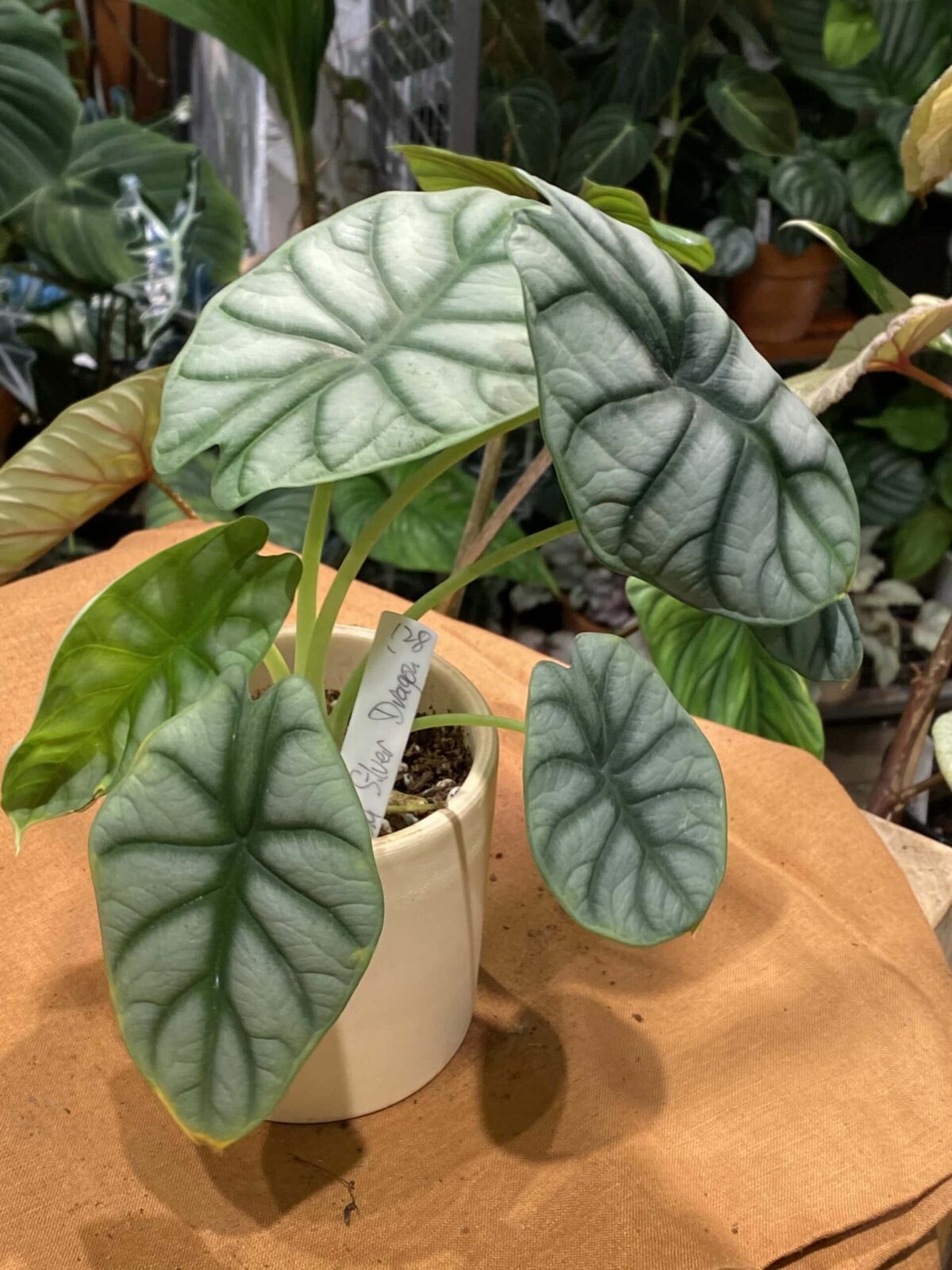
Alocasia 'Silver Dragon' 白犀牛海芋
Hong Kong care guide — useful before you buy and after it arrives.
Shop this plantSilver-grey armour plating veined in deep green — a jewel Alocasia that looks like it walked out of a fantasy film.
Origin & characteristics
Silver Dragon Alocasia is a select cultivar of Alocasia baginda, native to the rainforest floor of East Kalimantan, Borneo. Its thick, heart-shaped leaves have a distinctive bullate (bumpy) texture, with silver-grey surfaces veined in deep green, giving the overall impression of dragon scale armour — genuinely sci-fi in feel. Compared to its close relative Dragon Scale, Silver Dragon runs noticeably more silvery-white in tone and is the rarer of the two. Mature plants reach roughly 30–60 cm, staying compact and well suited to indoor spaces.
Light
Loves bright, indirect light, with east- or north-facing windows ideal. The silver leaf surface becomes even more luminous with good light, sharpening the contrast against the deep green veining. Avoid direct sun — although the thick leaves are fairly tough, prolonged direct exposure will fade the colour or even scorch it. If kept in a plant cabinet, supplemental LED lighting helps maintain leaf colour.
Watering
Wait until the top 2–3 cm of soil has dried before watering — better slightly dry than wet. Silver Dragon's roots are sensitive to waterlogging, and overly wet conditions quickly lead to root rot. Cut back watering substantially in winter as growth slows, keeping the soil just lightly moist. Use room-temperature filtered water to reduce mineral buildup on the thick leaves.
Soil & pot
Needs an extremely well-draining, airy aroid mix: peat or coco coir 40%, perlite 30%, orchid bark/pine bark 20%, activated charcoal 10%. Drainage holes are essential; a layer of leca at the base helps. Plastic or ceramic pots both work, though beginners may prefer a clear orchid pot to monitor roots. This cultivar likes being slightly root-bound and doesn't need a large pot — repot roughly every 1.5–2 years.
Temperature & humidity
Ideal temperature 18–27°C; below 15°C it may enter dormancy — keep it away from AC vents in Hong Kong winters. Humidity of 60–80% is ideal; below 50%, leaf tips dry out. A humidifier, pebble tray, or grouping with other plants all help maintain the humid environment that keeps its leaf texture at its best.
Common problems
| Issue | Likely cause | What to do |
|---|---|---|
| Yellowing, soft leaves | Almost always overwatering and root rot | Stop watering immediately, check roots, trim rot, repot into fresh soil |
| Brown, crispy leaf tips | Humidity too low or hard water | Raise humidity and switch to filtered water |
| Silver colour fading to green | Insufficient light | Move closer to a window or increase supplemental light |
| Winter leaf drop and dormancy | Temperature too low or light too weak | Reduce watering, keep lightly moist — new leaves return in spring |
How to explain to customers
"Silver Dragon's leaf texture really does look like dragon scales, with that silver-grey base and dark green veining — an instant style upgrade for any room. It's not the most beginner-friendly variety though — it needs well-draining soil, high humidity, and stable temperatures, so it does reward a bit of extra attention."
Fun facts
The species epithet baginda means "your majesty" or "royal" in Indonesian, forming an informal "royal family" of Alocasia names alongside reginae (queen) and reginula (little queen). Silver Dragon's thick, bumpy leaf surface is a natural adaptation that helps it collect and retain moisture in the dim, humid conditions of the rainforest floor.
Keywords
Silver Dragon Alocasia, Alocasia Silver Dragon, Alocasia baginda Silver Dragon, dragon-scale Alocasia, jewel Alocasia, Dragon Scale, medium Alocasia, collector grade, Borneo, bright indirect light, high humidity, well-draining soil
參考資料(想知來源可展開)
References
- Plants of the World Online (Kew) — Alocasia baginda. https://powo.science.kew.org
- RHS — Alocasia care. https://www.rhs.org.uk/plants/alocasia
- Proven Winners — How to Grow Alocasia Indoors and Outdoors. https://www.provenwinners.com/learn/houseplants/alocasia
⚠️ Pet / toxicity note: Contains calcium oxalate crystals throughout the plant; ingestion causes oral pain, swelling and digestive upset. Keep away from pets and small children, and wash hands after handling.
In-depth care guide
Introduction
Silver Dragon Alocasia (Alocasia baginda 'Silver Dragon') is a popular foliage cultivar within the Araceae family, belonging to the rock-dwelling (lithophytic) group of Alocasias. Its most eye-catching trait is its silver-grey leaf, textured with a distinctive dragon-scale pattern, with deep green veins forming a striking contrast against the silvery base — the whole leaf resembles a piece of metallic art, with a genuinely futuristic, sci-fi quality.
Silver Dragon is a small-to-medium Alocasia, with mature plants typically reaching 30–50 cm and leaves 15–25 cm long — nowhere near the space demands of larger Alocasia species, making it well suited to indoor growing. It's closely related to Dragon Scale (A. baginda 'Dragon Scale'), but Silver Dragon has a paler, more silvery-white overall tone, giving it somewhat different light requirements from its darker cousin.
Native habitat
Silver Dragon Alocasia is native to lowland rainforest in Southeast Asia (primarily Borneo), growing among rocks and in rock crevices — a classic "jewel Alocasia" lithophyte. Its native environment is humid with good airflow, and the surrounding soil consists mostly of rock fragments and organic matter with extremely fast drainage. This native trait means it particularly needs a well-aerated growing medium indoors and must avoid waterlogged conditions.
Light requirements
Ideal light
Silver Dragon Alocasia likes bright, diffused light. Because its leaf colour is paler, it's theoretically somewhat more sun-tolerant than darker-leaved cultivars. Position it somewhere with plenty of diffused light, such as 1–2 m from a south- or east-facing window. A north-facing window with good ambient light also works.
Insufficient light
Too little light will dull the leaf colour, fade the silvery sheen, and may result in smaller new leaves and noticeably slower growth. Prolonged low light can also cause the plant to become leggy, with stretched stems and sparse foliage.
Avoid direct sun
Although Silver Dragon is relatively sun-tolerant, strong direct midday sun will still scorch the leaves, causing brown patches on the silvery areas. Take extra care in summer — if the light through a window is too intense, use a sheer curtain or move the plant further away.
Supplemental lighting
If your home lacks good light, consider an LED grow light. Hang it 30–45 cm above the leaf canopy, running 12–14 hours daily. A grow light not only solves the light problem but can also enhance the metallic sheen of the leaves.
Humidity management
Ideal humidity range
Silver Dragon Alocasia's native humidity reaches 80–90%; indoors, aim to maintain 60–80% relative humidity. Like other lithophytic Alocasias, it has real humidity requirements, but doesn't want water sitting on the leaf surface for extended periods.
Problems from low humidity
Dry air causes leaf edges to dry out and brown, and leaves to curl; in severe cases, it can trigger a spider mite outbreak. Spider mites reproduce extremely quickly in dry conditions and are one of Silver Dragon's biggest enemies.
Ways to raise humidity
- Humidifier: the most reliable option — use an ultrasonic humidifier to maintain 60%+ humidity
- Wet tray: place moist perlite in the saucer beneath the pot, using evaporation to raise local humidity
- Grouping plants together, raising humidity mutually
- Regular misting: mist leaves lightly in the morning, but ensure good ventilation and avoid leaving water sitting on leaves overnight
A special note
Lithophytic Alocasia leaves have a waxy protective coating; if humidity is too high combined with poor airflow, translucent water-soaked patches can appear on the leaf underside — this is actually cell rupture. High humidity should always be paired with good ventilation.
Watering technique
Watering principle
Silver Dragon's roots are extremely sensitive to moisture — among the most rot-prone of all lithophytic Alocasias. Follow the principle of "dry thoroughly, then water thoroughly" — wait until the soil is dry 3–5 cm below the surface before watering again. Don't water frequently at the first sign of dryness; lithophytic Alocasias need a longer dry-wet cycle.
Checking soil moisture
Insert a finger about one knuckle deep (3–5 cm); if it feels dry, it's time to water. Alternatively, lift the pot to gauge weight — a noticeably lighter pot suggests most of the water has evaporated. A soil moisture meter can help too.
Watering method
A "half-pot watering" technique works well: water only half the pot at a time, letting moisture naturally spread through the rest, rather than saturating the entire pot at once. This helps avoid overly wet soil, which is especially useful for lithophytic Alocasias.
Water quality
Silver Dragon is fairly sensitive to water quality; prolonged use of tap water may cause leaf discolouration or slow growth. Use:
- Rainwater (best)
- Filtered water
- Tap water rested for at least 24 hours
In winter, make sure the water isn't cold — room temperature is ideal.
Seasonal adjustment
- Spring/summer (growing season): water thoroughly once dry, roughly every 5–7 days
- Autumn/winter (dormant/semi-dormant): cut back substantially, perhaps every 10–14 days or even less
- Below 15°C: proactively stop watering and feeding, letting the plant rest
Signs of overwatering
Yellowing leaves, softening and dropping lower leaves, persistently soggy soil, and a wilted appearance despite moist soil are all warning signs of root rot. Stop watering immediately, check the roots, and repot with trimmed roots if necessary.
Soil recipe
Soil requirements
Silver Dragon needs an extremely airy, fast-draining soil, since it's native to a rocky environment and its roots are accustomed to growing in loose media. Standard potting soil is too heavy and will suffocate the roots, leading to rot.
Recommended recipe
- Coarse-grain soil (akadama/kanuma/zeolite): 40%
- Perlite: 20%
- Coco coir / coconut husk: 20%
- Peat: 10%
- Orchid bark / pine bark: 10%
This recipe has a distinctly gritty texture and excellent drainage — water should drain through within seconds of watering. If you notice the soil staying sticky and wet for a long time after watering, it needs more coarse material.
Pot selection
- Terracotta: best breathability, recommended
- Air pots: side ventilation holes improve root airflow
- Clear plastic pots: convenient for monitoring roots and soil moisture
- Avoid: overly large or deep pots, or decorative pots without drainage holes
Repotting
Silver Dragon grows fairly slowly, so repotting once every 1–2 years is sufficient. Lithophytic Alocasias don't need large pots — smaller pots that dry faster actually suit them better. When repotting, try not to disturb the existing root ball too much; simply fill in fresh soil around the edges.
Temperature requirements
Ideal temperature
Silver Dragon's ideal temperature is 20–25°C — as a tropical plant, it likes warm, stable conditions.
Minimum temperature
15°C is the warning line — growth slows noticeably below this, and below 10°C there's a real risk of frost damage. Lithophytic Alocasias are generally more cold-sensitive, so good insulation is essential in winter.
High-temperature care
In summer, above 30°C, pay attention to ventilation and humidity — high heat combined with low humidity easily triggers spider mites. If the room feels stuffy, a fan can help improve air circulation (but avoid blowing directly onto the leaves).
Temperature stability
Silver Dragon is fairly sensitive to sudden temperature changes — avoid placing it near AC vents, heaters, or doors/windows. A stable environment matters more than any specific high or low temperature.
Feeding
Timing
Late spring to early autumn (roughly April to October) is the growing season — feed with diluted liquid fertiliser every 1–2 weeks. Stop feeding once autumn/winter temperatures drop below 18°C.
Fertiliser choice
Use a balanced liquid fertiliser (such as 10-10-10 or 20-20-20), diluted to half the recommended package strength. Lithophytic Alocasias don't need much fertiliser — "little and often" is the key principle.
Slow-release fertiliser
Besides liquid feed, you can also sprinkle a small amount of general-purpose slow-release granules (such as Osmocote) on the soil surface, releasing nutrients gradually with each watering — very convenient. One application typically lasts 3–6 months.
Overfeeding
If leaves become distorted or leaf edges scorch, this may indicate fertiliser burn. Stop feeding immediately and flush the soil thoroughly with plenty of water to dilute excess fertiliser.
Pruning and daily care
Pruning
Silver Dragon doesn't need special pruning — just regularly trim away yellowed or withered old leaves to keep the plant tidy. Use clean, sharp scissors, cutting at the base of the petiole.
Leaf cleaning
Silver leaves accumulate dust easily, affecting appearance and photosynthesis. Wipe leaves gently once a month with a soft, slightly damp cloth. Avoid leaf-shine products, which damage the natural waxy coating.
New leaf care
New Silver Dragon leaves start out pale green when they first unfurl, gradually turning silver-grey as they mature — this colour change is completely normal. Keep humidity and temperature stable during new leaf development, avoiding sudden environmental changes.
Propagation
Division (most common)
Silver Dragon produces offsets at the base of the mother plant; once an offset has grown to a reasonable size (3–4 leaves or more), it can be separated during repotting.
Steps:
- Remove the plant from its pot and gently shake off soil
- Locate where the offset connects to the mother plant, and cut with a sterilised blade
- Ensure the offset retains a reasonable amount of root
- Pot separately in fresh soil, keeping lightly moist
- Place in a warm, humid environment, away from strong light
Corm propagation
Silver Dragon has underground corms; small corms around the mother plant can be collected at repotting and potted separately. They typically sprout within 4–8 weeks.
Seed propagation
Silver Dragon can flower and fruit, but this rarely happens indoors, and seed propagation is slow with a low success rate — not commonly used by hobbyists.
Common problems
Yellowing leaves
- Lower leaves yellowing: may be natural ageing — just prune away
- Multiple leaves yellowing simultaneously: usually overwatering leading to root rot
- Uniform yellowing: possibly a nutrient deficiency or insufficient light
Dry, browning leaf edges
This is a classic sign of low humidity. Increase ambient humidity, or use a humidifier to consistently maintain 60%+ humidity.
Spider mites
Common in dry air. Signs include fine yellow speckling on the leaf surface and possible webbing on the underside. Treatment: increase humidity immediately, rinse leaf undersides with water, and use a miticide spray for severe cases.
Translucent water-soaked patches on leaf underside
This is cell rupture (edema), caused by excessive humidity combined with poor ventilation. Reduce watering frequency, improve airflow, and avoid water sitting on the leaf surface.
Petioles bending downward
Usually caused by an overly hot, dry environment, or underwatering. Check soil moisture — water if dry, and increase ambient humidity.
Smaller new leaves
Could be insufficient light, inadequate nutrients, or root health issues. Check light intensity, feeding frequency, and root condition.
Toxicity information
Like all Alocasia species, Silver Dragon contains calcium oxalate crystals, toxic to both humans and pets. Ingestion causes oral burning, swelling, drooling, and vomiting. Gloves are recommended when handling the plant to avoid direct skin contact with the sap. Households with children or pets should place it out of reach.
References
- Ohio Tropics — Alocasia Silver Dragon: 7 Tips to Grow this Stunning Beauty. https://www.ohiotropics.com/2022/10/11/alocasia-silver-dragon/
- Urbane Eight — Alocasia Silver Dragon Plant Care Guide. https://urbaneeight.com/blogs/news/alocasia-silver-dragon-care-guide
- Proven Winners — How to Grow Alocasia Indoors and Outdoors. https://www.provenwinners.com/learn/houseplants/alocasia
- Plants of the World Online (Kew) — Alocasia baginda. https://powo.science.kew.org
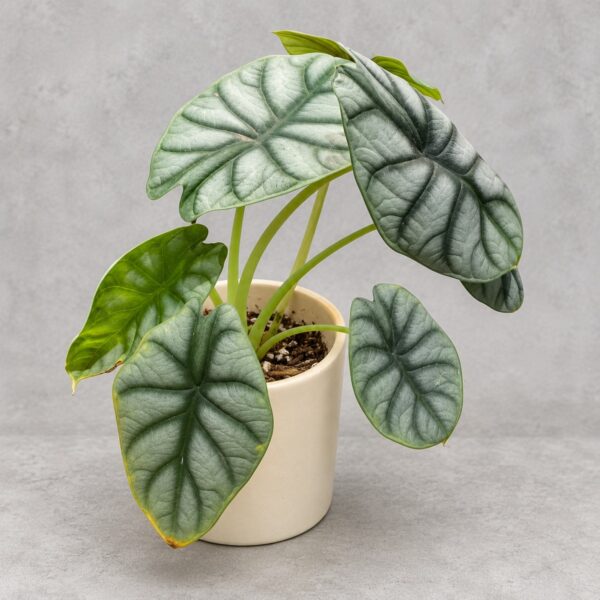
Plantjai shop · In stock online
Alocasia 'Silver Dragon'
Alocasia 'Silver Dragon'
HK$128.00
Hong Kong delivery · Causeway Bay pickup
For Hong Kong homes and offices. Stock and pricing follow the product page.
IN STORE NOW
Plants for this guide
Related plants in stock now — live prices, delivery or Causeway Bay pickup.
FREE PLANT ADVICE
Send us a photo before you change anything
WhatsApp a photo of the plant and your window light. Our Causeway Bay team will suggest care steps or plants that suit your space.
STORE · CAUSEWAY BAY
4/F, 39 Yiu Wa Street, Causeway Bay
Daily 12:30–8:00pm · ~3 min walk from Times Square
Map & directionsPlant Care