
How to Care for Alocasia Macrorrhizos Variegata in Hong Kong | Plantjai

Plantjai 植仔 · Care Encyclopedia
Alocasia Macrorrhizos Variegata
alocasia macrorrhizos variegata 熱亞海芋
Hong Kong care guide — useful before you buy and after it arrives.
Shop this plantEnormous marbled leaves in green and ivory, veined like natural stone — a living sculpture for anyone building a serious plant collection.
Origin & characteristics
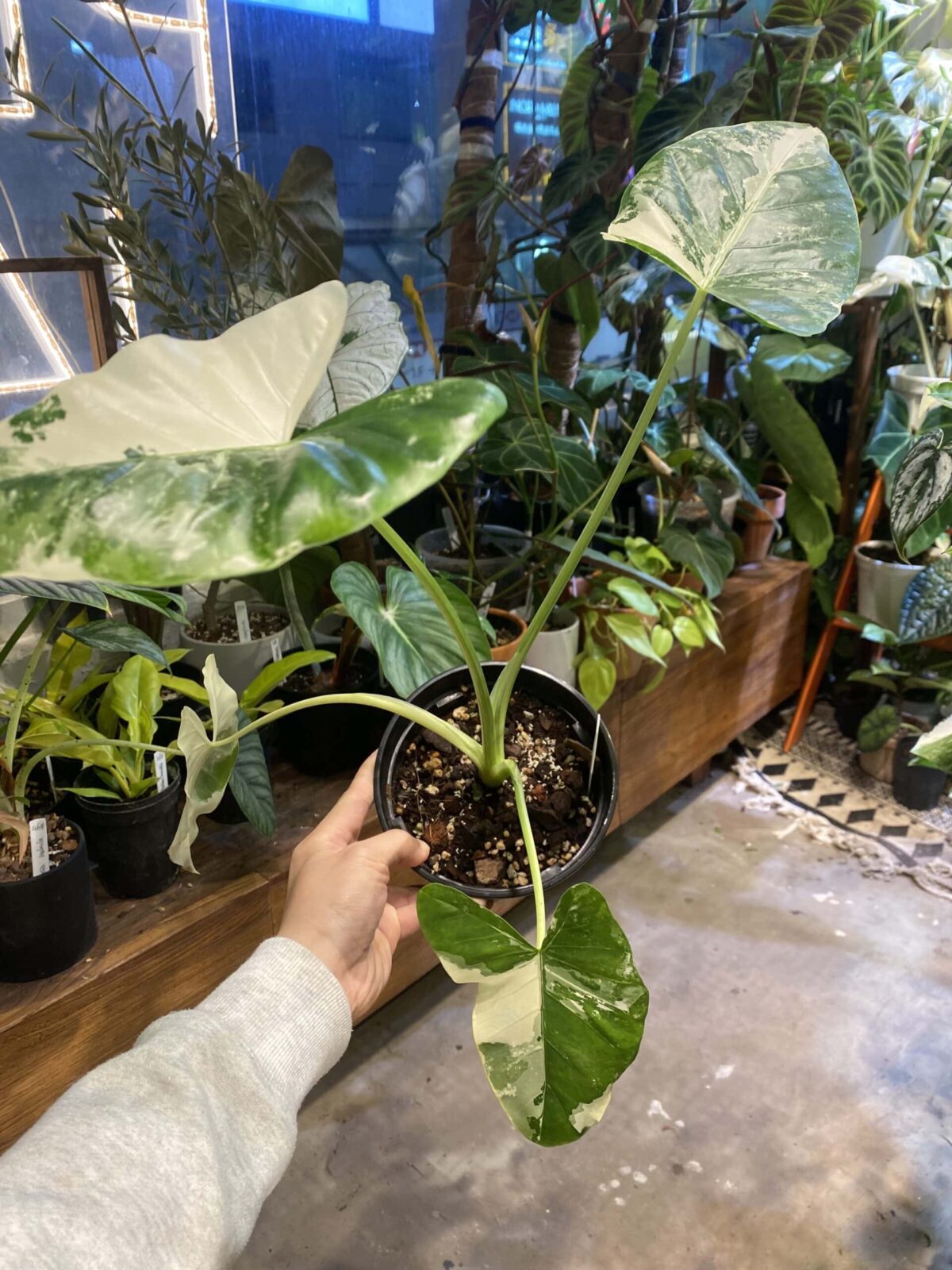
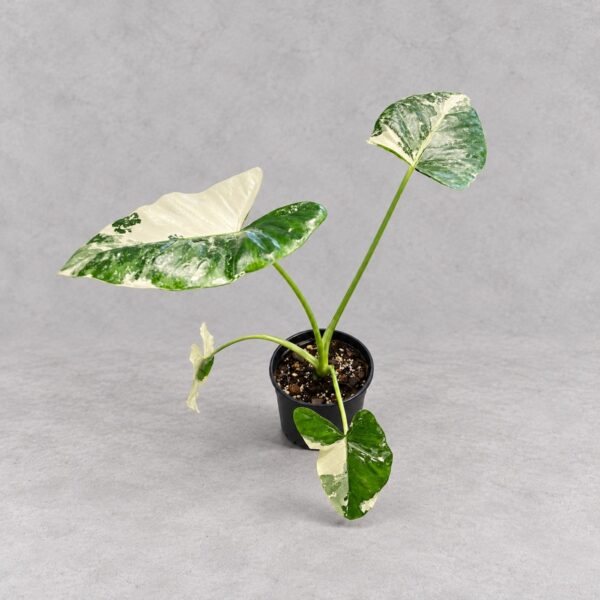
The variegated form of Alocasia macrorrhizos originates from the same native range as the species — Malaysia, Indonesia, the Philippines and wider Southeast Asia — where it's a large perennial herb in the Araceae family. This cultivar's signature is a marbled pattern of green and creamy white across huge, arrow-shaped leaves, with every leaf carrying its own unrepeatable design. The thick, glossy foliage resembles an elephant's ear in shape, hence the common name. Grown outdoors it can reach 2–3 m, though indoor specimens generally stay more modest. The entire plant contains calcium oxalate crystals and is toxic.
⚠️ Toxicity warning: The whole plant is toxic, particularly the stem and sap, which can cause severe oral burning, pain, drooling, and difficulty swallowing if ingested; skin contact with sap may cause allergic reactions. Wear gloves when handling, wash hands thoroughly afterward, and keep strictly away from pets and small children.
Light
- Ideal light: bright, indirect light, 5–7 hours daily to maintain vivid variegation.
- Placement: 1–2 m from an east- or north-facing window; a well-lit interior spot also works.
- Avoid: strong direct sun, which scorches leaves, especially the white variegated sections.
- Special note: the white patches lack chlorophyll and are more sensitive to strong light than the green portions.
- Tip: rotate the pot periodically for even light exposure and symmetrical growth.
Watering
- Frequency: water thoroughly once the top 2–3 cm of soil has dried, roughly every 5–7 days.
- Seasonal adjustment:
- Spring/summer growing season: keep lightly moist, roughly every 4–6 days
- Autumn/winter: reduce to every 10–14 days, erring dry
- Method: water slowly around the pot edge until it drains from the base; empty the saucer within 30 minutes.
- Water quality: room-temperature tap water is fine; filtered water or rainwater is even better.
- Caution: never let it sit in water — this plant likes moisture but is genuinely prone to root rot; cold water in winter can also shock and damage the roots.
Soil & pot
- Soil recipe: a loose, well-draining, nutrient-rich mix:
- Quality potting soil 40% + perlite 25% + coco coir 20% + leaf mould 15%
- Or use a ready-made aroid mix
- Drainage: pot must have drainage holes; a layer of leca or lava rock at the base helps.
- Repotting: once a year in spring, or once roots emerge from the drainage holes.
- Pot choice: breathable terracotta is ideal, though plastic works too; given the plant's size, a heavier pot reduces the risk of tipping.
- Feeding: every two weeks with diluted (half-strength) liquid fertiliser in spring/summer; monthly or none at all in autumn/winter.
Temperature & humidity
- Ideal temperature: 20–30°C for best growth; don't let it drop below 15°C.
- Cold tolerance: growth stalls below 10°C; serious cold damage is likely below 5°C.
- Humidity: 60–80% is ideal, helping keep leaves healthy and glossy.
- Raising humidity:
- A pebble tray (pot base above the waterline)
- Regular misting of the surrounding air
- Grouping with other plants
- A humidifier, especially with AC or heating running
- Note: this species is sensitive to dry air — watch for browning leaf tips as an early warning sign.
Common problems
| Issue | Likely cause | What to do |
|---|---|---|
| Variegation fading, turning green | Insufficient light | Move to a brighter spot, increase diffused light |
| White patches with scorched edges | Light too intense | Move to a slightly shadier spot, avoid direct sun |
| Yellow, scorched leaf tips | Air too dry or water too hard | Raise humidity, switch to filtered water or rainwater |
| Drooping leaves | Underwatering or root issues | Check soil moisture and adjust watering |
| Yellowing and dropping leaves | Overwatering or temperature too low | Adjust watering frequency, move somewhere warmer |
| Spider mite infestation | Air too dry | Raise humidity, mist regularly, use insecticide if needed |
| Stalled growth | Entering dormancy or unsuitable environment | Check temperature and humidity; growth resumes once conditions improve |
| Water-soaked spots on leaves | Fungal infection | Improve airflow, reduce leaf-surface moisture, use fungicide if needed |
How to explain to customers
"This variegated giant taro is a genuine dream plant among foliage collectors — those huge leaves with a green-and-white marble pattern instantly become the focal point of a room. It likes a properly humid environment, so a bit of misting or a humidifier goes a long way. Keep it in bright but indirect light — no direct sun, the white sections burn easily. Let the topsoil dry before watering again, and never let it sit in standing water. It is toxic, and not mildly so, so please handle with gloves, wash hands thoroughly afterward, and keep it well away from children and pets. It does take some care, but honestly, looking at those leaves, it's worth every bit of effort."
Fun facts
- Wild-type giant taro has a long history as a food crop in Southeast Asia, but corms must be soaked and thoroughly cooked for an extended time to remove toxicity before eating; the variegated ornamental form is strictly for display and must never be eaten.
- The species name macrorrhizos comes from Greek, meaning "large root," describing its substantial underground corm.
- Alocasia flowers generate their own heat through a process called thermogenesis, which helps volatilise fragrance compounds to attract pollinating insects.
- In parts of Southeast Asia, giant taro is traditionally planted around homes in the belief that it wards off misfortune.
- Because the white sections lack chlorophyll and photosynthesise less efficiently, variegated giant taro grows more slowly and propagates less readily than the wild type — exactly why collectors compete for it.
Keywords
Marble Elephant Ear, Alocasia macrorrhizos variegata, variegated Alocasia, elephant ear plant, Araceae, large foliage plant, indoor plant, variegated plant, marble pattern, tropical plant, high-humidity plant, statement plant, toxic to pets, collector-grade plant
參考資料(想知來源可展開)
References
- Plants of the World Online (Kew) — Alocasia macrorrhizos. https://powo.science.kew.org
- RHS — Alocasia care. https://www.rhs.org.uk/plants/alocasia
- Proven Winners — How to Grow Alocasia Indoors and Outdoors. https://www.provenwinners.com/learn/houseplants/alocasia
In-depth care guide
Introduction
Marble Elephant Ear is the variegated form of Alocasia macrorrhizos, one of the largest species in the genus and long known in Southeast Asia as both an ornamental and, in its cooked form, a traditional food crop. The variegated cultivar trades some of the wild type's vigour for a genuinely showstopping visual trait: broad, glossy leaves marbled in green and ivory-white, each one unique, in a pattern that looks almost hand-painted or carved from natural stone.
Botanically, the species was first described by Linnaeus in 1753 and later reassigned to Alocasia by George Don in 1839. Its native range stretches from Malaysia and Indonesia through the Philippines and into the wider Southeast Asian region, where the wild-type green form is a familiar sight along waterways, forest edges, and around human settlements. The variegated form arose and was selected in cultivation, and it has since become a genuine collector favourite worldwide, prized for the drama it brings to a room at a scale few other houseplants can match.
Growth habit and scale
Outdoors, in tropical conditions, giant taro can reach 2–3 m or more, forming an imposing clump of huge leaves on thick, sturdy petioles. Indoors, especially in a variegated form with reduced photosynthetic capacity, growth is naturally more modest — typically topping out at 1–1.5 m in a container, though this is still enough to dominate a room. Because the plant gets tall and top-heavy relatively quickly, stability becomes a genuine practical concern: a wide, heavy pot at the base is worth prioritising over an elegant but lightweight one.
Light and the variegation trade-off
The white portions of this cultivar's leaves lack chlorophyll and cannot contribute to photosynthesis, meaning the plant needs comparatively more overall light than its solid-green relatives to sustain the same rate of growth. At the same time, the same lack of chlorophyll makes those white areas markedly more vulnerable to sun damage — there's essentially no pigment to help dissipate the energy of direct light, so scorching happens fast and doesn't reverse.
The practical solution is bright, indirect light for a genuinely long daily duration — five to seven hours is a reasonable target — while keeping the plant just out of the path of direct sun. An east-facing window with a few metres of clearance, or a bright interior room with strong ambient light, usually threads this needle well. If you notice new leaves trending greener over time, that's the plant signalling it needs brighter conditions; if you see scorch marks specifically on the white sections, it's had too much direct exposure.
Watering, humidity and the risk of guttation
This is a genuinely thirsty-looking plant that is nonetheless surprisingly easy to overwater, especially given how slowly the variegated tissue processes moisture compared to a plain green giant taro. The safest approach is to water thoroughly, then wait for the topsoil to dry down 2–3 cm before watering again, adjusting the interval seasonally — shorter in the growing season, considerably longer once temperatures drop in autumn and winter.
Because the leaves are so large, humidity matters enormously to keep them looking glossy and undamaged at the edges. Aim for 60–80%, and don't rely on misting alone — a pebble tray, grouped plants, or (most effectively for a plant this size) a proper humidifier will do far more to protect the huge leaf surface from drying out at the margins.
You may occasionally notice droplets forming at the leaf tips, a phenomenon called guttation, where the plant releases excess water through specialised leaf-tip structures called hydathodes. This is a normal physiological response rather than a disease symptom, but if it happens very frequently, it's worth treating as a mild signal to ease off watering slightly, since it typically indicates the roots are taking up more water than the plant currently needs.
Soil, feeding and repotting at scale
Given how large this plant becomes, soil structure needs to support both drainage and a substantial root system without collapsing under regular watering. A blend of quality potting soil, coco coir or peat, perlite, and leaf mould in roughly even proportions strikes a reasonable balance, and a layer of leca or lava rock at the base of the pot adds further drainage insurance.
Feeding should be moderate rather than heavy — a diluted balanced liquid fertiliser every two weeks through spring and summer is plenty, tapering off or stopping entirely as growth slows in cooler months. Repot annually in spring while the plant is still a manageable size; as it matures and its container becomes genuinely heavy, you may find it easier to top-dress with fresh compost between full repots rather than moving the whole plant every year.
Toxicity — a genuine household consideration
It's worth being especially clear-eyed about this plant's toxicity given its size and the volume of sap-bearing tissue it contains. All parts are toxic, with the stem and sap carrying particularly strong concentrations of calcium oxalate crystals — ingestion can cause severe oral burning and swelling, and in serious cases, throat swelling that affects breathing. Skin contact with the sap can also trigger irritation or allergic reactions in sensitive individuals. Position a plant this size thoughtfully in any household with children or pets, wear gloves for any pruning or repotting work, and wash your hands and tools thoroughly afterward.
Common problems in more detail
Fading or reverting variegation is a light issue nine times out of ten — move the plant to a brighter (but still indirect) location and watch subsequent new leaves for improvement.
Scorched white patches point to too much direct light exposure; the damage is permanent on the affected leaf, but future growth should improve once the plant is repositioned.
Yellowing and dropping leaves can mean either overwatering or a temperature drop below the plant's comfort zone — check both the soil moisture and the room temperature before deciding on a fix.
Water-soaked spots or leaf-surface fungal issues usually point to poor air circulation combined with damp foliage; improving airflow around the plant and avoiding overhead watering are the most effective first steps.
References
- Plants of the World Online (Kew) — Alocasia macrorrhizos. https://powo.science.kew.org
- RHS — Alocasia care. https://www.rhs.org.uk/plants/alocasia
- Proven Winners — How to Grow Alocasia Indoors and Outdoors. https://www.provenwinners.com/learn/houseplants/alocasia
- Missouri Botanical Garden — Plant Finder, Alocasia macrorrhiza. https://www.missouribotanicalgarden.org/PlantFinder/PlantFinderDetails.aspx?taxonid=275730
Plantjai shop · In stock online
alocasia macrorrhizos variegata
HK$388.00
Hong Kong delivery · Causeway Bay pickup
For Hong Kong homes and offices. Stock and pricing follow the product page.
IN STORE NOW
Plants for this guide
Related plants in stock now — live prices, delivery or Causeway Bay pickup.
FREE PLANT ADVICE
Send us a photo before you change anything
WhatsApp a photo of the plant and your window light. Our Causeway Bay team will suggest care steps or plants that suit your space.
STORE · CAUSEWAY BAY
4/F, 39 Yiu Wa Street, Causeway Bay
Daily 12:30–8:00pm · ~3 min walk from Times Square
Map & directionsPlant Care