
How to Care for Alocasia Dragon Scale in Hong Kong | Plantjai

Plantjai 植仔 · Care Encyclopedia
Alocasia Dragon Scale
Hong Kong care guide — useful before you buy and after it arrives.
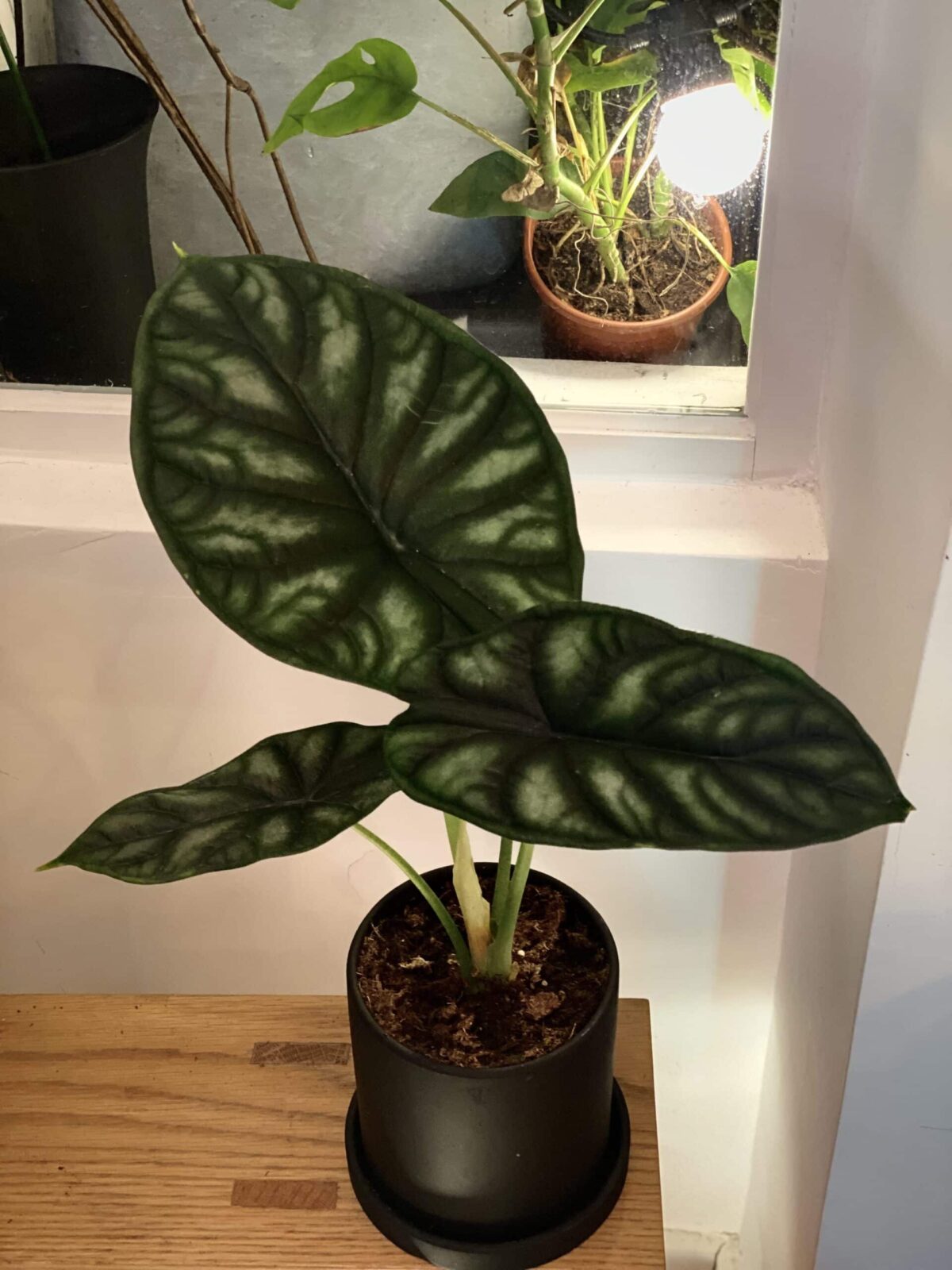
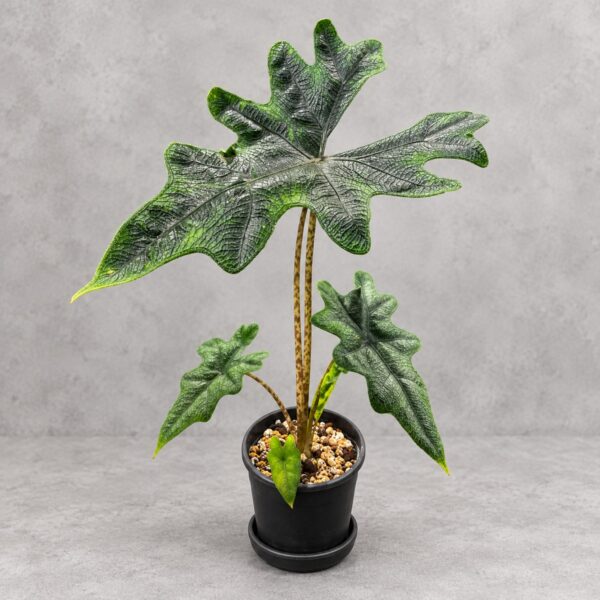
Shop this plantThick, sculptural leaves with a raised, scale-like texture in silver and green — a tactile showpiece for any serious collection.
Origin & characteristics
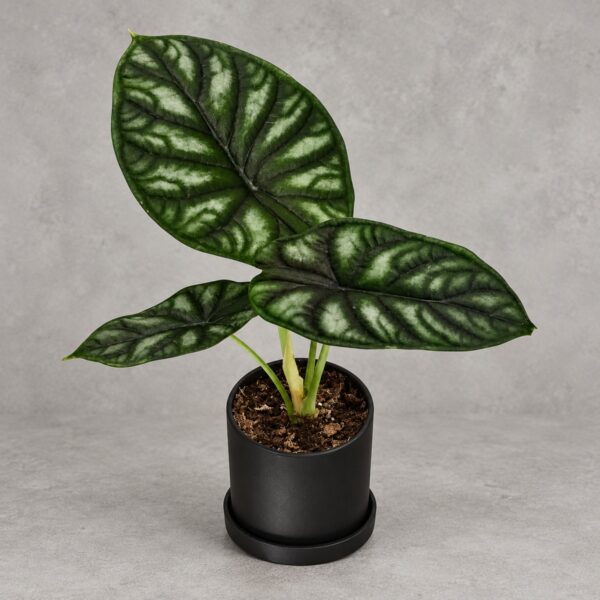
Native to the rainforest floor of East Kalimantan, Borneo, Alocasia baginda wasn't formally described as a species until 2011. The 'Dragon Scale' selection is prized for its thick, rigid leaves with a raised, bullate (blistered) surface — a deep green base threaded with silver-grey between the veins, creating a textured, carved appearance genuinely reminiscent of dragon scales. Mature plants reach 30–50 cm and grow slowly, but the visual payoff makes this a must-have for serious Alocasia collectors.
Light
- Bright, indirect light, ideally near an east-facing window.
- Gentle north-facing light is also acceptable — just avoid anything too dim.
- Never place in direct sun; the thick leaf surface traps heat and scorches easily.
- Good light intensifies the silver-grey patterning and makes the texture more pronounced.
Watering
- Let the top 2–3 cm of soil dry before watering.
- Roughly every 5–7 days in summer, extending to 10–14 days in winter.
- Use filtered water or water rested overnight to minimise leaf-surface mineral marks.
- Avoid watering directly into the central growing point to prevent crown rot.
Soil & pot
- Needs an extremely free-draining chunky mix: 40% quality potting soil, 25% perlite, 20% bark, 15% coco coir.
- A little added horticultural charcoal helps keep roots aerated.
- Use a pot with drainage holes — terracotta is the top choice.
- Dense garden soil will cause root rot; the roots need genuine airflow.
Temperature & humidity
- Ideal range: 18–27°C; growth stalls below 16°C.
- Keep well away from AC vents and drafty window gaps in Hong Kong winters.
- Aim for 60–70% humidity; the plant will tolerate down to about 50% while staying healthy.
- A humidifier or grouping with other plants helps maintain adequate local humidity.
Common problems
| Issue | Likely cause | What to do |
|---|---|---|
| Soft, yellowing leaves | Almost always overwatering or poor drainage | Check the roots immediately |
| Silver-grey patterning fading | Insufficient light | Gradually move closer to a window or add supplemental light |
| Very slow growth | Normal for this species | As long as leaves stay firm and glossy, this isn't a concern |
| Spider mites and scale | Thick leaves can hide pests easily | Check leaf undersides regularly, and keep air moving |
How to explain to customers
"Dragon Scale really lives up to its name — the leaves feel almost carved, with that raised texture and silvery patterning. It's a slower grower, but keep the soil well-drained and the environment reasonably humid, and it'll reward you with real presence on a shelf."
Fun facts
Alocasia baginda wasn't formally published as a species until 2011, even though it had already been circulating in the horticultural trade since the 2000s — meaning it spent years as a plant "with no official surname." Its thick, textured leaves aren't for water storage, but are thought to help scatter and capture dim, filtered light on the rainforest floor.
Keywords
Dragon Scale Alocasia, Alocasia baginda, jewel Alocasia, textured leaf, bullate leaf, silver-grey pattern, shade-tolerant, intermediate difficulty, collector plant, toxic to pets
參考資料(想知來源可展開)
References
- Plants of the World Online (Kew) — Alocasia baginda. https://powo.science.kew.org
- RHS — Alocasia care. https://www.rhs.org.uk/plants/alocasia
- Proven Winners — How to Grow Alocasia Indoors and Outdoors. https://www.provenwinners.com/learn/houseplants/alocasia
⚠️ Pet / toxicity note: Contains calcium oxalate crystals; toxic if ingested, causing oral irritation, swelling and vomiting. Keep away from pets and small children; gloves recommended when handling.
In-depth care guide
Introduction
Dragon Scale Alocasia (Alocasia baginda 'Dragon Scale') is a rare, richly textured member of the Araceae family, native to the rainforest floor of Southeast Asia's Borneo. Its defining feature is a leaf texture and pattern unlike almost any other houseplant — deep green foliage covered in raised, bumpy ridges, interlaced with silver-grey regions between the veins, giving each leaf a carved, three-dimensional appearance reminiscent of dragon scales.
Mature plants stay relatively compact, typically 30–50 cm tall, making them well suited to indoor spaces without demanding the floor space of larger Alocasias. The species took years of careful selective breeding to stabilise, and its slow growth rate and environmental sensitivity place it firmly among the mid-to-upper tier of collector plants — though the payoff for careful care is a genuinely showstopping specimen.
1. Light requirements
Dragon Scale evolved in the understorey of tropical rainforest, adapted to filtered light passing through layers of canopy. What it needs most is bright, indirect light — never direct sun.
Ideal placement
- East- or north-facing windows, where it receives gentle morning light
- South- or west-facing windows should be offset by 1.5–3 m, or filtered with a sheer curtain
- Supplemental grow lighting works well if natural light is limited
Signs of insufficient light
Progressively smaller new leaves, weakening and lengthening petioles, and a dull, lacklustre leaf surface all point to a lack of light. Extended low light will leave the plant soft and prone to flopping.
Signs of too much light
Direct sun, especially at midday, will scorch the foliage, leaving yellow-brown patches. The silvery-grey textured areas are particularly delicate and, once burned, won't recover — the damaged tissue simply has to grow out.
Light intensity at leaf height of roughly 10,000–20,000 lux is a reasonable target — essentially bright, filtered indoor light without any direct sun component.
2. Temperature requirements
As a genuine tropical species, Dragon Scale is fairly particular about temperature, with an ideal range of 21–29°C.
Suitable ranges
- Growing season (spring/summer): 20–28°C
- Resting period (autumn/winter): keep above 18°C
- Absolute minimum: never below 15°C, or root damage becomes likely
Management tips
- Keep away from AC vents and gaps around doors and windows
- Move plants away from cold window glass at night in winter
- Avoid sudden temperature swings when running AC in summer, since rapid drops can trigger water-soaked spotting on leaves
Sustained cold combined with wet soil is a particularly dangerous combination for root health — root activity essentially stalls below 16°C, and any excess moisture at that point is very likely to cause rot.
3. Humidity management
This species prefers relatively high humidity, ideally 60–80%. Hong Kong's climate is naturally humid for much of the year, but AC and heating both dry indoor air significantly, so this needs active attention.
Ways to raise humidity
- Humidifier — an ultrasonic unit placed roughly a metre from the plant works well
- Grouping plants — several tropical species together raise humidity through collective transpiration
- Pebble tray — a wide tray of water-topped pebbles under the pot (keeping the pot base dry)
- Glass cabinet or terrarium — an excellent option if your home is particularly dry
Signs of low humidity
Yellowing or browning leaf edges, malformed or torn new leaves as they unfurl, and fine surface cracking on the leaf blade are all signs humidity has dropped too low for too long — sustained humidity under roughly 55% for more than about 48 hours is often enough to trigger this.
4. Watering technique
Watering is arguably the single most important skill for keeping Dragon Scale alive long-term. It wants the soil evenly moist but never waterlogged — both extremes cause visible problems.
Correct method
- Insert a finger 3–4 cm into the soil; water only once it feels dry
- Water thoroughly until it runs from the drainage holes
- Empty the saucer within 15 minutes
- Slow down further in winter, letting the soil dry to roughly half its depth before watering again
Water quality
- Best: rainwater, distilled water, filtered water
- Acceptable: tap water rested 24+ hours
- Avoid: hard, high-mineral water, which leaves a white crust on leaf tips over time
Reading the signs
| Problem | Leaf symptoms | Fix |
|---|---|---|
| Overwatering | Yellowing, soft base, foul-smelling soil | Stop watering, inspect roots, repot if needed |
| Underwatering | Drooping, curled edges, dry hard soil | Water gradually, don't flood all at once |
Overwatering is by far the more common cause of death in this species — when in doubt, wait an extra day.
5. Soil recipe
Dragon Scale needs an extremely free-draining medium; ordinary garden soil will cause rapid root rot.
Recommended mix
- 35% coarse perlite (3–5 mm)
- 30% orchid bark (1–2 cm chunks)
- 25% low-salt coco coir
- 10% horticultural charcoal
This mix achieves roughly 70%+ air-filled porosity, ensuring the roots get plenty of oxygen alongside adequate moisture retention.
Pot choice
- A terracotta or concrete pot with good drainage holes is ideal
- Plastic pots are fine as long as drainage is generous
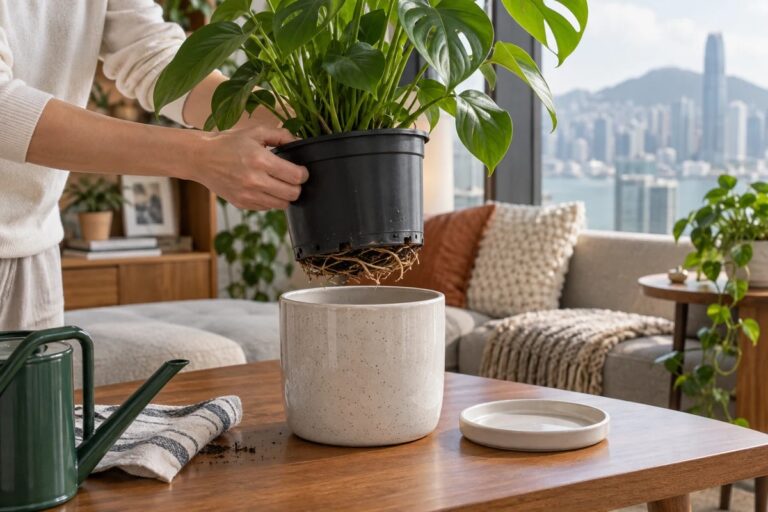
- Avoid oversized pots — excess soil volume takes too long to dry
- Repot roughly every 12–14 months, since organic components in the mix break down and compact over time
6. Feeding
Dragon Scale is a light feeder, and overfeeding is a real risk to its fine root system.
Recommendations
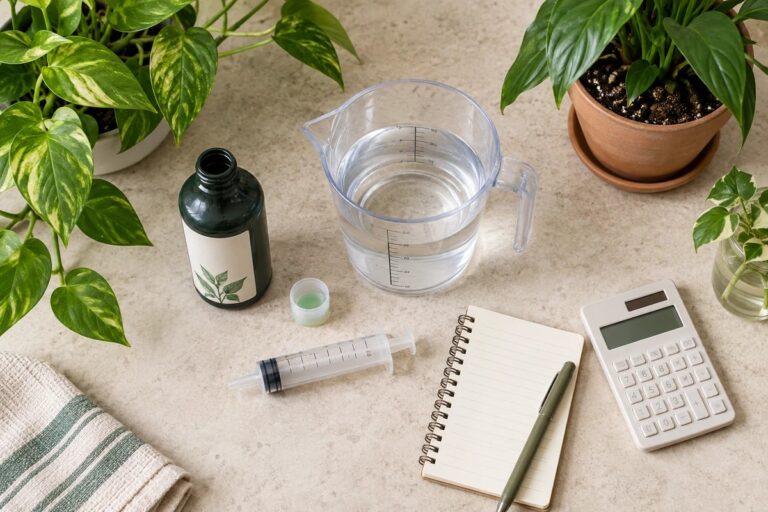
- Use a balanced liquid fertiliser (such as 9-3-6 or 20-20-20), diluted to half or quarter strength
- Growing season (April–September): feed once every third watering
- Resting period (October–March): stop entirely
- Never apply fertiliser directly to the leaves — the waxy cuticle resists absorption, and any residue can encourage fungal growth
Signs of overfeeding
Deep leaf colour with reduced pattern contrast, stalled new growth, and a white salt crust on the soil surface or pot rim. If you suspect overfeeding, flush thoroughly with distilled water several times to clear excess salts.
7. Common pests and diseases
Spider mites
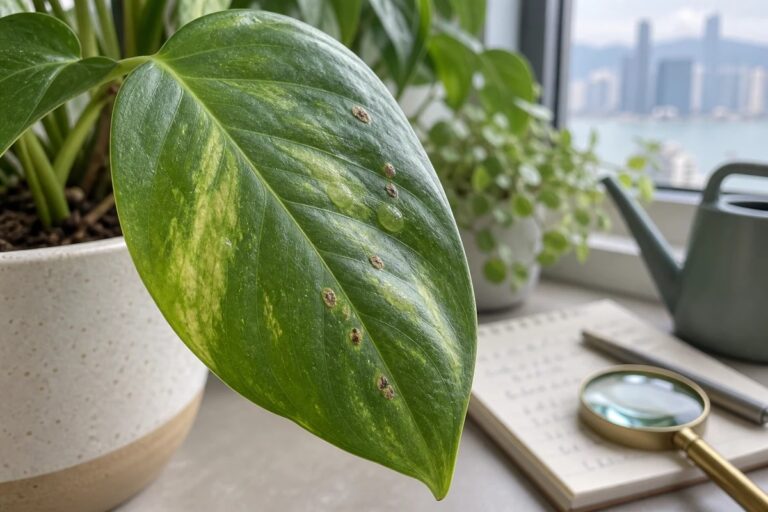
The most frequent pest, especially in dry air. Look for fine webbing and small speckled spots on leaf undersides.
Treatment: spray insecticidal soap every four days for about 12 days; regular gentle wiping with a damp cloth also helps prevent infestations.
Scale insects
Usually found tucked around the petiole base and leaf undersides, appearing as small brown or white bumps.
Treatment: remove individually with a cotton swab dipped in isopropyl alcohol; use neem oil for heavier infestations.
Root rot
Almost always the result of overwatering or poor drainage.
Treatment: unpot, trim away rotten roots, and repot into fresh, free-draining mix. Adjust your watering habits strictly going forward.
8. Propagation
Division and corm propagation are the two reliable methods for Dragon Scale.
Division
- Best done at spring repotting
- Gently loosen the root ball and separate offsets that have their own roots and growth point
- Each division should retain 2–3 roots and at least one leaf
- Pot into fresh soil, keeping it warm and moist
Corm (small tuber) propagation
- Look for small corms near the base of the plant when repotting
- Let them air-dry 1–2 days to callous the cut surface
- Plant in free-draining mix or sphagnum moss, kept lightly moist
- Maintain 25–28°C; sprouting typically takes 2–4 weeks, sometimes longer if the corm is dormant — patience is key here
9. Repotting guide
Timing
- Roots emerging from the drainage holes
- Soil drying unusually fast — bone dry the day after watering
- More than a year since the last repot
Steps
- Water thoroughly a day before repotting to reduce transplant shock
- Gently loosen the old soil and check root health
- Choose a pot roughly 2–3 cm larger in diameter
- Plant in fresh, free-draining mix
- Firm gently and water in
- Keep in a bright but shaded spot, avoiding direct sun, for 1–2 weeks after repotting
10. Frequently asked questions
Q: Is it normal for Dragon Scale to lose old leaves?
A: Yes, this is a normal part of its growth cycle. It typically maintains only a few leaves at a time — as new leaves emerge, the oldest naturally yellows and drops. As long as new growth stays healthy, there's no cause for concern.
Q: Can I use ordinary money tree (Pachira) potting soil for it?
A: No. Standard potting soil retains too much moisture and will quickly cause root rot in this species. Always use a well-aerated, chunky mix.
Q: Can I mist the leaves?
A: Occasional misting for cleaning is fine, but don't rely on it to raise humidity — the effect only lasts a few minutes and does little for overall ambient moisture. A humidifier or pebble tray is far more effective.
Q: Is Dragon Scale toxic?
A: Yes. Like all Alocasias, it contains calcium oxalate crystals; ingestion causes oral pain, drooling and vomiting. Keep it away from pets and small children.
Q: Why do new leaves sometimes have holes?
A: If humidity is too low while a new leaf is unfurling, the delicate tissue can tear. Keep humidity above 70% during active new growth to avoid this.
References
- Plants of the World Online (Kew) — Alocasia baginda. https://powo.science.kew.org
- RHS — Alocasia care. https://www.rhs.org.uk/plants/alocasia
- Proven Winners — How to Grow Alocasia Indoors and Outdoors. https://www.provenwinners.com/learn/houseplants/alocasia
- Missouri Botanical Garden — Plant Finder, Alocasia. https://www.missouribotanicalgarden.org/PlantFinder/PlantFinderDetails.aspx?taxonid=285730
Plantjai shop · In stock online
Alocasia 'Dragon Scale'
Alocasia 'Dragon Scale'
HK$368.00
Hong Kong delivery · Causeway Bay pickup
For Hong Kong homes and offices. Stock and pricing follow the product page.
IN STORE NOW
Plants for this guide
Related plants in stock now — live prices, delivery or Causeway Bay pickup.
FREE PLANT ADVICE
Send us a photo before you change anything
WhatsApp a photo of the plant and your window light. Our Causeway Bay team will suggest care steps or plants that suit your space.
STORE · CAUSEWAY BAY
4/F, 39 Yiu Wa Street, Causeway Bay
Daily 12:30–8:00pm · ~3 min walk from Times Square
Map & directionsPlant Care