
How to Care for Alocasia Black Velvet in Hong Kong | Plantjai

Plantjai 植仔 · Care Encyclopedia
Alocasia Black Velvet
Alocasia 'Black Velvet' 黑天鵝絨海芋
Hong Kong care guide — useful before you buy and after it arrives.
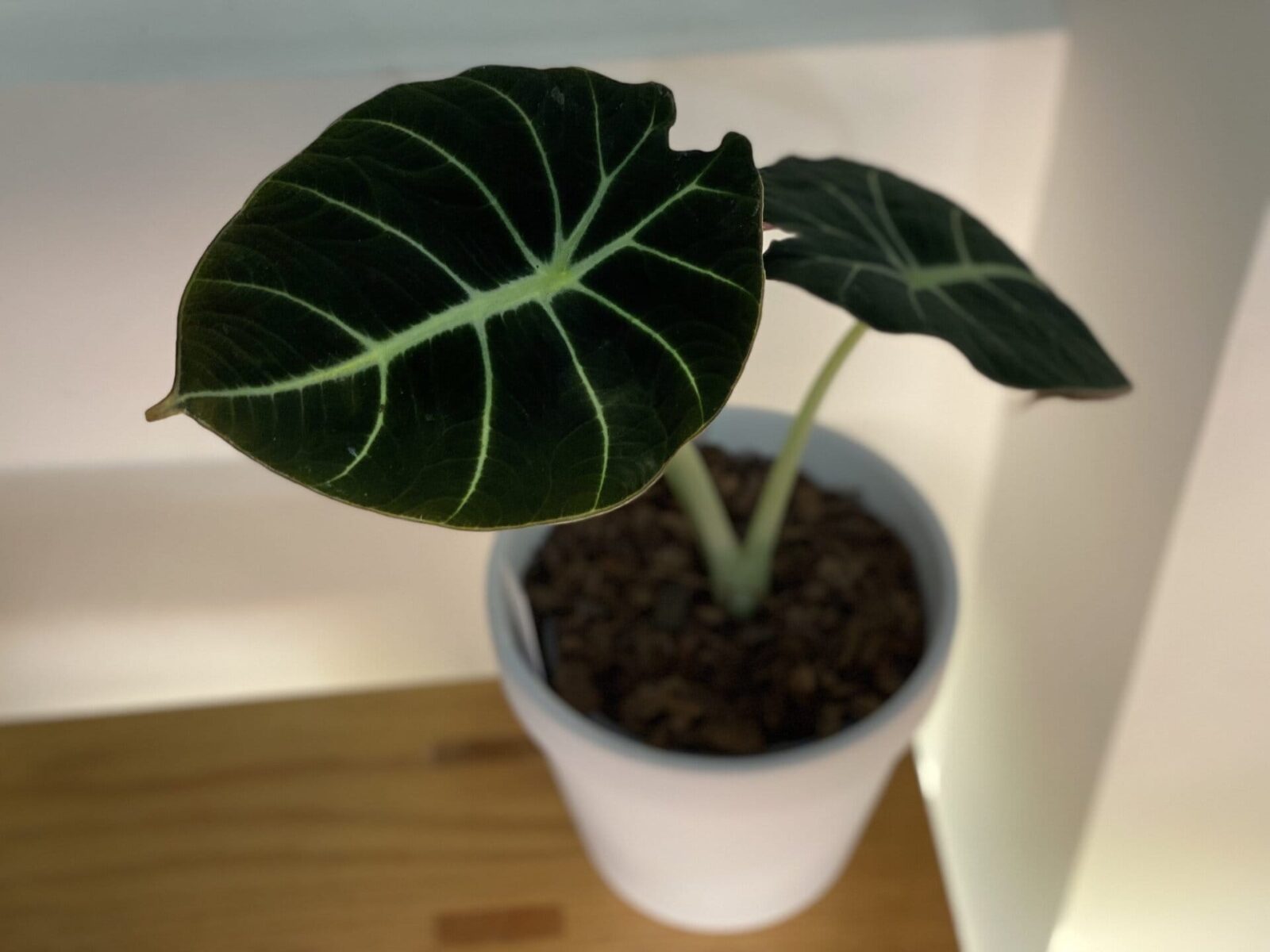
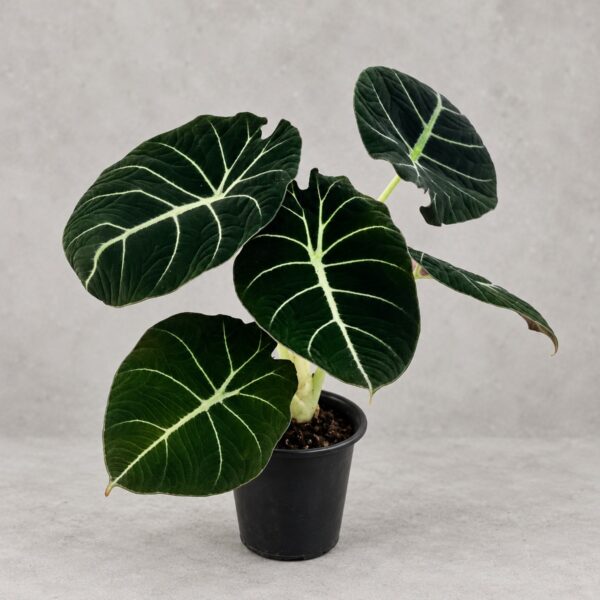
Shop this plantDeep velvet-black leaves with silver veining — a jewel-box houseplant that looks made for a desk or bookshelf.
Origin & characteristics
Native to limestone cliffs in Sabah, Borneo, this small Araceae species is a founding member of the "jewel Alocasia" group. Leaves are deep green to near-black with a thick, velvety texture and striking silver-green venation; the undersides are reddish-brown. It's a compact grower, reaching only 30–40 cm at maturity — ideal for tabletop display in a Hong Kong flat. In the wild it's found only in shaded, dry limestone habitat, which explains its unusually strong need for excellent drainage.
Light
- Prefers bright, indirect light — an east-facing window or north-facing sill is ideal.
- Responds well to supplemental LED grow lighting (8–10 hours daily).
- Avoid direct sun; the velvety leaves scorch easily.
- Too little light fades leaf colour, mutes the silver veining, and can trigger leaf drop or dormancy.
Watering
- Let the top 2–3 cm of soil dry before watering — this plant is decidedly "dry rather than wet."
- Roughly every 5–7 days in summer, stretching to 10–14 days in winter.
- Use room-temperature filtered or rested tap water; avoid cold water shocking the roots.
- Never let the pot sit in standing water — root rot is by far the most common way this plant dies.
Soil & pot
- Needs an extremely free-draining mix: roughly 40% specialty aroid substrate, 30% perlite, 20% bark, 10% coco coir.
- Growing entirely in live sphagnum moss also works well.
- Use a terracotta pot or a plastic pot with drainage holes — avoid unglazed, holeless ceramic.
- A slightly snug pot actually suits this plant better than sizing up too soon.
Temperature & humidity
- Ideal range: 18–26°C; below 15°C the plant tends to go dormant.
- Keep away from AC vents and cold window drafts in Hong Kong winters.
- Aim for 60%+ humidity, ideally 70–80%.
- A small humidifier or grouping plants together helps maintain a humid microclimate.
Common problems
| Issue | Likely cause | What to do |
|---|---|---|
| Yellowing leaves | Overwatering / root rot | Check drainage and cut back watering |
| Brown leaf tips | Air too dry or water too hard | Raise humidity, switch to filtered water |
| Dormancy / leaf drop | Cold snap or low light triggering rest | Reduce water and feed; new leaves return in spring |
| Spider mites | Common on velvet-textured leaves | Check leaf undersides regularly; treat with neem oil or soapy water |
How to explain to customers
"Black Velvet is the star of the jewel Alocasia family — that near-black velvety leaf with silver veins looks incredible on a desk or bookshelf. Its one real weak point is overwatering, so let it dry out a bit between waterings and use a fast-draining mix."
Fun facts
Unlike many trendy houseplant "cultivars," Black Velvet is a genuine wild species — botanists only confirmed in 2021 that its native range is limited to dry limestone cliffs within a wildlife reserve in Sabah. It was sold commercially under the trade name "Black Velvet" before it had a formal scientific name, which ironically led many buyers to assume it was a lab-bred hybrid.
Keywords
Black Velvet Alocasia, Alocasia reginula, jewel Alocasia, velvet leaf, silver veins, shade-tolerant, beginner-to-intermediate, compact houseplant, toxic to pets
參考資料(想知來源可展開)
References
- Plants of the World Online (Kew) — Alocasia reginula. https://powo.science.kew.org
- The Spruce — How to Grow and Care for Alocasia Black Velvet. https://www.thespruce.com/how-to-grow-and-care-for-alocasia-black-velvet-5235406
- Wikipedia — Alocasia. https://en.wikipedia.org/wiki/Alocasia
⚠️ Pet / toxicity note: Contains calcium oxalate crystals; ingestion causes oral irritation, swelling, drooling and vomiting. Keep away from pets and small children; gloves are recommended when handling.
In-depth care guide
Introduction
Black Velvet Alocasia (Alocasia reginula A.Hay) is one of the most coveted plants among houseplant collectors — its species name reginula is Latin for "little queen," and although it only reaches about 30–45 cm tall, it has a presence far beyond its size. It's native to the rainforests of Borneo and belongs to the informal "jewel Alocasia" group.
Its signature feature is near-black, velvety foliage marked with striking silver-white venation, giving each leaf the look of fine textile. The leaf surface is covered in extremely fine trichomes (hairs) that aren't purely decorative — in nature they help shed water and reduce direct light damage. Leaves are broadly heart-shaped, radiating from a central rhizome, and a healthy plant typically maintains 3–5 mature leaves at any one time.
Unlike many large Alocasias, Black Velvet stays genuinely compact and slow-growing, making it well suited to a desk, shelf, or bedside table in a typical Hong Kong apartment. Bear in mind that its leaves and sap contain calcium oxalate crystals and are toxic if ingested — keep it out of reach of children and pets.
Light requirements
Black Velvet's light needs could be summed up as "wants light but fears it too." As an understorey rainforest plant, it's adapted to filtered light passing through a forest canopy, so bright, indirect light — roughly 1,500–3,000 lux — is ideal. In practice, place it near an east- or north-facing window, about 3–5 feet back; for a large south-facing window, add a sheer curtain or move it 5–8 feet away to avoid burning the leaves.
Direct sun is a genuine hazard: leaf tissue exposed to more than roughly 5,000 lux of direct light can begin showing chlorophyll breakdown within 48 hours, with photosynthetic efficiency reportedly dropping sharply within days, leaving permanent pale patches and dead leaf margins. On the flip side, prolonged light below roughly 1,000 lux stops new growth entirely, causes stretched petioles (etiolation), and produces thin, dull leaves that lose their signature velvet sheen.
If natural light is limited, a full-spectrum LED grow light (3,000–4,000K, moderate intensity) hung 12–18 inches above the plant for about 10 hours a day works well. Avoid cheap narrow-spectrum "grow bulbs," which typically lack the blue-to-red ratio (roughly 1:2.5) this species needs for good stomatal regulation and trichome development.
Watering method
Black Velvet is decidedly a "dry rather than wet" plant, and overwatering is the single biggest cause of death among new growers. The correct approach is to let the top roughly 5 cm of soil dry before watering — check with a finger, or use a soil moisture meter if you prefer objective readings.
When you do water, do it thoroughly: pour slowly around the pot edge until water runs from the drainage holes, then empty the saucer within about five minutes. Never let the pot sit in standing water. In a typical Hong Kong home, expect to check the soil roughly every 2–3 days in summer and every 4–5 days in winter — but always verify with a finger rather than following a fixed schedule.
Three watering mistakes are worth calling out specifically. First, spraying water directly on the leaves — many people mist to raise humidity, but this actually promotes fungal spotting and washes away the leaf's protective wax layer; a cool-mist humidifier placed 3–4 feet away, or grouping the plant with other humidity-loving species over a pebble tray, works far better. Second, using hard tap water — if your water's total dissolved solids exceed roughly 100 ppm, long-term use causes tip burn and browning edges; switch to distilled water, rainwater, or reverse-osmosis water if this becomes an issue. Third, watering in the evening during cool months — slower evaporation at lower temperatures keeps the rhizome wet overnight, inviting Pythium and Phytophthora infection; water in the morning instead, ideally between 8am and noon.
Soil, pot & repotting
If there's one word to describe the ideal soil for Black Velvet, it's "airy." The roots need abundant oxygen, and soil structure matters more than nutrient content. A proven mix:
- 35% horticultural perlite (medium grade, ⅛–¼ inch)
- 25% aged fir bark (¼–½ inch chunks, sterilised)
- 20% long-fibre sphagnum moss (pre-soaked and wrung out)
- 20% sifted, mature compost (pH 5.8–6.2, weed-seed free)
Avoid using peat moss as a primary ingredient — it compacts irreversibly after just 3–4 waterings, suffocating the roots. If buying a ready-made mix, look for one explicitly sold as an "aroid mix" with clearly stated particle size and a stated air-filled porosity of 22% or higher.
For pots, terracotta is the best choice, since its breathability helps excess moisture evaporate and reduces rot risk. Whatever material you choose, drainage holes are non-negotiable. Black Velvet actually prefers being slightly root-bound, so repotting isn't needed often — every 12–14 months is usually plenty, best done in spring (April–May). Size up the new pot by only 1–2 inches in diameter; going too large increases the risk of waterlogging. When repotting, inspect the rhizome carefully and cut away any soft, black, or foul-smelling tissue, dusting the cut surface with sulfur powder to aid healing and prevent infection.
Humidity requirements
Black Velvet comes from rainforest conditions with humidity regularly above 80%, so humidity is a genuinely important factor in its care. When ambient humidity drops below 55%, the plant's stomata begin closing within about 90 minutes to conserve water, and by the next day you may notice leaves starting to curl. Extended exposure to 40% humidity or lower tends to push the plant toward dormancy.
The ideal range is 60% to 80%. A few effective ways to get there:
Double-potting: place the growing pot inside a larger waterproof cachepot, packing about an inch of damp sphagnum moss between the two, misting the moss every three days. This creates a localised microclimate of 70–80% humidity right at leaf height.
Humidifier: choose a model with a built-in hygrostat set to around 65%. Avoid mineral-depositing ultrasonic humidifiers without a demineralisation filter, since they can coat leaves in fine dust that clogs stomata.
Grouping plants: placing Black Velvet alongside other humidity-loving species (such as Calathea ornata, Boston fern, or Pilea involucrata) creates a shared microclimate through collective transpiration, potentially raising local humidity by 12–18% with no equipment needed.
Don't assume a bathroom placement alone solves the problem — unless you shower with the door closed for 15+ minutes daily, the brief humidity spike won't compensate for 22 hours of drier air the rest of the day.
Feeding
Black Velvet evolved in nutrient-poor, well-leached tropical forest soil, so its nutritional needs are genuinely modest — overfeeding is a more common cause of death than underfeeding, leading to salt buildup, tip burn, and rhizome damage.
Only fertilise during active growth (April–September), and only when you can see a new leaf actively unfurling. Use a balanced, urea-free formula (such as a 9-3-6 or 20-20-20), diluted to roughly a quarter of label strength (about 1.25 ml per gallon of water), applied every second or third watering — roughly every 2–3 weeks.
A few feeding rules to remember: avoid slow-release fertiliser pellets, which create pockets of high salt concentration right against the rhizome; skip foliar feeding entirely, since this species has almost no functional stomata on the leaf's upper surface and the fine hairs on the underside block absorption; and stop feeding altogether whenever humidity drops below 55% or temperature falls below 18°C, since the plant's slowed metabolism at that point can't make use of the extra nutrients. If you notice browning edges or yellowing that might be salt-related, flush the soil thoroughly with distilled water (three times the pot volume) and pause fertilising for about eight weeks.
Dormancy management
Black Velvet may enter partial dormancy in autumn and winter. True dormancy generally requires all three of the following: sustained temperatures below 15°C, less than 10 hours of daily light, and humidity below 45%. Under these conditions, leaves yellow from oldest to newest, petioles collapse, and the rhizome retracts into the soil.
During dormancy, cut watering back to roughly once every 3–4 weeks — just enough to prevent the rhizome from fully drying out — and stop fertilising completely. Don't panic and discard the pot just because it has no visible leaves — the rhizome can survive leafless for up to eight months as long as temperatures stay above 14°C and the soil remains lightly moist. Resume normal watering and feeding gradually once temperatures rise and new shoots appear in spring.
Propagation
Black Velvet rarely produces offsets under cultivation, so division is less common than with other Alocasias. The most reliable method is rhizome sectioning, best attempted in early spring (March–April):
- Remove the plant from its pot and gently clear soil away from the rhizome.
- Using a sterilised blade, cut a roughly 2-inch section of rhizome, ensuring it includes at least one visible growth eye (a small pink bump).
- Dust the cut surface with rooting hormone (0.1% IBA).
- Lay the section horizontally on moist sphagnum moss, burying it about ½ inch deep.
- Maintain 80% humidity and around 24°C.
- New roots typically begin forming within 4–7 weeks; wait until leaf primordia appear before resuming normal watering.
Black Velvet sometimes produces small corms as well, which can be removed and started in shallow water under a humidity dome or sealed container, typically sprouting within 2–3 weeks.
Common problems and solutions
Yellowing leaves with browning edges almost always indicates accumulated soluble salts. Flush the soil thoroughly with distilled water (three times the pot volume), then switch to rainwater or reverse-osmosis water and pause fertilising for about eight weeks.
Sudden leaf drop with an intact, firm rhizome often points to acute ethylene exposure — check for nearby ripening fruit (especially apples and bananas), gas stoves, or vehicle exhaust. Removing the source usually allows recovery within 3–5 weeks.
Small new leaves with distorted veining is frequently linked to zinc deficiency in lab-tested cases. A chelated zinc solution (Zn-EDTA, 0.05%) sprayed on leaf undersides in the evening, repeated after 14 days, can help.
A black, soft, foul-smelling rhizome is the classic sign of Phytophthora infection. Remove all infected tissue immediately, treat remaining healthy rhizome with a dilute phosphorous acid solution, and repot into fresh, sterile mix — discard the old soil and pot.
Spider mites are the most common pest. Early signs are tiny yellow specks and light webbing on leaf undersides. Isolate the plant, rinse leaf undersides thoroughly every other day, raise ambient humidity, and use neem oil or a dedicated miticide for persistent infestations, reapplying every few days to break the breeding cycle.
Toxicity
Black Velvet contains calcium oxalate crystals throughout its tissue, like all Alocasias. Ingestion causes oral and throat irritation, swelling, drooling, and potential vomiting. Keep it well out of reach of pets and small children, and consider wearing gloves when repotting or pruning, since the sap can also irritate skin.
References
- Plants of the World Online (Kew) — Alocasia reginula. https://powo.science.kew.org
- The Spruce — How to Grow and Care for Alocasia Black Velvet. https://www.thespruce.com/how-to-grow-and-care-for-alocasia-black-velvet-5235406
- Wikipedia — Alocasia. https://en.wikipedia.org/wiki/Alocasia
- RHS — Alocasia care. https://www.rhs.org.uk/plants/alocasia
- Missouri Botanical Garden — Plant Finder, Alocasia. https://www.missouribotanicalgarden.org/PlantFinder/PlantFinderDetails.aspx?taxonid=285730
For Hong Kong homes and offices. Stock and pricing follow the product page.
IN STORE NOW
Plants for this guide
Related plants in stock now — live prices, delivery or Causeway Bay pickup.
FREE PLANT ADVICE
Send us a photo before you change anything
WhatsApp a photo of the plant and your window light. Our Causeway Bay team will suggest care steps or plants that suit your space.
STORE · CAUSEWAY BAY
4/F, 39 Yiu Wa Street, Causeway Bay
Daily 12:30–8:00pm · ~3 min walk from Times Square
Map & directionsPlant Care