Why Potting Mix Stays Wet: A Practical Diagnosis


In this guide (7)
- 01“Wet” can describe three different situations
- 02Four checks, starting with those that leave roots undisturbed
- 03Fast runoff does not mean the root ball is dry
- 04Collect evidence across a watering cycle
- 05When waiting for the pot to dry is not enough
- 06Avoid shortcuts that create a second problem
- 07Further reading and next steps
There is no correct number of drying days for every houseplant. Compare the plant with its own previous behaviour and consider drainage, the root zone and growth together. Some plants need evenly moist mix. Persistent saturation, an unexplained change in drying rate, or wet mix accompanied by wilting and a softening stem base deserves closer attention.
Start with free-standing water, then recent environmental changes, then the relationship between roots and pot size. Inspect the whole root ball or replace the mix when the evidence warrants it—not simply because a healthy plant’s mix feels moist.
“Wet” can describe three different situations
- A slightly damp surface: this describes the surface, not the bottom of the pot.
- Moisture retained after excess water has drained: suitability depends on the plant and the structure of the medium.
- Free water in the pot, cover pot or saucer, with persistent saturation: address this risk in ordinary mix-grown foliage plants.
The University of Maryland explains that excess water reduces oxygen around roots. Damaged fine roots can then struggle to absorb water, so drooping leaves in wet mix are not an automatic instruction to water again.
This is not a guide to hydroponics or purpose-designed reservoir systems. Their root environments and management differ from leaving an ordinary nursery pot standing in water.
Four checks, starting with those that leave roots undisturbed
| Check | Evidence to look for | First adjustment |
|---|---|---|
| 1. Drainage and cover pot | A submerged base, blocked holes or retained runoff | Remove free water and restore drainage |
| 2. Light and environment | Closed curtains, relocation, cloudier conditions or changed air-conditioning | Restore suitable conditions and reassess watering |
| 3. Roots and pot size | A small root ball recently placed in a much larger volume of mix | Reassess pot size; do not upsize again to “improve drainage” |
| 4. Medium and root condition | Collapsed mix, disintegrating roots, a soft stem base or progressive decline | Inspect when necessary and match the setup to viable roots |
More than one cause may apply. A plant recently moved into a larger pot and then away from a window cannot be assessed solely by whether its mix contains enough chunky ingredients. A dated account of changes is often more useful than judging ingredients in isolation.
Fast runoff does not mean the root ball is dry
Water leaving the drainage holes proves that some water found an exit. It does not establish uniform moisture inside the original root ball or guarantee that the pot will subsequently dry appropriately. A finer nursery root ball and newly added coarse mix can behave differently. Do not judge only the outer ring.
The University of Illinois container guide notes that disproportionately large pots can remain wet longer. Choose with the existing roots and your care routine in mind, not only the size of the leaves.
The objective is suitable water retention and aeration, not the fastest possible drying. Plants that cannot tolerate a fully dry root ball should not be switched to an extremely drying mix after one wet episode. Conversely, a small, slow-growing root system may be poorly matched to a large volume of highly retentive medium.
Collect evidence across a watering cycle
If the plant is not deteriorating urgently, begin at the next genuinely necessary watering. Do not rewater a wet pot merely to start a test. Small pots can be compared by weight; weigh large containers only when you can handle them safely.
| Field | Record |
|---|---|
| Baseline | Plant, pot, medium, position and last repotting date |
| Watering day | Why watering was needed; weight or feel after drainage |
| Subsequent checks | Surface and deeper moisture, changing weight and any returning standing water |
| Environment | Changes in curtains, air-conditioning, weather or position |
| Plant | Leaf firmness, additional yellowing, stem base and growth |
An inexpensive moisture probe, a wooden skewer or a finger is a supporting tool. Avoid repeatedly stabbing a dense root ball, and do not let one reading overrule direct evidence such as a pot base standing in water. Remove a skewer after checking instead of leaving it as an indefinitely reliable indicator.
When waiting for the pot to dry is not enough
Progressively worsening wilt in wet mix, a softening stem base or root tissue that disintegrates warrants separation from other plants and closer inspection. The University of Maryland’s root-rot guidance describes yellowing, decline, discoloured roots and soft decay among possible symptoms. The particular pathogen cannot be identified from a short description alone.
Colour is not the only criterion: healthy roots are not universally pure white. Compare firmness, intact tissue, unusual odour and the plant’s overall trajectory rather than cutting anything that is not white. Persistent decay calls for informed diagnostic help, not a sequence of household disinfectant experiments.
Avoid shortcuts that create a second problem
- Do not bake the pot dry with sudden intense sun, a heater or a hairdryer.
- Do not repeatedly stir or puncture the root ball and damage functioning roots.
- Do not flush a waterlogged pot repeatedly to “wash the problem away”.
- Do not diagnose whole-plant root rot or apply fungicide solely from surface mould.
- Do not require every foliage plant to become completely dry before watering.
Success is not changing “ten days to dry” into “three days to dry”. It is a suitable root environment, an understandable moisture pattern and stable new growth in your actual home.
Further reading and next steps
IN STORE NOW
Plants for this guide
Related plants in stock now — live prices, delivery or Causeway Bay pickup.
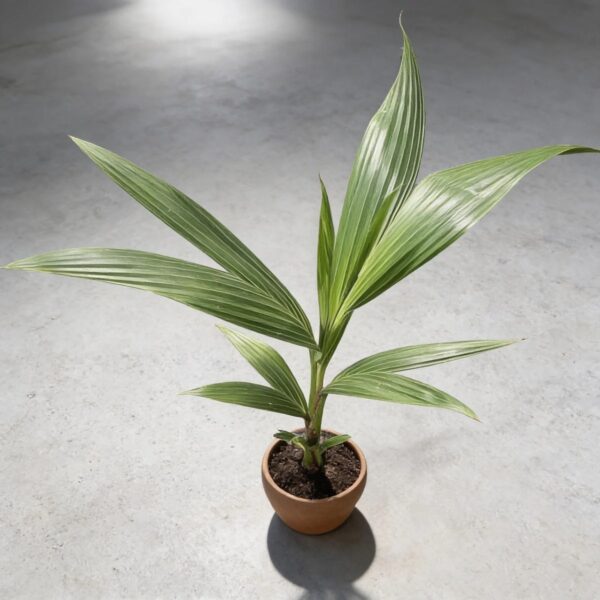
Cocos nucifera
Cocos nucifera
Original price was: HK$398.00.HK$298.00Current price is: HK$298.00.
In stock · store pickup
View plant
FREE PLANT ADVICE
Send us a photo before you change anything
WhatsApp a photo of the plant and your window light. Our Causeway Bay team will suggest care steps or plants that suit your space.
STORE · CAUSEWAY BAY
4/F, 39 Yiu Wa Street, Causeway Bay
Daily 12:30–8:00pm · ~3 min walk from Times Square
Map & directionsPlant Care