

The World of Begonias: From Begonia phuthoensis to Mary Selvistre’s Thousand Forms

Getting to Know the Begonia Family
An Ever-Expanding Giant Family
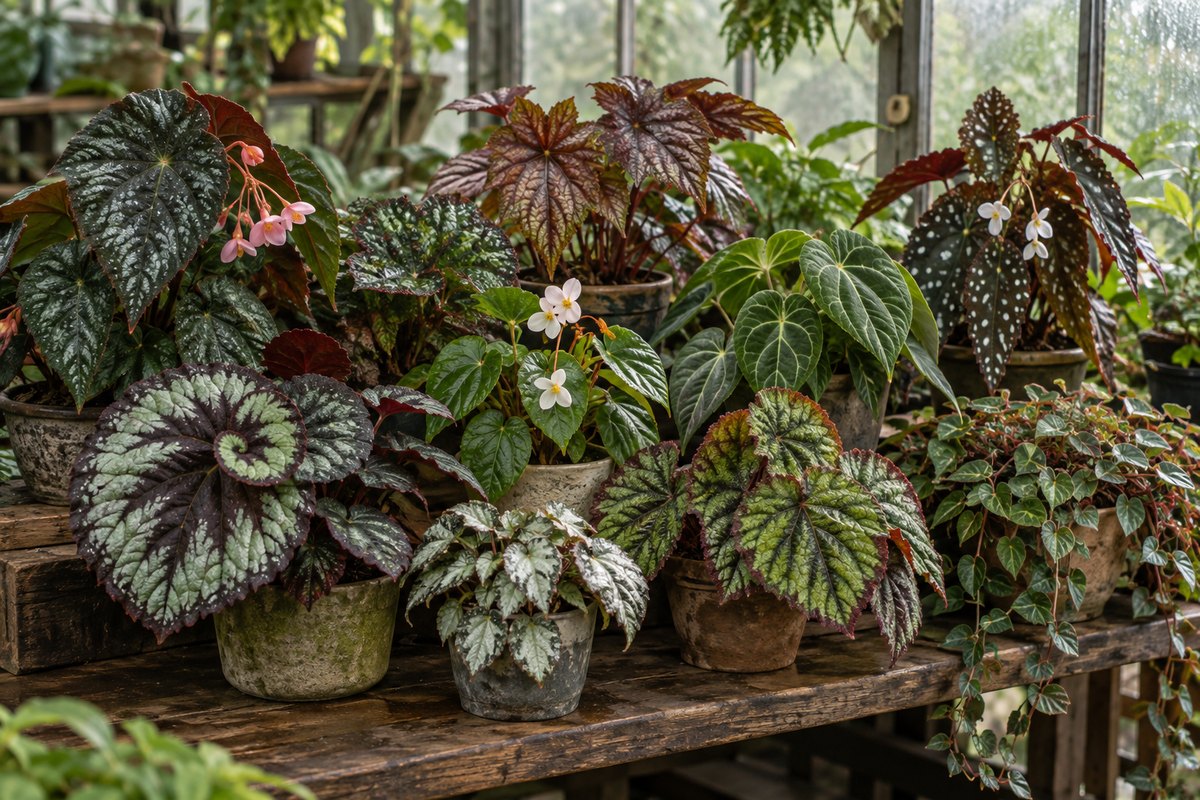
The genus Begonia is one of the largest genera of flowering plants, with over 2,000 described species and counting. They are primarily distributed in tropical and subtropical regions, from the Andes Mountains of South America to the rainforests of Southeast Asia, from African river valleys to the foothills of the Himalayas — virtually every warm, moist place on Earth hosts them.
Members of this genus vary enormously in form: some only a few centimeters tall, growing moss-like along the ground; others reaching three meters and forming Begonia thickets in the rainforest. Some are prized for their flowers, others rely entirely on their foliage to catch the eye.
The Beauty of Asymmetric Leaves
One of the most distinctive features of Begonias is that their leaves are almost always asymmetrical — if you fold a Begonia leaf along its central vein, the left and right sides will never perfectly overlap. This asymmetry gives Begonia leaves a sense of movement and vitality; no two leaves are ever exactly alike.
Begonia phuthoensis: The Silver Spirit from the Vietnamese Highlands
A Mountain Forest Native
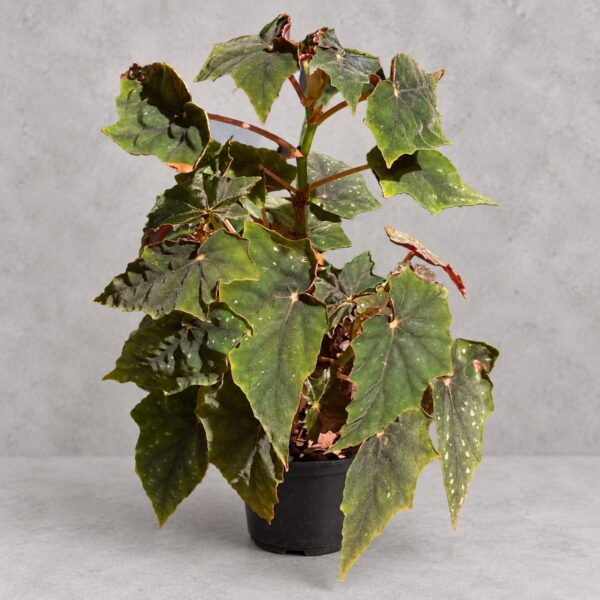
Begonia phuthoensis is a regular at the Archive and one of my top recommendations for indoor growing in Hong Kong. Native to Phú Thọ Province in northern Vietnam, it grows in higher-elevation mountain forests, making it particularly well-adapted to the cool, shaded conditions of indoor environments.
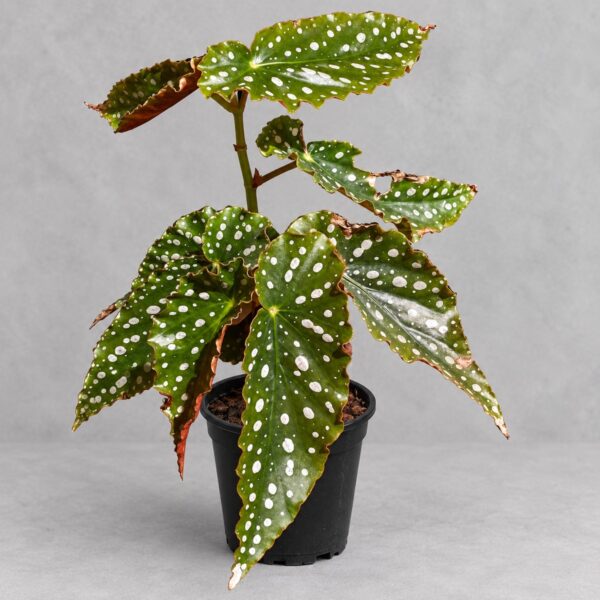
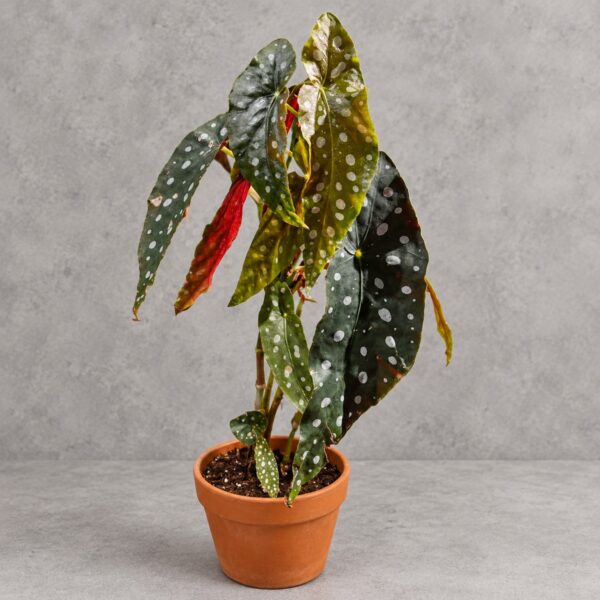
The most captivating feature of B. phuthoensis is its foliage. The leaves are elongated and lance-shaped, with a deep ink-green base color adorned with silvery-white spots and streaks — like moonlight scattered across fallen leaves in a forest. The leaf surface has a fine layer of fuzz that feels incredibly soft to the touch. The undersides are typically reddish-brown, creating a beautiful contrast with the silver-green upper surface.
This variety stays relatively compact, reaching only about 20–30 cm in height, making it perfect for desks, windowsills, or office partitions. It doesn’t take up much space yet adds a refined, forest-like atmosphere to its surroundings.
Care Tips
Begonia phuthoensis enjoys bright, indirect light but cannot tolerate direct sun exposure. I usually recommend placing it about one to two meters from a window, or using sheer curtains to filter the light. It prefers higher humidity, ideally above 50% — not an issue in Hong Kong, but if you run air conditioning for extended periods, a small water tray nearby can help.
When it comes to watering, Begonias dread waterlogged conditions most of all. Use a loose, well-aerated potting mix — something like peat moss, perlite, and pine bark in a 4:3:3 ratio. Each time you water, make sure excess water drains from the bottom, and discard any standing water after 30 minutes. Experienced growers even use the “tray method” — placing the pot on a shallow tray filled with pebbles and water, allowing humidity to rise naturally rather than watering from above.
Quality Begonia phuthoensis specimens are currently available at plantjai.com. If you’d like to welcome this silver spirit from the Vietnamese mountains into your home, come take a look.
Begonia ‘Mary Selvistre’: A Symphony of Silver and Dark Green
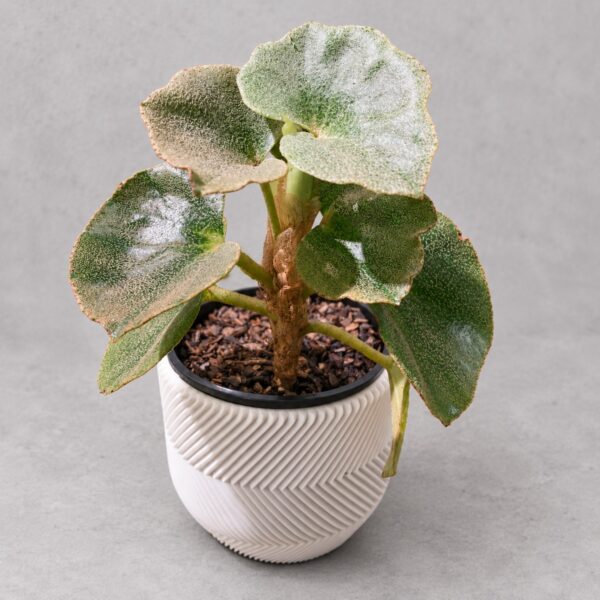
Mary Selvistre is a classic among Begonia cultivars. Its leaves are massive, reaching 20–30 cm in length, with an irregular shield-like shape and slightly wavy, ruffled edges.
The most stunning aspect is the leaf color and texture. Dark green to nearly black veins form an intricate network across a silver-white leaf surface — viewed from above, it resembles an exquisite silver-and-black print. A silvery layer of fuzz coats the leaf surface, making the entire leaf appear dusted with silver powder that shifts subtly under different angles of light.
This variety grows relatively large and works beautifully as a floor plant or on a low cabinet as a visual focal point. It has a commanding presence — a single leaf is enough to anchor an entire corner.
Other Begonia Varieties Worth Knowing
Begonia ‘Silver Queen’
As the name suggests, Silver Queen boasts nearly all-silver leaves, with only the veins and edges retaining dark green. Like an elegant silver-haired noblewoman, she quietly radiates refined, understated grace. Silver Queen is sensitive to light — too dark and the silver fades, too bright and the leaves may scorch. Finding the right spot takes some experimentation.
Begonia ‘Malachosticta’
This cultivar’s leaves are covered with pink dots on an olive-green background, looking as though someone dotted the leaves countless times with a pink marker. It’s extremely distinctive and particularly eye-catching when placed among a collection of green plants.
Begonia masoniana (Iron Cross Begonia)
Commonly known as the Iron Cross Begonia, its leaves feature striking dark brown cross-shaped markings with a rough, sandpaper-like texture. This variety has loads of personality — its bumpy leaf surface looks like a living fossil from the dinosaur era.
Universal Begonia Care Guidelines
High Humidity Is Key
Begonias come from humid tropical rainforests, and high humidity is crucial for their wellbeing. Hong Kong’s natural humidity is usually sufficient, but during air-conditioned or dehumidifier-heavy seasons, consider placing humidity trays nearby or grouping plants together to create a microclimate.
Avoid Waterlogging, But Don’t Let Them Dry Out Completely
Begonia roots are fine and delicate, prone to rotting in soggy conditions, yet they don’t appreciate completely drying out either. The best approach is to keep the potting mix lightly moist but not wet. Insert your finger one to two centimeters into the soil — water when it feels almost dry.
Good Air Circulation
Begonias dislike stagnant, stuffy environments, which can lead to issues like powdery mildew. Maintaining moderate air circulation is important for their health.
Propagation: A Single Leaf Can Become a New Plant
Leaf Cuttings
Begonias are among the easiest plants to propagate from leaf cuttings. Take a healthy leaf with its petiole attached, insert it into moist perlite or vermiculite, and maintain high humidity with bright, indirect light. After about three to four weeks, you’ll see new plantlets emerging from the base of the petiole.
Another fascinating method involves cutting the leaf into sections (works best for varieties with prominent veins), with each section containing a main vein. Lay these flat on moist potting medium, secure with toothpicks, and each vein cut may produce a new plantlet — one leaf can yield several baby plants!
Conclusion: Every Leaf Is a Painting
Begonias have taught me one thing: beauty doesn’t require perfect symmetry or uniform standards. Those irregular leaf shapes, randomly distributed spots, and interplays of silver and green — these are nature’s most moving creations.
If you’d like to add a few “living paintings” to your home, visit plantjai.com to browse our selection of Begonia phuthoensis and other curated varieties. Each plant is a healthy specimen nurtured with care at the Archive, full of vitality and ready for your home.
And of course, you’re welcome to visit our Causeway Bay store and browse the Begonia section at the Archive at your leisure. After all, with Begonias, seeing them in person delivers an impact that photos simply cannot convey. I’ll be here, waiting to help you discover your perfect leaf.
IN STORE NOW
Plants for this guide
Related plants in stock now — live prices, delivery or Causeway Bay pickup.
FREE PLANT ADVICE
Send us a photo before you change anything
WhatsApp a photo of the plant and your window light. Our Causeway Bay team will suggest care steps or plants that suit your space.
STORE · CAUSEWAY BAY
4/F, 39 Yiu Wa Street, Causeway Bay
Daily 12:30–8:00pm · ~3 min walk from Times Square
Map & directions