

The Complete Field Guide to Variegated Plants: Why Can a Single Leaf Cost Thousands?


Introduction
Step into the specimen archive, and you’ll notice the afternoon light catching something extraordinary—a Monstera borsigiana albo variegata unfurling a new leaf, half emerald green, half pure snow-white. Visitors often gasp at this moment, then ask the same question: “Why does this leaf have two colours?”
That is the magic of variegation. Over the past few years, variegated foliage plants have exploded from a niche obsession among serious collectors into a global phenomenon. A single perfectly half-moon variegated monstera leaf can fetch thousands—or even tens of thousands—of Hong Kong dollars at auction. Some call it hype. But as someone who lives and breathes these plants every day inside the archive, I want to offer you a different lens: variegation is nature at its most capricious and artistic.
What Is Variegation? A Journey Into the Cellular World of Colour
Variegation is, at its core, a genetic mutation at the cellular level. To understand it, we need to shrink ourselves down to the microscopic world inside a leaf.
Plant leaves appear green because chloroplasts contain chlorophyll, the pigment responsible for photosynthesis. In variegated plants, certain cells have lost the ability to produce chlorophyll. These areas cannot photosynthesise and therefore don’t appear green—instead, they show up as white, yellow, or even pink. This isn’t a disease; it’s a natural mutation that occurs during cell division, technically called a somatic mutation.
When mutated cells coexist with normal cells at the same growing point (meristem), the result is the mottled pattern we see with our naked eyes. It’s rather like marble—no two pieces are ever identical.
Chimeras: The Engine Behind Variegation
The most common type of variegation in horticulture is chimeric variegation. The term comes from Greek mythology—Chimera was a creature assembled from parts of different animals. In chimera plants, mutated and normal cells are arranged in distinct layers within the plant’s tissues, creating a stable multi-coloured structure.
Stability is the key concern for growers. Some variegation patterns are remarkably steady and can be reliably propagated through cuttings. Others behave like temperamental children—one day they’re perfectly variegated, the next they’ve reverted to plain green. We call this reversion, and it’s the nightmare of every serious collector.
Six Faces of Variegation—Which Type Is Your Plant?
Wander through the variegation section of our archive, and you’ll quickly realise that “variegated” isn’t a single look. Here are the six types I encounter most often:
White Variegation (Albo)
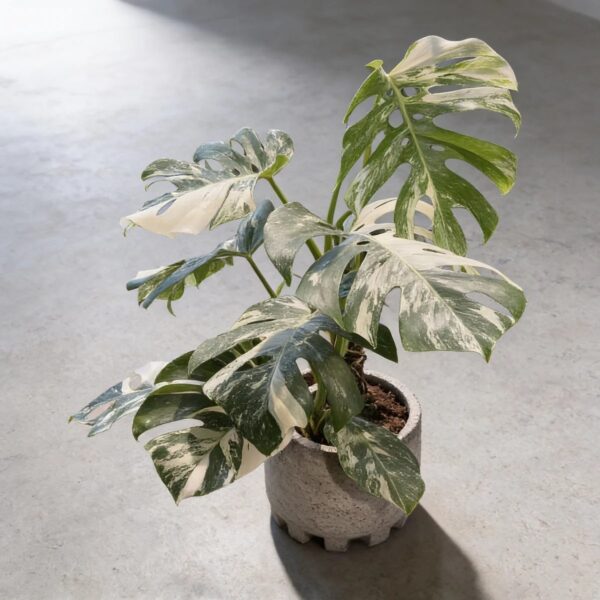
The most ethereal—and most delicate—form. Monstera deliciosa ‘Albo Borsigiana’ is the poster child: creamy white patches scattered across deep green foliage, the contrast so striking you can’t look away. The white areas contain zero chlorophyll and cannot photosynthesise, which means these plants grow more slowly and are more sensitive to light conditions.
Yellow Variegation (Aurea)
Monstera deliciosa ‘Aurea’ and Epipremnum aureum ‘Neon’ display golden-yellow markings caused by carotenoids becoming visible. Yellow tissue retains some photosynthetic ability, making these varieties slightly easier to care for than their white-variegated cousins. That warm golden glow acts like a natural soft-focus filter in any room.
Mint Variegation
The hottest newcomer of the past two years. Mint variegation isn’t simply white or yellow—it’s a green-tinted pale marking that resembles the colour of fresh mint leaves. Philodendron ‘Mint’ prices have skyrocketed precisely because this translucent, cool-toned colouring is so irresistibly beautiful.
Half-Moon Variegation
The holy grail. A near-perfect line divides the leaf in half—one side entirely green, the other entirely white (or yellow). Whenever a half-moon leaf unfurls in the archive, I feel like a child on Christmas morning. This symmetry is entirely random, impossible to control, and statistically as likely as winning the lottery.
Splash / Marbled Variegation
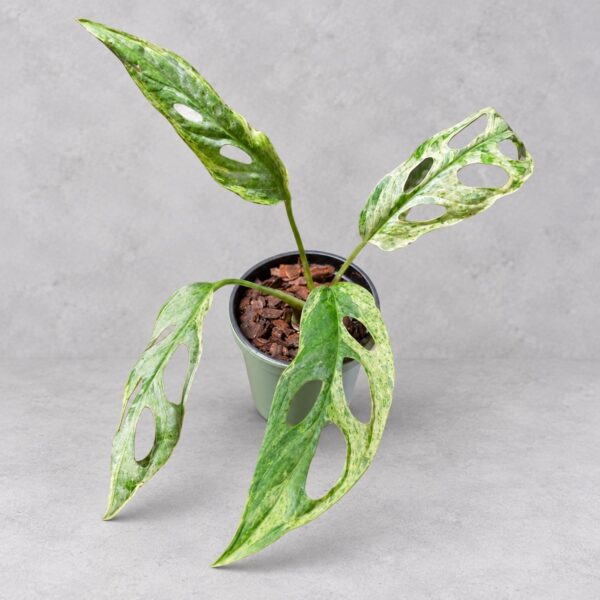
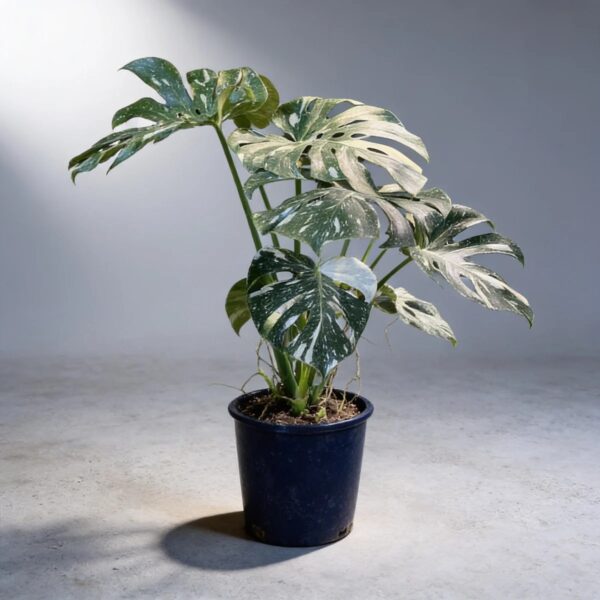
As if someone flicked a paintbrush across the leaf surface, spots scatter randomly across the blade. Syngonium podophyllum ‘Albo Variegata’ is a classic example. The joy of splash variegation lies in its unpredictability—you never know what the next leaf will look like.
Sectorial Variegation
Large, blocky patches of colour that look as if a palette knife scraped across a canvas. Some variegated forms of Philodendron gloriosum fall into this category, delivering enormous visual impact.
Why Are Variegated Plants So Expensive? Three Hard Truths
Guests in the archive regularly stare at price tags in disbelief. Let me be straight with you: there are solid, practical reasons behind those numbers.
Propagation Difficulty: Every Cutting Is a Gamble
Variegated plants cannot reliably reproduce their variegation patterns from seed (sexual reproduction disrupts the chimera’s layered cell structure). Growers must rely on tissue culture, stem cuttings, or division. The problem? Cuttings don’t always inherit the mother plant’s variegation pattern. You might take ten cuttings from a perfect half-moon plant and end up with only two or three producing variegated new growth. This uncertainty directly drives up production costs.
Slower Growth: Time Is Money
White or yellow tissue can’t photosynthesise, which means the plant has fewer “factories” producing energy. Growing a variegated plant to maturity can take two to three times longer than its all-green equivalent. And in horticulture, time is never free.
Market Demand: Basic Economics
Instagram and online plant marketplaces have transformed variegated plants from a secret shared among a small circle of fanatics into a global trend. When millions of people want a Monstera albo and suppliers can’t rapidly scale production, prices naturally climb. This isn’t a bubble—it’s supply and demand.
Before You Start Collecting: Honest Advice
Variegated plants are stunning, but let me share some hard-won wisdom. If you’re just starting out, consider more affordable varieties first—variegated pothos like Epipremnum aureum ‘Marble Queen’ or variegated arrowhead vines like Syngonium ‘Albo’. Their variegation is equally captivating, prices range from a few dozen to a few hundred Hong Kong dollars, and they’re far more forgiving to grow.
For those ready to advance their collection, the archive’s variegated monsteras, philodendrons, and alocasias await. When selecting, pay close attention to variegation on the stem—the patterns on the stem are the best predictor of future leaf variegation. This matters far more than how pretty a single leaf happens to look.
Conclusion
For me, variegated plants have never been about money. Each one is nature improvising at the cellular level—no two leaves identical, no two growing seasons bringing the same surprises. When you step onto your balcony at dawn and discover your variegated monstera has unfurled a new leaf with the perfect splash of white, that feeling is something only those who’ve experienced it can truly understand.
If you’d like to witness these living artworks in person, you’re always welcome at Plantjai’s Causeway Bay store. Our variegated plant section houses over thirty species and hundreds of specimens, from beginner-friendly to serious collector grade. Or browse plantjai.com first to see which splash of variegated colour speaks to you.
After all, the greatest joy of collecting variegated plants isn’t owning them—it’s the anticipation of what the next unfolding leaf might reveal.
IN STORE NOW
Plants for this guide
Related plants in stock now — live prices, delivery or Causeway Bay pickup.
Monstera 'Thai Constellation'
Monstera 'Thai Constellation'
from HK$280.00
In stock · store pickup
View plant
FREE PLANT ADVICE
Send us a photo before you change anything
WhatsApp a photo of the plant and your window light. Our Causeway Bay team will suggest care steps or plants that suit your space.
STORE · CAUSEWAY BAY
4/F, 39 Yiu Wa Street, Causeway Bay
Daily 12:30–8:00pm · ~3 min walk from Times Square
Map & directions