
How to Care for Hoya Kentiana Variegata in Hong Kong | Plantjai

Hong Kong care guide for Hoya Kentiana Variegata.
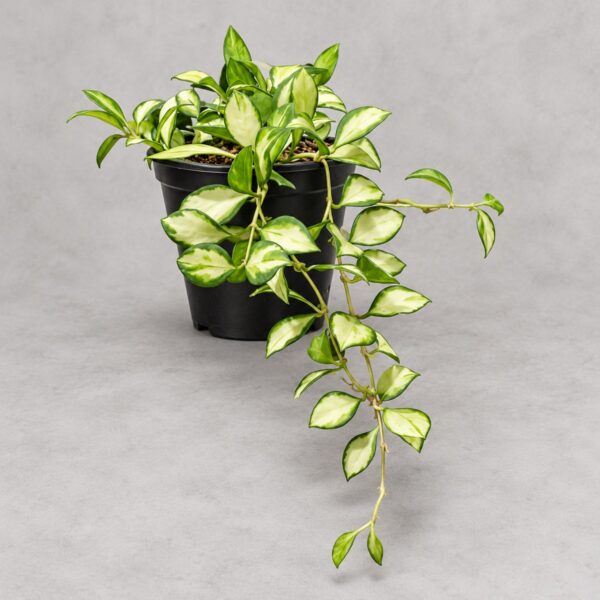
Long leaves edged with a rock-candy-like creamy-yellow border, with new growth blushing soft pink under bright light — an elegant cascade like a green waterfall.
Origin & characteristics
- Native range: the Philippines
- Classification: Apocynaceae, genus Hoya
- Growth habit: epiphytic climbing vine with thin, flexible stems, suited to hanging pots or a small trellis
- Leaf characteristics: long-oval to lance-shaped succulent leaves, with a creamy yellow to ivory-white variegated margin and deep green centre; new leaves develop a lovely pink blush under ample light, adding real ornamental appeal
- Flower characteristics: mature plants produce small star-shaped flowers in umbel clusters, reddish-brown to pink, with a light sweet fragrance
- Growth rate: moderate to slow, as variegation reduces photosynthetic efficiency
- Size: vines can reach 1–1.5 metres, typically kept at 30–60 cm as an indoor potted plant
- Also known as: Variegated Kentiana, Rock Candy Hoya
Light
| Item | Recommendation |
|---|---|
| Ideal light | Bright indirect light, 6–8 hours daily |
| Best placement | East- or southeast-facing windowsills, tolerating gentle morning direct sun |
| Avoid | Harsh west-facing afternoon sun, which scorches the variegated leaf margin |
| Tip | Ample light makes the variegation more vivid and new leaves develop that pink blush; insufficient light causes the variegation to fade and stems to become sparse and leggy |
💡 Plantjai tip: if the creamy margin starts turning green, that's your plant's way of telling you it needs more light!
Watering
| Season | Frequency | Notes |
|---|---|---|
| Spring/summer (growing) | Water thoroughly once the topsoil dries out, roughly every 7–10 days | The succulent leaves store water well and tolerate drought |
| Autumn/winter (dormant) | Reduce to every 10–14 days | Water once the soil is nearly fully dry |
Watering principles:
- Insert a finger 2–3 cm into the soil, and only water once it feels dry
- Water slowly and evenly until it drains from the base
- Empty the saucer to prevent roots sitting in water long-term
- This variegated cultivar grows more slowly and needs less water than solid green forms — remember "better dry than wet"
⚠️ Root rot warning: the most common cause of root rot in this variegated Kentiana is actually "over-caring" — watering every time you think it might be dry, when the roots are actually still wet!
Soil & pot
Recommended soil recipe:
- Orchid mix (bark/coconut husk chips): 40%
- Perlite or pumice: 25%
- Coco coir or peat: 25%
- Charcoal chips: 10%
Key point: drainage and aeration come first, mimicking its natural epiphytic environment in the wild.
Pot choice:
- Terracotta is the top choice, offering the best breathability
- Plastic pots need clear, unobstructed drainage holes
- Hoyas like their roots "a bit snug" and don't need frequent repotting into larger pots
When to repot: roughly every 2–3 years, in spring. Consider repotting once roots wrap around the base or emerge from the drainage holes.
Temperature & humidity
| Item | Ideal range | Minimum tolerance |
|---|---|---|
| Temperature | 16–29°C | 10°C |
| Humidity | 50–80% | 40% |
- Typical Hong Kong indoor conditions suit it well
- Keep it away from heater vents in autumn/winter — hot, dry air can cause brown leaf tips
- Higher humidity promotes growth and flowering, but must be paired with good ventilation
- A humidity tray or occasional misting of the surrounding area both help raise humidity
Common problems
| Issue | Likely cause | What to do |
|---|---|---|
| Wrinkled, soft leaves | Underwatering or root rot | Check the soil; if root rot is present, trim affected roots and repot with fresh mix |
| Variegated margin turning green | Insufficient light | Move closer to a window, gradually increasing light intensity |
| Leggy stems, widely spaced leaves | Severe light deficiency | Increase light exposure time, using a grow light if needed |
| Brown spots on leaves | Sunburn or cold damage | Damaged leaves won't recover — adjust placement to prevent further decline |
| Leaf drop | Cold damage, overwatering, or severe drought | Check environmental and soil conditions, addressing the specific cause |
| Persistently won't flower | Immature plant, insufficient light, or insufficient temperature differential | Plants generally mature after 2+ years; a slight autumn/winter temperature differential helps encourage blooming |
| Mealybugs | Poor ventilation or spread from nearby plants | Wipe with an alcohol-soaked cotton swab, or spray with neem oil |
How to explain to customers
"What people love most about this variegated Kentiana Hoya is that creamy-yellow margin on the leaves — it genuinely looks like rock candy! If there's enough light, new leaves even come out with a soft pink blush, really pretty. It's a trailing variety, so hanging it up high or on a bookshelf lets the vines cascade down beautifully. For watering, remember to let it dry out fully first, since the roots really don't like sitting in moisture. It's non-toxic to cats and dogs, so you can grow it worry-free!"
Fun facts
- Although this variegated Kentiana's flowers are tiny, they release a subtle sweet fragrance, especially noticeable in the evening — making it one of the rare foliage varieties that's both beautiful to look at and lovely to smell.
- Never cut off the peduncle after a Hoya flowers! The same flowering spot can rebloom year after year, with older plants producing even more flowering points over time.
- Hoya kentiana is often confused with Hoya wayetii — the two have similar leaf shapes, but wayetii has distinctly wavy leaf margins, while kentiana's are flatter.
Keywords
Plantjai, variegated Kentiana Hoya, Hoya kentiana variegata, rock candy Hoya, Hoya, central variegation, variegated leaves, creamy yellow margin, climbing plant, trailing plant, fragrant flowers, non-toxic to pets, indoor plant, Hong Kong potted plant, foliage plant, epiphyte, succulent leaves, Philippine Hoya
參考資料(想知來源可展開)
References
- Royal Botanic Gardens, Kew — Plants of the World Online: genus Hoya, https://powo.science.kew.org/
- ASPCA — Toxic and Non-Toxic Plant List, https://www.aspca.org/pet-care/animal-poison-control/toxic-and-non-toxic-plants
⚠️ Non-toxic to cats and dogs; sap may cause mild skin irritation in sensitive individuals.
Plantjai · Causeway Bay collector indoor plants · WhatsApp +852 66807550
For Hong Kong homes and offices. Stock and pricing follow the product page.
IN STORE NOW
Plants for this guide
Related plants in stock now — live prices, delivery or Causeway Bay pickup.
FREE PLANT ADVICE
Send us a photo before you change anything
WhatsApp a photo of the plant and your window light. Our Causeway Bay team will suggest care steps or plants that suit your space.
STORE · CAUSEWAY BAY
4/F, 39 Yiu Wa Street, Causeway Bay
Daily 12:30–8:00pm · ~3 min walk from Times Square
Map & directionsPlant Care