
How to Care for Anthurium Clavigerum in Hong Kong | Plantjai

Plantjai 植仔 · Care Encyclopedia
Anthurium Clavigerum
Hong Kong care guide — useful before you buy and after it arrives.
Shop this plantSilver-white veins scattered across the leaf like fallen snowflakes — a dreamy velvet foliage plant that's hard not to fall for.
Botanical note: "clarvigerum" may be a historical variant spelling, and reliable sources indicate the correct name is likely Anthurium clavigerum, as confirmed by Kew's Plants of the World Online database.
Origin & characteristics
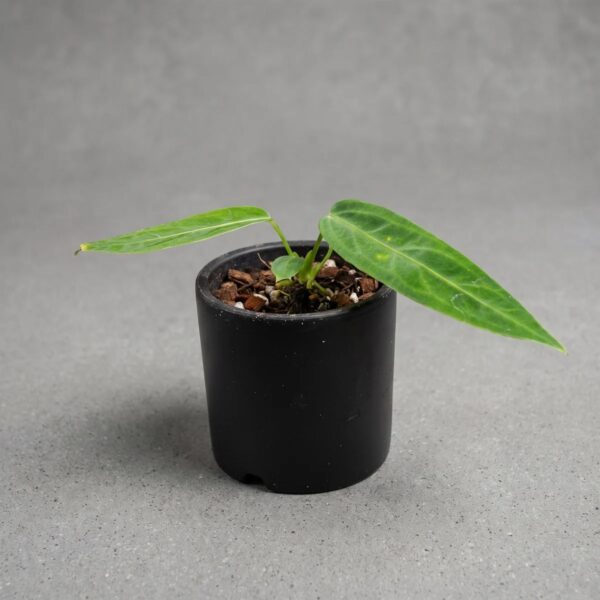
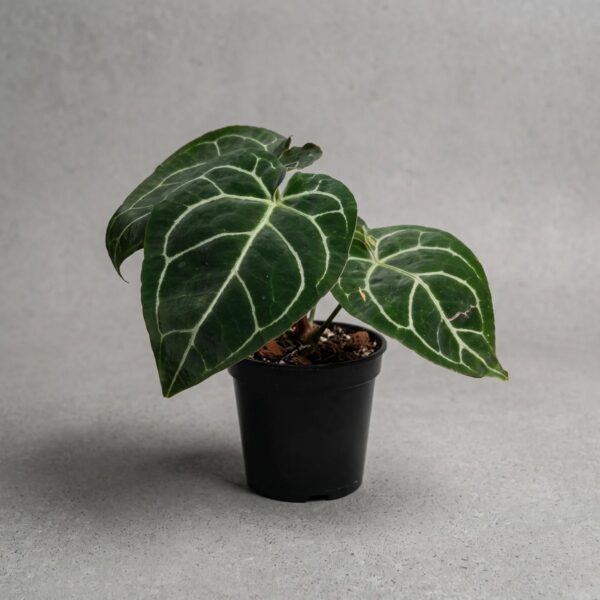
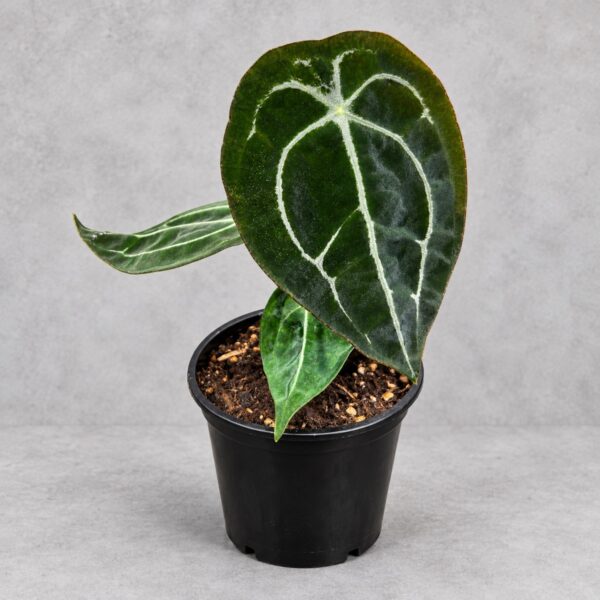
Snowflake Anthurium is native to Central and South America's tropical rainforests, a small-to-medium Anthurium species. Its leaves have a deep green velvet texture, and its most captivating feature is silver-white veining scattered across the leaf like fallen snowflakes, hence the name. Leaves are rounded to heart-shaped, with a thick texture. Growth is moderate, well suited to indoor display, and it's become a popular mid-tier collector's plant in recent years.
Light
Likes bright, diffused light, with east- or north-facing windowsills best. The reflective venation needs enough light to really shine, but direct sun will damage the velvety leaves. If the snowflake pattern dims, that's a sign of insufficient light; scorched leaf edges mean the light is too strong. Aim for 6–8 hours of gentle daily light, using a grow light at 30–45 cm distance if needed.
Watering
Water once the soil has dried 2–3 cm below the surface, roughly every 7–10 days, extending to 10–14 days in winter. Use room-temperature filtered or settled water, avoiding cold water that could shock the roots. Water slowly around the pot edge until it drains from the base, then empty the saucer after about 30 minutes. Snowflake Anthurium likes moisture, but its roots absolutely cannot sit in water for extended periods, since root rot is very hard to reverse once it sets in.
Soil & pot
Needs an extremely well-draining, coarse-grained mix: pine bark 40% + perlite 25% + coconut husk fibre 20% + sphagnum moss 10% + bamboo charcoal 5%. Maintain pH 5.5–6.5. Drainage holes are essential — a clear orchid pot is the most convenient for spotting healthy white roots. Avoid an oversized pot. Repot every 1–2 years in spring, sizing up by just one pot size each time.
Temperature & humidity
Ideal temperature 20–26°C; growth slows below 15°C, and there's frost-damage risk below 10°C. Humidity must be at least 60%, ideally 70–80% — low humidity causes the snowflake pattern's edges to dry out. A humidifier, pebble tray, or growing in a glass cabinet all help maintain humidity. Good air circulation is essential — stuffy, humid conditions easily lead to fungal disease and pest problems.
Common problems
| Issue | Likely cause | What to do |
|---|---|---|
| Fading or disappearing snowflake pattern | Mostly light too dim; or humidity too low | Move to a brighter spot, or increase humidity |
| Dry, yellowing leaf edges | Insufficient humidity or fertiliser salt buildup | Raise humidity first, then flush the soil thoroughly with plain water |
| Thin, soft leaves | Overwatering leading to root rot | Stop watering immediately, check roots, repot and trim roots if needed |
| Stalled growth, no new leaves | Temperature too low, or the pot may be root-bound | Check the environment and consider repotting |
Pet and child safety
⚠️ Anthuriums contain calcium oxalate crystals and are toxic! Ingestion causes severe burning of the mouth and throat, drooling, vomiting, and possibly difficulty breathing. Keep well out of reach of pets and children; wash hands thoroughly after handling, and avoid touching your face. Seek medical attention immediately if ingestion occurs.
How to explain to customers
"Snowflake Anthurium's silver-white veining really does look like fallen snow — a gorgeous addition to a study or living room. Humidity is really the key to growing it well — a humidifier, or grouping it with other plants, makes a real difference."
Fun facts
The silver-white venation on Snowflake Anthurium's leaves is actually a special tissue called sclerenchyma, which not only looks beautiful but also provides structural support and helps direct light deeper into the leaf. In the wild, these reflective veins channel weak, diffused light down into the leaf's interior, improving photosynthesis efficiency in the low-light rainforest understorey.
Keywords
Snowflake Anthurium, Anthurium clarvigerum, silver-veined Anthurium, velvet foliage, crystal-vein pattern, tropical rainforest plant, mid-tier Anthurium, high-humidity plant, indoor foliage plant, Plantjai
參考資料(想知來源可展開)
References
- Plants of the World Online (POWO), Royal Botanic Gardens, Kew — Anthurium clavigerum. https://powo.science.kew.org/taxon/urn:lsid:ipni.org:names:84666-1
- Croat, T.B. (1983). A revision of the genus Anthurium (Araceae) of Mexico and Central America. Annals of the Missouri Botanical Garden, 70(2), 211-420.
- Royal Horticultural Society (RHS) — How to grow anthuriums. https://www.rhs.org.uk/plants/anthuriums/how-to-grow-anthuriums
- Proven Winners — Caring for Anthurium Plants Indoors. https://www.provenwinners.com/learn/houseplants/anthurium
In-depth care guide
Introduction
Snowflake Anthurium, scientifically named Anthurium clavigerum, is a genuinely dramatic large-growing foliage plant within the genus Anthurium. Its scientific name is sometimes spelled "clarvigerum," but according to the Plants of the World Online database maintained by the Royal Botanic Gardens, Kew, the correct name is Anthurium clavigerum (POWO, 2011). Its common name, "Snowflake Anthurium," comes from the deeply divided, snowflake-like form of its mature leaf and the striking white venation, together evoking the feel of falling snow.
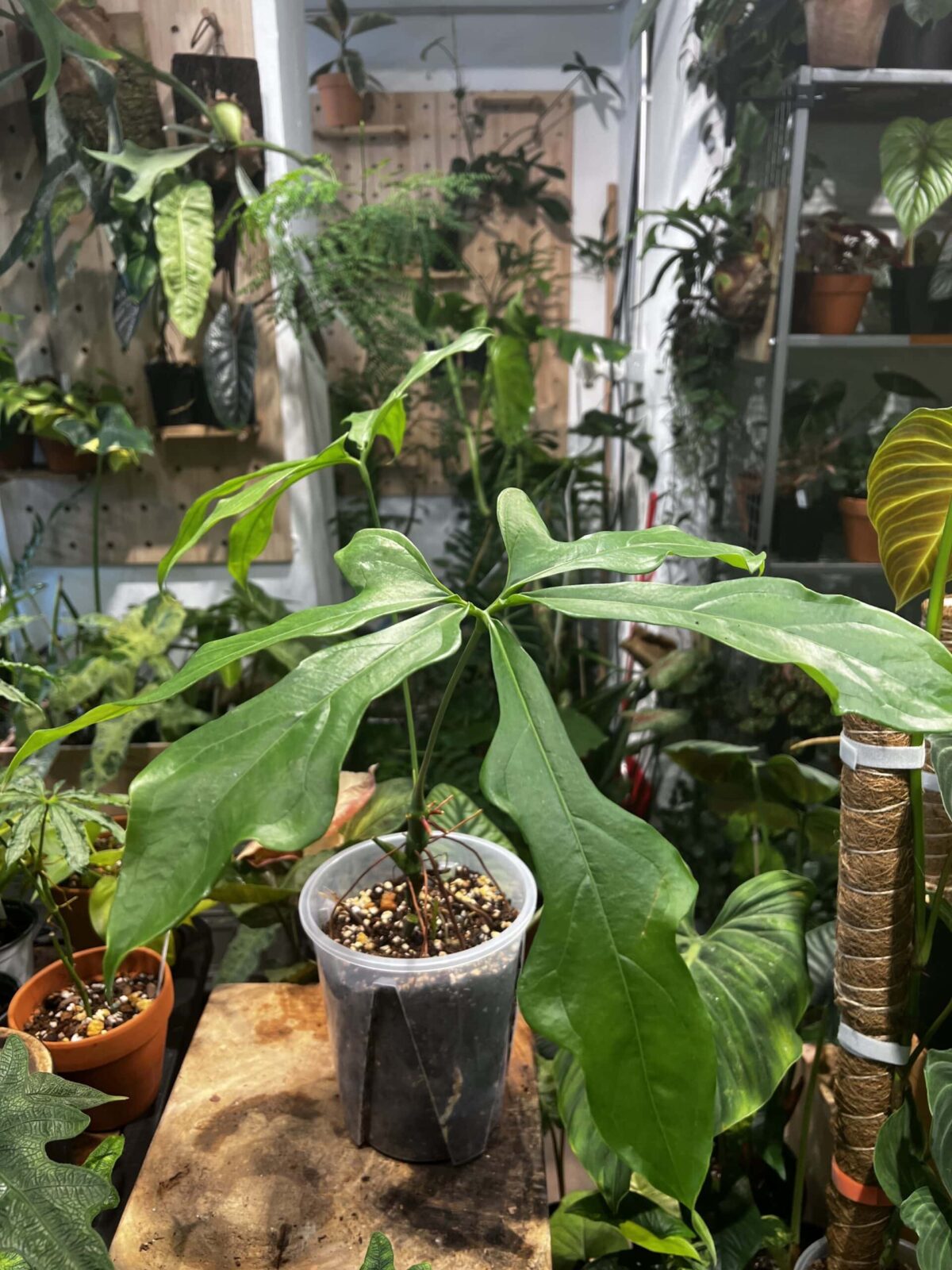
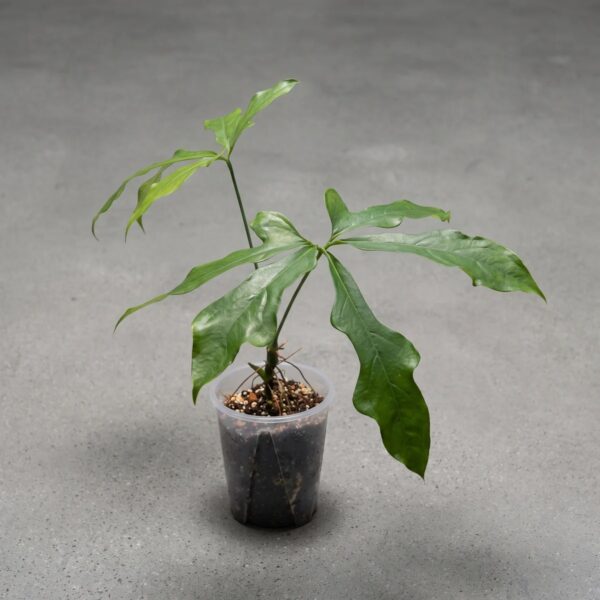
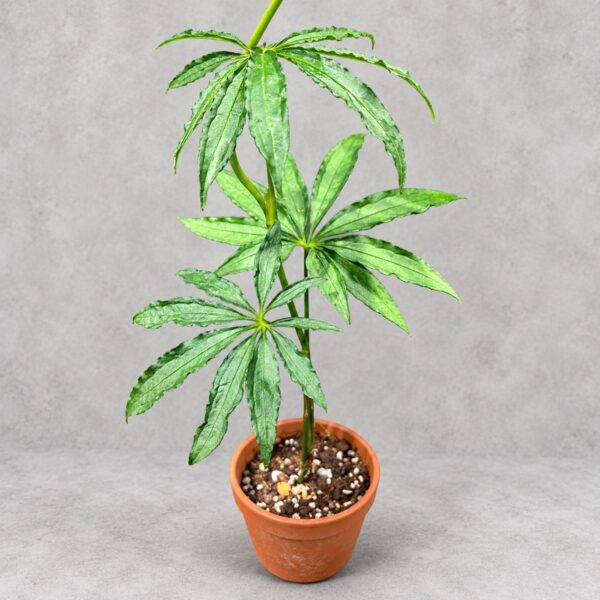
The single most striking feature of Anthurium clavigerum is its enormous, deeply lobed, palmate leaves. According to Wikipedia and Missouri Botanical Garden records, its main stem can grow several metres long, and a single mature leaf can exceed two metres in diameter — making it the largest-leaved species of any Anthurium native to Central America (Wikipedia, 2011; Croat, 1983). The leaf is deeply divided into a palmate shape, sometimes with wavy margins, thick and glossy in texture, with clearly raised veining, giving the overall form more than a passing resemblance to an oak leaf.
This species is a compact climbing epiphyte (Grow Tropicals, n.d.), attaching to large trees in the wild and climbing upward, with mature leaves drooping downward to form a dramatically tropical, rainforest-like display. While indoor cultivation can't replicate its full wild scale, good care still produces impressively large, striking foliage.
Native distribution
Anthurium clavigerum's native range is remarkably broad, extending from Honduras in Central America down through central and western Brazil in South America, passing through Nicaragua, Costa Rica, Panama, Colombia, Venezuela, Guyana, French Guiana, Suriname, Ecuador, Peru, and Bolivia (POWO, 2011). It grows primarily in warm, humid tropical rainforests, attaching epiphytically to large trees — a classic example of a tropical rainforest biome plant.
According to Deni Bown's Aroids: Plants of the Arum Family, Anthurium clavigerum is a highly representative species within the genus, and its enormous palmate leaves are quite well known in tropical botany circles (Bown, 2000).
Light requirements
Snowflake Anthurium needs bright but soft, diffused light. In its native environment, it grows between the understorey and mid-canopy of the rainforest, receiving indirect light filtered through the canopy above. Position it near an east- or north-facing window, allowing it to enjoy plenty of gentle, non-glaring natural light.
Avoid direct sunlight, especially strong midday sun — even though the large leaves are fairly thick, prolonged sun exposure will still cause sunburn spots. If light is too weak, new leaves will come in smaller, with reduced lobing, and overall growth will slow noticeably. Rotating the pot regularly ensures even growth on all sides, preventing the plant from leaning toward one direction.
If natural light is insufficient, consider a full-spectrum plant grow light, providing about ten to twelve hours of illumination daily. For a large species like this, adequate light is genuinely essential for maintaining healthy growth and its impressively dramatic foliage.
Watering method
Snowflake Anthurium's watering principle is "moist, but never waterlogged." Wait until the top two to three inches of medium begins to dry before watering again. Test by inserting a finger into the medium — if it feels slightly dry, it's time to water.
Grow Tropicals recommends that newly acquired plants should initially stay in their original nursery pot, watering only once the topsoil dries, giving the plant time to adjust to its new environment (Grow Tropicals, n.d.). In summer's peak growing season, water roughly every five to seven days; in winter, extend this to every seven to ten days.
Use filtered water, rainwater, or tap water rested overnight to reduce mineral damage to the roots. Water thoroughly in one go, letting excess water fully drain from the pot's base, then empty the saucer's standing water. Both Alocasia and Anthurium species are prone to root rot from waterlogging, so drainage should never be overlooked.
Humidity requirements
As a native epiphyte of tropical rainforests, Snowflake Anthurium has real humidity requirements, with ideal humidity maintained above 60%. If humidity persistently falls below 50%, you're likely to see dry, brittle leaf margins and difficulty with new leaves unfurling.
Ways to raise humidity include: an ultrasonic humidifier as the most direct and effective method; grouping plants together to create a shared, humid microclimate; or placing a pebble tray filled with water beneath the pot (keeping the water level below the pot's base). Maintaining good air circulation is important too — a stuffy, humid, windless environment can easily lead to fungal disease.
For this large species in particular, a stable high-humidity environment is especially important for new leaves to unfurl smoothly. Insufficient humidity often causes new leaves to get "stuck," resulting in permanent creases or damage.
Temperature control
Snowflake Anthurium's ideal growing temperature range is 18–27°C. It doesn't tolerate cold, with growth noticeably slowing below 15°C, and prolonged exposure below 10°C potentially causing frost damage. Avoid direct AC exposure in summer, and keep it away from cold window draughts and heater vents in winter.
Given its broad native distribution, from Central America down to low-elevation Amazonian regions, its temperature tolerance is relatively wide, but warm and stable conditions remain ideal. When winter temperatures drop, move the plant indoors to a warm spot, or use a plant-specific heating mat.
Growing medium
Snowflake Anthurium needs a well-draining, extremely well-aerated growing medium. A recommended coarse-grain mixed formula is: 40% orchid bark + 30% perlite + 20% coco coir + 10% sphagnum moss. This combination ensures water drains away quickly while retaining enough moisture for the roots to absorb.
According to RHS recommendations, Anthurium-type plants need an orchid-like medium, providing ample drainage and airflow around the root system (RHS, 2026). Avoid using standard garden potting soil, since it's too dense and prone to waterlogging, which is very harmful to Anthurium root health.
For pots, choose either plastic or ceramic with drainage holes. Plastic pots help retain moisture better, while ceramic pots offer superior breathability. Since Snowflake Anthurium is a climbing species, mature plants may need a support structure (such as a coir pole or bark board) to climb.
Feeding recommendations
During the growing season (spring through autumn), apply a diluted balanced liquid fertiliser (such as NPK 20-20-20) once a month, diluted to half strength. RHS recommends using an orchid-specific fertiliser, since Anthurium's growing conditions resemble those of orchids (RHS, 2026). Ensure the medium is already moist before feeding, avoiding concentrated fertiliser contacting dry roots.
Because Snowflake Anthurium's leaves are enormous, growth demands more nutrients, but overfeeding will still cause scorched leaf tips or salt buildup in the medium. Pause feeding in winter as growth slows. If you notice slow new leaf growth with pale colouring, that may indicate a nutrient deficiency.
Repotting timing
Snowflake Anthurium typically needs repotting every one to two years, ideally in spring. Once you see roots filling the pot or even emerging from the drainage holes, it's time to size up. A new pot roughly 2–3 cm larger in diameter is sufficient — there's no need to jump to a much bigger size at once.
When repotting, gently loosen tangled roots, trim away any rotten or blackened sections, then plant into fresh medium. Because Snowflake Anthurium's leaves are relatively large, take care to support the foliage during repotting to avoid breaking or damaging it. Afterward, place the plant in bright, indirect light to recover for a few days.
Pruning and maintenance
Snowflake Anthurium doesn't need particular pruning — mainly just removing yellowed, damaged, or aged leaves, which helps keep the plant looking tidy and encourages new growth. Use clean, sharp scissors and cut at the base of the petiole. Remember to wear gloves, since Anthurium sap contains irritant compounds.
Regularly wipe the leaf surface with a soft, damp cloth to remove dust and keep the leaves clean and glossy. Clean large leaves gently to avoid mechanical damage, and regularly check the leaf undersides for signs of pests, addressing them early.
Propagation methods
Snowflake Anthurium can be propagated in several ways. According to RHS recommendations, you can cut a stem section together with a leaf and aerial roots, place it in clean water, and position it somewhere warm and bright until roots develop, then transplant into a pot (RHS, 2026). Alternatively, in spring, a multi-stemmed plant can be divided, with each division retaining healthy roots and leaves before potting separately.
As a large species, Snowflake Anthurium requires more space when propagating. Newly propagated plants also need considerable time before they develop the large, characteristically lobed leaves of the species, so patience is essential.
Common problems
Brown spots on leaves: could be sunburn from direct sunlight, or fungal infection from water sitting on the leaf surface too long. Adjust the plant's position away from strong light, and try to avoid getting the leaf surface wet when watering.
Smaller new leaves, reduced lobing: usually a sign of insufficient light or nutrients. Check the light intensity at the plant's location, and consider increasing feeding frequency.
Dry leaf margins: low humidity is the most common cause. Increase environmental humidity, particularly while new leaves are unfurling.
Root rot: overwatering is the main cause. Anthurium roots need plenty of oxygen, and the medium absolutely cannot stay soggy for extended periods. If roots turn soft and black, repot immediately, trim away the rotten sections, and replant in fresh, dry medium.
Stalled growth: winter cold may cause growth to slow, which is normal. But if growth stalls even in spring and summer, check light, humidity, feeding, and root health.
Toxicity information
Like all Anthurium species, Snowflake Anthurium contains calcium oxalate crystals, toxic to both humans and pets. Ingestion may cause burning of the mouth, tongue, and throat, excessive drooling, vomiting, and difficulty swallowing (Chalet Boutique, 2023). Skin contact with the sap can also cause irritation; wear gloves when handling. Keep the plant somewhere children and pets cannot reach.
References
- Plants of the World Online (POWO), Royal Botanic Gardens, Kew. (2011). Anthurium clavigerum. https://powo.science.kew.org/taxon/urn:lsid:ipni.org:names:84666-1
- Wikipedia. (2011). Anthurium clavigerum. https://en.wikipedia.org/wiki/Anthurium_clavigerum
- Croat, T.B. (1983). A revision of the genus Anthurium (Araceae) of Mexico and Central America. Annals of the Missouri Botanical Garden, 70(2), 211-420.
- Bown, D. (2000). Aroids: Plants of the Arum Family. Timber Press. ISBN 978-0-88192-485-5
- Madison, M. (1978). The Species of Anthurium with Palmately Divided Leaves. Selbyana, 2(2/3), 239-282.
- Grow Tropicals. (n.d.). Anthurium clavigerum. https://growtropicals.com/products/anthurium-clavigerum
- Royal Horticultural Society (RHS). (2026). How to grow anthuriums. https://www.rhs.org.uk/plants/anthuriums/how-to-grow-anthuriums
- Chalet Boutique. (2023). Anthurium Plant Care Guide. https://chaletboutique.com/blogs/plant-care/anthurium-plant-care-guide
- Proven Winners. (n.d.). Caring for Anthurium Plants Indoors. https://www.provenwinners.com/learn/houseplants/anthurium
Plantjai shop · In stock online
Anthurium clarvigerum
Anthurium clarvigerum
Original price was: HK$788.00.HK$480.00Current price is: HK$480.00.
Hong Kong delivery · Causeway Bay pickup
For Hong Kong homes and offices. Stock and pricing follow the product page.
IN STORE NOW
Plants for this guide
Related plants in stock now — live prices, delivery or Causeway Bay pickup.
Anthurium crystallinum
Anthurium crystallinum
Original price was: HK$780.00.HK$380.00Current price is: HK$380.00.
In stock · store pickup
View plant
FREE PLANT ADVICE
Send us a photo before you change anything
WhatsApp a photo of the plant and your window light. Our Causeway Bay team will suggest care steps or plants that suit your space.
STORE · CAUSEWAY BAY
4/F, 39 Yiu Wa Street, Causeway Bay
Daily 12:30–8:00pm · ~3 min walk from Times Square
Map & directionsPlant Care