How to Care for Alocasia Black Stem Varieata in Hong Kong | Plantjai


Plantjai 植仔 · Care Encyclopedia
Alocasia Black Stem Varieata
Alocasia Black Stem Varieata 紫脈海芋錦
Hong Kong care guide — useful before you buy and after it arrives.
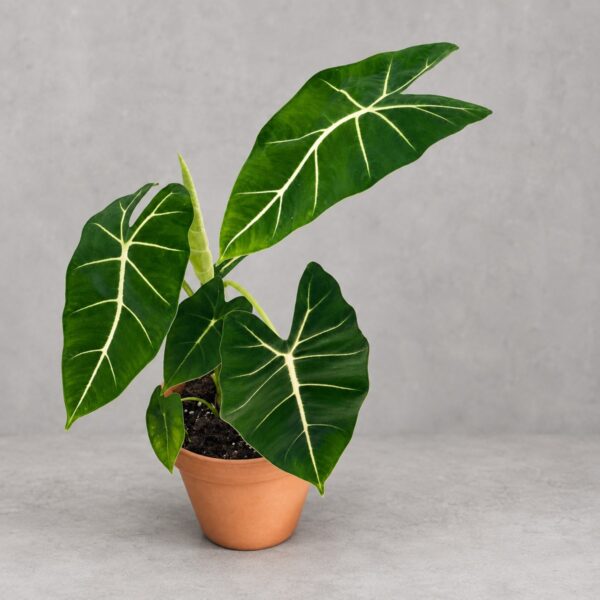
Shop this plantNear-black stems holding up giant green-and-white marbled leaves — the drama queen of the Alocasia world.
Origin & characteristics
Black Stem Variegata is a variegated cultivar of Alocasia macrorrhizos, the giant taro, whose parent species is native to Southeast Asian rainforest through to Queensland, Australia. Its most striking feature is a thick, deep purple-black petiole supporting enormous leaves splashed with green and cream-white variegation. Indoors it can reach two metres tall, bringing serious tropical presence to a room. Because the white sections lack chlorophyll, they need brighter light to stay vivid without scorching — a genuine balancing act that makes this an advanced-level showpiece plant.
Light
Needs bright, indirect light — close to an east-facing window, or 1–2 m from a south-facing one. The variegated areas need enough light to avoid reverting to green, but the white patches scorch easily in direct sun, so avoid harsh rays entirely. Gentle morning sun is fine. Too little light causes new leaves to come in fully green, losing the plant's signature look.
Watering
Keep the soil lightly moist through the growing season; water once the top 2–3 cm has dried. Never let it sit in water, and extend the interval between waterings in winter. Large pots can stay damp at the centre even when the surface looks dry, so check with a finger before watering. Use room-temperature water — this plant's roots are highly sensitive to waterlogging, and it's better to run slightly dry than slightly wet.
Soil & pot
Use a chunky, well-draining aroid mix: 40% coco coir or peat, 30% perlite or pumice, 30% orchid bark. Always choose a pot with drainage holes. Because mature plants get tall and top-heavy, a heavier ceramic pot adds welcome stability. Avoid oversized pots, which hold excess moisture and invite rot.
Temperature & humidity
Ideal range is 20–30°C; growth stalls and roots become vulnerable to cold damage below 15°C. Hong Kong air-conditioned rooms are generally fine, but keep the plant well away from direct AC airflow. Humidity of 60–80% is ideal — the large leaves lose moisture quickly, so place a humidifier nearby or group with other plants. Dry air causes crisping leaf edges.
Common problems
| Issue | Likely cause | What to do |
|---|---|---|
| Petiole colour fading | Insufficient light or stalled growth | Move to a brighter, warmer spot |
| Variegation turning green | Light too low | Increase diffused light strength |
| White patches scorched | Direct sun or excessive light | Add a sheer curtain or move away from the window |
| Lower leaves yellowing | Overwatering, nutrient deficiency, or natural ageing | Check soil moisture and root health |
| Small new leaves | Underdeveloped roots, low light, or cool temperatures | Review overall growing conditions |
| Crispy leaf edges | Air too dry | Raise humidity |
How to explain to customers
"The showstopper on this one is the deep purple-black stem holding up those huge green-and-white leaves — it instantly elevates any room. Just keep direct sun off the white patches, they'll scorch, and it's toxic, so keep it well away from kids and pets."
Fun facts
Alocasia macrorrhizos is one of the largest species in the genus, reaching up to four metres in the wild. The stem's deep purple-black colour intensifies with the plant's age, light exposure, and overall vigour — the healthier and better-grown the plant, the darker and richer the stem colour becomes.
Keywords
Black Stem Variegata, Alocasia macrorrhizos, variegated Alocasia, giant taro, elephant ear, large foliage plant, tropical statement plant, advanced houseplant, toxic to pets
參考資料(想知來源可展開)
References
- Plants of the World Online (Kew) — Alocasia macrorrhizos. https://powo.science.kew.org
- RHS — Alocasia care. https://www.rhs.org.uk/plants/alocasia
- Proven Winners — How to Grow Alocasia Indoors and Outdoors. https://www.provenwinners.com/learn/houseplants/alocasia
⚠️ Pet / toxicity note: Contains calcium oxalate crystals; toxic if ingested, causing oral pain, swelling, drooling, and in severe cases breathing difficulty. Keep away from pets and children, and wash hands after pruning.
In-depth care guide
Introduction
Black Stem Variegata (Alocasia macrorrhizos 'Black Stem Variegata') is a dream-tier variegated cultivar within the Araceae family, derived from Alocasia macrorrhizos — commonly known as giant taro or elephant ear. Its most arresting feature is a thick, upright petiole in near-black purple, supporting huge leaves marbled with white or cream variegation in patterns that are unique to every leaf.
As a variegated form of A. macrorrhizos, it inherits the parent species' vigorous, towering growth habit, reaching 1–2 m indoors — a genuinely commanding presence for a large living room or office lobby. Because the variegated portions lack chlorophyll and therefore contribute less to photosynthesis, growth is slower than the fully green species, and the plant is noticeably more demanding about its environment, placing it firmly in the advanced-collector category.
1. Light requirements
Black Stem Variegata needs more light than an ordinary Alocasia, since the variegated tissue must be compensated for by the green portions of the leaf.
Ideal conditions
- Bright indirect light, ideally near an east- or west-facing window
- 1–2 m back from a south-facing window, filtered through a sheer curtain
- Avoid direct midday sun, especially in summer
The variegation balancing act
The white or cream areas are especially delicate — direct sun quickly causes yellow-brown scorch marks. But too little light has the opposite problem: variegation gradually fades, and new leaves come in almost entirely green. Growers who've kept this plant more than a metre from an east window have reported new leaves emerging nearly solid green; moving the plant to within 1–2 m of a bright window restored clear white variegation on the next leaf.
Reading the signals
| Sign | Cause | Fix |
|---|---|---|
| New leaves mostly green | Light too weak | Move closer to a light source |
| Scorching on variegated areas | Light too strong | Add a sheer curtain or move further back |
| Thin, soft leaves | Prolonged low light | Gradually increase light exposure |
2. Temperature requirements
Like all tropical Alocasias, Black Stem Variegata wants warmth and stability.
Ideal ranges
- Active growth: 20–29°C
- Dormant/resting period: keep above 18°C
- Minimum tolerance: 15°C — root damage becomes likely below this
Management tips
- Keep well away from AC vents, drafty doors/windows, and heaters
- Be cautious of cold drafts when opening windows in autumn and winter
- Larger specimens are more sensitive to temperature swings simply due to their size
- Sustained cold combined with wet soil is the leading cause of root rot
3. Humidity management
This plant wants relatively high air moisture, ideally 60–80%.
Signs of insufficient humidity
- Yellow or brown, crispy leaf margins
- Malformed or torn new leaves as they unfurl
- Stalled growth, dull leaf surface
Ways to raise humidity
- Humidifier — especially valuable when AC or heating is running
- Pebble tray — a wide tray of pebbles topped up with water below the pot's base
- Grouping plants together to create a shared microclimate
- Occasional misting — helpful as a supplement, not a substitute for the above
Variegated cultivars are particularly prone to crispy leaf margins in low humidity, so daily misting or a dedicated humidifier is worth the investment to keep the plant looking its best.
4. Watering technique
Watering needs special care, since variegated plants grow more slowly and take up water less readily than their fully green counterparts.
The key principle
Do not water a variegated Alocasia on the same schedule as a green one. Reduced chlorophyll means slower metabolism — watering at a "normal" Alocasia pace easily leads to waterlogging and rot.
Correct method
- Insert a finger 3–5 cm into the soil; water only once it feels dry
- For large pots, you can wait until the soil is more than half dry
- Always water thoroughly until it runs from the drainage holes
- Empty the saucer within 15 minutes
- Cut back significantly on watering frequency in winter
Warning signs of overwatering
Growers have observed that keeping the soil too consistently wet often shows up first as yellowing in the variegated sections — an early indicator of root stress. Switching to a "let it dry halfway" rule typically resolves the issue.
Water quality
- Best: rainwater, distilled water
- Acceptable: tap water rested 24 hours
- Avoid hard, high-mineral water
5. Soil recipe
Black Stem Variegata needs an extremely free-draining medium, since its roots are more rot-prone than standard green Alocasias.
Recommended mix
- 30% coarse perlite (3–5 mm)
- 30% orchid bark (1–2 cm chunks)
- 25% low-salt coco coir
- 10% horticultural charcoal
- 5% coarse sand
This blend drains rapidly and effectively prevents waterlogging. The relatively high bark content increases pore space within the mix.
Pot choice
- Terracotta or concrete pots are ideal for breathability and moisture cycling
- Drainage holes are essential and should be generously sized
- Avoid oversized pots — excess soil volume takes longer to dry
- Size up only 2–3 cm in diameter at each repot
6. Feeding
This is a light feeder, and fertilising needs a cautious hand.
Recommendations
- Use a balanced liquid fertiliser (NPK 20-20-20)
- Dilute to half strength or less
- Spring/summer growth period: once a month
- Autumn/winter: reduce frequency or stop entirely
- Water the plant before feeding to protect the roots from fertiliser burn
Signs of overfeeding
- Deep leaf colour but reduced contrast in variegation
- Slow growth in new leaves
- White salt crust on the soil surface
If overfeeding is suspected, flush the soil with three times the pot's volume in distilled water to wash out excess salts.
7. Common pests and diseases
Spider mites
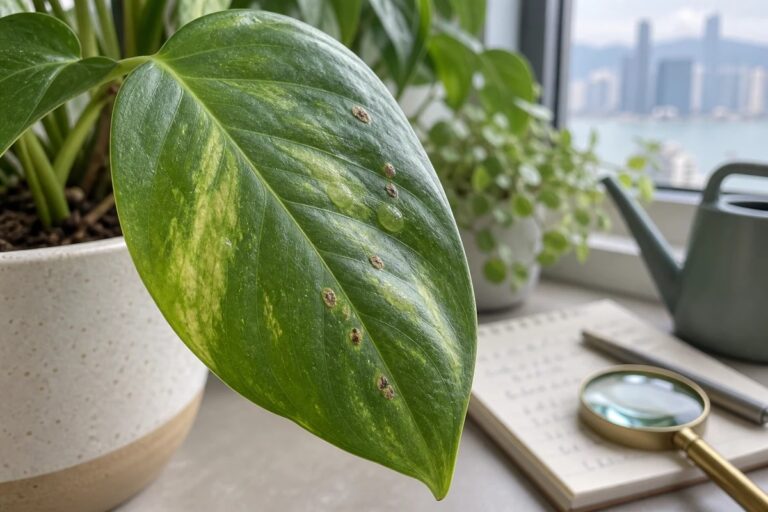
The most common pest, especially in dry conditions. Look for fine webbing under leaves and tiny yellow speckling on the surface.
Treatment: wipe leaves regularly with a slightly damp cloth; use insecticidal soap for heavier infestations.
Scale insects
Found on petioles, leaf undersides, and stems, appearing as small brown or white bumps.
Treatment: remove individually with a cotton swab dipped in alcohol; use neem oil for widespread infestations.
Whitefly
Tiny white flying insects clustering on leaf undersides.
Treatment: yellow sticky traps for monitoring; insecticide for severe cases.
Root rot
Almost always caused by overwatering or poor drainage.
Treatment: unpot, trim away rotten roots, and repot into fresh, free-draining mix. Adjust your watering routine strictly afterward.
8. Propagation
Division and corm propagation are the most reliable methods.
Division
- Best done during spring repotting
- Gently loosen the roots and separate offsets that have their own growth point
- Each division should retain several roots
- Pot into fresh soil and keep warm and moist
Corm propagation
- Collect small corms found near the base of the mother plant during repotting
- Let them dry for 1–2 days in a warm, dry spot to callous over
- Plant in free-draining mix or sphagnum moss, kept lightly moist
- Maintain 25–28°C; expect sprouting in 2–4 weeks
Stem cuttings
- Suitable for mature plants over four years old
- Choose a side branch with at least two leaves
- Cut with a sterilised blade, keeping as much stem as possible
- Root in water or soil, covering soil-rooted cuttings with a humidity bag
- Keep warm and in bright, indirect light
9. Repotting guide
Timing
- Every 1–2 years
- When roots emerge from drainage holes
- When soil dries unusually quickly
- Best done in spring before new growth begins
Steps
- Water thoroughly the day before repotting
- Gently loosen the old soil and inspect root health
- Trim away any rotten or dried-out roots
- Choose a new pot 2–3 cm larger in diameter
- Plant in fresh, free-draining mix
- Water in well and place somewhere bright and well-ventilated
10. Frequently asked questions
Q: My plant has lost its variegation — what do I do?
A: Insufficient light is the most common cause. Move the plant closer to a light source, while still protecting variegated areas from direct sun. A grow light can help if natural light is limited. Always judge the environment by the newest leaf.
Q: The stem feels soft and leaves are drooping — what's wrong?
A: This is the classic sign of overwatering and root rot. Stop watering immediately, unpot, and inspect the roots. Trim away anything rotten and repot into fresh, free-draining soil, then cut back watering significantly going forward.
Q: Can it handle direct sun?
A: It can tolerate gentle early morning or late afternoon sun, but midday direct sun should always be avoided. Variegated sections are especially vulnerable, and scorch marks are permanent.
Q: Why is it growing so slowly?
A: Variegated cultivars naturally grow slower than fully green ones, since the white portions can't photosynthesise. As long as light, temperature and humidity are all adequate, slow growth is completely normal.
Q: Is it toxic?
A: Yes. It contains calcium oxalate crystals, which cause oral pain, drooling and vomiting if ingested. Keep it away from pets and children.
References
- Plants of the World Online (Kew) — Alocasia macrorrhizos. https://powo.science.kew.org
- RHS — Alocasia care. https://www.rhs.org.uk/plants/alocasia
- Proven Winners — How to Grow Alocasia Indoors and Outdoors. https://www.provenwinners.com/learn/houseplants/alocasia
- Missouri Botanical Garden — Plant Finder, Alocasia macrorrhiza. https://www.missouribotanicalgarden.org/PlantFinder/PlantFinderDetails.aspx?taxonid=275730

Plantjai shop · In stock online
Alocasia Black Stem Varieata
HK$2,980.00
Hong Kong delivery · Causeway Bay pickup
For Hong Kong homes and offices. Stock and pricing follow the product page.
IN STORE NOW
Plants for this guide
Related plants in stock now — live prices, delivery or Causeway Bay pickup.
FREE PLANT ADVICE
Send us a photo before you change anything
WhatsApp a photo of the plant and your window light. Our Causeway Bay team will suggest care steps or plants that suit your space.
STORE · CAUSEWAY BAY
4/F, 39 Yiu Wa Street, Causeway Bay
Daily 12:30–8:00pm · ~3 min walk from Times Square
Map & directionsPlant Care