
How to Care for Syngonium Pink Splash in Hong Kong | Plantjai

Hong Kong care guide for Syngonium Pink Splash.
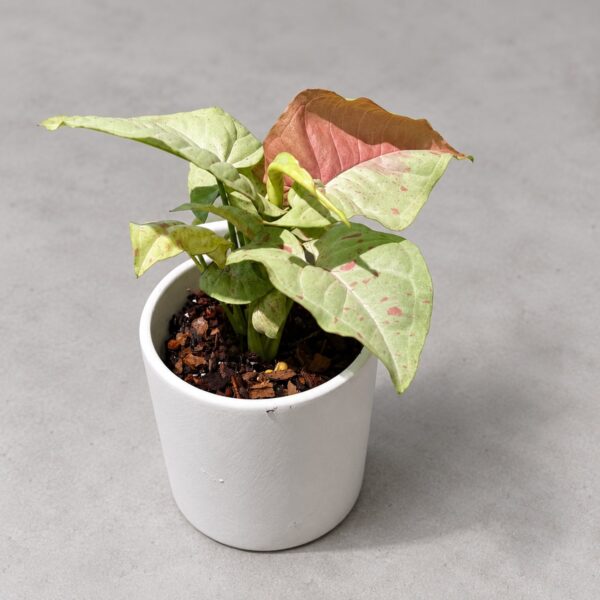
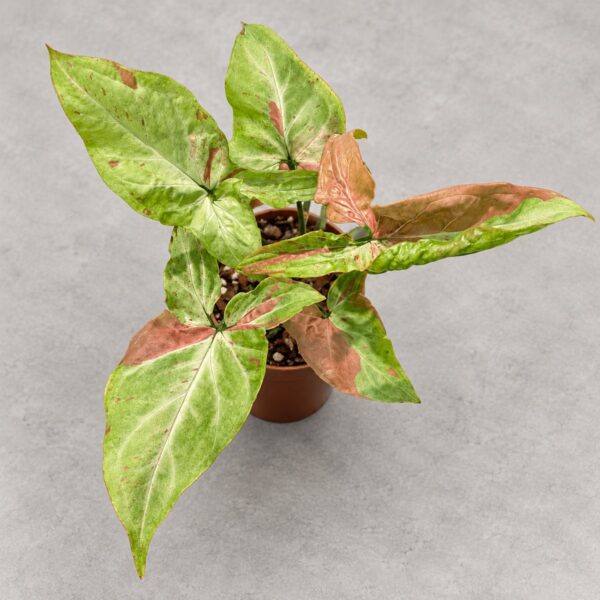
Pink speckles scattered across deep green leaves like flecks of splattered paint — every leaf a spontaneous piece of abstract art from nature.
Origin & characteristics
Pink Splash Syngonium belongs to the family Araceae, genus Syngonium, native to the tropical rainforests of Central and South America. 'Pink Splash' is a highly popular horticultural cultivar in recent years, its defining feature being the irregular pink splash patterning scattered across a deep green leaf surface, as though someone had flicked pink paint onto a green canvas — a dreamy, distinctive effect.
Unlike 'Pink Salmon,' whose whole leaf takes on a pink tone, 'Pink Splash' displays its colour as scattered spots against a green base, giving it a bolder, more eye-catching look. Young leaves are arrowhead-shaped, developing into three-lobed palmate leaves at maturity. It has a vining habit, growing at a moderate to fast pace, well suited to trailing or climbing.
⚠️ Toxicity warning: Pink Splash Syngonium contains calcium oxalate crystals and is a toxic plant. Ingestion may cause mouth pain, swelling, and drooling, and in severe cases breathing difficulty. Sap contact with skin may cause redness or an allergic reaction. Keep it somewhere out of reach of children and pets, wear gloves when handling, and wash your hands thoroughly afterward.
Light
'Pink Splash' needs bright indirect light to maintain the vividness of its pink speckling. Ample light makes the pink spots more pronounced with stronger contrast.
- Ideal placement: within 1 metre of an east- or north-facing window; a south-/west-facing window needs a sheer curtain to filter the light
- Signs of adequate light: vivid, densely distributed pink spots, with a deep, glossy green base leaf colour
- Signs of insufficient light: pink spots fade or disappear, leaves lean toward solid green, losing the cultivar's distinctive character
- Avoid: prolonged intense direct sun, especially harsh midday summer sun, which easily scorches the leaves
- Tip: at least 5-6 hours of bright indirect light daily is ideal
Watering
Follow the principle of "water thoroughly once the topsoil is dry" — better slightly dry than persistently waterlogged.
- How to check: insert a finger 2-3 cm into the soil — water once it feels dry
- Growing season (spring to autumn): roughly every 5-7 days, adjusted for weather and ambient humidity
- Dormant season (winter): roughly every 10-14 days, as the soil takes longer to dry out
- Method: water slowly around the rim until it drains from the base
- Tray runoff: empty within half an hour to avoid the roots sitting in water for too long
- Note: never let the soil stay wet for extended periods, which can easily lead to root rot and fungal disease
Soil & pot
Soil recipe
Needs a loose, breathable, well-draining, slightly acidic soil:
- Quality indoor plant potting soil 45%
- Perlite 25%
- Coco coir 15%
- Pine bark chips or coconut husk 10%
- Activated charcoal 5%
Pot choice
- Red terracotta pot: most recommended, good breathability and drainage, effectively prevents root rot
- Plastic pot: lightweight and economical, but requires more careful watering control
- Cement pot: attractive texture, suits home decor, moderate breathability
- Drainage holes: essential — a decorative pot without holes should only be used as an outer cachepot
- Repotting timing: repot once a year in spring, once roots emerge from the drainage holes or growth noticeably slows
Temperature & humidity
Temperature
- Ideal growing temperature: 20-28°C
- Minimum tolerance: 15°C — sustained cold below this stalls growth
- Summer note: above 32°C, growth may slow — ensure good ventilation
- Winter note: keep away from AC vents and drafty windows; reduce watering in cold weather
Humidity
- Ideal humidity: 50-70%
- Hong Kong climate: usually sufficient in spring/summer; needs extra humidifying in the drier autumn/winter months
- Humidifying methods:
- Mist the surrounding air (avoid spraying directly onto the leaves)
- Pebble tray method
- Group with other plants to create a humid microclimate
- A small humidifier for air-conditioned rooms
Common problems
| Issue | Likely cause | What to do |
|---|---|---|
| Pink spots fading or disappearing | Insufficient light | Move to a brighter spot, transition gradually |
| Brown edges appearing on pink spots | Sunburn or humidity too low | Avoid direct light, increase surrounding humidity |
| Whole leaf turning yellow | Overwatering / root rot | Stop watering, check roots, trim rot and repot in fresh soil |
| Leaf tips scorching yellow | Air too dry or water too hard | Increase humidity, switch to filtered water |
| Slow growth, small leaves | Insufficient nutrients or roots have filled the pot | Apply diluted liquid fertiliser during the growing season, or move to a larger pot |
| Elongated internodes, sparse leaves | Severely insufficient light | Move to a brighter position |
How to explain to customers
"This Pink Splash is really beautiful! Look at the deep green leaves with pink splash-like spots scattered across them, as if pink paint had been flicked onto them — every leaf's pattern is different, genuinely distinctive. Just like other Syngonium, it's easy to care for — no need to water every day, just water once the soil has dried out. Keep it somewhere indoors with plenty of light, and the pink spots will look even more vivid. Remember it's toxic, so keep it up high if you have kids or pets at home. This one photographs beautifully — a real standout piece in your home!"
Fun facts
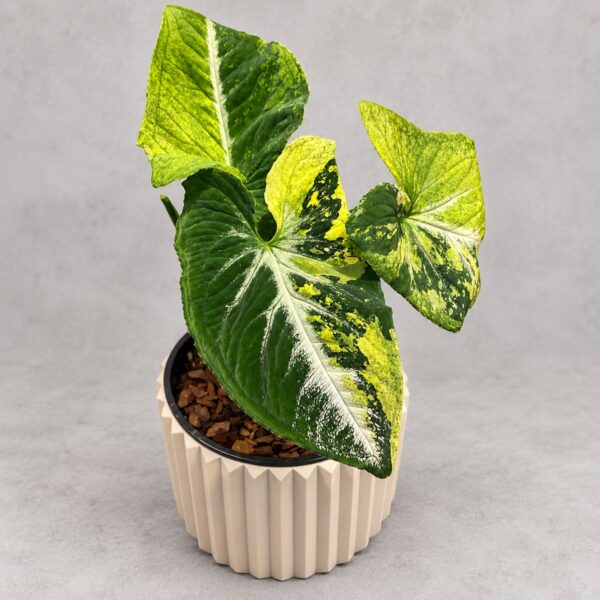
- 'Pink Splash' and 'Milk Confetti' share a similar patterning style but differ in colour — the former has pink spots on a green base, the latter has white spots — planting them together creates a genuinely dreamy display
- The pink-toned Syngonium cultivars (including 'Pink Splash,' 'Pink Salmon,' and 'Neon Robusta') get their pink colouring from lower chlorophyll content, which allows other pigments (mainly carotenoids) to show through
- 'Pink Splash's splash pattern is a highly popular form of variegation in horticultural breeding, since the distribution on every leaf is unique, making each plant a distinct piece of living art
Keywords
Syngonium podophyllum Pink Splash, Pink Splash Syngonium, pink-spotted Syngonium, splash variegation, Araceae, pink-toned foliage plant, indoor plant, easy-care potted plant, Hong Kong indoor greenery, partial-shade plant, climbing plant, trailing plant, recommended pink plant, Plantjai
參考資料(想知來源可展開)
References
- Missouri Botanical Garden — Plant Finder: Syngonium podophyllum, https://www.missouribotanicalgarden.org/PlantFinder/PlantFinderDetails.aspx
- ASPCA — Toxic and Non-Toxic Plant List, https://www.aspca.org/pet-care/animal-poison-control/toxic-and-non-toxic-plants
⚠️ Contains calcium oxalate crystals; toxic to humans and pets if ingested. Keep out of reach of children and pets.
Plantjai · Causeway Bay collector indoor plants · WhatsApp +852 66807550
For Hong Kong homes and offices. Stock and pricing follow the product page.
IN STORE NOW
Plants for this guide
Related plants in stock now — live prices, delivery or Causeway Bay pickup.
Syngonium Wendlandii 'Scrambled Eggs'
Original price was: HK$1,280.00.HK$280.00Current price is: HK$280.00.
In stock · store pickup
View plantSyngonium podophyllum 'Milk Confetti'
Syngonium podophyllum 'Milk Confetti'
HK$168.00
In stock · store pickup
View plantSyngonium podophyllum 'Pink Salmon'
Syngonium podophyllum 'Pink Salmon'
HK$380.00
In stock · store pickup
View plantSyngonium podophyllum 'Batik'
Syngonium podophyllum 'Batik'
HK$138.00
In stock · store pickup
View plant
FREE PLANT ADVICE
Send us a photo before you change anything
WhatsApp a photo of the plant and your window light. Our Causeway Bay team will suggest care steps or plants that suit your space.
STORE · CAUSEWAY BAY
4/F, 39 Yiu Wa Street, Causeway Bay
Daily 12:30–8:00pm · ~3 min walk from Times Square
Map & directionsPlant Care