

Variegation, Silver Patterns, and Fuzz: The Science of Foliage Plant Leaf Texture

Introduction
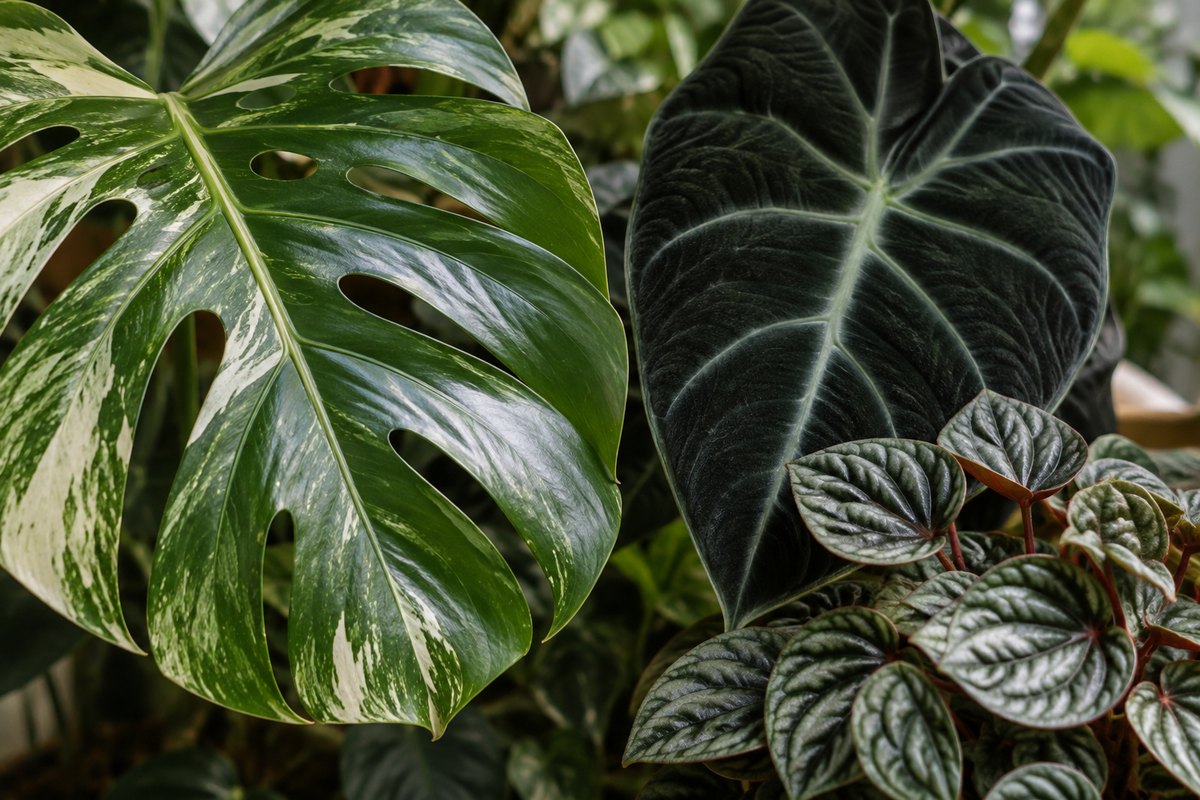
Close your eyes and imagine running your finger across the leaf of a foliage plant. Is it smooth as leather, like Monstera deliciosa? Soft as velvet, like Alocasia reginula? Or subtly textured with fine ridges, like a peperomia? Leaf surface texture is one of the most overlooked yet captivating dimensions in the world of foliage plants.
Many people choose foliage plants based solely on color and shape, missing the secret weapon of texture. A fuzzy leaf glowing silver in the morning light is enough to transform the atmosphere of an entire room. Today, let’s examine the science behind foliage plant leaf textures — through a magnifying glass, or better yet, a microscope.
Five Faces of Leaf Surface Texture
Glabrous Leaves: The Rainforest’s Waterproof Coating
Glabrous (smooth) leaf surfaces are the most common type. Monstera deliciosa, Ficus elastica, and most Philodendron species fall into this category. They feel waxed, with water droplets rolling off rather than wetting the surface.
This smoothness comes from the cuticle — a layer covering the epidermal cells. The cuticle consists mainly of cutin and wax, the plant’s first line of defense against water loss. In rainforests, smooth leaf surfaces also allow rainwater and leaf debris to slide off quickly, denying fungal spores the opportunity to settle on the leaf.
Interestingly, the “smoothness” you feel is actually “precision engineering” at the microscopic level. Under an electron microscope, the epidermal cells of a smooth leaf are arranged as tightly as fish scales, with an ultra-thin layer of wax crystals on top — only a few micrometers thick, yet giving the entire leaf a subtle sheen.
Pubescent Leaves: A Gentle Defensive Armor
Pubescent (fuzzy) leaf surfaces are the most irresistible textures in the foliage plant world. Alocasia reginula (Black Velvet Alocasia) is covered in fine fuzz that gives its leaves a deep black luster in the light. African violets (Saintpaulia ionantha) have fuzzy leaves that make the entire plant look like a sleeping little animal.
Under a microscope, these “hairs” are slender single-celled or multicellular projections called trichomes. They exist far more than just to delight human eyes — each hair is a defensive weapon for the plant.
Reducing water loss is the primary function of trichomes. They create a layer of still air at the leaf surface, slowing water exchange between the leaf and ambient air. In dry environments, this “fuzzy blanket” significantly reduces transpiration rates. This is why many plants native to arid or high-altitude regions have evolved fuzzy leaf surfaces.
Pest defense is another important role. Imagine an aphid trying to crawl across a fuzzy leaf — those dense trichomes are like a miniature “thorn forest,” making movement extremely difficult for tiny insects. Some plant trichomes even secrete sticky substances or irritating chemicals at their tips to further deter invaders.
Waxy Leaves: Plants with Built-In Sunscreen
Waxy (glaucous) leaf surfaces give a misty blue or silvery-white beauty. Certain Peperomia varieties and a few succulent foliage plants are covered with a thicker-than-normal wax layer, making the leaves appear as if dusted with light frost.
This wax is the plant’s “sunscreen.” In strong light environments, the waxy layer reflects some UV radiation, protecting mesophyll cells from photo-oxidative damage. The wax layer also dramatically reduces water evaporation, making these plants more drought-tolerant than smooth-leaf varieties. If you’re a “forgetful” plant owner who doesn’t water often, waxy-leaf species might be your best match.
Rugose Leaves: Three-Dimensional Light Sculptures
Rugose (wrinkled) leaves resemble a crumpled then flattened piece of paper, with uneven凹凸 textures across the surface. Certain Peperomia and Begonia varieties display this unique texture. Wrinkles not only increase leaf surface area (beneficial in low-light environments) but also create fascinating light-and-shadow effects — the same leaf can show different tonal layers depending on the viewing angle.
Rugose leaves also have a hidden advantage: rainwater and dust don’t easily remain in the crevices, providing some self-cleaning effect.
Bullate Leaves: Miniature Ventilation Systems
Bullate (blistered) leaves feature rounded protrusions across the surface, reminiscent of toad skin. Certain peperomias (such as Peperomia caperata) and a few begonia varieties have this texture. Beneath each bump are enlarged intercellular spaces in the mesophyll; the air stored in these gaps can help leaves float in water (an adaptation in some aquatic peperomias) and also slow heat loss.
The Science of Silver Patterns: Why Do Some Leaves Seem to Glow?
The Magic of Air Layers in Leaf Tissue
Silver patterns are one of the most visually captivating phenomena in the foliage plant world. Peperomia argyreia (Watermelon Peperomia) has silver-green stripes across its leaves resembling a watermelon’s rind. Certain begonia varieties have silver patches that almost seem to “glow” in dim light.
The cause of these silver patterns is not pigment — but air layers between mesophyll cells. In normal green leaves, mesophyll cells are tightly packed; light penetrates and is absorbed by chlorophyll, and we see green. But in silver-patterned areas, large numbers of tiny air gaps exist between the upper epidermis and underlying mesophyll cells. When light hits these air gaps, the difference in refractive index between air and cell walls causes light to be reflected back rather than passing through the leaf. This structural reflection makes our eyes perceive silver-white.
Functionally, silver patterns may help reflect excess light, protecting chlorophyll from photo-oxidative damage. For plants growing in the dappled light of forest understories, this is an exquisite “light modulation system.”
Differences Among Silver-Patterned Plants
Different plants employ slightly different silver-pattern mechanisms. Watermelon peperomia’s silver stripes are arranged in regular concentric circles, related to the timing of cell differentiation during leaf development. Silver spots on Scindapsus pictus (Satin Pothos) come from specialized reflective structures in epidermal cells. Though mechanisms vary, the end result is the same — leaves with a dreamy silver luster.
The Functions of Fuzzy Leaves: More Than Just Beautiful
The “Ninja Suit” of Black Velvet Alocasia
The leaf fuzz of Alocasia reginula is one of the most extreme examples among foliage plants. That near-black dark green, combined with the matte texture created by the fuzz, makes the entire leaf look like an expensive velvet fabric. In low-light environments, this dark color maximizes absorption of every available photon; the fuzz reduces specular reflection, allowing more photons to be absorbed by the leaf tissue.
The Self-Protection of African Violets
African violet fuzz doesn’t just repel insects — it has another interesting function: preventing dew formation on leaf surfaces. In environments with fluctuating humidity, leaf surfaces are prone to condensation. If these water droplets are focused by sunlight, they can burn brown spots on the leaf. Fuzzy leaves disperse water into tiny droplets, avoiding the focusing effect. This is why fuzzy-leaf plants generally show fewer leaf burn symptoms.
Care Differences for Different Textures
Fuzzy Leaves: Never Spray Water!
This is one of the most common mistakes I see at the archive. Guests see a fuzzy-leaf plant, think “how cute and fluffy,” and give the leaves a “spa treatment” with a spray bottle. The result? Water droplets get trapped between the hairs, cannot evaporate for a long time, and eventually cause brown water stains on the leaves or even fungal infections.
Care principle for fuzzy-leaf plants: Absolutely avoid spraying water directly on leaves. If you need to increase humidity, place a humidifier near the plant, or set the pot on a shallow tray filled with pebbles and water (making sure the pot base doesn’t directly touch the water). To clean the leaf surface, use a soft dry cloth or makeup brush to gently sweep away dust.
Waxy Leaves: Drought Tolerance Experts
Waxy-leaf plants have a powerful waterproof layer, lower transpiration rates, and require less frequent watering. However, this same waxy layer also makes foliar fertilizer absorption less efficient. If you spray fertilizer on waxy-leaf plants, add a small amount of surfactant to the solution, or gently wipe the leaf surface with a damp cloth after spraying to help nutrients penetrate.
Glabrous Leaves: Easiest to Maintain
Glabrous (smooth) leaves are the easiest to clean — a gentle wipe with a damp cloth is all it takes to restore their shine. Regular cleaning is not only aesthetically pleasing but also ensures that stomata are not blocked by dust, maintaining normal photosynthesis and respiration. I recommend giving smooth-leaf plants a “face wash” every two weeks.
Rugose and Bullate Leaves: Watch for Water Accumulation
The depressions in rugose and bullate leaf surfaces can trap water and dust, becoming potential breeding grounds for fungi. Avoid splashing water on leaves when watering; if water does accumulate, use a cotton swab or tissue to gently absorb moisture from the depressions.
The Aesthetic Effect of Texture Combinations
The Secret Weapon for Creating Visual Layers
In professional interior plant styling, texture combinations are key to creating visual depth. Imagine this scene: a smooth-leaf Monstera deliciosa beside a fuzzy-leaf Alocasia reginula, accented with a rugose-leaf Peperomia caperata — three textures contrasting against each other. Even if all are green, the display won’t look monotonous.
The principle: A space should ideally contain at least two different leaf textures. All smooth leaves looks “too clean”; all fuzzy leaves feels “too heavy.” Smooth + fuzzy is the most classic combination; add one special texture (rugose or bullate) as an accent, and the overall effect becomes wonderfully rich.
The Interaction Between Light and Texture
Different textures respond to light very differently. Smooth leaves produce distinct specular highlights (bright reflections). Fuzzy leaves display soft, diffuse reflections. Waxy leaves carry a hazy silver-blue sheen. When arranging a plant corner, consider the direction of light: place fuzzy-leaf plants facing soft, diffused light; smooth-leaf plants can handle slightly stronger illumination without appearing harsh.
Conclusion
Leaf surface texture is the most delicate language of foliage plants. Smoothness speaks of efficiency. Fuzz speaks of defense. Wax speaks of protection. Wrinkles speak of artistry. Bumps speak of innovation. Behind each texture is a nuanced dialogue between plant and environment, refined over millions of years.
The next time you select a foliage plant, close your eyes and feel the leaf texture with your fingers. That tactile experience — the cool smoothness, the gentle fuzz, the powdery softness of wax — is another way of connecting with plants beyond vision.
Want to touch different foliage plant textures in person? Visit us at PLANTJAI Specimen Archive at 4/F, Nam Hing Fong, 39 Yiu Wa Street, Causeway Bay, where dozens of foliage plants with wildly different leaf textures await your “hands-on experience.” You can also browse our curated collection at plantjai.com and choose a tactilely captivating plant for your home.
May every touch reveal the secret language of plant leaves.
IN STORE NOW
Plants for this guide
Related plants in stock now — live prices, delivery or Causeway Bay pickup.
FREE PLANT ADVICE
Send us a photo before you change anything
WhatsApp a photo of the plant and your window light. Our Causeway Bay team will suggest care steps or plants that suit your space.
STORE · CAUSEWAY BAY
4/F, 39 Yiu Wa Street, Causeway Bay
Daily 12:30–8:00pm · ~3 min walk from Times Square
Map & directions