

Leaf Morphology: Why Does Alocasia Have Arrow-Shaped Leaves?

Introduction
Walk into the specimen archive, and the most common question I get is: “Curator, why does this plant’s leaf look like this?” Guests point at the alocasia’s sky-piercing arrow-shaped leaf, or the Swiss cheese plant’s gap-ridden giant foliage, eyes full of wonder. I always smile and reply: “Because every leaf shape is the result of millions of years of negotiation between the plant and its environment.”
Leaf shape is no accident. It is the plant’s comprehensive response to light, water, wind, temperature, and even enemies. In today’s lesson, we won’t dive into obscure Latin terminology. Instead, we’ll start with the foliage plant right beside you and explore the ancient and fascinating science of leaf morphology.
The Basic Structure of a Leaf
Blade, Petiole, and Stipule
Before discussing shapes, let’s identify the three basic components of a leaf. The blade (lamina) is that flat “green panel” responsible for photosynthesis — converting sunlight, carbon dioxide, and water into sugars. The petiole is the “stem” connecting the blade to the main plant, acting like an arm that adjusts the leaf’s angle to capture optimal light. Stipules are small leaf-like structures at the petiole base; some plants have them, some don’t, and their functions range from protecting young buds to assisting with photosynthesis.
For foliage plants, ornamental value primarily comes from the blade — its shape, color, texture, and venation patterns. So that’s where we’ll focus today.
The Leaf Shape Garden of Foliage Plants
Cordate Leaves: A Gentle First Impression
Cordate (heart-shaped) leaves resemble an inverted heart, with a notched base and rounded tip. The juvenile leaves of Epipremnum aureum (golden pothos) are classic cordate shapes — that adorably rounded outline makes it the entry-level foliage plant for countless enthusiasts. The design logic behind cordate leaves is “maximizing light capture within limited space.” Rounded edges reduce wind resistance, making the leaf less likely to tear in strong gusts.
Sagittate Leaves: Rainwater Slides Pointing Skyward
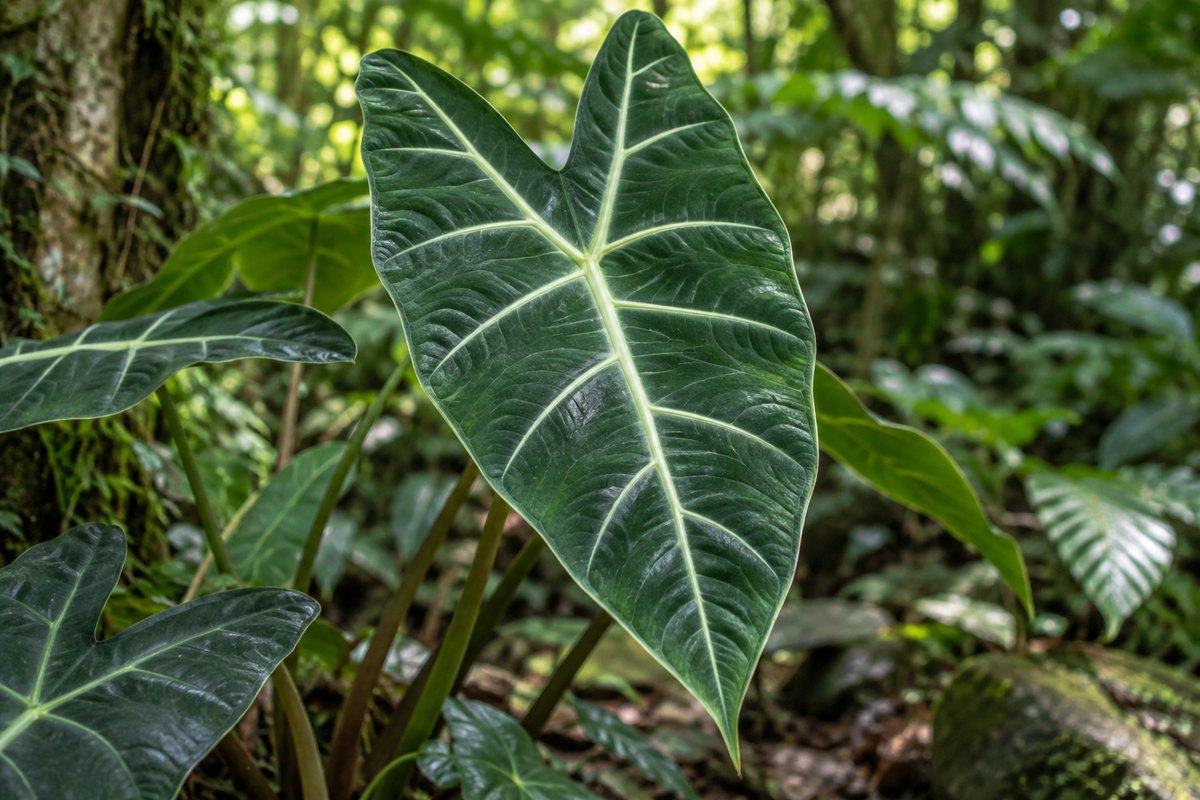
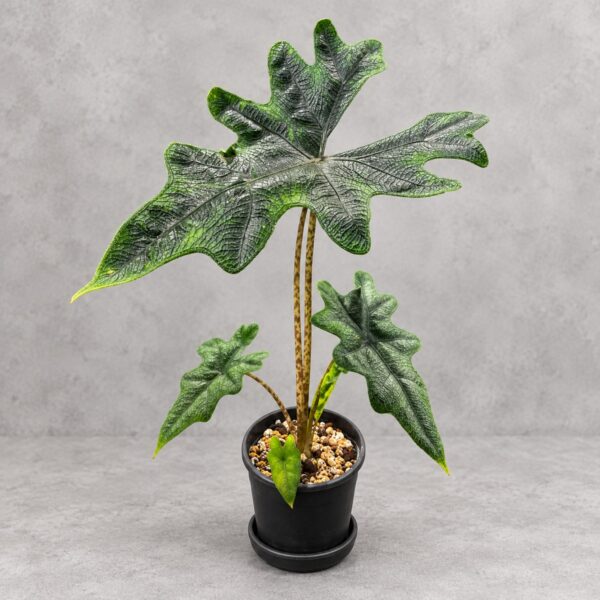
Sagittate (arrow-shaped) leaves are the signature feature of the Alocasia genus. The leaf base extends wing-like on both sides, creating a sharp triangular silhouette from top to bottom. This shape isn’t just beautiful — it is rainforest survival wisdom.
Alocasias grow in the forest understory, where layers of canopy overhead channel rain into heavy droplets. The arrow-shaped leaf’s pointed tip and angled surface act like an efficient waterslide, rapidly shedding water rather than letting it pool. Standing water breeds bacteria and fungi — a deadly threat in humid rainforests.
Palmately Lobed Leaves: The Geometric Code of Monstera
Palmately lobed leaves resemble an open hand, with the blade splitting into multiple lobes radiating from a central point. Monstera deliciosa is the superstar of this category, but its leaves carry an even more peculiar feature — the oval holes (fenestrations) scattered across the blade.
Botanists have proposed several theories for these holes. The most widely accepted explanation is this: in their native rainforest habitat, monstera plants climb from the forest floor upward. Young plants produce complete, unbroken leaves. Only when they reach the canopy level, facing strong winds and heavy rain, do they begin producing mature leaves with holes and splits. These openings and slits allow wind to pass through rather than slamming against the leaf, dramatically reducing the risk of tearing. At the same time, the holes allow light to reach the leaves below — a unique “light-sharing” strategy for climbing plants.
Pinnate Leaves: The Elegant Symmetry of Feathers
Pinnate leaves resemble a feather, with a central midrib and symmetrical pairs of smaller leaflets arranged along it. Certain Anthurium species and some Philodendron varieties display this elegant form. The advantage of pinnate leaves is “modularity” — if leaflets on one side are damaged, the entire leaf doesn’t lose all function; the remaining leaflets continue photosynthesizing.
Lyrate Leaves: Sound Catchers of the Rainforest
Ficus lyrata (fiddle-leaf fig) has leaves shaped like a violin — a broad upper portion that narrows toward the base. These lyrate leaves are a remarkable adaptation to low-light environments. Fiddle-leaf figs grow along riverbanks in African tropical rainforests, where seedlings spend their early years in the dim understory. Their enormous leaf surface area is designed to capture every available photon in weak light conditions.
More interestingly, the fiddle-leaf fig’s venation displays a prominent reticulate pattern, branching outward from the petiole like a river delta. This reticulate venation is characteristic of dicot plants, efficiently transporting water and nutrients to every corner of the leaf.
Peltate Leaves: Little Open Umbrellas
Peltate leaves have their most distinctive feature: the petiole attaches to the center of the leaf blade’s underside, not the edge. Imagine an opened umbrella with the handle emerging from the center of the canopy — that’s a peltate leaf. Lotus (Nelumbo nucifera) leaves are the classic example, and certain Begonia species also display similar structures. Peltate leaves allow the blade to spread horizontally, maximizing light capture while letting rainwater slide off evenly in all directions.
Vein Structure: The Underground River System of Leaves
Reticulate vs. Parallel Venation
Hold any foliage plant leaf up to the light, and you’ll see an intricate network of veins. Dicot plants (such as Araceae, Moraceae, and Malvaceae) almost universally have reticulate venation — a main vein extends from the petiole, branching repeatedly into finer and finer capillary networks that eventually converge at the leaf margin. This system is like a city’s road network: even if a “main highway” is blocked, water and nutrients can find alternate routes.
Monocot plants (such as Orchidaceae, Arecaceae, and Musaceae) typically have parallel venation — veins run roughly parallel from base to tip. Among foliage plants, dicots dominate, so reticulate venation is what you’ll encounter most often.
The Survival Wisdom Behind Leaf Shapes
Rapid Water Drainage: The Drainage Engineering of Tropical Rainforests
We’ve discussed the drainage function of alocasia’s arrow-shaped leaves, but this principle is widespread among tropical foliage plants. You’ll notice that many rainforest plants have distinctly pointed leaf tips — this feature is called a “drip tip.” As water accumulates on the leaf surface, it is channeled to the sharpest point where it drips away rapidly. Research shows that leaves with drip tips dry three times faster than rounded leaves.
Lobed Leaves Against Wind: The Structural Engineering of Monstera
From a structural engineering perspective, monstera’s split leaves and holes are analogous to “wind tunnel design” in architecture. As wind passes through the holes, the total pressure on the leaf is dramatically reduced. Mathematical models show that a monstera leaf with 30% fenestration experiences only about 40% of the pressure that a complete leaf would face at the same wind speed. That’s why you’ve never seen a monstera leaf shredded by wind — it comes with built-in “wind resistance.”
Large Leaves for Light Capture: Photon Catchers in Dim Environments
The enormous leaves of fiddle-leaf figs and certain alocasia varieties are direct responses to shady environments. Photosynthetic efficiency is proportional to light capture area; in the dim understory, only bigger leaves can harvest sufficient energy. But large leaves come with costs — they require thicker petioles and stronger vascular tissue for support, plus greater water supply. This is why large-leaf plants typically need more frequent watering.
Leaf Shape and Ornamental Value: The Science Behind Aesthetics
Why Do We Find Certain Leaf Shapes “Beautiful”?
This is a fascinating question. Human aesthetic preferences for plant leaf shapes may stem from millions of years of evolutionary experience in reading environments. Healthy plants mean water, food, and safe shelter. The upward posture of arrow-shaped leaves conveys “vitality.” The complex geometry of split leaves stimulates our cognitive curiosity. The soft texture of fuzzy leaves triggers our tactile instincts.
Interior designers understand this well. Rounded cordate leaves (like pothos) bring approachability, perfect for desks and bedside tables. Sharp arrow-shaped leaves (like alocasia) create visual focal points, ideal for living room corners. Giant split leaves (like monstera) excel at filling space, serving as the essential supporting character in Scandinavian-inspired interiors.
Conclusion
The next time you gaze at the leaf of a foliage plant in your hands, remember — you are not looking at an ordinary green leaf. It is an engineering blueprint drawn by millions of years of evolution. That arrow shape is for draining rain. That split is for resisting wind. Those veins are rivers that carry life itself.
The beauty of leaf morphology lies in its ability to satisfy both our rational curiosity and our aesthetic sensibility. This is also why foliage plants are so captivating — they are not merely decoration, but living exhibitions of natural design.
Want to see more fascinating leaf shapes in person? Visit us at PLANTJAI Specimen Archive at 4/F, Nam Hing Fong, 39 Yiu Wa Street, Causeway Bay, where over a hundred foliage plant species with wildly different leaf shapes await your comparison. You can also browse our online collection at plantjai.com and discover the story behind each leaf shape.
May every gaze read the language of the leaf.
IN STORE NOW
Plants for this guide
Related plants in stock now — live prices, delivery or Causeway Bay pickup.
FREE PLANT ADVICE
Send us a photo before you change anything
WhatsApp a photo of the plant and your window light. Our Causeway Bay team will suggest care steps or plants that suit your space.
STORE · CAUSEWAY BAY
4/F, 39 Yiu Wa Street, Causeway Bay
Daily 12:30–8:00pm · ~3 min walk from Times Square
Map & directions